2253 Easy Plants | 2026 Guide - Page 2
Discover 2253 easy plants for your garden. Complete care guide.
2253 Easy Plants
Showing 37-72 of 2253

Aeonium
Aeonium
Aeonium is a genus of succulents with approximately 35 species, primarily native to the Canary Islands. Unlike most succulents, Aeonium grows actively in the fall and winter, entering dormancy during the hot summer. Its perfect rosettes of glossy leaves form stunning ornamental colonies, making it one of the most elegant succulents for Mediterranean gardens and pots.
Black Rose
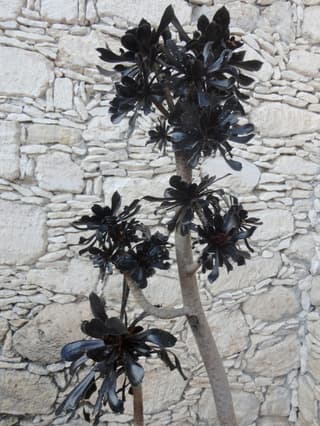
Aeonium 'Zwartkop'
Aeonium 'Zwartkop' is a striking succulent shrub prized for its near-black, burgundy-purple rosettes that sit atop slender, woody stems. A cultivar of Aeonium arboreum, native to the Canary Islands, it forms an architectural, sculptural silhouette in gardens and containers alike. The dark foliage deepens to almost jet black in full sun and softens to green-purple in shade, making it a dramatic focal point in succulent arrangements. In spring, mature rosettes can send up conical clusters of bright yellow star-shaped flowers, though the flowering rosette dies back afterward while the rest of the plant continues to grow.
Tree Aeonium
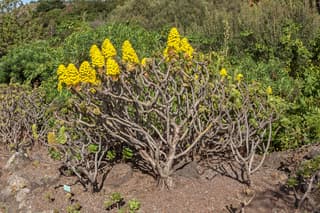
Aeonium arboreum
Aeonium arboreum is a woody-stemmed succulent native to the Canary Islands and North Africa, renowned for its striking rosettes of fleshy leaves atop branching stems. The dark-purple cultivar 'Schwarzkopf' (also spelled 'Zwartkop') is one of the most popular ornamental succulents worldwide.

Giant Velvet Rose
Aeonium canariense
Aeonium canariense, commonly known as the Giant Velvet Rose or Canary Island Aeonium, is a perennial succulent endemic to the Canary Islands and native to the laurel forest edges and high-mountain scrub of the archipelago. It forms large, velvety rosettes of spirally arranged leaves that can reach 15 to 30 cm across. In spring and early summer, mature rosettes send up a tall flowering stalk, up to 1 meter high, topped with clusters of small, star-shaped yellow flowers. The species is monocarpic: each rosette dies after flowering, though the plant persists through offsets produced at its base.
Green Pinwheel
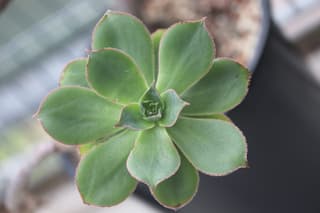
Aeonium decorum
Aeonium decorum is a compact, multi-branched succulent from the Canary Islands, forming rosettes of pale green, spoon-shaped leaves often edged in red. Its architectural pinwheel shape makes it a popular ornamental succulent for pots and rock gardens.
Pinwheel Aeonium
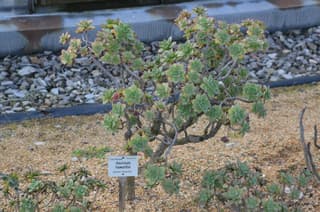
Aeonium haworthii
Aeonium haworthii is a branching succulent shrub native to the Canary Islands, prized for its rosettes of blue-green leaves edged in red, arranged like the blades of a pinwheel. It grows into a low, multi-stemmed shrub and produces star-shaped white to pale yellow flowers in spring.

Sim's Aeonium
Aeonium simsii
Aeonium simsii is a compact, mat-forming succulent endemic to the rocky highlands of Gran Canaria in the Canary Islands, where it grows on cliffs and outcrops between 500 and 1,900 meters elevation. It forms dense clumps of short, branching stems tipped with cup-shaped rosettes of yellowish-green leaves marked with brownish longitudinal stripes on their undersides. Unusually for the genus, individual rosettes of A. simsii can flower repeatedly and survive, unlike almost all other Aeonium species, whose rosettes die after a single bloom.
Stalked Aeonium
Aeonium undulatum
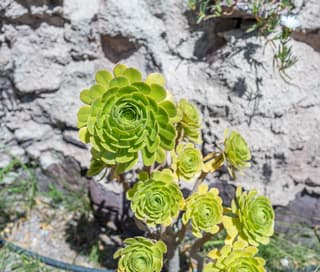
Aeonium undulatum is a striking succulent subshrub native to the Canary Islands, specifically Gran Canaria. Known for its large rosettes of bright, glossy, wavy-edged green leaves, it can grow over 2 meters tall on a single unbranched stem, making it one of the tallest species in the Aeonium genus. It is monocarpic, producing stunning pyramidal panicles of yellow star-shaped flowers after approximately 5 years.
Lily of the Nile
Agapanthus africanus
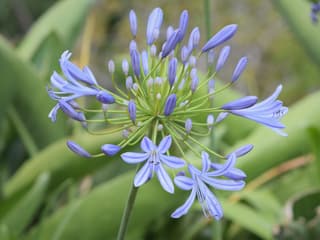
Lily of the Nile (Agapanthus africanus) is a perennial plant native to the Western Cape region of South Africa. It forms compact clumps of long, strap-like evergreen leaves, from which sturdy flower stalks emerge, topped with dense umbels of trumpet-shaped flowers ranging from blue to violet. It is widely used in gardens, borders, and containers, prized for its striking summer blooms and toughness.
Oriental Agapanthus
Agapanthus orientalis
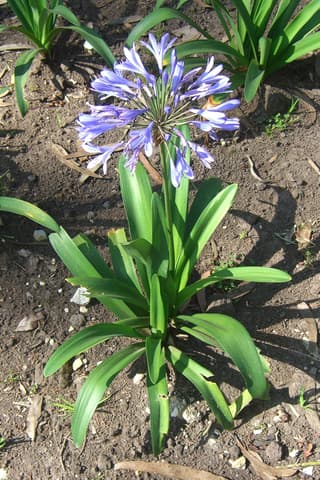
Agapanthus orientalis is an evergreen, clump-forming perennial native to South Africa, prized for its tall, sturdy flower stalks topped with large spherical umbels of trumpet-shaped blooms in blue, lavender, purple, or white. Its strap-like, glossy dark-green leaves form a dense mound at the base, making it a popular border and container plant in warm climates.
African Lily
Agapanthus praecox
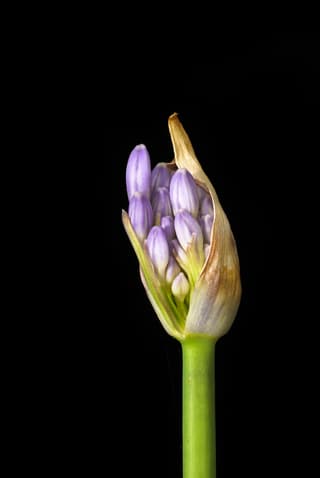
Agapanthus praecox is an evergreen perennial plant native to South Africa. It is characterized by its long, strap-like green leaves and spectacular globular umbels of blue or white flowers that rise on tall, sturdy stems. It is an extremely hardy species and popular in Mediterranean landscaping.
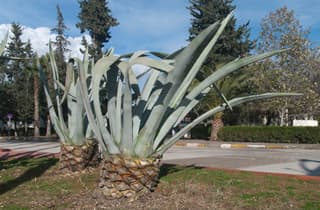
Century Plant (genus)
Agave
Agave is a large genus of monocarpic succulents native to the Americas, particularly Mexico. Their stiff, spine-tipped leaves form striking rosettes. The plant blooms only once in its lifetime, sending up a towering flower spike before dying.
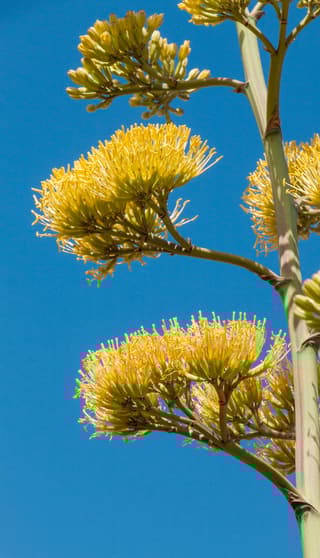
Century Plant
Agave americana
Agave americana, commonly known as the Century Plant, is a large succulent native to Mexico and the southern United States. Its striking blue-gray leaves are long, rigid, and tipped with sharp spines. It is monocarpic — blooming only once in its lifetime after 10 to 30 years, producing a spectacular flower stalk up to 25 feet tall, then dying. Before dying, it produces numerous basal pups that ensure the species' continuation.
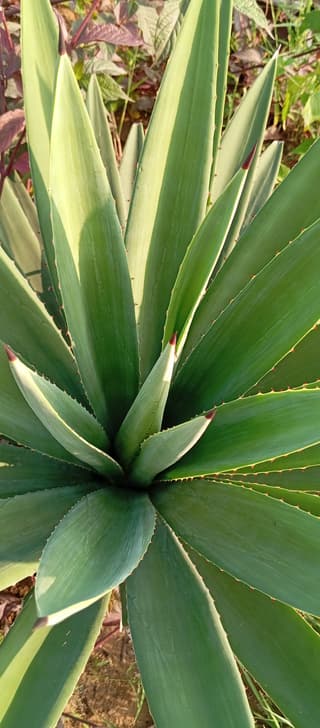
Caribbean Agave
Agave angustifolia
Caribbean Agave (Agave angustifolia) is a perennial succulent in the Asparagaceae family, native to Mexico and Central America. It forms dramatic rosettes of long, rigid, sword-shaped leaves in greyish-green to bluish-grey tones, with serrated margins and sharp terminal spines. A monocarpic plant, it blooms only once in its lifetime — after 10 to 30 years — producing a towering flower spike up to 16 ft (5 m) tall with greenish-yellow flowers, then dies. It leaves behind offsets (pups) that continue the colony. Prized both as an ornamental landscape specimen and historically for mezcal and textile fiber production.
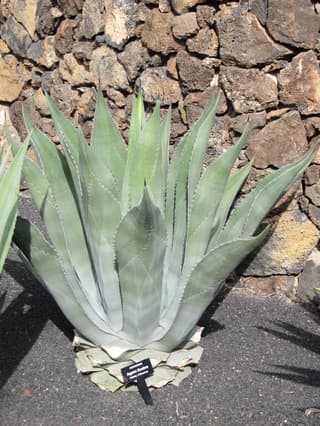
Rough Agave
Agave asperrima
Agave asperrima is a stemless, evergreen succulent native to the arid scrublands of southern Texas and central-northern Mexico. It forms a dense rosette of 30-40 broad, gray-green leaves edged with sharp marginal teeth and tipped with a stout terminal spine, reaching roughly 1 meter tall and up to 2 meters across. After 7 to 15 or more years of slow growth, a mature rosette sends up a tall flowering stalk 4-7 meters high bearing yellow blooms, then dies - but not before producing offsets (pups) around its base that carry the plant forward. In its native Mexico it is a traditional source for mezcal-style spirits distilled from the roasted, fermented core.

Foxtail Agave
Agave attenuata
Agave attenuata is a sculptural perennial succulent, famous for its rosettes of wide, soft, light-green leaves that lack the sharp spines typical of other agaves. Native to Mexico, it develops a thick trunk and, when mature, produces a long, curved inflorescence resembling a swan's neck, which gives it one of its common names.
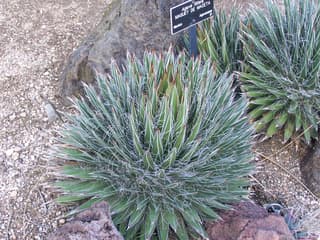
Thread-leaf Agave
Agave filifera
Agave filifera is a compact, slow-growing succulent native to central Mexico, prized for the distinctive white threads or filaments that curl away from the edges of its dark green leaves. It forms a tight, symmetrical rosette and is an excellent choice for sunny gardens, rock gardens, or bright indoor spaces. Highly drought-tolerant and low-maintenance.

Parry's agave
Agave parryi
Agave parryi, Parry's agave, is a hardy rosette-forming succulent native to the southwestern United States and Mexico. It makes a compact, symmetrical rosette of blue-grey leaves tipped with dark spines and is prized in dry gardens for its exceptional cold tolerance.
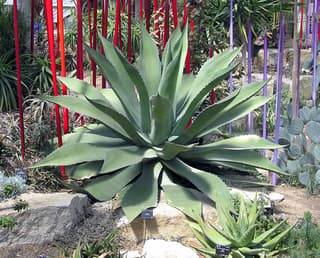
Butterfly Agave
Agave potatorum
Agave potatorum, commonly known as Butterfly Agave or Tobala, is a compact rosette succulent native to the highlands of Oaxaca and Puebla, Mexico. Slow-growing and small in stature, its gray-green leaves with terminal spines form an elegant rosette up to 1.2 m tall and 1.5 m wide. It is monocarpic — flowering only once in its lifetime, producing a towering 4–6 m flower spike, then dying and leaving offsets as its legacy.
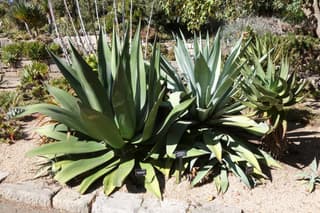
Pulque Agave
Agave salmiana
Agave salmiana, commonly known as Pulque Agave or Giant Agave, is one of the largest and most impressive agaves native to central Mexico. Its massive succulent leaves can reach up to 2 meters in length, armed with sharp spines. This species is the primary source of aguamiel (sap) used to produce pulque, a fermented beverage consumed in Mexico for thousands of years. It is monocarpic — flowering only once after 15–25 years, producing a spectacular flowering stalk up to 12 meters tall.
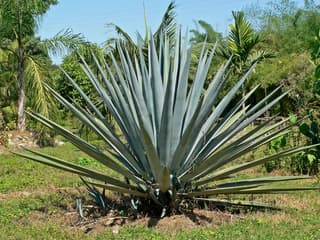
Blue Agave
Agave tequilana
Agave tequilana, commonly known as Blue Agave, is a striking succulent native to the highlands of Jalisco, Mexico. Its thick, blue-gray leaves form a dramatic rosette that can reach up to 2.4 m across, tipped with sharp spines along the margins and tip. Best known as the sole legal source of tequila, this drought-tolerant succulent grows slowly for years before sending up a towering flower stalk once in its lifetime, then setting offsets (pups) at its base to continue the cycle.
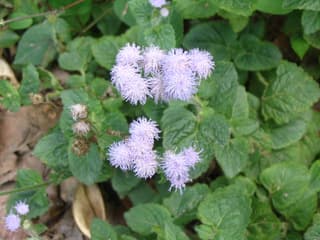
Billygoat Weed
Ageratum conyzoides
Billygoat weed (Ageratum conyzoides) is a fast-growing annual herb in the daisy family (Asteraceae), native to tropical America and now naturalized throughout tropical and subtropical regions worldwide. It has softly hairy stems and oval, serrated leaves with a distinctive musky scent when crushed. Small blue-lavender to white flower heads cluster in terminal clusters, attracting bees and butterflies. Common in gardens, roadsides, and disturbed ground, it is regarded by many growers as a weed but is also widely valued in traditional medicine.
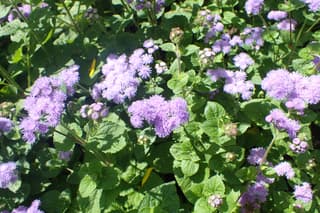
Floss Flower
Ageratum houstonianum
Ageratum houstonianum, commonly known as Floss Flower, is a frost-tender annual native to Central America (Guatemala, Belize, and adjacent Mexico), prized for its dense, fluffy, pom-pom-like flower clusters in shades of blue, purple, pink, and white. Growing 15–90 cm tall, it features soft, ovate to triangular, slightly hairy leaves and blooms continuously from late spring until frost. A favorite in summer bedding, borders, and containers, it reliably attracts butterflies and other pollinators throughout its long flowering season.
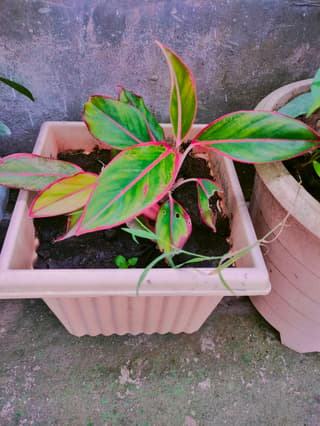
Chinese Evergreen 'Crete'
Aglaonema 'Crete'
Aglaonema 'Crete' is a compact evergreen cultivar of Chinese evergreen (Araceae, Aglaonema) prized for its lance-shaped, dark green leaves splashed with vivid pink and burgundy-red variegation along the veins and margins, carried on pale pink stems. Native to the understory forests of tropical Southeast Asia, it thrives as a low-maintenance houseplant that tolerates a wide range of indoor light levels while showing its boldest color in bright, indirect light. Like other aroids, its tissues contain insoluble calcium oxalate crystals, making the whole plant mildly to moderately toxic if chewed or ingested.
Red Valentine Chinese Evergreen
Aglaonema 'Red Valentine'
Vibrant hybrid cultivar selected for dramatic pink-red foliage accented by green margins and occasional yellow-green flecks. This tropical houseplant from the Araceae family is renowned for air-purifying abilities and easy care requirements.

Red Aglaonema
Aglaonema 'Siam Aurora'
Aglaonema 'Siam Aurora', widely known as Red Aglaonema, is a compact evergreen cultivar of Chinese Evergreen prized for its striking foliage — deep green leaves splashed and edged with vivid red, pink and cream variegation. Native to the tropical understories of Southeast Asia, this Araceae family member is one of the most popular colored-leaf houseplants thanks to its resilience, moderate light tolerance, and low-maintenance nature. It grows as a bushy, clumping plant reaching about 90 cm (3 ft) tall and wide indoors, and occasionally produces small greenish spathe flowers with white spadixes in late summer to fall.
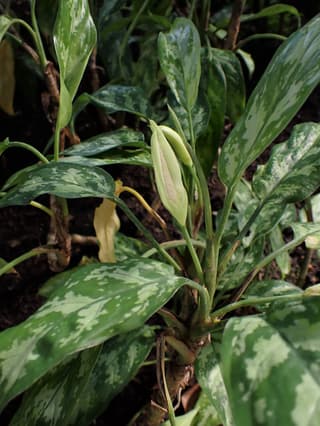
Chinese Evergreen
Aglaonema commutatum
Aglaonema commutatum, commonly known as Chinese Evergreen, is a popular tropical houseplant native to the Philippines and northeastern Sulawesi. Prized for its attractive variegated foliage with silver and green patterns, this slow-growing plant is perfect for beginners due to its tolerance of low light conditions and minimal care requirements. It has been cultivated for centuries in Asia as a symbol of good fortune.
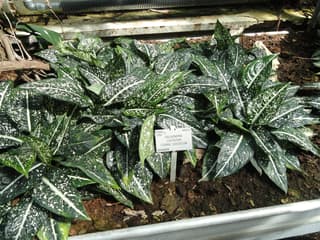
Spotted Evergreen
Aglaonema costatum
Aglaonema costatum, commonly known as the Spotted Evergreen, is a compact tropical aroid native to the rainforests of Southeast Asia. It features striking dark green leaves adorned with silver-white spots and a distinctive white midrib, making it one of the most visually appealing low-light houseplants available.
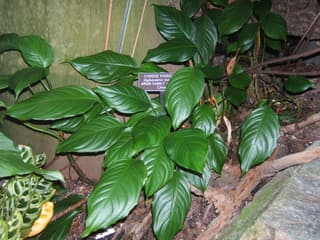
Chinese Evergreen
Aglaonema modestum
Aglaonema modestum, commonly known as Chinese Evergreen, is a tropical foliage plant native to China, Vietnam, and the Philippines. With long, glossy dark-green leaves, it is one of the most resilient and adaptable houseplants, thriving in low light and tolerating dry indoor air. It belongs to the Araceae family.
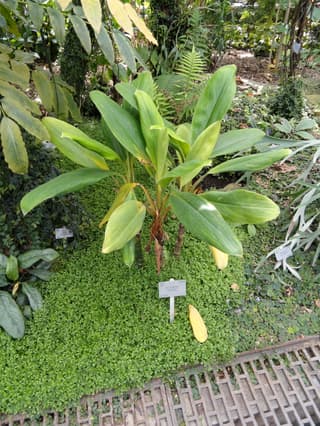
Glossy Aglaonema
Aglaonema nitidum
Aglaonema nitidum, commonly known as Glossy Aglaonema or Painted Drop Tongue, is a striking tropical foliage plant native to the rainforests of Southeast Asia. Its broad, lance-shaped leaves display a deep glossy green, sometimes adorned with silver or light green markings, making it a prized ornamental houseplant. As a member of the Araceae family, it is one of the most adaptable and low-maintenance indoor plants available.
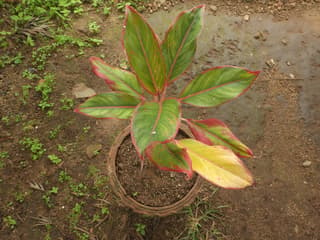
Round-Leaf Aglaonema
Aglaonema rotundum
Aglaonema rotundum is a striking true species of Chinese evergreen native to the shaded rainforest understory near Medan, North Sumatra, Indonesia. It is prized for its rounded, leathery, near-black leaves marked with vivid pink to wine-red veins, one of the boldest color contrasts found in any Aglaonema species. Compact and slow-growing, it typically reaches 30-50 cm indoors, making it well suited to shelves, side tables, and low-light corners of the home.

Agrimony
Agrimonia eupatoria
Agrimony (Agrimonia eupatoria) is a perennial herbaceous plant in the Rosaceae family, native to Europe and Southwest Asia, where it grows wild in damp meadows, pastures, roadsides, and stream banks. It reaches between 60 and 100 cm in height, featuring dark green pinnate leaves covered in soft downy hairs, and long terminal flower spikes of five-petaled yellow flowers that emit a spicy, apricot-like scent. It blooms between June and September, producing small hooked fruits that cling to animal fur to disperse its seeds. It is a hardy, low-maintenance plant traditionally cultivated for its medicinal properties rather than its ornamental value.
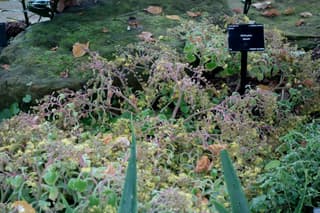
Tree of Love
Aichryson laxum
The Tree of Love (Aichryson laxum) is a compact succulent native to the Canary Islands, belonging to the Crassulaceae family. It features fleshy heart-shaped leaves arranged in rosettes at the tips of its branches, and produces small star-shaped yellow flowers in spring and summer. It is an annual or biennial plant that naturally dies after flowering.
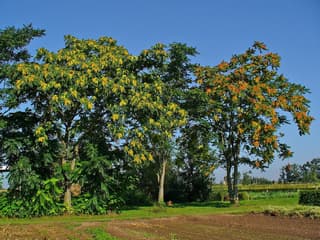
Tree of Heaven
Ailanthus
The Tree of Heaven (Ailanthus altissima) is an extremely fast-growing deciduous tree native to northern China and Taiwan. Belonging to the family Simaroubaceae, it can reach up to 25 metres in height and is renowned for its extraordinary resilience in harsh urban environments, tolerating pollution, poor soils, drought, and extreme temperatures. While classified as an invasive species in most temperate regions worldwide, Ailanthus has a rugged beauty with its large, pinnately compound leaves. The plant contains allelopathic compounds that inhibit the growth of surrounding vegetation, and contact with its sap may cause contact dermatitis in sensitive individuals. It carries mild toxicity and should be handled with care, especially during pruning.
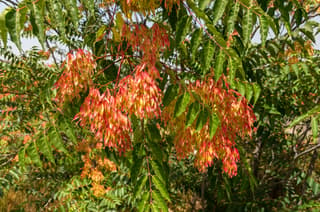
Tree of Heaven
Ailanthus altissima
Tree of Heaven (Ailanthus altissima) is an extremely fast-growing deciduous tree native to northern and central China, belonging to the family Simaroubaceae. It is widely regarded as one of the most aggressive invasive species in the world, rapidly colonizing roadsides, vacant lots, and disturbed urban environments across 30+ U.S. states and much of Europe. A single female tree can produce over 300,000 seeds per year and spreads aggressively via root sprouts. Despite its invasive character, it has traditional medicinal uses in Chinese medicine. WARNING: invasive species — illegal to plant in many jurisdictions. Contact with sap may cause skin irritation and respiratory allergic reactions.
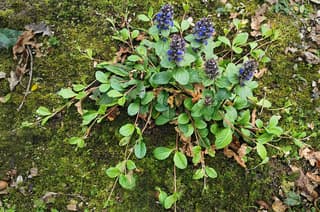
Bugleweed
Ajuga
Bugleweed (Ajuga reptans) is a low-growing, mat-forming perennial groundcover native to Europe. It spreads via creeping stolons, forming dense carpets of foliage that range from deep green to bronze-purple, topped with spikes of blue to purple flowers in spring and summer.
What are Easy Plants?
Easy Plants are ideal for beginners or people with little time for care. These species are tolerant of watering mistakes, light variations, and don't require constant attention. Perfect for those just starting out with plants.
Tips for Growing Easy Plants
To succeed with easy plants, remember: less is more. Avoid overwatering, choose a spot with adequate light, and let the soil dry between waterings. Most of these plants prefer to be 'forgotten' occasionally.