2307 Easy Plants | 2026 Guide - Page 3
Discover 2307 easy plants for your garden. Complete care guide.
2307 Easy Plants
Showing 73-108 of 2307
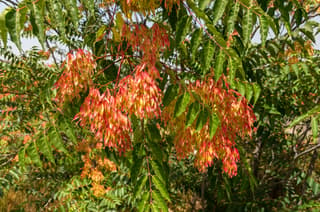
Tree of Heaven
Ailanthus altissima
Tree of Heaven (Ailanthus altissima) is an extremely fast-growing deciduous tree native to northern and central China, belonging to the family Simaroubaceae. It is widely regarded as one of the most aggressive invasive species in the world, rapidly colonizing roadsides, vacant lots, and disturbed urban environments across 30+ U.S. states and much of Europe. A single female tree can produce over 300,000 seeds per year and spreads aggressively via root sprouts. Despite its invasive character, it has traditional medicinal uses in Chinese medicine. WARNING: invasive species — illegal to plant in many jurisdictions. Contact with sap may cause skin irritation and respiratory allergic reactions.
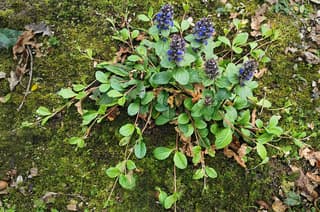
Bugleweed
Ajuga
Bugleweed (Ajuga reptans) is a low-growing, mat-forming perennial groundcover native to Europe. It spreads via creeping stolons, forming dense carpets of foliage that range from deep green to bronze-purple, topped with spikes of blue to purple flowers in spring and summer.
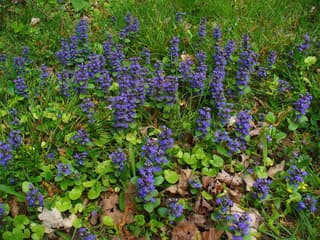
Bugleweed
Ajuga reptans
Ajuga reptans, commonly known as Bugleweed or Carpet Bugle, is a low-growing perennial herb in the Lamiaceae family, native to Europe, northern Africa, and southwestern Asia. It forms a dense, compact mat of glossy, oval leaves with scalloped edges, spreading rapidly via stolons. In spring, it produces spikes of blue-violet, white, or pink flowers highly attractive to pollinators. It is one of the most versatile and hardy ground covers available, thriving in shady spots where grass and other plants struggle.
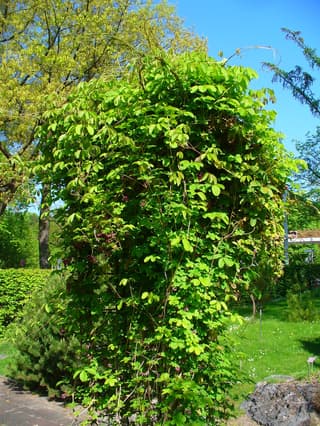
Chocolate Vine
Akebia quinata
Akebia quinata, commonly known as chocolate vine, is a vigorous, twining, semi-evergreen to deciduous climber native to Japan, Korea and China. In spring, it produces clusters of small, fragrant, chocolate-scented flowers in shades of deep purple and maroon, followed in autumn by sausage-shaped, edible purple seed pods. Its five-lobed leaflets and rapid growth make it a popular choice for covering fences, pergolas and trellises, though it can become invasive in mild climates if left unchecked.
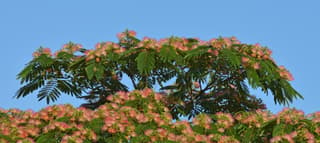
Silk Tree / Mimosa (genus)
Albizia
Albizia is a genus of tropical and subtropical ornamental trees in the Fabaceae family, known for their delicate pink powder-puff flowers and feathery bipinnate foliage. The most widely grown species is Albizia julibrissin.
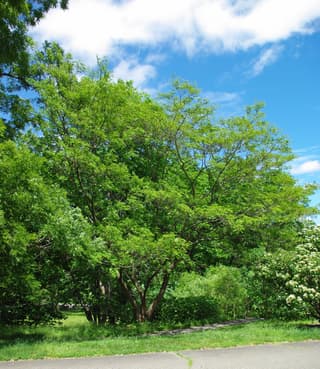
Silk Tree
Albizia julibrissin
Albizia julibrissin, commonly known as the Silk Tree or Mimosa, is a fast-growing deciduous tree native to Iran, India, China, and Japan. It is celebrated for its stunning pink and white powder-puff flowers that bloom in spring and summer, attracting bees, butterflies, and hummingbirds. Its light, airy canopy — like an open parasol — can reach up to 12 meters tall and 15 meters wide, casting dappled shade below. The finely cut, fern-like bipinnate leaves fold at night and during rain, giving the tree a dreamy, animated quality. Introduced to the United States in 1745, it has become a beloved ornamental tree across temperate climates worldwide.
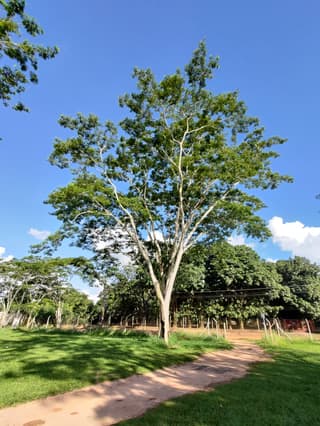
White Silk Tree
Albizia niopoides
Albizia niopoides, commonly known as White Silk Tree or Farinha Seca, is a fast-growing deciduous tree native to South America and Central America, belonging to the Fabaceae family. It can reach 10 to 35 meters in height, developing a characteristic wide, umbrella-shaped crown. Its delicate white to light-pink feathery flowers bloom from spring through summer, attracting bees and hummingbirds. The tree is known for nitrogen fixation, making it valuable for reforestation and agroforestry. It is highly drought-tolerant once established and adapts well to a wide range of tropical and subtropical conditions.
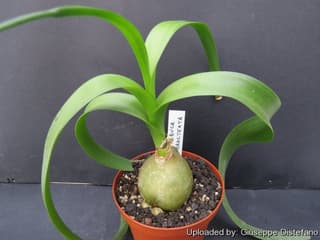
Pregnant Onion
Albuca bracteata
Albuca bracteata, popularly known as the Pregnant Onion, is a perennial bulbous plant native to South Africa (Cape Provinces and KwaZulu-Natal). Its large, bright green bulb grows mostly above the substrate surface, from which arching lanceolate leaves up to 60 cm long sprout. In spring and summer, it produces long flower stalks up to 90 cm tall, topped with dense racemes of small white flowers with a green central vein. It is a popular houseplant due to its unusual appearance and ease of cultivation.
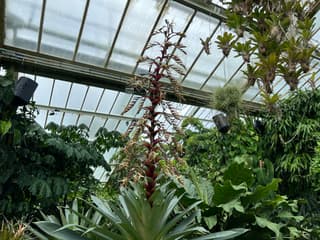
Alcantarea / Imperial Bromeliad (genus)
Alcantarea
Alcantarea is a genus of giant bromeliads native to rocky outcrops and cliff faces in Brazil, particularly in Rio de Janeiro state. These monumental plants form a central water-holding tank with their massive leaf rosettes and are adapted to full sun and periodic drought, making them outstanding specimens for tropical and subtropical gardens.
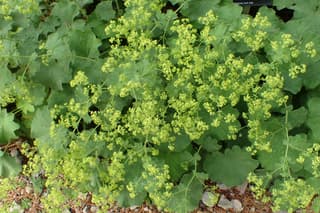
Lady's mantle
Alchemilla mollis
Lady's mantle (Alchemilla mollis) is a hardy perennial from the rose family (Rosaceae), native to Southeast Europe. The plant forms elegant, rounded mounds of softly hairy, fan-shaped leaves with scalloped edges. Thanks to these fine hairs, rain and dew water bead up on the leaves—an effect that alchemists once considered the purest form of water and used in their experiments. In summer, loose clusters of countless tiny, chartreuse flowers appear above the foliage. Lady's mantle is a very low-maintenance groundcover that is excellent for borders, under trees, and along paths, and it naturalizes easily through self-seeding.

Common Water-plantain
Alisma plantago-aquatica
Alisma plantago-aquatica is a hardy marginal perennial of pond edges, ditches and slow-moving water across Europe and Asia. From a basal rosette of long-stalked, plantain-like leaves it sends up tall, airy, much-branched stems studded with tiny three-petalled flowers in white to pale pink that open in the afternoon. It dies back in winter and regrows from its rootstock each spring.
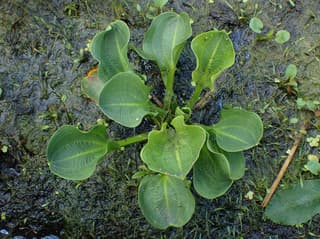
American water plantain
Alisma subcordatum
Alisma subcordatum, the American water plantain, is a native perennial emergent aquatic plant in the water-plantain family (Alismataceae). It forms a rosette of long-stalked, oval to heart-shaped leaves rising from a bulbous corm, and through summer sends up airy, much-branched panicles of tiny three-petaled flowers that open white to pale pink. Reaching about 1 m tall, it colonizes pond margins, ditches, marshes and muddy shallows across eastern and central North America, where it self-seeds freely.
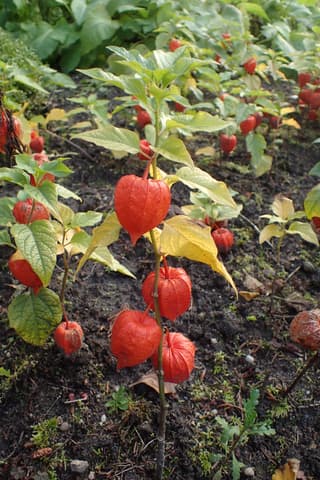
Chinese lantern
Alkekengi officinarum
Chinese lantern is a spreading, rhizomatous herbaceous perennial in the nightshade family, grown for its papery calyces that inflate into bright orange "lanterns" around an edible berry in late summer and autumn. Native to Asia and southeastern Europe, it naturalizes readily and is a favorite for dried-flower arrangements.
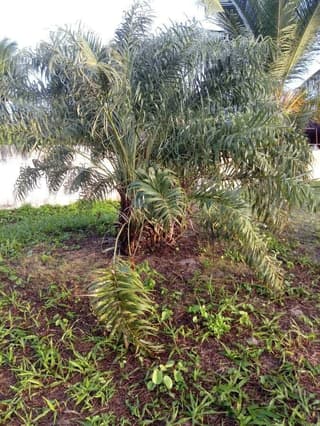
Seashore Palm
Allagoptera arenaria
Allagoptera arenaria, commonly known as the Seashore Palm or Shore Palm, is a small palm species native to the restingas (coastal scrublands) of the Brazilian coast. It typically features an underground or very short stem, with grayish-green pinnate leaves that emerge directly from the sandy soil. It is an extremely resilient plant, adapted to strong winds, high salinity, and intense solar radiation, playing a vital ecological role in dune stabilization.
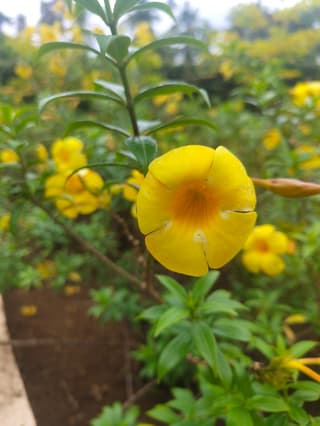
Golden Trumpet
Allamanda cathartica
Allamanda cathartica, commonly known as Golden Trumpet or Yellow Allamanda, is a fast-growing tropical vine native to Brazil, belonging to the Apocynaceae family. It is prized for its stunning golden-yellow, trumpet-shaped flowers that bloom nearly year-round in tropical climates. Widely used to cover pergolas, fences, and walls, it thrives in full sun with regular watering. WARNING: All parts of the plant are highly toxic, containing cardiac glycosides and irritating latex.
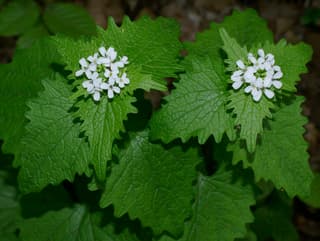
Garlic Mustard
Alliaria petiolata
Garlic mustard (Alliaria petiolata) is a biennial herbaceous plant in the mustard family (Brassicaceae), widely distributed across Central and Northern Europe as well as parts of Asia. In its first year, it forms a basal rosette of heart-shaped, deeply toothed leaves, while in its second year, it sends up a 60–100 cm tall stem with white, four-petaled flowers. Its distinctive feature is the intense garlic scent released when the leaves are crushed, which is due to the presence of glucosinolates. The plant inhabits open deciduous forests, road and forest edges, and slopes, and is known as an invasive species in North America. It is an important host plant for the Orange-tip butterfly (Anthocharis cardamines) and its caterpillars.
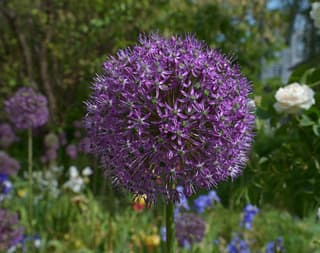
Ornamental Onion
Allium
Allium is a large genus of bulbous flowering plants in the family Amaryllidaceae, comprising approximately 700 species including ornamental garden plants as well as culinary staples such as onion, garlic, and chives. Ornamental alliums produce striking spherical flower heads in shades of purple, pink, white, and yellow, and are prized in gardens and cut flower arrangements alike.
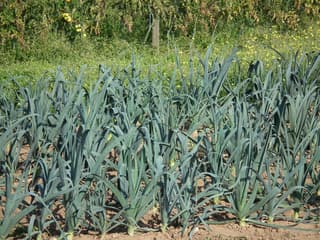
Leek
Allium ampeloprasum
Allium ampeloprasum, commonly known as leek or wild leek, is a biennial bulbous plant in the Amaryllidaceae family, native to southern Europe, southwestern Asia, and northern Africa. It produces broad, flat, blue-green leaves and a tender white shaft prized in cooking. In its second year, it forms a beautiful spherical umbel of lilac flowers that attract pollinators.
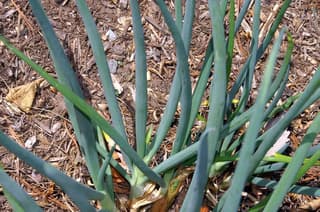
Onion
Allium cepa
The onion (Allium cepa) is one of the most widely cultivated and consumed vegetables in the world, originating from Central Asia. Belonging to the Amaryllidaceae family, it has been grown for thousands of years for its culinary and medicinal properties. It produces succulent bulbs rich in sulfur compounds, flavonoids, and antioxidants.
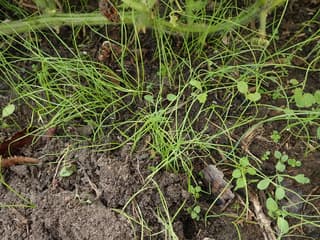
Green onions
Allium fistulosum
Allium fistulosum, popularly known as green onions, is a perennial herbaceous plant essential for any vegetable garden. Its leaves are cylindrical, hollow, and deep green, growing in compact clumps. Unlike the common onion, it does not form developed globose bulbs, being prized for the mild and refreshing flavor of its stalks and white bases.
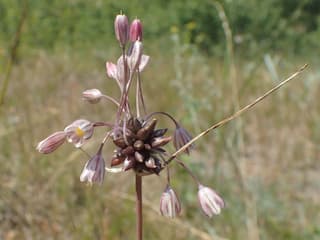
Field Garlic
Allium oleraceum
Field garlic (Allium oleraceum) is a wild bulbous perennial in the Amaryllidaceae family, native to Europe, where it grows in fields, banks, and roadsides. It produces narrow, semi-cylindrical leaves and, in summer, a loose umbel of bell-shaped flowers ranging from white to greenish, pink, or brownish, often accompanied by small aerial bulbils that enable vegetative propagation. It is a hardy, easy-to-grow species traditionally foraged as an edible aromatic herb similar to cultivated garlic.
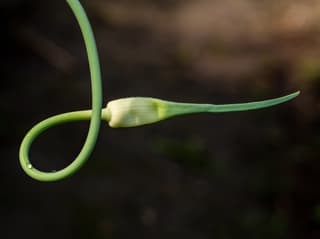
Garlic
Allium sativum
Allium sativum, popularly known as garlic, is a bulbous plant in the Amaryllidaceae family. It is widely cultivated worldwide for its culinary and medicinal properties. The plant produces an underground bulb composed of several segments called cloves, encased in a papery skin.
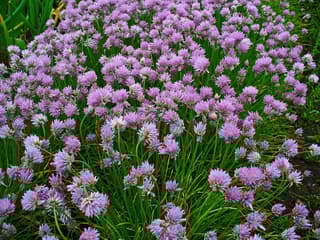
Chives
Allium schoenoprasum
Chives (Allium schoenoprasum) are a versatile herbaceous perennial native to Europe and Asia, prized for their mild onion-like flavor and attractive globe-shaped purple flowers. Forming dense grass-like clumps of hollow, cylindrical leaves up to 50 cm tall, they are among the easiest edible herbs to grow. Hardy in zones 4–8, chives die back in winter and regrow vigorously each spring. Both the leaves and flowers are edible, making this plant a favorite in herb gardens and kitchen windowsills worldwide.
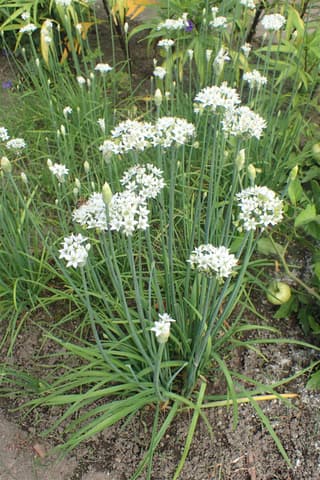
Garlic Chives
Allium tuberosum
Garlic chives (Allium tuberosum) is a bulbous perennial herb native to the Himalayan region and China. It produces flat, green strap-like leaves with a mild garlic flavor and aroma, widely prized in Asian cuisine. In summer, it bears fragrant white star-shaped flowers in umbrella-like clusters that attract pollinators. It is easy to grow and extremely versatile in the kitchen.
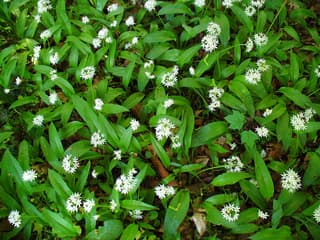
Ramsons
Allium ursinum
Allium ursinum, commonly known as ramsons or wild garlic, is a bulbous perennial herb native to the temperate woodlands of Europe and Asia. It forms lush carpets of broad, lance-shaped leaves in spring, filling forest floors with a distinctive garlic scent. Star-shaped white flowers appear from March to May, attracting pollinators. All parts of the plant are edible and it has been treasured for centuries both as a food source and medicinal herb.
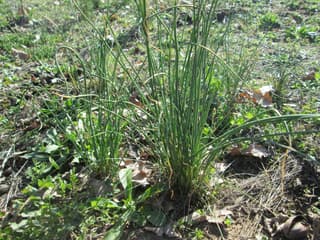
Wild Garlic
Allium vineale
Allium vineale, commonly known as wild garlic or crow garlic, is a perennial bulb-forming plant in the family Amaryllidaceae. Native to Europe, northwestern Africa, and the Middle East, it has been naturalized in North America where it is considered an invasive weed. It produces slender hollow leaves with a strong garlic scent and bears small white to purple flowers in tight umbels during spring and early summer. All parts of the plant are edible, with a flavor similar to common garlic.
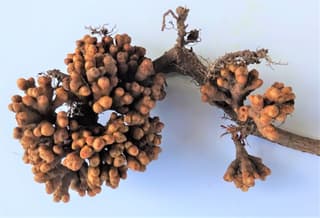
Alder
Alnus
Alder (genus Alnus) is a deciduous tree from the birch family (Betulaceae), growing predominantly near watercourses, lakes, and in moist soils across the temperate zone of the Northern Hemisphere. It is characterized by rapid growth and the ability to fix atmospheric nitrogen through symbiosis with Frankia bacteria, which enriches the surrounding soil. In early spring, before the leaves emerge, it blooms with striking pendulous catkins. Alder wood does not rot when submerged in water, which is why it was traditionally used for building piles and bridge structures.

Common Alder
Alnus glutinosa
The common alder (Alnus glutinosa) is a fast-growing deciduous tree native to Europe, western Asia, and North Africa, prized for its ability to thrive in wet, boggy, and riverside soils where few other trees survive. Reaching up to 25 meters, it produces distinctive reddish-brown catkins in late winter before its rounded, glossy leaves emerge, followed by small woody cone-like fruits that persist into winter. Its roots host nitrogen-fixing bacteria (Frankia alni), allowing it to enrich poor soils naturally, making it a valuable pioneer species for riverbank stabilization, wetland restoration, and windbreaks.
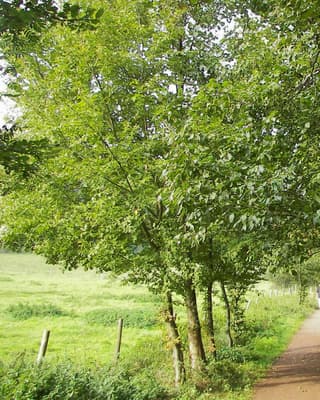
Grey Alder
Alnus incana
Grey alder is a fast-growing deciduous tree native to the cooler regions of Europe and parts of North America, prized for its hardiness, adaptability to poor and wet soils, and its role as a pioneer species that fixes nitrogen in the soil. It produces distinctive purplish male catkins and small cone-like female catkins in late winter before the leaves emerge.
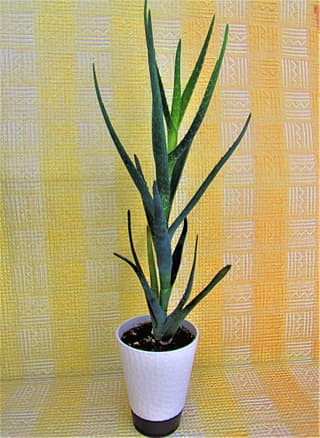
Aloe
Aloe
Aloe is a genus of over 500 species of succulent flowering plants native primarily to Africa, Madagascar, and the Indian Ocean islands. These robust plants form rosettes of thick, fleshy, water-storing leaves often with serrated margins. They are widely cultivated worldwide as ornamental and medicinal plants.
Krantz Aloe
Aloe arborescens
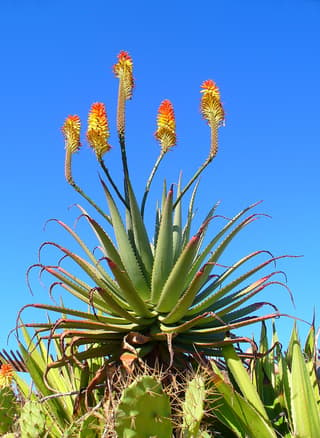
Aloe arborescens, commonly known as Krantz Aloe or Candelabra Aloe, is a large succulent shrub native to South Africa. It forms dense clumps of blue-green leaves arranged in rosettes, with edges serrated by small teeth. In winter, it produces spectacular flower spikes with tubular orange or red flowers that are extremely rich in nectar, attracting various pollinators such as hummingbirds.
Short-Leaved Aloe
Aloe brevifolia
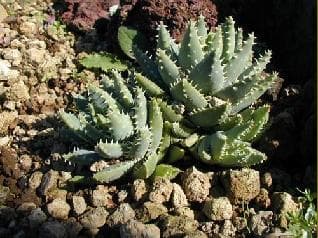
Aloe brevifolia is a compact, clump-forming succulent native to the Western Cape of South Africa. It forms dense rosettes of short, broadly triangular, blue-green fleshy leaves edged with soft white teeth. In late spring, mature clumps send up tall spikes topped with tubular orange-red flowers that attract pollinators. Slow-growing and drought tolerant, it is a popular choice for rock gardens, succulent borders, and container displays.
Bitter Aloe
Aloe ferox
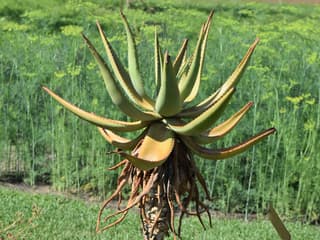
Aloe ferox, commonly known as bitter aloe or Cape aloe, is a tree-like succulent native to South Africa, forming a single rosette of spiny, grey-green leaves atop an unbranched stem that can reach up to 3 meters tall. It is renowned for its tall flower spikes bearing tubular orange-red blooms in winter, which attract sunbirds and bees.

Haworthia-leaved Aloe
Aloe haworthioides
Aloe haworthioides is a miniature succulent endemic to the central highlands of Madagascar, where it grows nestled in quartz rock crevices. It forms compact and prolific rosettes 3 to 5 cm in diameter that cluster into dense mats, featuring dark green lanceolate leaves covered in soft white spines and pustules that give it an appearance similar to the Haworthia genus (hence its name). In late summer and fall, it produces striking, fragrant, tubular flowers ranging from orange to pale pink on tall, slender stalks up to 30 cm. It is a slow-growing species, reaching barely 10 cm in height in cultivation, and is listed in CITES Appendix I due to its conservation status.
Spider Aloe
Aloe humilis
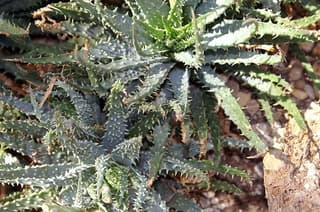
Aloe humilis, the spider aloe, is a small clumping succulent from South Africa forming tight rosettes of blue-green, upcurved leaves edged with soft white teeth. In late winter and spring it sends up tall stalks of tubular orange to coral-red flowers loved by pollinators.
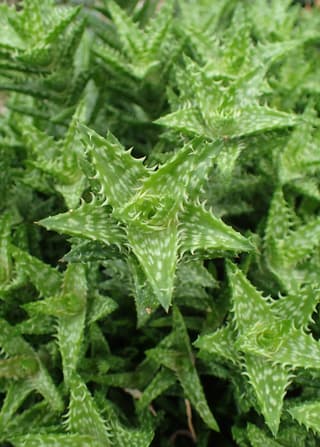
Tiger Tooth Aloe
Aloe juvenna
Aloe juvenna, popularly known as Tiger Tooth Aloe, is a charming succulent native to Kenya. It grows in compact, stacked rosettes with short, triangular, vibrant green leaves speckled with white spots. Its margins are adorned with small, harmless white teeth that resemble a tiger's jaw. When exposed to intense sunlight, the plant can develop a very attractive bronze or reddish hue.
What are Easy Plants?
Easy Plants are ideal for beginners or people with little time for care. These species are tolerant of watering mistakes, light variations, and don't require constant attention. Perfect for those just starting out with plants.
Tips for Growing Easy Plants
To succeed with easy plants, remember: less is more. Avoid overwatering, choose a spot with adequate light, and let the soil dry between waterings. Most of these plants prefer to be 'forgotten' occasionally.