Asparagaceae
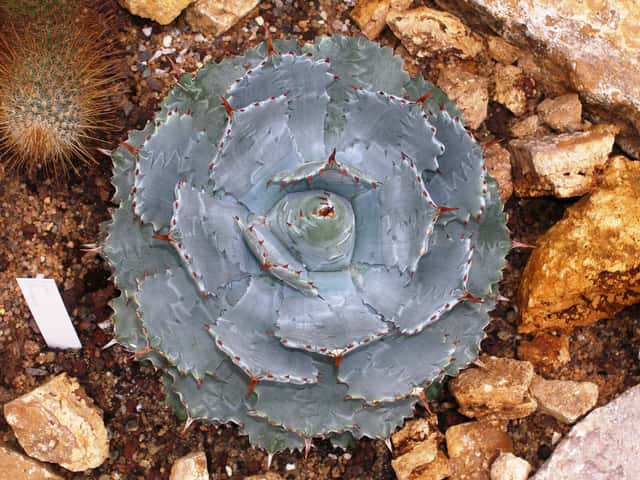
Dwarf Butterfly Agave (Agave isthmensis)
Agave isthmensis
Full or filtered sun, very fast-draining mix, and water only when the mix is completely dry. Barely water in winter. It survives light frost down to about -3 °C only if the soil is dry; where it gets colder, grow it in a pot and bring it under cover.
Every 14 days
Direct sun
-3° - 40°C
20% - 50%
Categories
What is Dwarf Butterfly Agave?
Dwarf Butterfly Agave (Agave isthmensis) is a easy-care plant from the Asparagaceae family. Agave isthmensis is a dwarf agave endemic to the Isthmus of Tehuantepec, on the southern coast of Oaxaca and Chiapas in Mexico, where it grows among rocks from near sea level to about 875 m. It forms compact rosettes 12-30 cm across, with short, broad, powdery blue-grey leaves edged with dark reddis...
Dwarf Butterfly Agave grows up to 30cm, spread of 30cm, watering every 14 days, -3°C – 40°C, 20–50% humidity. It is suitable for indoor environments and not safe for pets.
Unlike many tropical plants, Dwarf Butterfly Agave tolerates watering mistakes. Best for beginners. Without precautions, ingestion can cause irritation in pets. Keep out of reach of cats and dogs. Without adequate drainage, root rot can develop within 28 days.
How to Care for Dwarf Butterfly Agave?
TLDR: Dwarf Butterfly Agave needs Direct sun, watering every 14 days, and temperatures between -3-40°C with 20-50% humidity.
How Often Should You Water Dwarf Butterfly Agave?
Soak thoroughly, then let it dry out completely before watering again, roughly every 2 weeks in summer and once a month or less in winter. Too much water rots the base.
How Much Light Does Dwarf Butterfly Agave Need?
Direct or very bright sun. If it comes from a nursery or indoors, move it into full sun gradually so it doesn't scorch.
What Is the Best Soil for Dwarf Butterfly Agave?
Cactus mix with plenty of grit, pumice or perlite. Don't bury it deeper than the base of the rosette, or the neck may rot.
What Pot Should You Use for Dwarf Butterfly Agave?
A shallow, wide terracotta pot with drainage holes, only slightly bigger than the rosette.
What Is Dwarf Butterfly Agave and Where Does It Come From?
Agave isthmensis is a dwarf agave endemic to the Isthmus of Tehuantepec, on the southern coast of Oaxaca and Chiapas in Mexico, where it grows among rocks from near sea level to about 875 m. It forms compact rosettes 12-30 cm across, with short, broad, powdery blue-grey leaves edged with dark reddish to black teeth and tipped with a black spine 3-4 cm long. For a long time it was confused with Agave potatorum, which grows alongside it, until it was described as a separate species in the 1990s for its smaller size and flowers. It flowers only once, in summer, on a 1.5-2 m stalk of yellow flowers flushed red, and then the rosette dies, usually after producing plenty of pups.
How to Propagate Dwarf Butterfly Agave?
Offsets
Wear gloves: the teeth and tip spine are sharp. Pups without roots still root well if the mix drains fast.
- 1 Remove a pup that has a few leaves and, ideally, its own roots
- 2 Let the cut dry in the shade for 2-5 days
- 3 Plant in dry or barely moist cactus mix
- 4 Wait a week before the first watering
Materials needed:
Seed
Seeds sprout easily, but plants take years to form a mature rosette.
- 1 Sow on the surface of moist sandy mix
- 2 Cover with a thin layer of sand
- 3 Keep warm and bright without letting it dry out
- 4 Transplant when seedlings have 3 or 4 leaves
Materials needed:
How Big Does Dwarf Butterfly Agave Grow?
TLDR: Dwarf Butterfly Agave can reach up to 30cm tall with Slow growth rate.
Max height
30cm
Spread
30cm
Growth rate
Slow
Foliage
Evergreen
Warning: Toxic Plant
This plant can be toxic if ingested. Keep out of reach of:
Plant Uses
Ornamental
Great for decoration
Is your plant showing symptoms?
Click on the symptom to discover possible causes:
What Diseases Commonly Affect Dwarf Butterfly Agave?
TLDR: Dwarf Butterfly Agave is susceptible to 7 known diseases. Monitor regularly for early detection.
Root Rot
Root rot is a serious fungal disease that affects the root system of plants, causing them to decay and die. It is primarily caused by overwatering, poor drainage, or soil-borne fungi such as Pythium, Phytophthora, Rhizoctonia, and Fusarium. The disease thrives in waterlogged conditions where roots are deprived of oxygen, making them susceptible to fungal infection.
Crown Rot
Crown rot is a serious fungal disease that attacks the crown (base) of the plant where the stem meets the soil. It is caused by various fungal pathogens including Phytophthora, Fusarium, and Rhizoctonia. The disease thrives in waterlogged conditions and can quickly spread to kill the entire plant if not addressed promptly.
Overwatering
Overwatering occurs when plants receive too much water, depriving roots of oxygen and causing root rot. This environmental stress is one of the most common causes of houseplant death, as waterlogged soil prevents roots from breathing and functioning properly.
Mealybugs
Mealybugs are small, soft-bodied insects covered with a white, waxy, cottony material. They are common pests of houseplants and outdoor plants in mild climates. These sap-sucking insects feed on plant tissue, causing damage, stunted growth, and can lead to plant death if left untreated. They produce sticky honeydew which attracts sooty mold.
Fun Facts
It is known from only a few sites on the Isthmus of Tehuantepec
Each rosette flowers once in its life and then dies, leaving pups behind
Variegated forms with white or yellow leaf bands are highly sought after
Frequently asked questions
Is Agave isthmensis the same as Agave potatorum?
How often should I water it?
Can it handle frost?
Is it toxic to cats and dogs?
Compare with similar plants
| Attribute | Difficulty | Light | Watering | Pet Safe |
|---|---|---|---|---|
| Field Maple | Easy | Bright indirect | 14d | ✓ |
| Iberian Houseleek | Easy | Direct sun | 14d | ✓ |
| Silver Birch | Easy | Direct sun | 14d | ✓ |
| Common Blanketflower | Easy | Direct sun | 10d | ✓ |





