Complete Plant Guide
Explore plants by difficulty, season and more. Find the perfect plant for you.
Difficulty
Categories
Plants by City
🗺️ Plants by City3768 plants found
Showing 2737-2772 of 3768
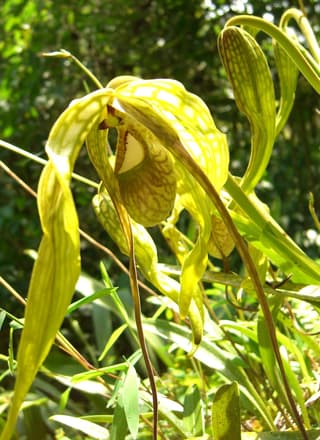
Tailed Slipper Orchid
Phragmipedium caudatum
Phragmipedium caudatum is a large, fan-shaped terrestrial to lithophytic orchid native to cloud forests from Mexico to Peru and Bolivia, growing on humid, mossy slopes and cliff faces between 800 and 2500 meters elevation. It is famed for its extraordinarily long, spiraling lateral petals, which trail downward and can reach 60 to 90 centimeters (occasionally over a meter) in mature specimens, among the longest floral structures in the plant kingdom. The cream to yellow-green flowers are veined with darker green and flushed with maroon-red along the twisting petals, opening in succession over many weeks. Prized by collectors since Victorian times, it remains one of the most spectacular and challenging slipper orchids to grow well.

Common Reed
Phragmites australis
The Common Reed (Phragmites australis) is a tall, perennial wetland grass that grows in dense stands—known as reed beds—along the banks of standing and slow-flowing bodies of water. It reaches heights of up to four meters and often spreads extensively via vigorous underground rhizomes. The characteristic dark purple to silvery-gray flower panicles appear in late summer and autumn above narrow, blue-green leaves that turn golden-brown in winter. Distributed worldwide, the reed is considered an ecologically significant habitat for birds and insects, but once established, it can spread very aggressively.

Aztec Sweet Herb
Phyla dulcis
Aztec Sweet Herb (Phyla dulcis, syn. Lippia dulcis) is a perennial herb in the Verbenaceae family, native to southern Mexico, Central America, the Caribbean (Cuba, Hispaniola, Puerto Rico), and northern South America (Colombia, Venezuela). The Aztecs used it as a natural sweetener and medicinal herb long before the arrival of Europeans; it was first scientifically described in the 16th century by Spanish physician Francisco Hernández. The leaves contain an extremely sweet substance called hernandulcin, but also contain camphor, so they should only be consumed in small quantities. The plant forms low, creeping to trailing mats with tiny white flowers and is popular in hanging baskets as well as a groundcover.
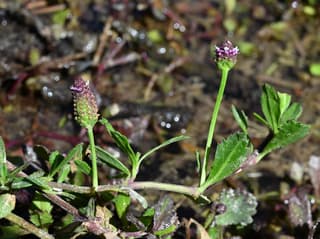
turkey tangle fogfruit
Phyla nodiflora
Phyla nodiflora, commonly known as turkey tangle fogfruit or frogfruit, is a vigorous, low-growing perennial groundcover. It features small, serrated green leaves and unique cylindrical flower heads surrounded by tiny white to pinkish-purple flowers. It is highly valued as a sustainable lawn alternative due to its ability to handle foot traffic and its high attractiveness to pollinators like butterflies and bees.
Stonebreaker
Phyllanthus amarus
A small annual tropical herb that grows rapidly to 30-60 cm in height. Native to tropical and subtropical regions of Africa, Americas, India, and Southeast Asia. Characterized by alternately arranged small elliptic-oblong leaves (5-10mm), tiny greenish-yellow flowers, and small seeds. The plant is drought-tolerant and thrives in warm, humid climates. Reaches maturity in 2-3 months.
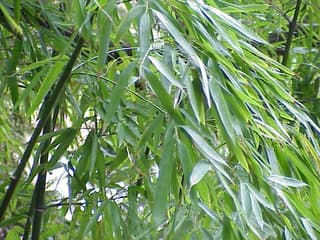
Golden Bamboo
Phyllostachys aurea
Golden Bamboo (Phyllostachys aurea) is a fast-growing, clump-forming bamboo native to southern China. Its canes start green and develop a golden-yellow hue when exposed to full sun, giving the plant its popular name. It can reach up to 9 meters tall and is widely used as a privacy screen, windbreak, and ornamental feature. However, it is classified as invasive in many regions due to its aggressive underground rhizome spread.
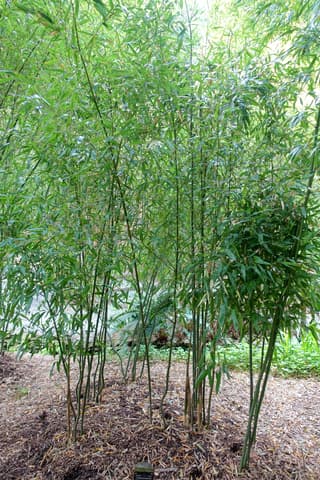
Yellow Groove Bamboo
Phyllostachys aureosulcata
Yellow Groove Bamboo (Phyllostachys aureosulcata) is a striking running bamboo native to the Zhejiang Province of China. It is named for the distinctive yellow groove that runs along each dark green culm, creating an eye-catching two-tone effect. One of the hardiest bamboos available, it tolerates temperatures down to -20°C (-4°F), making it suitable for temperate gardens in USDA zones 4–9. Its fast, vigorous growth makes it popular as a privacy screen, windbreak, and ornamental specimen. The young shoots are edible and notably free of the bitter flavor common to many bamboo species.
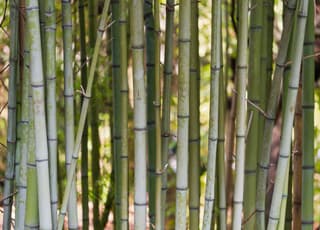
Moso Bamboo
Phyllostachys edulis
Moso Bamboo (Phyllostachys edulis) is the world's largest temperate bamboo, native to the mountain forests of central China. Its culms can reach up to 28 meters tall and 15 cm in diameter. Widely cultivated for edible shoots, construction timber, and ornamental beauty, it is also one of the fastest-growing plants on Earth.
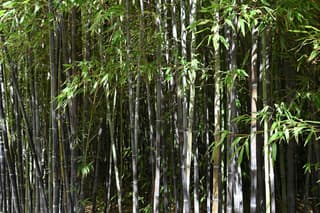
Black bamboo
Phyllostachys nigra
Phyllostachys nigra, or black bamboo, is a fast-growing, evergreen running bamboo prized for its glossy green canes that mature to a striking jet-black over two to three years. Native to China, it forms tall, dense clumps of arching foliage and is widely used as an ornamental screen or privacy hedge. As a running bamboo it spreads via underground rhizomes and can become invasive if left uncontained, so planting in a large container or behind a rhizome barrier is recommended.
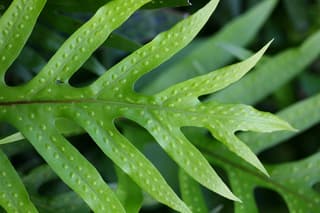
Wart Fern
Phymatosorus grossus
Phymatosorus grossus, commonly called the wart fern or maile-scented fern, is a rhizomatous fern native to the tropical Pacific and Australasia. Its glossy, leathery fronds emerge from creeping, scaly rhizomes and release a maile-like fragrance when crushed. In Hawaii, where it naturalized after being introduced in the early 20th century, its fronds are woven into lei and used to scent traditional kapa cloth. As a houseplant it forms dense, spreading mats of deeply lobed foliage that tolerates low light better than most ferns.
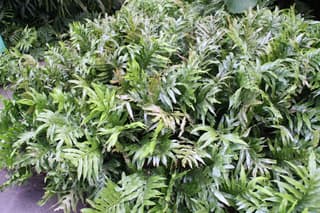
Wart Fern
Phymatosorus scolopendria
Phymatosorus scolopendria, popularly known as the Wart Fern, is a perennial, rhizomatous fern native to the tropical regions of Africa, Asia, and Oceania. Its fronds are leathery, bright green, and deeply lobed, reaching up to 90 cm (35 inches) in height. A striking feature is its sori (reproductive organs) which form rounded protuberances on the upper surface of the leaves, resembling small warts, hence its common name 'wart fern'. Extremely versatile, it can grow as an epiphyte on trees, as ground cover in tropical gardens, or as an indoor ornamental plant in environments with good humidity. It adapts well to shade and partial shade conditions, making it ideal for interiors, well-lit bathrooms, and shaded gardens.
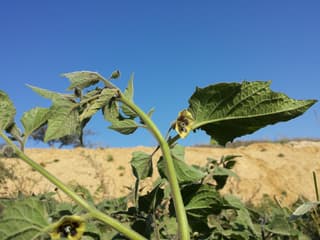
Groundcherry (genus)
Physalis
Physalis is a large genus of the nightshade family (Solanaceae) comprising over 100 species, including the cape gooseberry (P. peruviana), tomatillo (P. ixocarpa), and Chinese lantern (P. alkekengi). All species produce fruit enclosed in a papery husk (calyx), the genus's hallmark trait. They thrive in full sun with well-draining soil and are easy to grow.
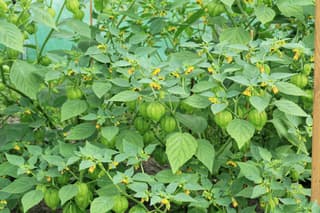
Tomatillo
Physalis ixocarpa
Physalis ixocarpa, commonly known as tomatillo, is an annual plant in the Solanaceae family native to Mexico and Central America. It produces green fruits enclosed in a distinctive papery husk, widely used in traditional Mexican cuisine for salsas, moles, and sauces.
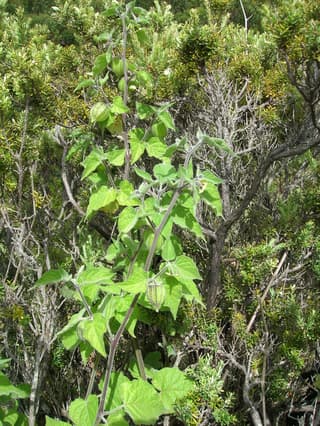
Cape Gooseberry
Physalis peruviana
Physalis peruviana, commonly known as cape gooseberry or goldenberry, is a sprawling perennial subshrub in the nightshade family (Solanaceae), native to the Andean highlands of Peru, Ecuador, Colombia, and Bolivia. It produces small, round, golden-orange berries wrapped in a papery husk (calyx) that resembles a Chinese lantern. Only the fully ripe fruit is edible; the unripe fruit and all vegetative parts (leaves, stems, and the papery husk) contain solanine and other toxic alkaloids and should never be eaten.

Tomatillo
Physalis philadelphica
Tomatillo (Physalis philadelphica) is an annual herbaceous plant native to Mexico, grown for its small green fruits encased in a papery husk. A staple of Mexican cuisine, tomatillos are essential in salsas, green sauces, and stews. The plant grows vigorously in warm climates with full sun and well-drained soil, often noted as a synonym of Physalis ixocarpa.

Ground Cherry
Physalis sp
Physalis is a genus of about 90 species in the Solanaceae family, native to the Americas, particularly Central and South America. Known for their distinctive papery husk enclosing an orange berry, these plants are valued for ornamental beauty, edible fruit, and medicinal properties. White to yellow flowers bloom in spring and summer, followed by nutritious fruits rich in vitamins and antioxidants.
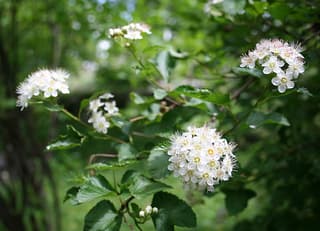
Common Ninebark
Physocarpus opulifolius
Common Ninebark (Physocarpus opulifolius) is a deciduous shrub native to eastern North America, renowned for its distinctive exfoliating bark that peels in multiple thin layers revealing reddish and light-brown inner bark. It produces clusters of creamy-white to pink-tinged flowers in late spring, and is widely valued in landscape gardening for its hardiness, multi-season interest, and adaptability.
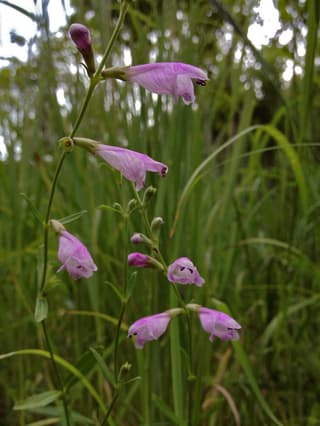
Obedient Plant
Physostegia virginiana
Obedient Plant (Physostegia virginiana) is a hardy, rhizomatous perennial from the mint family (Lamiaceae), native to moist meadows, stream banks, and prairies of North America. Its square stems bear spikes of pink, white, or purplish, dragonhead-like flowers from July to October. It gets its name from the fact that individual flowers, when manually moved, will temporarily hold their new position, as if obeying. It spreads quickly, forming dense clumps, so it's advisable to thin it out occasionally in the garden by division.
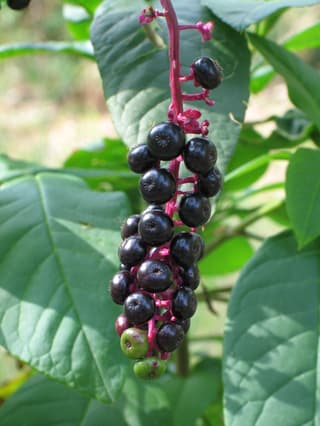
Pokeweed (genus)
Phytolacca
Phytolacca is a genus of approximately 25 species of perennial herbs, shrubs, and trees native to tropical and temperate regions worldwide. The most notable species are Phytolacca americana (American pokeweed), a vigorous weedy perennial of eastern North America, and Phytolacca dioica (ombú), the iconic giant tree-herb of the Argentine pampas. All species are extremely toxic — every part contains saponins and phytolaccatoxin, with berries being particularly dangerous.
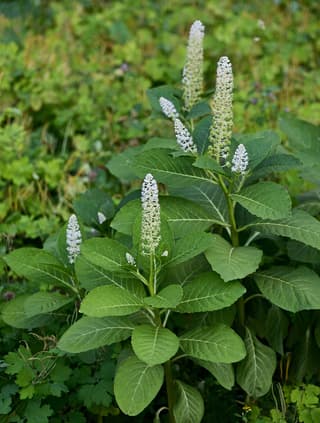
Indian Pokeweed
Phytolacca acinosa
Phytolacca acinosa is a robust, fast-growing herbaceous perennial in the pokeweed family (Phytolaccaceae), native to temperate and tropical Asia (the Himalayas, China, Japan, Korea and Vietnam). It forms clumps of large ovate leaves on reddish-green stems, topped in summer by upright racemes of small white to greenish flowers that ripen into dark purple-black berries. Widely naturalized in parts of Europe and North America, it is grown ornamentally for its bold foliage and berry spikes, though every part of the plant is toxic if eaten raw.
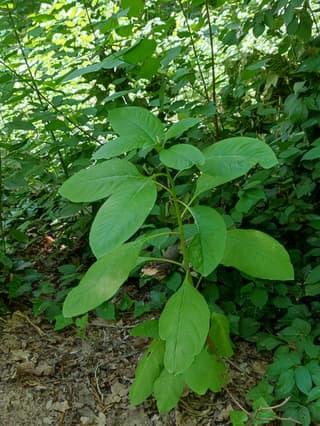
American pokeweed
Phytolacca americana
Phytolacca americana, commonly known as American pokeweed, is a large, fast-growing herbaceous perennial native to eastern North America. It can reach up to 10 feet tall with stout reddish-purple stems and large leaves that emit an unpleasant odor when crushed. In summer it produces long racemes of small white flowers followed by striking dark purple-black berries beloved by birds. WARNING: All parts of the plant are highly toxic to humans, dogs, and cats.

Ombú
Phytolacca dioica
Ombú (Phytolacca dioica) is a majestic South American tree from the family Phytolaccaceae, native to the pampas of Argentina and Uruguay. Despite resembling a true tree, its trunk is composed primarily of water and soft tissue rather than wood, making it unusually light. It is a fast-growing, dioecious species — male and female flowers appear on separate plants. The ombú can reach 15+ meters in height with a broad, dense canopy that provides generous shade, and is celebrated as a cultural icon of the gaucho identity.
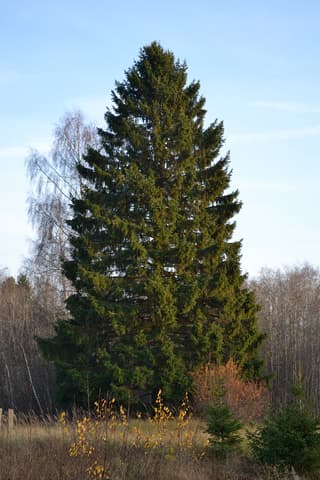
Norway Spruce
Picea abies
Norway Spruce (Picea abies) is a fast-growing evergreen conifer native to northern and central Europe, widely planted as a Christmas tree and ornamental landscape tree. It has a conical crown, dark green needles, and distinctive pendulous cones.
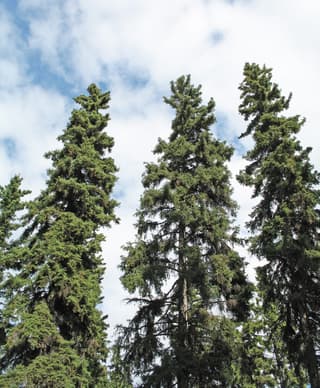
White Spruce
Picea glauca
White spruce (Picea glauca) is a cold-hardy evergreen conifer native to Canada and the northern United States, prized for its dense pyramidal habit and soft, bluish-green needles. While the wild species can reach 18-24 m in forests, its compact cultivar 'Conica' (Dwarf Alberta Spruce) grows only a few centimeters a year, making it one of the most popular conifers for containers, bonsai and indoor/patio growing.
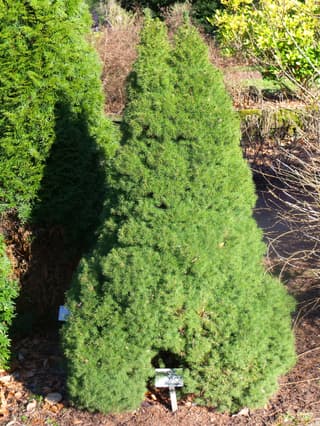
Dwarf Alberta Spruce
Picea glauca 'Conica'
Picea glauca 'Conica', or the Dwarf Alberta Spruce, is a slow-growing evergreen conifer derived from the native white spruce (Picea glauca) and discovered in Alberta, Canada, in 1904. This cultivar is renowned for its perfect, symmetrical conical shape—growing only 2 to 4 inches (5–10 cm) per year, making it ideal for small gardens, rockeries, and containers. Its short, soft, bright green needles are densely packed on the stems, giving the plant an elegant, compact appearance. This variety is very cold-hardy (down to -40 °F/-40 °C) and requires minimal maintenance, but it is highly susceptible to spider mites and does not tolerate high humidity or hot summers.
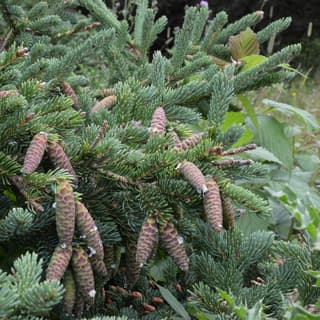
White Spruce
Picea laxa
White spruce (Picea glauca), also known as Canadian spruce, is a majestic coniferous tree native to the northern regions of North America—from Alaska to Newfoundland and south to Montana. It is characterized by a dense, conical crown, short four-sided needles of a blue-green color with a characteristic pungent odor, and small, thin cones. It is among the hardiest trees in the world, withstanding freezing temperatures down to -50 °C and surviving harsh northern winters. It grows to a height of up to 25 meters, naturally growing at a slower pace. It is a foundational species of northern forests and provides shelter for many birds and mammals. Dwarf cultivars such as 'Conica' are popular as ornamental plants for both gardens and containers.
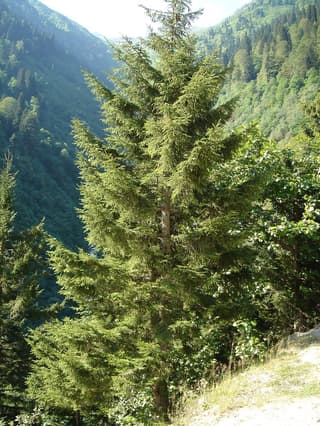
Oriental spruce
Picea orientalis
Oriental spruce (Picea orientalis) is an evergreen conifer from the Pinaceae family, native to northeastern Turkey and the Caucasus region of Georgia. The tree forms a dense, narrow, pyramidal crown with pendulous side branches and short, glossy, dark green needles that lie close to the shoots. In spring, the tree bears conspicuous reddish-purple male cones, which later mature into brown seed cones in the fall. In gardens and parks, the species typically reaches 15-18 meters in height with a width of 4-7 meters after many years of growth, while wild specimens can grow even taller. It is known for its slow but steady growth and is often used as an ornamental tree, windbreak, or specimen plant in large gardens and parks.

Colorado Blue Spruce
Picea pungens
The Colorado Blue Spruce (Picea pungens) is a large, pyramidal evergreen conifer native to the Rocky Mountains of the western United States. Prized for its stiff, silvery-blue needles arranged in a dense brush-like pattern, it can reach 15-23 m (50-75 ft) tall in the landscape. It is the official state tree of Colorado and a popular choice for windbreaks, privacy screens, and as a living Christmas tree.
Black-footed polypore
Picipes badius
Picipes badius, formerly known as Polyporus badius, is a wood-decay fungus characterized by its smooth, shiny cap ranging from bay-brown to chestnut in color. Its stem is typically black at the base and off-center. It is primarily found on the deadwood of deciduous trees. Although non-toxic, its texture becomes extremely leathery with age, making it inedible.
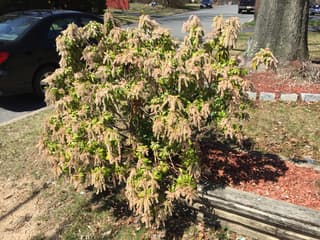
Japanese Andromeda
Pieris japonica
Pieris japonica, commonly known as Japanese andromeda or lily-of-the-valley shrub, is an evergreen shrub in the heath family (Ericaceae), native to Japan, southern China, and Taiwan. It is prized for its coppery-red new growth that matures to glossy dark green, and for its drooping clusters of small, urn-shaped white flowers that bloom in early spring. A slow grower, it thrives in partial shade with consistently moist, acidic soil.

Pilea
Pilea
Pilea is a genus of tropical plants in the family Urticaceae, native to southern China and Vietnam. It includes popular houseplants such as P. peperomioides (Chinese money plant), P. cadierei (aluminum plant), and P. mollis (Moon Valley plant). These compact, fast-growing plants are easy to care for and thrive indoors.
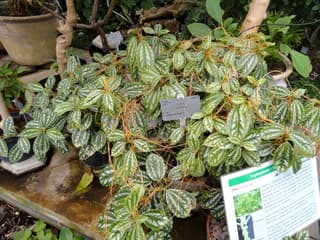
Aluminum Plant
Pilea cadierei
Pilea cadierei, commonly known as the Aluminum Plant, is a striking tropical perennial native to the forests of Vietnam. Prized for its oval, dark-green leaves adorned with four raised silvery patches that give the plant a metallic sheen, it belongs to the nettle family (Urticaceae). Compact and fast-growing, it reaches about 30-40 cm indoors and makes an excellent houseplant for beginners.
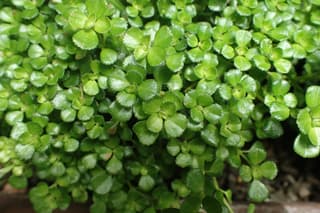
Depressa Pilea
Pilea depressa
Pilea depressa is a small, fast-growing creeping and trailing plant in the Urticaceae family, native to tropical regions of Central America and the Caribbean. Its tiny, round, glossy green leaves form dense mats that cascade beautifully from hanging baskets, drape over pot edges, or carpet terrarium floors. It is completely non-toxic to humans, cats, and dogs, making it a popular choice for pet-friendly households.
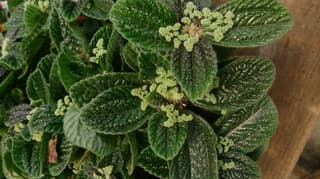
Friendship Plant
Pilea involucrata
Pilea involucrata is a tropical evergreen perennial native to Central and South America, belonging to the Urticaceae family. It features stunning oval, velvety leaves with a deeply quilted or crinkled texture, displaying dark green tones with bronze and copper highlights, and reddish-purple undersides. This compact plant reaches 15-30 cm in height, making it perfect for terrariums, desks, and bright indoor spaces.
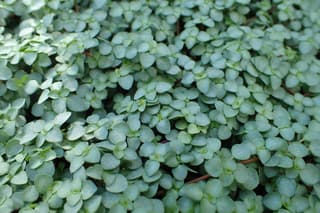
Silver Sparkle Pilea
Pilea libanensis
Pilea libanensis is a low-growing, mat-forming evergreen perennial in the nettle family (Urticaceae), prized for its tiny, glaucous blue-gray leaves that shimmer with a silvery frost on wiry, reddish trailing stems. Native to Central and South America, it is often sold interchangeably with Pilea glauca and Pilea glaucophylla and is a popular choice for hanging baskets, terrariums, and as a groundcover in mixed containers.
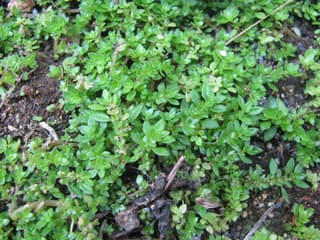
Artillery Plant
Pilea microphylla
The Artillery Plant (Pilea microphylla) is a small tropical plant native to the Tropical Americas, prized for its incredibly tiny, moss-like leaves that form a lush, dense green carpet. It belongs to the family Urticaceae and is famous for its remarkable pollen-shooting mechanism — when its stamens mature, they forcefully eject pollen into the air in a visible cloud, which gives the plant its name. It is widely used as a ground cover, in terrariums, and as an indoor ornamental.
Find the Perfect Plant
Our plant guide helps you find ideal species for your experience level and time of year.
Browse by Difficulty, Season & More
Use the filters below to narrow this catalog by care difficulty, season, environment, or search directly by name. Each filter leads to a focused list tailored to your specific growing conditions.