Complete Plant Guide
Explore plants by difficulty, season and more. Find the perfect plant for you.
Difficulty
Categories
Plants by City
🗺️ Plants by City3781 plants found
Showing 2593-2628 of 3781
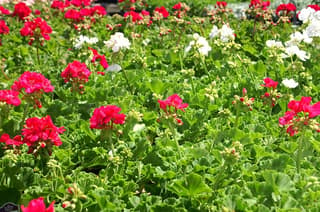
Zonal Geranium
Pelargonium × hortorum
Pelargonium hortorum, commonly known as Zonal Geranium or Horseshoe Geranium, is one of the most popular flowering plants in gardens and containers worldwide. Native to South Africa, it is a hybrid derived from Pelargonium zonale and P. inquinans. Its distinctive rounded leaves feature a darker horseshoe-shaped band, and it produces prolific clusters of flowers in vibrant shades of red, pink, orange, white, and purple from spring through fall.
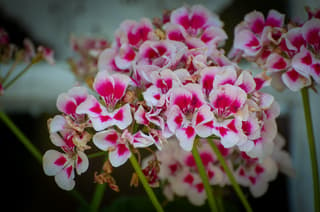
Garden Geranium
Pelargonium × hybridum
Garden Geranium (Pelargonium × hybridum) is a hybrid ornamental plant originating from a cross between Pelargonium zonale and Pelargonium inquinans. Widely grown in pots, garden beds, and balconies, it is prized for its abundant and colorful blooms throughout spring, summer, and fall. Flowers range from red, pink, white to salmon, making it one of the most popular plants for outdoor decoration worldwide.
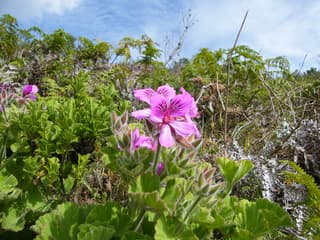
Hooded-leaf Pelargonium
Pelargonium cucullatum
Pelargonium cucullatum is a tall, sprawling evergreen shrub native to the sandy and granite slopes of the Cape fynbos in South Africa, growing over 2 m tall. Its rounded, cupped, hairy leaves give the species its name, and it produces masses of pink to mauve or white flowers with striking purple veining from spring into summer. It is the parent species of countless modern pelargonium hybrids grown worldwide.
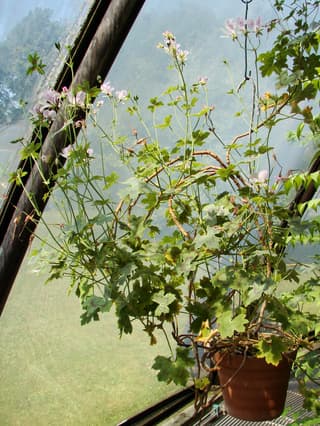
Regal Storksbill
Pelargonium grandiflorum
Pelargonium grandiflorum, commonly known as the Regal Pelargonium or Regal Storksbill, is an ornamental plant native to the Cape region of South Africa. It stands out for its large, showy flowers in shades of white, pink, red, and purple, often featuring distinctive dark markings on the upper petals. It is one of the most elegant species in the Pelargonium genus, widely grown in pots and temperate gardens.
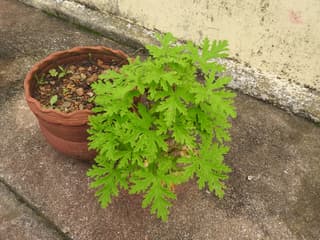
Rose Geranium
Pelargonium graveolens
Pelargonium graveolens, commonly known as rose geranium, is a fragrant subshrub native to South Africa. Its deeply lobed, velvety leaves release a strong rose-like scent when touched, and it produces small pink to purple flowers in spring and summer. Widely cultivated for its essential oil used in perfumery and aromatherapy, it is also a popular ornamental and culinary herb.
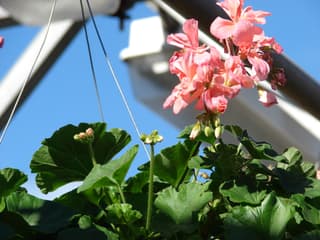
Zonal Geranium
Pelargonium hortorum
The zonal geranium (Pelargonium hortorum) is a popular perennial subshrub prized for its rounded leaves marked with a distinctive dark horseshoe-shaped "zone" and its long-lasting clusters of red, pink, salmon, or white flowers. Widely used in garden beds, containers, and window boxes, it is heat-tolerant and blooms from spring through fall.
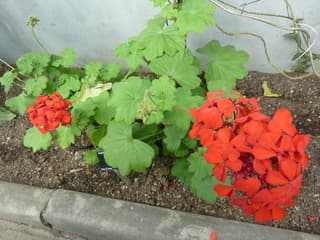
Scarlet Geranium
Pelargonium inquinans
Pelargonium inquinans is a soft, woody shrub native to the Eastern Cape, KwaZulu-Natal and Mpumalanga provinces of South Africa, where it grows along coastal scrub and clay-soil margins. It forms a rounded bush up to 2 m tall, with velvety, orbicular leaves that leave a brown stain on the fingers when touched, the source of its Latin name inquinans, meaning to soil. Clusters of 5 to 30 bright scarlet-red flowers, occasionally pink, salmon or white, appear almost year-round. Introduced to Europe in the early 1700s, it is one of the two wild ancestors, alongside Pelargonium zonale, of the modern zonal geraniums grown in gardens worldwide.
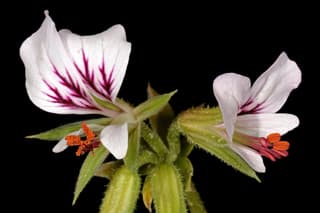
Myrrh-leaved Pelargonium
Pelargonium myrrhifolium
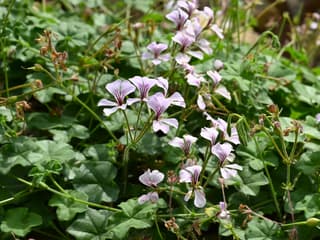
Pelargonium myrrhifolium is a slow-growing subshrub native to the Western Cape of South Africa. It is prized for its finely divided, fern-like leaves that release a soft myrrh-like fragrance when touched, and for its delicate white, pink, and red flowers that bloom from spring through summer.
Ivy Geranium
Pelargonium peltatum
Pelargonium peltatum, commonly known as Ivy Geranium, is a trailing and cascading flowering plant native to the coastal cliffs and rocky slopes of South Africa. Its ivy-shaped, glossy leaves and abundant blooms in shades of pink, white, red, lavender, salmon, and burgundy make it one of the most beloved plants for hanging baskets, window boxes, and balcony gardens. It blooms profusely from spring through fall, rewarding gardeners with months of continuous color.
Oak-leaved Geranium
Pelargonium quercifolium
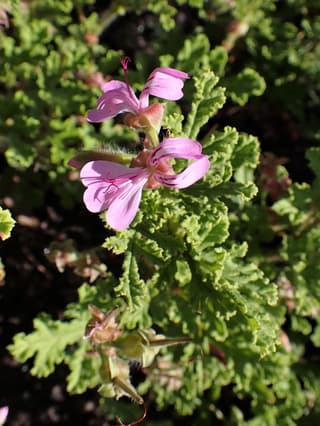
The oak-leaved geranium (Pelargonium quercifolium) is a densely branching evergreen shrub native to South Africa, named for its deeply lobed, oak-shaped leaves. The sticky, aromatic foliage releases a resinous scent when touched, with fragrance notes that vary by cultivar from balsam to mint. In late spring and summer it produces small pink flowers with darker purple markings, held in umbels above the foliage.
Rasp-leaf pelargonium
Pelargonium radens
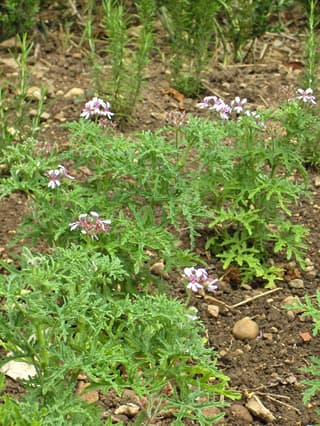
Pelargonium radens is an aromatic, evergreen shrub native to the southern and eastern Cape of South Africa, where it grows in ravines and among mountainside shrubs. It forms a closely branched shrub up to 1.5 m tall, with deeply divided, gray-green triangular leaves that release a strong rose-lemon fragrance when bruised, and clusters of small pale purple to pink flowers with deep purple markings that bloom from summer into fall. It is one of the parent species behind many rose-scented pelargonium hybrids grown for essential oil.
Currant-leaved Pelargonium
Pelargonium ribifolium
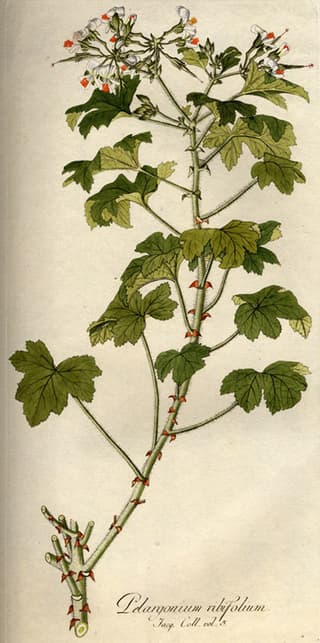
Pelargonium ribifolium is a much-branched, evergreen shrub native to the southern Western and Eastern Cape of South Africa, where it is more common along the margins of streams and other consistently moist habitats. Reaching up to 2 m in height and around 1 m in spread, it forms an erect, woody-based shrub with softly hairy, aromatic, three-lobed leaves reminiscent of currant (Ribes) foliage - the origin of its species epithet ribifolium. Small white flowers, roughly 20 mm across and marked with red veining on the two upper petals, appear intermittently through the year with a peak flush from September to November (Southern Hemisphere spring). Unlike many of its Cape relatives that demand full baking sun, this species is notably adaptable, thriving in full sun near water as well as in partially or fully shaded understorey positions. In cultivation it makes an attractive, low-maintenance garden shrub for moist, humus-rich beds or large containers, and propagates readily from softwood or semi-ripe cuttings.
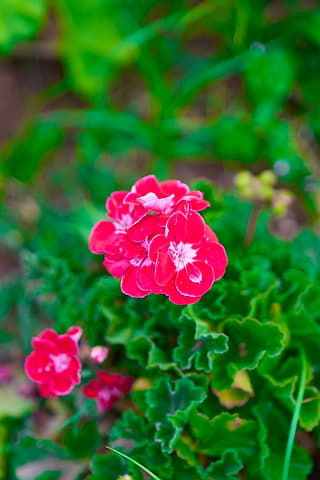
Horseshoe Geranium
Pelargonium zonale
Pelargonium zonale, commonly known as the Horseshoe Geranium or Zonal Geranium, is the most popular and widely grown "geranium" in the world — though it is not a true Geranium at all, but belongs to the genus Pelargonium in the family Geraniaceae. Native to South Africa, it is prized for its distinctive horseshoe-shaped darker zone on its rounded leaves and its prolific clusters of red, pink, white, salmon, or magenta flowers that bloom from spring through fall. It thrives in full sun and tolerates drought well, making it ideal for pots, balconies, window boxes, and garden beds.
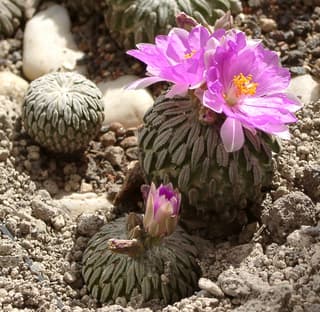
Hatchet Cactus
Pelecyphora
Pelecyphora is a genus of small, slow-growing Mexican cacti in the family Cactaceae, prized by collectors worldwide. Characterized by distinctive flattened tubercles resembling axe heads or woodlice, the most well-known species P. aselliformis (peyotillo) is native to San Luis Potosí, Mexico, and produces violet-red flowers in spring and summer. Both P. aselliformis and P. strobiliformis are listed on CITES Appendix I, making international trade strictly regulated.
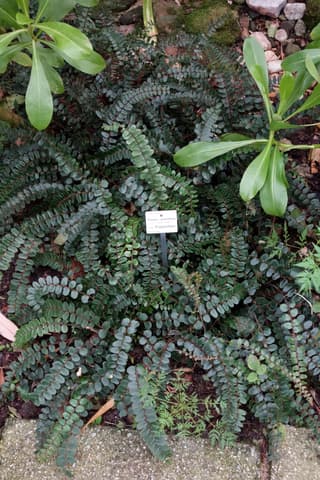
Button Fern
Pellaea rotundifolia
Pellaea rotundifolia is a compact, evergreen fern native to New Zealand and Australia, prized for its distinctive round, button-like leaflets arranged along dark, wiry stems. Unlike many ferns, it tolerates lower humidity and is remarkably drought-resistant, making it an excellent low-maintenance houseplant. It received the Royal Horticultural Society Award of Garden Merit.
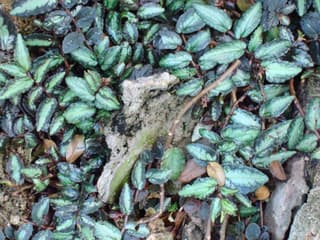
Trailing Watermelon Begonia
Pellionia repens
Trailing Watermelon Begonia (Pellionia repens, synonym Elatostema repens) is a small perennial indoor plant from the Urticaceae family, native to Southeast Asia, including Vietnam and Malaysia. It reaches a height of only about 6 inches, but its prostrate to trailing stems can spread up to 24 inches wide. The oval leaves are olive green with darker, purplish or brown markings that resemble the rind of a watermelon, which is why it is commonly called the Watermelon Begonia. The tiny greenish-white flowers are inconspicuous and hold little ornamental value. It is well-suited for hanging baskets, terrariums, and as a groundcover in warm, humid environments. It is considered non-toxic to cats, dogs, and humans.
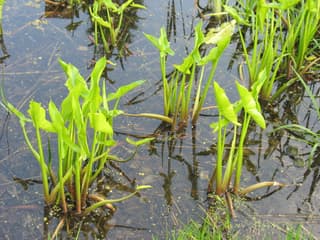
Arrow Arum
Peltandra
Peltandra is a genus of aquatic and wetland perennials in the arum family (Araceae), native to marshes, swamps, and pond edges of eastern North America. This profile covers the genus as a whole (most commonly represented by Peltandra virginica, green arrow arum) rather than a single species, since all members share the same emergent, bog-loving growth habit, arrow-shaped leaves, and calcium-oxalate toxicity. Grown submerged or in permanently saturated soil, Peltandra forms dense clumps of glossy, sagittate leaves topped by greenish-white spadix flowers in spring, followed by berry clusters that mature underwater.
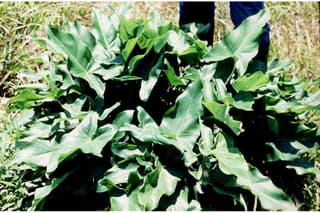
Green Arrow Arum
Peltandra virginica
Green arrow arum is an emergent perennial native to freshwater wetlands, marshes, and pond margins of eastern North America. It forms clumps of glossy, arrowhead-shaped leaves rising from thick rhizomes, with greenish-white flowers borne on a spadix wrapped in a pale green spathe in spring. The plant grows rooted in mud under shallow standing water and is a key food source for waterfowl, muskrats, and other wetland wildlife.
felt lichen
Peltigera
Peltigera, commonly known as felt lichen, is a genus of approximately 100 species of foliose lichens. They are characterized by large, leaf-like thalli that often have a fuzzy or 'felt-like' lower surface. These lichens form a symbiotic relationship between a fungus and a cyanobacterium (usually Nostoc), which allows them to fix nitrogen from the atmosphere, making them vital for forest ecosystem health.
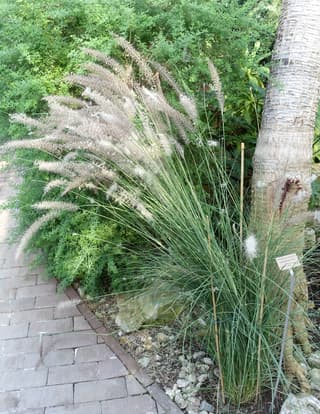
Fountain Grass
Pennisetum setaceum
Fountain Grass (Pennisetum setaceum) is an ornamental grass native to East Africa and the Middle East. Known for its arching foliage and feathery plumes in shades of pink to purple, it brings elegant movement and texture to gardens and landscapes. Highly drought-tolerant and low-maintenance, it thrives in hot, sunny conditions with minimal care.
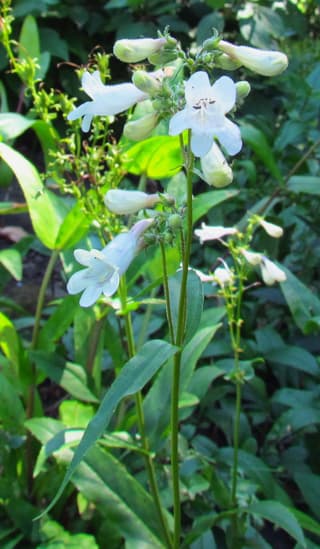
Foxglove Beardtongue
Penstemon digitalis
Penstemon digitalis, commonly known as foxglove beardtongue, is a perennial herbaceous plant native to eastern and central North America, belonging to the plantain family (Plantaginaceae). From its basal rosette, branched flowering stems rise 60–120 cm tall, bearing dense clusters of white, tubular, two-lipped flowers between May and July. Although its specific epithet refers to foxglove (Digitalis), the plant is not related to it and is non-toxic to humans, dogs, and cats. It is an excellent nectar source and pollinator plant, attracting bees, hummingbirds, and butterflies; it is also extremely cold-hardy (USDA zones 3a–8b) and a low-maintenance garden ornamental.
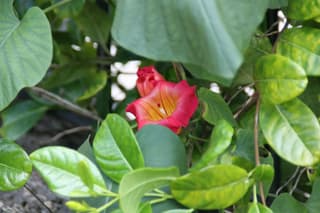
hammock viper's-tail
Pentalinon luteum
Pentalinon luteum, commonly known as hammock viper's-tail or wild allamanda, is a vigorous evergreen woody vine native to Florida, the Bahamas, and the Caribbean. It is prized for its glossy, leathery elliptical leaves and its prolific production of bright yellow, funnel-shaped flowers that resemble those of the true Allamanda. While it is a beautiful ornamental climber, it is important to note that all parts of the plant contain milky sap that can be irritating to the skin and toxic if ingested.
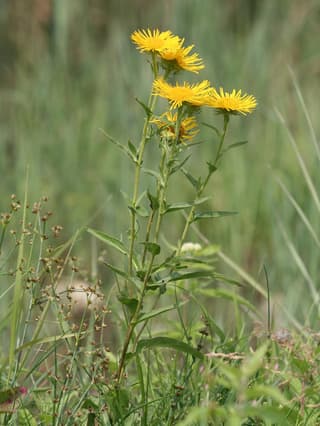
British yellowhead
Pentanema britannica
The British yellowhead (Pentanema britannica, formerly Inula britannica) is a perennial herbaceous plant in the Asteraceae family, native to damp habitats across Europe and temperate Asia, including riverbanks, stream edges, marshes, ditches, and wet meadows. It features erect, finely pubescent stems reaching 15-80 cm in height, topped with bright yellow sunflower-like flower heads that bloom from late summer to early autumn. Its lanceolate, entire leaves are sparsely hairy on top and more densely pubescent underneath. Due to its thick rhizomes, it spreads vigorously and rapidly, leading it to be considered an invasive weed in parts of North America.
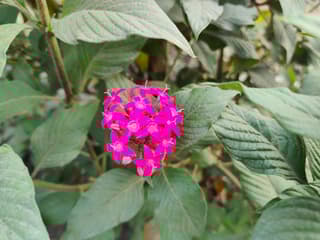
Egyptian Star Flower
Pentas lanceolata
Pentas lanceolata, commonly known as the Egyptian Star Flower, is a tropical flowering shrub native to East Africa and the Arabian Peninsula. It produces dense clusters of small, star-shaped flowers in shades of red, pink, white, purple, and lavender, blooming almost year-round in warm climates. A magnet for butterflies and hummingbirds, it is a favorite in garden beds and container plantings alike.
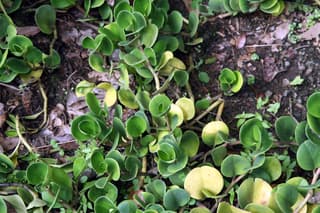
Peperomia
Peperomia
Peperomia is a vast genus of tropical plants in the family Piperaceae, with over 1,000 species native primarily to the rainforests of South America. Their fleshy, succulent-like leaves store water, making them remarkably forgiving and drought-tolerant. Peperomias thrive indoors with minimal care, adapting well to indirect light — perfect for homes and offices.
Nevada Peperomia
Peperomia 'Nevada'
Peperomia 'Nevada' is a compact evergreen cultivar in the Piperaceae family, closely related to Peperomia ferreyrae. It forms a dense rosette of thick, deep-green, ripple-textured leaves radiating from a short central stem, giving the plant a lush, semi-succulent appearance. Popular as a low-maintenance houseplant, it stays small and tidy, making it ideal for shelves, desks, and terrariums.
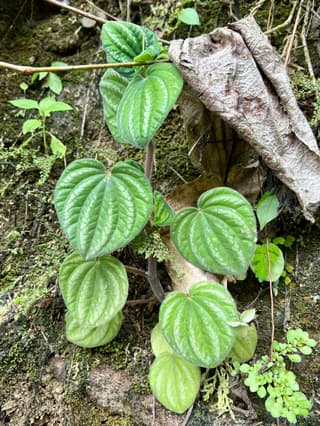
Piccolo Banda Peperomia
Peperomia albovittata
Peperomia albovittata, commonly known as Piccolo Banda, is a compact semi-succulent houseplant in the Piperaceae family, native to South America. It is prized for its velvety, dark green leaves adorned with silvery or light-colored stripes along the veins, forming an eye-catching striped pattern. A slow-growing and low-maintenance plant, it is an excellent choice for beginners and indoor plant collectors alike.
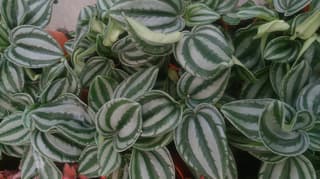
Watermelon Peperomia
Peperomia argyreia
The Watermelon Peperomia is a compact ornamental plant native to Brazil, known for its rounded leaves with silver stripes that resemble watermelon rinds. It belongs to the Piperaceae family and is highly valued as an indoor plant for its beauty and easy care.
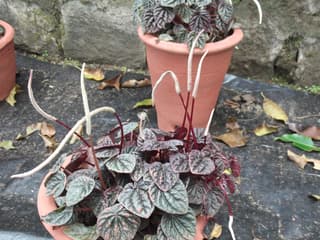
Emerald Ripple Peperomia
Peperomia caperata
A compact perennial herbaceous plant native to Brazil, prized for its ornamental heart-shaped leaves with deeply corrugated, rippled texture. Perfect for indoor spaces as it thrives in the shade of tropical forest understories. Produces thin spike-like inflorescences with tiny white flowers resembling a rat's tail.
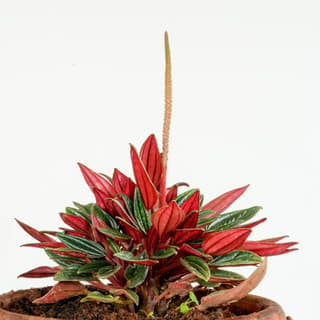
Peperomia Rosso
Peperomia caperata 'Rosso'
Peperomia 'Rosso', sold as Peperomia caperata 'Rosso' or 'Eden Rosso', is a compact rosette-forming peperomia grown for its two-tone foliage. Its narrow, pointed leaves, about 5 cm long, are deeply puckered between the veins, dark glossy green on top and deep red underneath, on red leaf stalks, so the plant looks green from above and red from the side. It was bred in the Netherlands by Obed Smit and, according to its US plant patent, comes from a 2010 cross between Peperomia marmorata and Peperomia metallica, although the trade lists it under Peperomia caperata. It stays small (around 20 cm tall and 25 cm wide), grows slowly and is non-toxic to people, cats and dogs. In short days it sends up thin, upright spikes of tiny cream to yellow-green flowers.
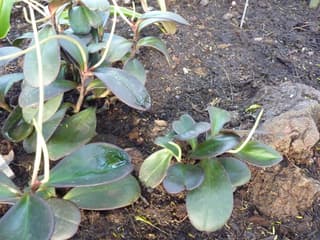
Red-Edge Peperomia
Peperomia clusiifolia
Peperomia clusiifolia, commonly known as Red-Edge Peperomia or Ginny Peperomia, is a tropical succulent-like houseplant from the family Piperaceae. Native to the tropical rainforests of Central America and the West Indies, it features thick, fleshy leaves with a striking tricolor pattern: deep green centers, cream margins, and vivid pink-to-red leaf edges. This compact, slow-growing plant is beloved for its ornamental foliage, easy care requirements, and complete non-toxicity to pets and humans.
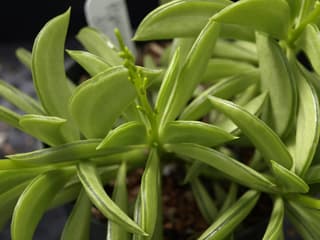
Prayer pepper
Peperomia dolabriformis
Peperomia dolabriformis, called prayer pepper, is a shrubby succulent in the Piperaceae family, native to Peru. Its thick, fleshy leaves fold upward like hands in prayer, with a translucent window along the upper edge that aids photosynthesis. It is compact, slow growing and excellent as a houseplant.
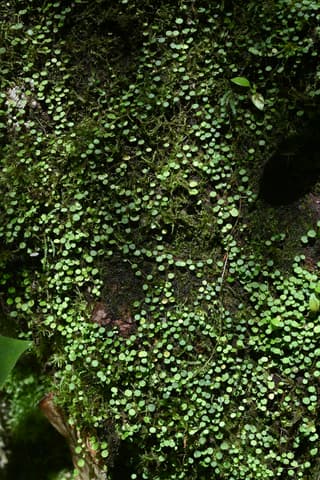
Miniature Peperomia
Peperomia emarginella
Peperomia emarginella is a tiny, charming species native to tropical America. Its small, rounded leaves grow on delicate stems, making it a perfect candidate for terrariums, mini pots, and desktop gardens. It thrives with minimal care and is non-toxic to pets.
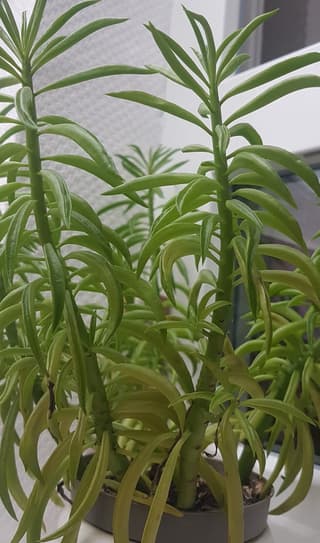
Happy Bean
Peperomia ferreyrae
Peperomia ferreyrae, known as the Happy Bean or Pincushion Peperomia, is a compact succulent-like plant native to the tropical forests of Peru. Its slender, bean-shaped leaves grow densely along upright stems, each leaf featuring a translucent window that helps the plant capture light in its shaded native habitat. This slow-growing, low-maintenance species is prized by houseplant collectors for its unusual sculptural form.
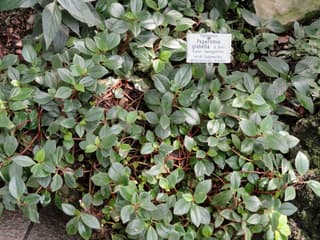
Cypress Peperomia
Peperomia glabella
Cypress Peperomia is a trailing, semi-succulent epiphyte native to South Florida and tropical America, where it grows on trees and rocks in humid hammocks and cloud forests. It has glossy, oval, dark green leaves on reddish stems that cascade gracefully, making it a popular low-maintenance houseplant for hanging baskets.

Ivy Peperomia
Peperomia griseoargentea
Peperomia griseoargentea, known as ivy peperomia, is a compact evergreen perennial from Brazil grown for its heart-shaped, silvery-gray leaves marked with deep, corrugated veining. It forms neat rosettes on reddish, wiry stems and rarely exceeds 25-30 cm in height, making it a popular choice for desks, shelves, and terrariums.
Find the Perfect Plant
Our plant guide helps you find ideal species for your experience level and time of year.
Browse by Difficulty, Season & More
Use the filters below to narrow this catalog by care difficulty, season, environment, or search directly by name. Each filter leads to a focused list tailored to your specific growing conditions.