Piperaceae
Peperomia Rosso (Peperomia caperata 'Rosso')
Peperomia caperata 'Rosso'
An easy, small houseplant for bright indirect light. Let the top half of the mix dry before watering (roughly every 7 days in summer, less in winter), use an airy, well-draining mix and a pot with drainage holes. Keep it at 18-26 °C, away from cold drafts and below 15 °C, with average to moderately humid air. Feed lightly about once a month in spring and summer.
Every 7 days
Partial shade
18° - 26°C
40% - 60%
Categories
What is Peperomia Rosso?
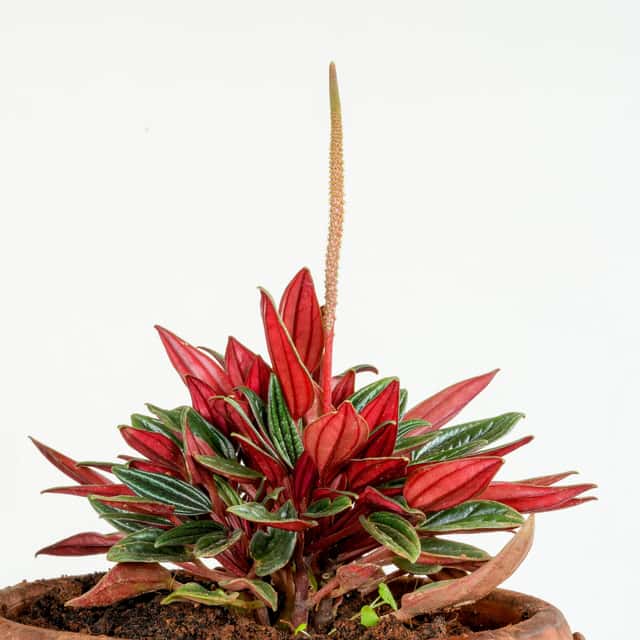
Peperomia Rosso (Peperomia caperata 'Rosso') is a easy-care plant from the Piperaceae family. Peperomia 'Rosso', sold as Peperomia caperata 'Rosso' or 'Eden Rosso', is a compact rosette-forming peperomia grown for its two-tone foliage. Its narrow, pointed leaves, about 5 cm long, are deeply puckered between the veins, dark glossy green on top and deep red underneath, on red leaf stalks, so t...
Peperomia Rosso grows up to 20cm, spread of 25cm, watering every 7 days, 18°C – 26°C, 40–60% humidity. It is suitable for indoor environments and safe for pets.
Unlike many tropical plants, Peperomia Rosso tolerates watering mistakes. Best for beginners. Unlike many popular species, Peperomia Rosso is safe to keep around pets. Without adequate drainage, root rot can develop within 14 days.
How to Care for Peperomia Rosso?
TLDR: Peperomia Rosso needs Partial shade, watering every 7 days, and temperatures between 18-26°C with 40-60% humidity.
How Often Should You Water Peperomia Rosso?
Water when the pot feels light and the top 2-3 cm of mix are dry; in practice about once a week in the growing season and every 2-3 weeks in winter. Water at the soil, not into the rosette, and empty the saucer. Overwatering is the main killer: limp stems, dropped lower leaves or small corky bumps under the leaves mean it is getting too much.
How Much Light Does Peperomia Rosso Need?
Bright, indirect light brings out the strongest red. A spot near an east window or behind a sheer curtain is ideal; it also does well under grow lights or office lighting. Strong direct sun can bleach or scorch the leaves, and too little light makes the rosette stretch and lose color.
What Is the Best Soil for Peperomia Rosso?
Use a light, airy potting mix that drains fast, such as houseplant mix with perlite, pumice or orchid bark. Its fine roots rot in dense, wet soil, so always use a pot with drainage holes.
What Pot Should You Use for Peperomia Rosso?
A small pot (8-12 cm) with drainage holes; terracotta helps the mix dry out between waterings.
Care Schedule
Fertilize
Every 30 days
Repot
Every 730 days
What Is Peperomia Rosso and Where Does It Come From?
Peperomia 'Rosso', sold as Peperomia caperata 'Rosso' or 'Eden Rosso', is a compact rosette-forming peperomia grown for its two-tone foliage. Its narrow, pointed leaves, about 5 cm long, are deeply puckered between the veins, dark glossy green on top and deep red underneath, on red leaf stalks, so the plant looks green from above and red from the side. It was bred in the Netherlands by Obed Smit and, according to its US plant patent, comes from a 2010 cross between Peperomia marmorata and Peperomia metallica, although the trade lists it under Peperomia caperata. It stays small (around 20 cm tall and 25 cm wide), grows slowly and is non-toxic to people, cats and dogs. In short days it sends up thin, upright spikes of tiny cream to yellow-green flowers.
How to Propagate Peperomia Rosso?
Leaf cutting
Keep the mix just barely moist; too much water rots leaf cuttings. A clear cover helps keep humidity up.
- 1 Cut a healthy, mature leaf with its stalk using clean scissors
- 2 Let the cut end dry for a few hours
- 3 Insert the stalk into moist, light propagation mix or place it in a little water
- 4 Keep warm (around 20 °C) and in bright indirect light
- 5 Pot it up once roots and a small new shoot appear
Materials needed:
Stem cutting
Commercial growers root it from cuttings at about 20 °C; warmth speeds things up.
- 1 Cut a short stem section with a few leaves from the rosette
- 2 Remove the lowest leaves
- 3 Insert into moist, well-draining mix or a glass of water
- 4 Keep warm and in bright indirect light until rooted
Materials needed:
How Big Does Peperomia Rosso Grow?
TLDR: Peperomia Rosso can reach up to 20cm tall with Slow growth rate.
Max height
20cm
Spread
25cm
Growth rate
Slow
Foliage
Evergreen
Plant Uses
Ornamental
Great for decoration
Is your plant showing symptoms?
Click on the symptom to discover possible causes:
What Diseases Commonly Affect Peperomia Rosso?
TLDR: Peperomia Rosso is susceptible to 13 known diseases. Monitor regularly for early detection.
Root Rot
Root rot is a serious fungal disease that affects the root system of plants, causing them to decay and die. It is primarily caused by overwatering, poor drainage, or soil-borne fungi such as Pythium, Phytophthora, Rhizoctonia, and Fusarium. The disease thrives in waterlogged conditions where roots are deprived of oxygen, making them susceptible to fungal infection.
Overwatering
Overwatering occurs when plants receive too much water, depriving roots of oxygen and causing root rot. This environmental stress is one of the most common causes of houseplant death, as waterlogged soil prevents roots from breathing and functioning properly.
Rhizoctonia solani
Rhizoctonia solani is a soil-borne fungus that attacks stems, roots, and young seedlings. It thrives in warm, humid weather and in soil that stays wet or drains poorly. Typical signs include seedlings collapsing at the soil line (damping-off), sunken brown lesions near the soil on stems, brown rotting roots, wilting even when the soil is moist, and slow, stunted growth. In lawns, it can cause the well-known “brown patch” during warm, humid periods. Many plants are at risk, including vegetables (such as lettuce, beans, and brassicas), ornamentals, houseplants, and turfgrass.
Mealybugs
Mealybugs are small, soft-bodied insects covered with a white, waxy, cottony material. They are common pests of houseplants and outdoor plants in mild climates. These sap-sucking insects feed on plant tissue, causing damage, stunted growth, and can lead to plant death if left untreated. They produce sticky honeydew which attracts sooty mold.
Fun Facts
Its US plant patent describes it as a cross between Peperomia marmorata and Peperomia metallica, made in the Netherlands in 2010.
The plant flowers in response to short days, when daylight is under 12 hours.
Seen from above it looks green; seen from the side it looks red, because the leaf undersides and stalks are red.
Frequently asked questions
Is Peperomia Rosso toxic to cats and dogs?
How often should I water Peperomia Rosso?
Why is my Peperomia Rosso losing its red color?
Is Peperomia Rosso the same as Peperomia caperata?
Compare with similar plants
| Attribute | Difficulty | Light | Watering | Pet Safe |
|---|---|---|---|---|
| Field Maple | Easy | Bright indirect | 14d | ✓ |
| Iberian Houseleek | Easy | Direct sun | 14d | ✓ |
| Silver Birch | Easy | Direct sun | 14d | ✓ |
| Common Blanketflower | Easy | Direct sun | 10d | ✓ |