Complete Plant Guide
Explore plants by difficulty, season and more. Find the perfect plant for you.
Difficulty
Categories
Plants by City
🗺️ Plants by City3728 plants found
Showing 3169-3204 of 3728
Saxifrage
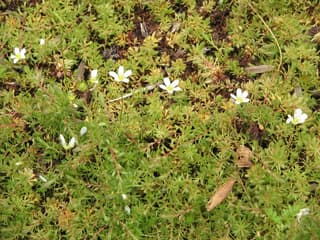
Saxifraga
Saxifraga is a large genus of roughly 440 species of low-growing, mat- or cushion-forming perennials native mainly to alpine and arctic regions of the Northern Hemisphere. Commonly called saxifrage or rockfoil, the name comes from the Latin for "stone-breaker," a nod to the way these tough little plants root into rock crevices. Species range from tiny alpine cushions to trailing houseplants like strawberry saxifrage.
creeping saxifrage
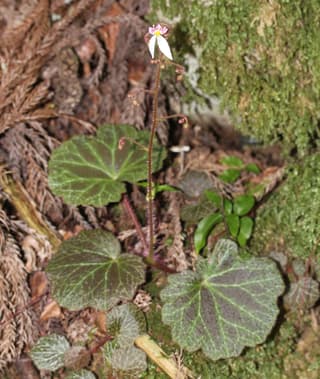
Saxifraga stolonifera
Saxifraga stolonifera, commonly known as Strawberry Begonia, is a charming perennial that spreads via long, slender red stolons similar to strawberry runners. It features rounded, hairy, dark green leaves with striking silver veins and maroon undersides. In spring, it produces airy panicles of delicate white flowers. Despite its common names, it is neither a begonia nor a geranium, but a member of the saxifrage family.
Mourning Bride
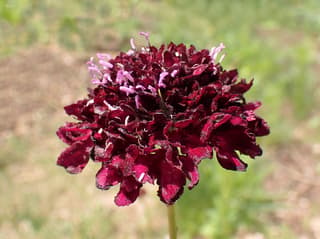
Scabiosa atropurpurea
Scabiosa atropurpurea, popularly known as Mourning Bride, is a charming herbaceous plant that produces globular flowers with prominent stamens resembling a pincushion. Its flowers are rich in nectar, making it a favorite in pollinator gardens to attract butterflies and bees. It features long, slender stems, ideal for cut flower arrangements, and very characteristic lobed basal foliage.
Pigeon Scabious
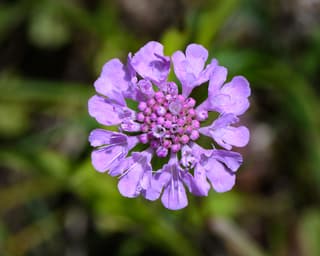
Scabiosa columbaria
Pigeon Scabious (Scabiosa columbaria) is a delicate perennial wild herbaceous plant from the honeysuckle family (Caprifoliaceae), native to Europe, West Asia, and North Africa. It forms finely feathered leaves and bears delicate, pincushion-like flower heads in purple, blue-violet, or pink from June to October. It thrives in calcareous, well-drained soils and is a valuable nectar source for bees, butterflies, and hoverflies. As a robust, drought-tolerant plant, it is excellently suited for natural gardens, rock gardens, gravel beds, and wildflower meadows.
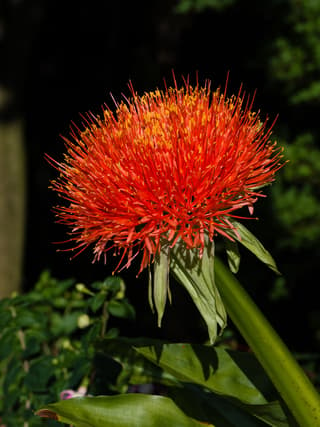
Fireball Lily
Scadoxus
Scadoxus is a small genus of bulbous perennials native to tropical and southern Africa, prized for dramatic globe-shaped flower heads made up of hundreds of tiny red florets with prominent yellow-tipped stamens, resembling a burst of fireworks or a paintbrush dipped in scarlet paint. Strap-shaped leaves emerge in a loose rosette from an underground bulb, and in several species the flowers appear on a bare stalk before the foliage unfurls. The plant dies back to the bulb during a dry dormant season, then re-emerges with fresh leaves and blooms the following year.
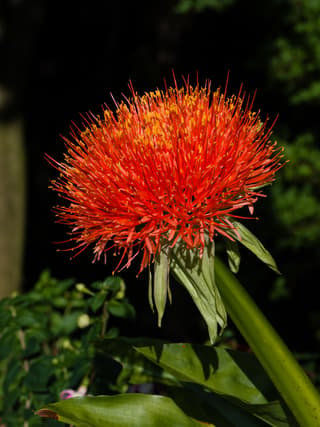
Blood Lily
Scadoxus multiflorus
The Blood Lily (Scadoxus multiflorus) is a spectacular bulbous plant native to sub-Saharan Africa, celebrated for its globe-shaped scarlet flower heads that can contain up to 200 individual blooms and reach 20 cm in diameter. It grows from a rhizomatous bulb, producing broad decorative leaves. The plant enters winter dormancy before putting on a striking floral display in spring and summer.
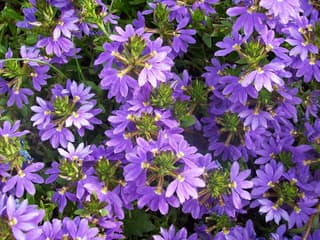
Fan Flower
Scaevola
Scaevola is a genus in the family Goodeniaceae, native to arid and semi-arid regions of Australia. The most widely cultivated species, Scaevola aemula, is a trailing, mounding plant popular in hanging baskets and containers, prized for its distinctive fan-shaped blue or purple flowers with petals arranged on one side.

Fan Flower
Scaevola aemula
Scaevola aemula, commonly known as Fan Flower or Fairy Fan Flower, is a cheerful Australian native perennial prized for its unique fan-shaped blooms. The flowers are arranged in a distinctive half-fan formation — a quirky feature that gives it its common name. Blooming prolifically from spring through summer, it produces masses of small purple, blue, or white flowers, making it a favourite for containers, hanging baskets, and garden borders. Native to the coastal regions of New South Wales and Victoria, it thrives in full sun and well-drained soils, and is remarkably tolerant of drought, heat, and salt spray.
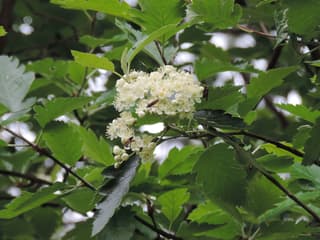
Swedish Whitebeam
Scandosorbus intermedia
Scandosorbus intermedia, commonly known as Swedish Whitebeam, is a medium-sized deciduous tree native to southern Scandinavia, the Baltic states, and parts of the UK. It is widely prized as an urban street tree for its exceptional tolerance of pollution, wind, and coastal exposure. In spring it bears clusters of white flowers, followed by ornamental orange-red berries in autumn that attract birds.
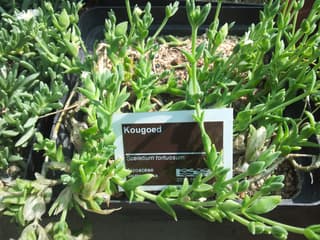
Kanna
Sceletium tortuosum
Kanna (Sceletium tortuosum) is a creeping, succulent plant with fleshy leaves native to the semi-desert, quartz-rich regions of South Africa. Its name (derived from the Greek 'skeletos', meaning skeleton) comes from the skeleton-like, veined patterns formed by dried leaves remaining on the stem. Its small, white, pale yellow, or pink flowers, measuring 20-30 mm in diameter, bloom in spring. Kanna is known in the centuries-old traditions of the Khoisan and San peoples as a mood-enhancing, calming plant, traditionally consumed by chewing or fermenting ('kougoed').
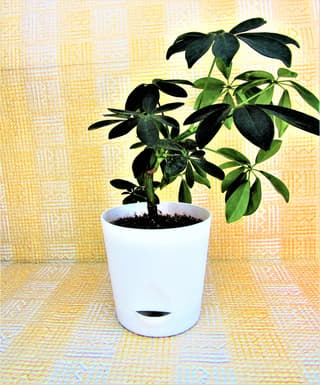
Umbrella Plant
Schefflera
Schefflera is a genus of about 600 evergreen shrubs, trees, and vines in the Araliaceae family, prized worldwide as a resilient houseplant. The most widely cultivated member, Schefflera arboricola (dwarf umbrella tree), produces glossy, palmately compound leaves arranged like the spokes of an umbrella, giving the plant its common name. Native to Taiwan and Hainan, it has become one of the most popular low-maintenance indoor foliage plants thanks to its tolerance of a wide range of light and humidity conditions.
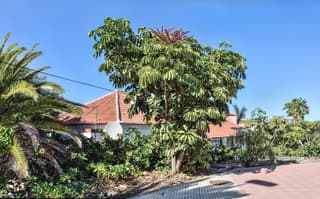
Queensland Umbrella Tree
Schefflera actinophylla
Schefflera actinophylla, commonly known as the Queensland Umbrella Tree or Australian Umbrella Tree, is a fast-growing tropical tree native to the rainforests of northern Queensland, Australia, New Guinea, and Java. Its large, glossy palmate leaves radiate from a central point like an umbrella, making it one of the most popular ornamental plants for both indoor and outdoor tropical landscapes.
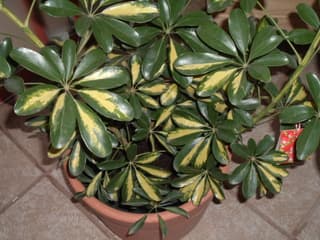
Dwarf Umbrella Tree
Schefflera arboricola
The Dwarf Umbrella Tree (Schefflera arboricola) is a versatile, attractive evergreen shrub native to Taiwan and Hainan, China. Known for its glossy, palmately compound leaves with 7-9 leaflets arranged like an umbrella, this resilient plant has become one of the most popular houseplants worldwide. It can grow as a small tree or shrub indoors and is valued for its tolerance of varying light conditions and ease of care.
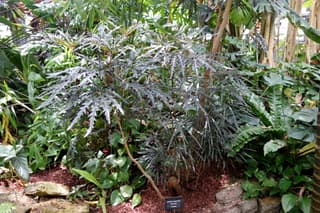
False Aralia
Schefflera elegantissima
False aralia (Schefflera elegantissima, syn. Dizygotheca elegantissima and Plerandra elegantissima) is a striking evergreen shrub from the Araliaceae family, native to New Caledonia in the South Pacific. It is prized as a houseplant for its dramatic, deeply serrated, coppery-bronze juvenile leaves that mature to a dark, glossy green with a leathery texture. Young plants have narrow, almost lacy leaflets arranged in a whorled, umbrella-like pattern, while mature specimens develop thicker leaflets and a woody, tree-like trunk that can reach 1.8-2.5 m indoors. False aralia has a reputation for being a bit temperamental compared to other Schefflera relatives, reacting quickly to drafts, sudden temperature swings, and inconsistent watering with leaf drop, so it rewards a stable spot and a steady care routine.

Peruvian peppertree
Schinus molle
Schinus molle, known in Italy as "false pepper" or "pink pepper," is a majestic evergreen tree native to the arid and semi-arid regions of Peru and the South American Andes. It can reach 15 meters in height, developing a broad, dense, and weeping canopy that gives it an unmistakable appearance, similar to a weeping willow. Its leaves are pinnate, very aromatic to the touch, composed of numerous bright green, lanceolate leaflets. In spring and summer, it produces small white or cream flowers gathered in pendulous panicles, followed in autumn by abundant clusters of pinkish-red berries — the so-called pink peppercorns — which are highly ornamental and used as a spice. Thanks to its extraordinary drought resistance and ability to adapt to poor and stony soils, it is widely used in Mediterranean landscaping, as street trees, and in parks. It was considered sacred by pre-Columbian Peruvian populations, who used it in religious rituals and traditional medicine.

Brazilian Pepper Tree
Schinus terebinthifolius
The Brazilian pepper tree (Schinus terebinthifolius) is a native tree from Brazil belonging to the Anacardiaceae family, related to poison ivy and sumac. It is widely recognized for its clusters of bright red aromatic berries, known commercially as pink pepper, used as a gourmet spice worldwide. This evergreen tree can reach up to 10 meters in height and is cultivated as an ornamental plant in warm climates, though it is considered invasive in parts of the United States.
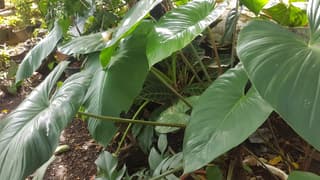
Schismatoglottis
Schismatoglottis calyptrata
Schismatoglottis calyptrata is a perennial, stoloniferous herb from the Araceae family, native to Southern China and Southeast Asia, extending to Vanuatu and the Pacific. It grows in the understory of humid tropical rainforests, on rocks and forest floors, reaching between 15 and 60 cm in height, with cordate to sagittate leaves up to 35 cm that sometimes display silver variegation. Its inflorescence consists of a spathe that ranges from green at the base to a cream or pale greenish-yellow hue when flowering, covering a spadix with unisexual flowers.
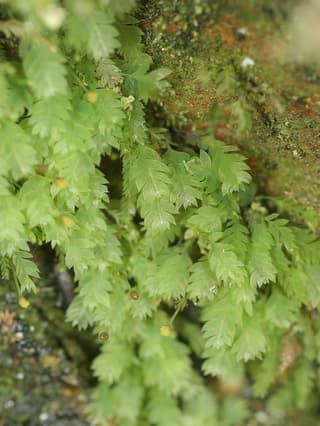
Luminous moss
Schistostega pennata
Schistostega pennata is a unique and fascinating moss from the Schistostegaceae family. This bryophyte is famous for its luminescent property: in low-light conditions, its protonema emits a soft golden-green glow. This occurs because specialized spherical cells in the protonema act as biological lenses, concentrating weak light onto the chloroplasts. The plant is small, with gametophytes of only 1.5 cm, featuring opposite leaves with a simple structure. It is native to temperate regions of the Northern Hemisphere (Europe, Asia, and North America).
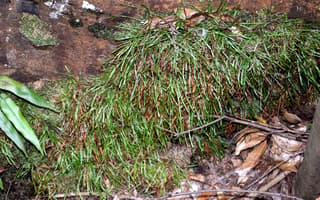
Comb Fern (genus)
Schizaea
Schizaea is a genus of primitive ferns in the family Schizaeaceae, characterized by grass-like sterile fronds and distinctive comb-shaped fertile segments. Native to tropical and subtropical humid regions worldwide, they are rarely seen outside specialist collections and greenhouses.
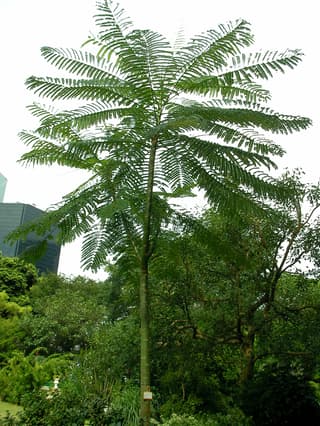
Brazilian Firetree
Schizolobium parahyba
The Brazilian firetree (Schizolobium parahyba) is a tree native to the Atlantic Forest of Brazil, belonging to the Fabaceae family. It is renowned for its extremely fast growth, reaching great heights within a few years. It is deciduous, shedding its leaves in winter and flowering profusely with vibrant yellow blossoms in spring, before or during the emergence of new leaves.
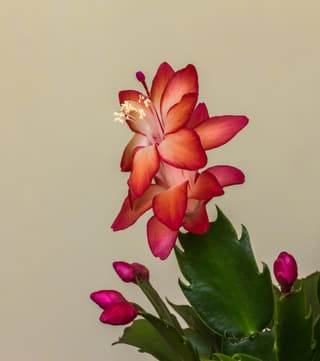
Christmas Cactus
Schlumbergera
Schlumbergera is an epiphytic cactus native to the humid coastal rainforests of southeastern Brazil, where it grows on tree branches and rock crevices in dappled shade. Unlike desert cacti, its flattened, segmented stems (cladodes) store some water but need humidity and indirect light to thrive. Grown worldwide as a popular houseplant, it produces showy tubular flowers in red, pink, white, orange, and purple during fall and winter.
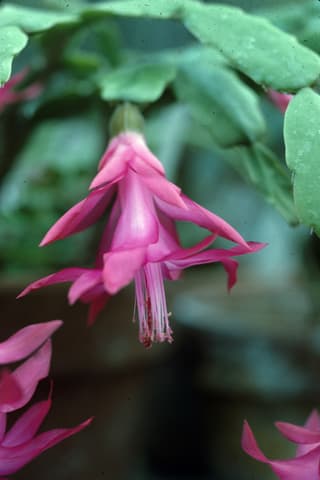
Christmas Cactus
Schlumbergera × buckleyi
Schlumbergera × buckleyi, the true Christmas Cactus, is a hybrid epiphytic cactus that originates from the crossing of S. truncata and S. russelliana, native to the cloud forests of Brazil. Unlike the more common Thanksgiving Cactus (S. truncata), it bears smooth, rounded stem segments and blooms reliably in late December, making it one of the most beloved winter-flowering houseplants in the world. Its tubular, drooping flowers range from pink and red to white and purple, and the plant can live for decades with proper care.
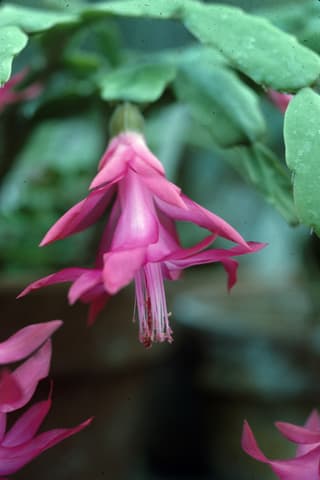
Christmas Cactus
Schlumbergera buckleyi
The Christmas Cactus (Schlumbergera buckleyi) is a tropical epiphytic cactus native to the cloud forests of southeastern Brazil. Unlike desert cacti, it thrives in humid conditions with bright indirect light, producing spectacular tubular flowers in shades of pink, red, white, purple, and coral during winter. It is one of the most beloved holiday houseplants worldwide, celebrated for blooming around Christmas.
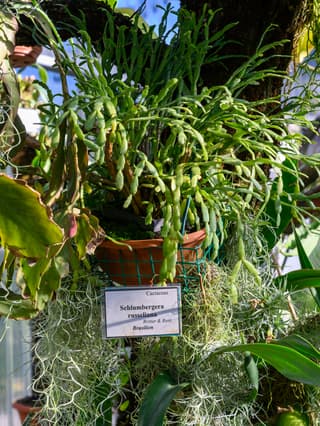
Christmas Cactus
Schlumbergera russelliana
Schlumbergera russelliana, commonly known as Christmas Cactus, is an epiphytic cactus native to the Brazilian Atlantic Forest. It is the ancestral species of garden Christmas cactus hybrids, producing tubular flowers in shades of pink, red, and purple during winter. It naturally grows on trees and rocks in filtered light and moderate humidity typical of tropical rainforests.
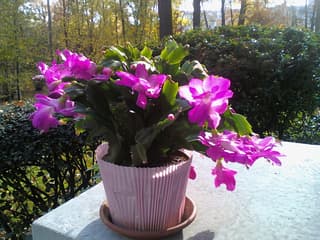
Thanksgiving Cactus
Schlumbergera truncata
The Thanksgiving Cactus is an epiphytic succulent native to the humid Atlantic Forest of southeastern Brazil, particularly found in the mountains of Rio de Janeiro state. Its flattened, pendulous stems produce spectacular tubular flowers in shades of pink, red, white, orange, and purple during fall and winter. It is highly valued as an ornamental plant for its beauty and ease of cultivation.
Schwantesia
Schwantesia pillansii
Schwantesia pillansii is a compact, dwarf succulent of the ice plant family (Aizoaceae) from the arid regions of South Africa and Namibia. It forms low tufts of pairs of opposite, boat-shaped, fleshy leaves that are erect to spreading. Like other Schwantesia species it is a winter grower that rests through the hot summer.
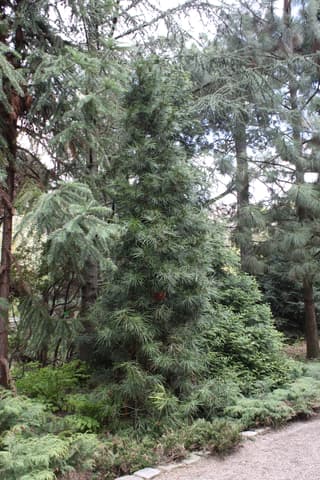
Japanese umbrella pine
Sciadopitys verticillata
The Japanese umbrella pine (Sciadopitys verticillata) is the only living species in the Sciadopityaceae family—a true "living fossil," as its closest relatives are known only from fossil records. Endemic to Japan, it is native to the mountain forests of Shikoku, Kyushu, and the Kii Peninsula, typically growing at altitudes of 700–1400 meters on rocky slopes and in river gorges. Its most distinctive feature is the umbrella-like whorls of flattened, 4–14 cm long needle-like structures (cladodes) at the tips of the shoots, from which its common name is derived. It is an extremely slow-growing evergreen tree: in its homeland, centuries-old specimens can reach 30–40 meters in height, while in garden cultivation, it may only reach a few meters even after several decades.
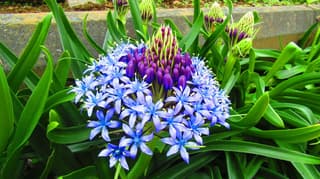
Portuguese Squill
Scilla peruviana
Despite its name, Scilla peruviana is not native to Peru; it is indigenous to the western Mediterranean, found in Portugal, Spain, Italy, and North Africa. It is a perennial bulbous plant that forms a basal rosette of long, dark green, lance-shaped, semi-evergreen leaves. In spring and early summer, it produces a spectacular pyramid-shaped inflorescence (a dense conical raceme), gathering between 50 and 100 small star-shaped flowers in shades of deep violet-blue (white varieties also exist). After flowering, the bulb enters a short period of dry dormancy during the summer.
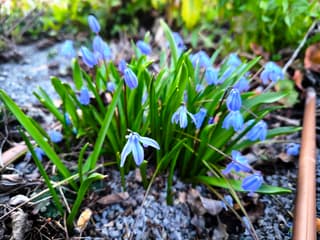
Siberian squill
Scilla siberica
The Siberian squill (Scilla siberica) is a low-growing, bulbous perennial from the Asparagaceae family that begins blooming in early spring, often immediately after the snow melts. Despite its name, it does not originate from Siberia, but from southern Russia, the Caucasus, and Turkey. On 10-15 cm tall stems, 2-5 nodding, star-shaped, bright blue (rarely white) flowers bloom, forming a dense, picturesque carpet under trees and shrubs within a few weeks. It is an undemanding, frost-hardy plant that reproduces through self-seeding and bulb division, creating large, naturalized patches over a few years. It is important to know that its bulb and all green parts contain cardiac glycosides, making it toxic and potentially irritating to the skin—keep away from pets and children.
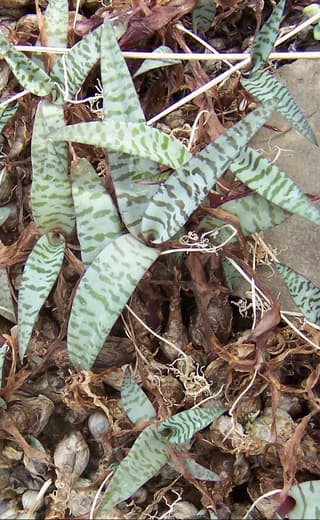
Silver Squill
Scilla violacea
Silver Squill (Ledebouria socialis), also known as Scilla violacea, is an evergreen bulbous plant belonging to the Asparagaceae family, native to the Eastern Cape Province of South Africa. Its fleshy, lance-shaped leaves display an olive-green to silvery-gray color marbled with dark green spots, and a distinctive purple underside. The small bulbs, partly exposed above the soil, multiply into dense colonies over time. In spring and summer, slender pink flower stalks bear discreet greenish-white flowers with purple stamens.
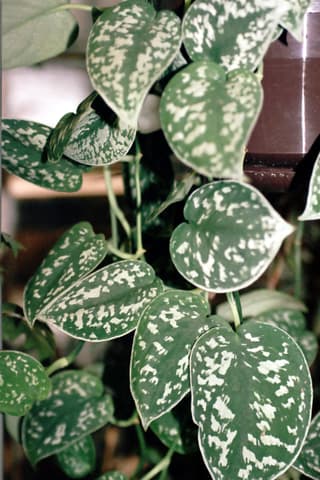
Satin Pothos
Scindapsus pictus
Scindapsus pictus, commonly known as Satin Pothos, is a stunning tropical vine native to Southeast Asia. It features heart-shaped matte green leaves adorned with silvery-gray spots and splashes that give it a satin-like appearance. This elegant trailing plant is beloved for its easy-care nature and ability to thrive in various indoor conditions, making it perfect for hanging baskets or climbing on supports.
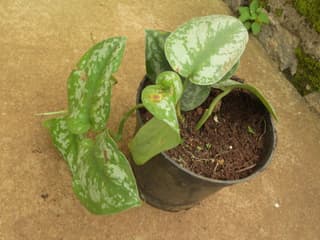
Silver Satin Pothos
Scindapsus pictus 'Argyraeus'
The Silver Satin Pothos (Scindapsus pictus 'Argyraeus') is a trailing vine in the Araceae family, native to Southeast Asia. It is prized for its heart-shaped, dark green leaves splashed with iridescent silver variegation. One of the easiest houseplants to grow, it tolerates lower light and irregular watering better than most aroids.
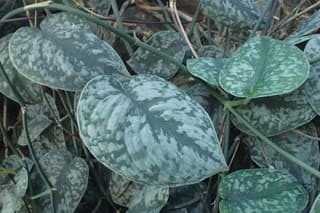
Silver Satin Pothos 'Exotica'
Scindapsus pictus 'Exotica'
Scindapsus pictus 'Exotica' is a cultivated variety of satin pothos native to the tropical rainforests of Southeast Asia. Its heart-shaped, dark green leaves are covered in irregular, shimmering silver patches that are more concentrated than on the standard species. A trailing or climbing vine, it is ideal for hanging baskets or moss poles and is one of the hardiest, easiest aroids to grow indoors.
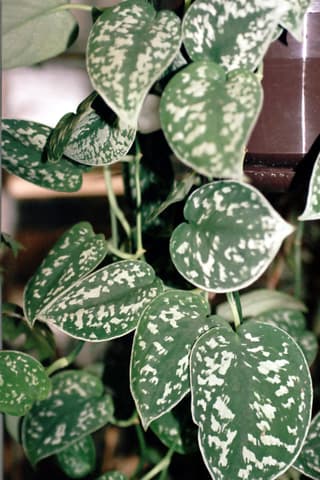
Satin Pothos
Scindapsus pictus argyraeus
Scindapsus pictus 'Argyraeus', commonly known as Satin Pothos or Silver Pothos, is a stunning trailing vine native to Southeast Asia. It features heart-shaped, dark green leaves adorned with silver-white satin markings that shimmer in the light. Despite the name "pothos," it belongs to the genus Scindapsus and the Araceae family. It is highly popular as an indoor plant due to its low maintenance requirements and its ability to thrive in moderate to low light conditions.

Sterling Silver Scindapsus
Scindapsus treubii
Scindapsus treubii, commonly known as Sterling Silver Scindapsus or Moonlight Scindapsus, is a stunning tropical aroid native to the rainforests of Southeast Asia. It is celebrated for its thick, waxy leaves adorned with a distinctive silvery-green sheen that shimmers under light. Two main cultivars are popular among collectors: 'Moonlight', which boasts brighter silver variegation, and 'Dark Form', with deeper, darker foliage. As a slow-growing climber, it rewards patient gardeners with breathtaking leaves that become more striking as the plant matures.
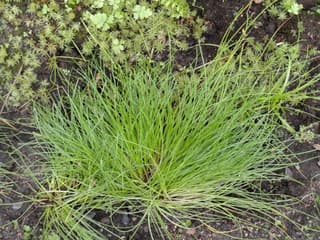
Fiber optic grass
Scirpus cernuus
Scirpus cernuus (also classified as Isolepis cernua), commonly known as fiber optic grass, is a small, tufted sedge in the Cyperaceae family that forms a dense, mounding clump of thread-thin, hair-like green stems reaching 20-30 cm tall and spreading up to 50 cm. Each stem nods slightly and is tipped with a tiny silver-white flower head that matures to tan or brown, giving the whole plant the look of a miniature fiber optic lamp. In the wild it grows in boggy ground, pond margins, dune slacks, and other consistently damp or brackish sites across Australasia, Eurasia, Africa, and the Americas, which is why it is grown as a container, houseplant, or marginal water-garden plant that never wants to dry out.
Find the Perfect Plant
Our plant guide helps you find ideal species for your experience level and time of year.
Browse by Difficulty, Season & More
Use the filters below to narrow this catalog by care difficulty, season, environment, or search directly by name. Each filter leads to a focused list tailored to your specific growing conditions.