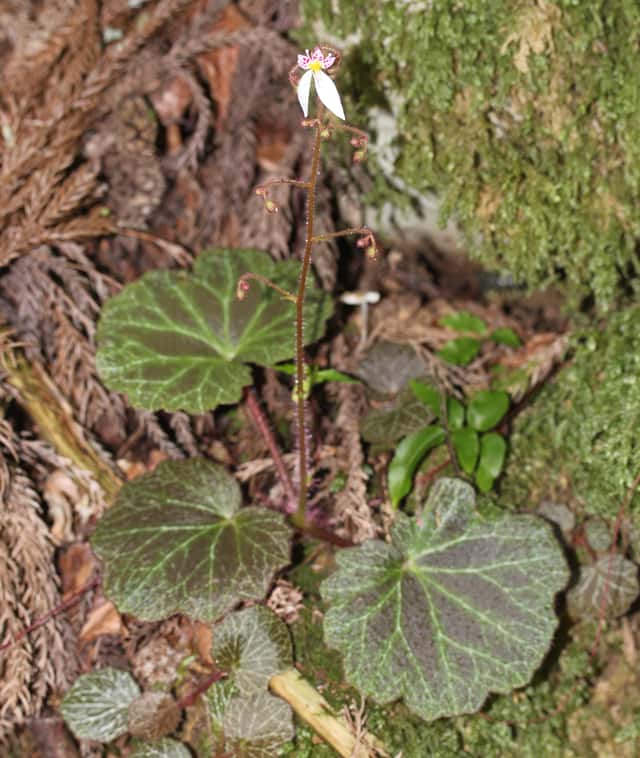
Saxifragaceae
creeping saxifrage: Ground Cover Plant
Saxifraga stolonifera
Thrives in cool, humid environments with bright indirect light. Keep soil consistently moist but well-drained, and avoid wetting the foliage to prevent rot.
Every 7 days
Partial shade
10° - 24°C
45% - 60%
Categories
What is creeping saxifrage?
creeping saxifrage (Saxifraga stolonifera) is a easy-care plant from the Saxifragaceae family. Saxifraga stolonifera, commonly known as Strawberry Begonia, is a charming perennial that spreads via long, slender red stolons similar to strawberry runners. It features rounded, hairy, dark green leaves with striking silver veins and maroon undersides. In spring, it produces airy panicles of delic...
creeping saxifrage grows up to 45cm, spread of 60cm, watering every 7 days, 10°C – 24°C, 45–60% humidity. It is suitable for indoor environments and safe for pets.
Unlike many tropical plants, creeping saxifrage tolerates watering mistakes. Best for beginners. Unlike many popular species, creeping saxifrage is safe to keep around pets. Without adequate drainage, root rot can develop within 14 days.
How to Care for creeping saxifrage?
TLDR: creeping saxifrage needs Partial shade, watering every 7 days, and temperatures between 10-24°C with 45-60% humidity.
How Often Should You Water creeping saxifrage?
Water when the top inch of soil feels dry. Use a long-necked watering can to apply water directly to the soil, avoiding the hairy leaves which are prone to fungal issues.
How Much Light Does creeping saxifrage Need?
Prefers bright, filtered light. Direct hot afternoon sun can scorch the leaves, while too little light will cause the silver variegation to fade.
What Is the Best Soil for creeping saxifrage?
Use a rich, loamy potting mix that retains moisture but allows excess water to drain away quickly.
What Pot Should You Use for creeping saxifrage?
Hanging baskets are excellent for allowing the runners to cascade, or shallow wide pots to encourage ground-cover growth.
Care Schedule
Fertilize
Every 14 days
Misting
Every 14 days
Repot
Every 730 days
What Is creeping saxifrage and Where Does It Come From?
Saxifraga stolonifera, commonly known as Strawberry Begonia, is a charming perennial that spreads via long, slender red stolons similar to strawberry runners. It features rounded, hairy, dark green leaves with striking silver veins and maroon undersides. In spring, it produces airy panicles of delicate white flowers. Despite its common names, it is neither a begonia nor a geranium, but a member of the saxifrage family.
How to Propagate creeping saxifrage?
Runner Propagation
- Keep the soil of the new plantlet consistently moist during the rooting phase
- Use a small U-shaped wire or paperclip to hold the plantlet in contact with the soil
- 1 Select Plantlet
Identify a healthy miniature plantlet forming at the end of a runner.
- 2 Pin to Soil
Place the plantlet on top of moist potting soil in a small pot, keeping it attached to the parent plant.
- 3 Sever Runner
Once the plantlet has developed its own root system, snip the connecting runner from the parent.
Materials needed:
How Big Does creeping saxifrage Grow?
TLDR: creeping saxifrage can reach up to 45cm tall with Medium growth rate.
Max height
45cm
Spread
60cm
Growth rate
Medium
Foliage
Evergreen
Plant Uses
Ornamental
Great for decoration
Ground Cover
Soil coverage
Medicinal Uses
- Used in traditional herbal medicine for treating earaches
- Applied topically to soothe skin inflammations and minor burns
Culinary Uses
- Leaves are used in Japanese cuisine as tempura
- Fresh leaves can be used in salads or as a garnish
Is your plant showing symptoms?
Click on the symptom to discover possible causes:
What Diseases Commonly Affect creeping saxifrage?
TLDR: creeping saxifrage is susceptible to 10 known diseases. Monitor regularly for early detection.
Root Rot
Root rot is a serious fungal disease that affects the root system of plants, causing them to decay and die. It is primarily caused by overwatering, poor drainage, or soil-borne fungi such as Pythium, Phytophthora, Rhizoctonia, and Fusarium. The disease thrives in waterlogged conditions where roots are deprived of oxygen, making them susceptible to fungal infection.
Crown Rot
Crown rot is a serious fungal disease that attacks the crown (base) of the plant where the stem meets the soil. It is caused by various fungal pathogens including Phytophthora, Fusarium, and Rhizoctonia. The disease thrives in waterlogged conditions and can quickly spread to kill the entire plant if not addressed promptly.
Spider Mites
Spider mites are tiny arachnids (less than 1/20 inch long) related to spiders and ticks that feed on plant sap. They thrive in hot, dry conditions and can cause significant damage to ornamental and vegetable plants. During severe infestations, crop losses can reach 14% or higher as these pests disrupt vital plant processes including photosynthesis, carbon dioxide absorption, and transpiration.
Aphids
Aphids are small, soft-bodied, pear-shaped insects (1/16 to 1/8 inch long) that feed by sucking nutrient-rich sap from plants. They reproduce rapidly and can quickly weaken plants, causing distorted growth and transmitting plant viruses. Aphids come in various colors including green, black, red, yellow, brown, and gray. They secrete honeydew, a sticky substance that attracts ants and encourages sooty mold growth.
Meaning & Symbolism
Represents endurance, persistent love, and the ability to find beauty in rocky or shaded places.
Compare with similar plants
| Attribute | Difficulty | Light | Watering | Pet Safe |
|---|---|---|---|---|
| Field Maple | Easy | Bright indirect | 14d | ✓ |
| Silver Birch | Easy | Direct sun | 14d | ✓ |
| Common Blanketflower | Easy | Direct sun | 10d | ✓ |
| Cushion Bush | Easy | Direct sun | 14d | ✓ |





