Complete Plant Guide
Explore plants by difficulty, season and more. Find the perfect plant for you.
Difficulty
Categories
Plants by City
🗺️ Plants by City3783 plants found
Showing 1441-1476 of 3783
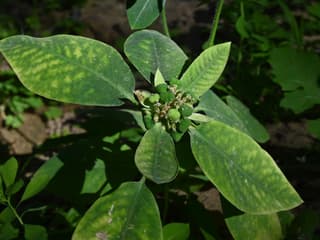
Mexican Fireplant
Euphorbia heterophylla
Euphorbia heterophylla, commonly known as Mexican fireplant or wild poinsettia, is a herbaceous annual or short-lived perennial in the family Euphorbiaceae. Native to tropical and subtropical Americas, it grows 30–100 cm tall with variably shaped leaves and upper bracts that turn bright red or white, giving it a striking ornamental appearance similar to the cultivated poinsettia. It produces a milky white latex sap that is a skin irritant and toxic if ingested, causing dermatitis and potentially anaphylaxis in latex-sensitive individuals. The plant flowers rapidly — within 30 days of emergence — and seeds mature in another 25–30 days, making it highly prolific. It is widely naturalized across the tropics and considered an invasive agricultural weed in parts of Asia.
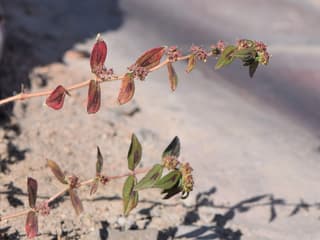
Asthma-plant
Euphorbia hirta
Euphorbia hirta, commonly known as the Asthma-plant, is a pantropical annual herb. It is characterized by its hairy, reddish stems and opposite, elliptical leaves with serrated edges. The plant contains a milky white latex that is typical of the Euphorbia genus. It is widely known for its presence in traditional medicine, particularly for respiratory and gastrointestinal ailments, though it is often considered a weed in agricultural settings.
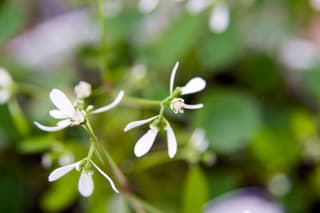
Diamond Frost Euphorbia
Euphorbia hypericifolia
Diamond Frost Euphorbia (Euphorbia hypericifolia) is a tender ornamental annual prized for its delicate white bracts that create an airy, cloud-like effect. Native to tropical Americas from Mexico to South America, it belongs to the Euphorbiaceae family. The milky sap is toxic and can irritate skin, eyes, and mucous membranes. Widely used in containers, hanging baskets, and garden borders for its non-stop blooming from spring until frost.
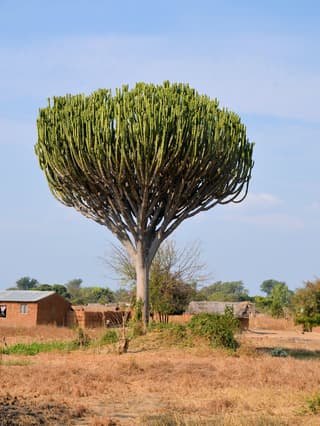
Candelabra Tree
Euphorbia ingens
Euphorbia ingens, commonly known as the Candelabra Tree, is a striking succulent tree native to southern Africa. In its natural habitat it can grow over 12 meters tall, with upright green columnar branches arranged like a giant candelabra. It is widely cultivated as an ornamental plant in tropical and subtropical gardens and is increasingly popular as a large indoor specimen. WARNING: the milky white sap is severely toxic to humans, cats, and dogs — always handle with thick gloves and eye protection.
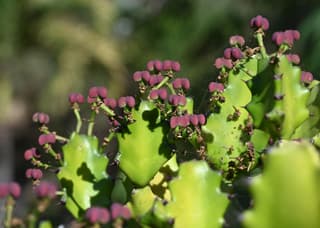
Mottled Spurge
Euphorbia lactea
Euphorbia lactea is a succulent shrub native to India and Southeast Asia. Its angular candelabra-like stems display distinctive silver-white zigzag markings, making it a striking ornamental plant. It exudes a milky white latex sap that is severely toxic on contact.
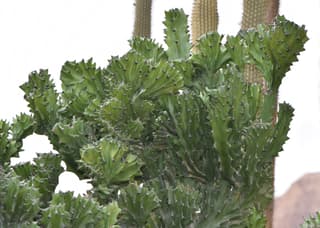
Coral Cactus
Euphorbia lactea 'Cristata'
Euphorbia lactea 'Cristata', commonly called Coral Cactus, is a crested cultivar of the milk-striped euphorbia. It is typically sold grafted onto a Euphorbia neriifolia rootstock, producing a fan-like, wavy crest that resembles coral or brain coral, making it a striking sculptural houseplant.

Caper spurge
Euphorbia lathyris
Euphorbia lathyris is an erect biennial in the Euphorbiaceae, native to Asia and widely naturalised in temperate regions. It forms a rosette in its first year and a stem up to 1.5 m tall in its second, clothed in blue-green, lance-shaped leaves arranged in tidy opposite ranks with a pale midrib. Small green to yellow-green flowers without petals appear from spring into early summer, followed by rounded seed capsules that resemble capers. It is architectural and tolerates poor, dry soils, but every part, especially the milky latex, is toxic and irritant. It is reputed to repel moles, though this is unproven. It self-seeds freely and can become weedy.
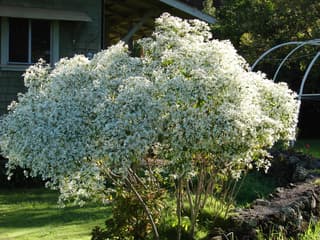
Snow bush
Euphorbia leucocephala
Euphorbia leucocephala is a deciduous, fast-growing shrub or small tree from Mexico and Mesoamerica, prized for the cloud of small white bracts that cover its branches in winter, resembling snow or lace. Like other spurges, it exudes a milky latex sap that is an irritant to skin and eyes and toxic if ingested.
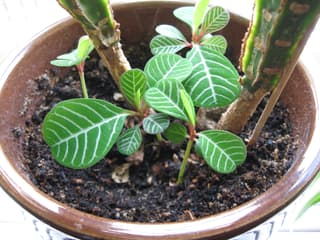
Madagascar Jewel
Euphorbia leuconeura
Euphorbia leuconeura, commonly known as Madagascar Jewel, is a striking semi-succulent houseplant native to Madagascar. It features an upright, angular stem with attractive white-veined leaves that give it an exotic appearance. As a member of the Euphorbiaceae family, it produces a toxic milky sap and can explosively disperse its seeds several metres away — a remarkable adaptation known as ballochory.
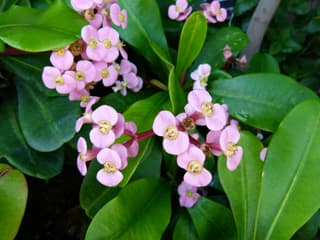
Madagascar Euphorbia
Euphorbia lophogona
Euphorbia lophogona is a succulent shrub native to Madagascar. It features erect, spiny stems and produces small yellowish flowers with white to pink bracts in summer. It exudes a highly toxic milky latex when cut, requiring careful handling.
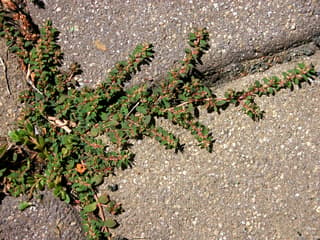
Spotted spurge
Euphorbia maculata
Euphorbia maculata is a low-growing, mat-forming annual weed native to North America and now naturalized worldwide. Its small, opposite leaves are marked with a distinctive maroon-purple central spot, and the trailing reddish stems exude a milky, irritant latex when broken. Tiny greenish-white to pink cup-shaped flowers appear from summer into early fall, followed by hairy seed capsules that enable rapid self-seeding.
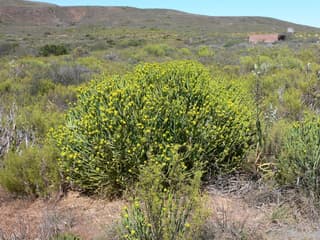
Yellow Milkbush
Euphorbia mauritanica
Euphorbia mauritanica is a spineless, much-branched succulent shrub native to the Succulent Karoo of South Africa and Namibia, where it is one of the most widespread shrubby euphorbias. It grows upright, pencil-thin, yellowish-green cylindrical stems from a woody base, reaching up to 1.5 m tall. Small, bright yellow flower clusters (cyathia) appear at the branch tips from late winter into spring. All parts contain a milky latex sap that is irritant and toxic if it contacts skin or eyes, or if ingested.
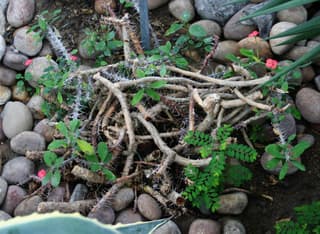
Crown of Thorns
Euphorbia milii
Euphorbia milii is a striking thorny succulent shrub native to Madagascar, prized for its colorful bracts that bloom nearly year-round. Despite its fierce thorns, it is one of the easiest flowering houseplants to grow, thriving on bright light and minimal water. The showy red, pink, white, or yellow bracts surround tiny true flowers, creating a vibrant display even in the driest conditions.
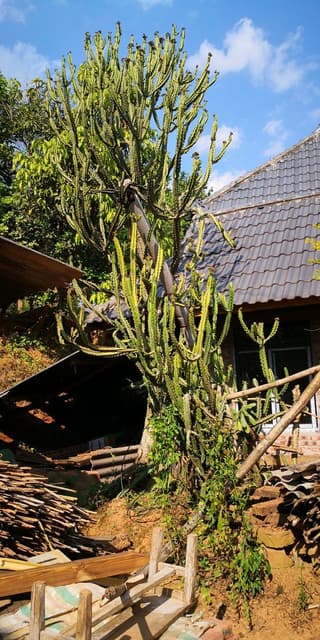
Indian Spurge Tree
Euphorbia neriifolia
Euphorbia neriifolia, commonly known as the Indian spurge tree, is a large, cactus-like succulent shrub or small tree native to India and naturalized across Southeast Asia. Its thick, pentagonal, spiny branches store water for long periods of drought, while its milky latex, used historically in traditional medicine, is toxic and irritating on contact. It produces small clusters of yellow-green flowers with bright red bracts and is popularly grown as an ornamental hedge or living fence.
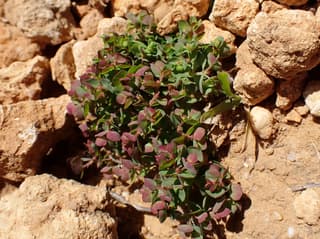
Petty Spurge
Euphorbia peplus
Euphorbia peplus, commonly known as petty spurge, is a small annual herbaceous plant in the Euphorbiaceae family, native to Europe and western Asia. It grows 10-40 cm tall with slender stems and alternate oval leaves. Small greenish-yellow flowers appear at the branch tips. The plant is well known for its toxic milky latex sap, historically used in folk medicine for skin ailments.
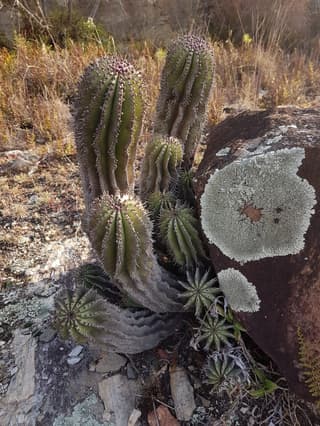
Snowflake Euphorbia
Euphorbia polygona
Euphorbia polygona is a slow-growing columnar succulent from South Africa with ribbed, blue-green to grey stems edged in tidy rows of dark spines; the popular 'Snowflake' form is dusted powdery white. Small purple flowers line the ridges in summer. It makes an architectural, sculptural feature plant for bright spots.

Poinsettia
Euphorbia pulcherrima
Euphorbia pulcherrima, commonly known as the poinsettia, is a tropical shrub native to Mexico and Central America. Celebrated for its vibrant colored bracts that appear in winter, it is the quintessential Christmas plant worldwide. It can grow up to 2 meters tall when planted outdoors in warm climates.
Dwarf Medusa's Head
Euphorbia ramiglans
Euphorbia ramiglans is a dwarf medusoid succulent native to the arid, winter-rainfall coastal regions of South Africa (Western and Northern Cape). It forms a central "head" from which dozens of thin, spineless, sinuous branches radiate outward, resembling the snake hair of the Gorgon Medusa from Greek mythology. It is closely related to Euphorbia caput-medusae and is treated by some authorities as its dwarf variety (var. confluens). Like all Euphorbias, it exudes a toxic milky latex when a branch is cut or damaged.
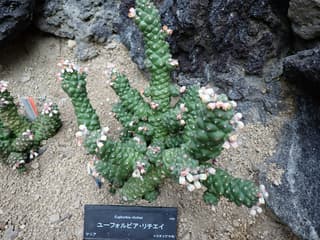
Ritchie's Euphorbia
Euphorbia ritchiei
Euphorbia ritchiei, formerly known as Monadenium ritchiei, is a striking succulent native to Kenya. It features thick, fleshy, spine-covered stems and circular green leaves. In spring, it produces beautiful bright pink to red cyathia (false flowers). Like all euphorbias, it exudes a toxic milky latex when damaged that should be handled with care.
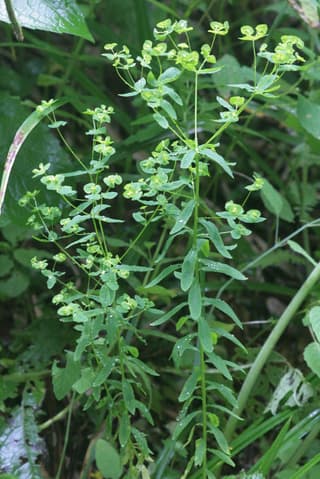
Upright Spurge
Euphorbia stricta
Upright Spurge is a bushy, self-seeding member of the Euphorbiaceae native to Europe and southwest Asia. Slender, branching stems carry spear-shaped, pale to yellowish-green leaves and are topped from June to September by clusters of small greenish-yellow flowers. Like all spurges, its stems ooze a milky, irritant latex when cut, so gloves are recommended when handling it. It thrives as an easy-going garden plant, tolerating a wide range of soils and both sun and part shade.
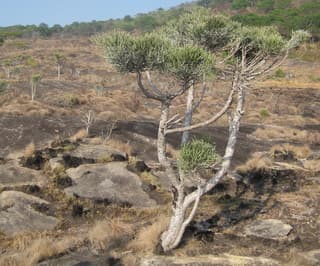
Pencil Cactus
Euphorbia tirucalli
Euphorbia tirucalli, commonly known as Pencil Cactus or Pencil Tree, is a striking succulent shrub native to tropical and subtropical Africa. Despite its common name, it is not a true cactus but belongs to the Euphorbiaceae family. It produces dense clusters of cylindrical, pencil-thin green stems that turn brilliant orange-red in cooler temperatures or high light conditions — a cultivar known as Firesticks. The plant produces a highly caustic white latex sap that is one of the most dangerous among houseplants, capable of causing severe chemical burns and temporary blindness on eye contact.
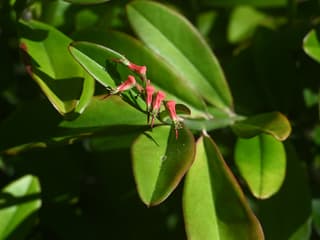
Devil's Backbone
Euphorbia tithymaloides
Devil's Backbone (Euphorbia tithymaloides) is a succulent shrub native to Tropical Americas, prized for its striking zigzag stems and colorful foliage. Easy to grow and drought-tolerant, it thrives in bright light with minimal watering. Its milky white latex sap is toxic and irritating to skin — always handle with gloves.
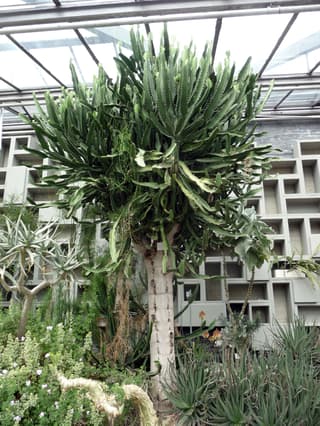
Chandelier Tree
Euphorbia triangularis
Euphorbia triangularis is a tree-like succulent native to South Africa, distinguished by its triangular central stem and chandelier-like branching. It grows slowly but can reach several meters tall in warm climates.
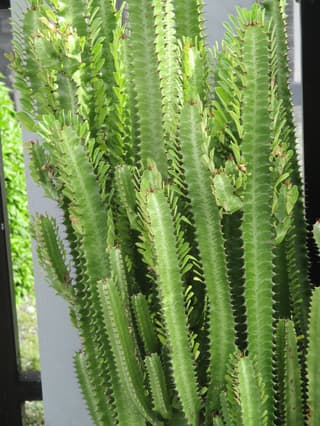
African Milk Tree
Euphorbia trigona
The African Milk Tree is a striking succulent native to Central Africa, featuring tall, columnar stems with ridges lined with small leaves and thorns. Despite its cactus-like appearance, it belongs to the Euphorbia family. This architectural plant can grow up to 2.7 meters tall indoors and makes a dramatic statement in any space. The plant produces a toxic milky white sap when damaged, so handle with care.
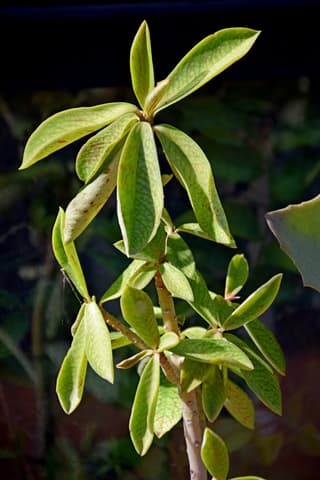
African Milk Bush
Euphorbia umbellata
Euphorbia umbellata, commonly known as the African Milk Bush, is a fast-growing, semi-succulent evergreen shrub or small tree in the family Euphorbiaceae, native to eastern and southern Africa. In cultivation it typically reaches 3–5 metres in height, though specimens in their natural habitat can exceed 10 metres. The plant features thick, fleshy green stems and large, dark green, oval leaves with prominent veins arranged oppositely on the branches. When any part of the plant is cut or damaged, it exudes a white milky latex that is severely toxic and highly irritating to skin, eyes, and mucous membranes. Small dark red to maroon flowers appear in winter, clustered in the cyathia typical of Euphorbia species. This species is widely cultivated as an ornamental in tropical and subtropical gardens worldwide, and in Brazil (where it is known as "leitosinha" or "janaúba") it holds additional cultural significance as a folk medicinal plant.
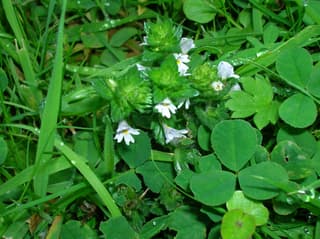
Eyebright
Euphrasia officinalis
Eyebright (Euphrasia officinalis) is a small, annual meadow plant from the broomrape family (Orobanchaceae). It is a hemiparasite: its roots form haustoria that attach to the roots of nearby grasses and sedges to extract water and nutrients, although the plant also photosynthesizes on its own. The plant grows 10–30 cm tall, with opposite, oval, and serrated leaves. Small white flowers with violet stripes and a yellow spot on the lower lip bloom from July to September. Eyebright grows in meadows, pastures, and roadsides, and has declined significantly in Finland due to the reduction of traditional mowing and grazing practices.
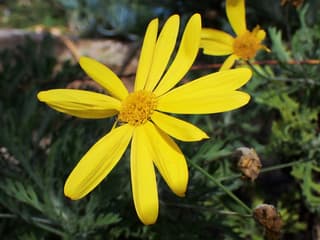
Gray-leaved Euryops
Euryops pectinatus
Gray-leaved Euryops (Euryops pectinatus) is an evergreen shrub native to South Africa, belonging to the Asteraceae family. It is prized for its silvery-gray aromatic foliage and vivid bright-yellow daisy-like flowers, which bloom almost year-round in mild climates. The plant forms a rounded mound 90–180 cm tall and wide, making it ideal for borders, slopes, and coastal gardens.
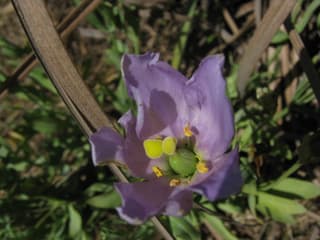
Lisianthus
Eustoma grandiflorum
Lisianthus (Eustoma grandiflorum) is a stunning flowering plant native to the southern Great Plains of North America, including southern USA and Mexico. Its rose-like blooms come in shades of white, pink, purple, blue, and bicolor. Prized as one of the finest cut flowers in the world, it is widely used in bridal bouquets and floral arrangements. Though notoriously difficult to grow, the reward is breathtaking.
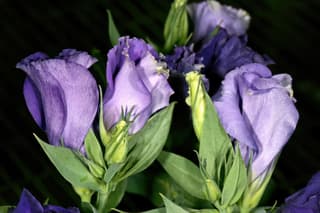
Lisianthus
Eustoma russellianum
Eustoma russellianum, commonly known as Lisianthus, is an herbaceous plant famous for its elegant flowers that resemble roses or tulips. Native to the prairies of the United States and Mexico, this species is highly valued in floriculture as a cut flower due to its sophisticated beauty and long vase life. Its petals have a satiny texture, and colors range from soft pastels to deep purples.
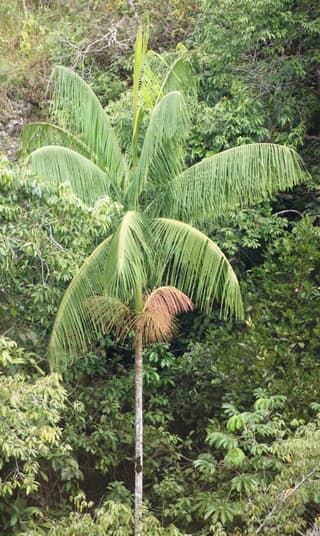
Juçara Palm
Euterpe edulis
Euterpe edulis, known as the Juçara Palm, is a native palm of Brazil's Atlantic Forest, critically threatened by illegal palm heart extraction. Its antioxidant-rich fruits are used as a sustainable alternative to Amazonian açaí, and the species plays a vital role in forest restoration and wildlife habitat for over 30 bird species.
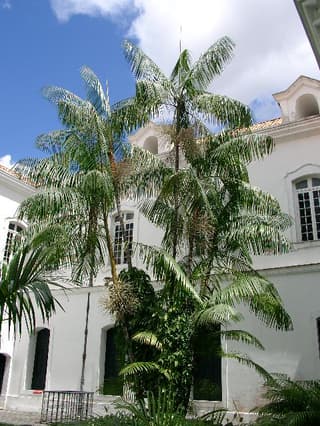
Açaí Palm
Euterpe oleracea
The açaí palm is a clustering, multi-stemmed palm native to the seasonally flooded várzea floodplains of the Amazon basin. Its slender, elegant stems can reach 15 to 25 meters tall and are topped with arching, pinnate fronds about a meter long. Clusters of hundreds of small, globose fruits ripen from green to deep purple-black, yielding the antioxidant-rich açaí pulp that has become famous worldwide.
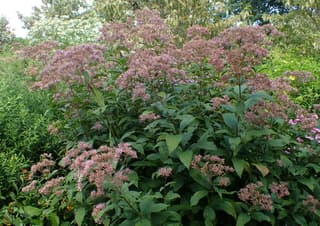
Spotted Joe-Pye Weed
Eutrochium maculatum
Spotted Joe-Pye weed (Eutrochium maculatum, synonym Eupatorium maculatum) is a perennial herbaceous plant native to North America in the Asteraceae family, growing naturally in moist meadows, stream banks, and marshy areas. The plant forms upright, sturdy, often purple-spotted stems up to 210 cm tall and bears large hemispherical pinkish-purple flower heads in late summer and autumn that attract butterflies and bees. In gardens, it is used as a background plant for moist borders, rain gardens, and naturalistic plantings.
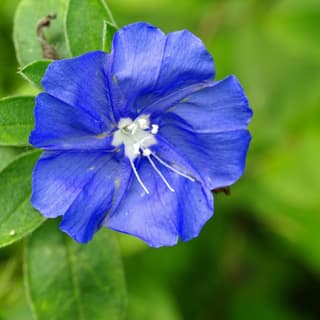
Blue Daze
Evolvulus glomeratus
Blue Daze (Evolvulus glomeratus) is a low-growing, spreading perennial native to Brazil, belonging to the Convolvulaceae family. It produces a continuous display of sky-blue flowers with white centers that open each morning and close in the evening or on cloudy days. It is widely used as ground cover, border plant, and in hanging baskets.
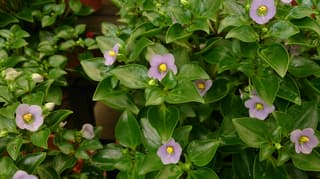
Persian Violet
Exacum affine
Exacum affine, commonly known as Persian Violet, is a charming compact flowering plant native to the island of Socotra in Yemen. Prized for its profusion of small, fragrant blue-purple flowers with bright yellow centers, it belongs to the Gentianaceae family. Though often grown as an annual houseplant, it is actually a short-lived perennial in its native subtropical habitat. Its glossy, rounded foliage and sweet fragrance make it a delightful indoor companion during spring and summer.
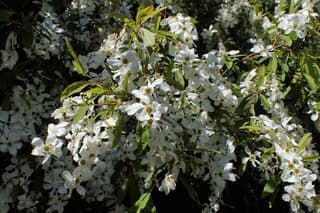
common pearlbush
Exochorda racemosa
A deciduous ornamental shrub native to China and Korea, common pearlbush is prized for its brief but spectacular spring display: masses of pure-white, five-petaled flowers open from round buds that resemble strings of pearls along arching branches. It grows 8-10 ft (2.4-3 m) tall and often wider, with a graceful, fountain-like habit. Medium-green, oval leaves show no notable fall color. Once established it is drought- and heat-tolerant, low-maintenance, and largely free of serious pests or diseases, making it a reliable backbone shrub for borders, foundation plantings, and mixed hedges.

Buckwheat
Fagopyrum esculentum
Buckwheat is an extremely fast-growing annual herbaceous plant. Although it is used as a cereal, it is technically a pseudocereal belonging to the Polygonaceae family. Its leaves are heart-shaped, and it produces clusters of small white or pink flowers that are very attractive to bees. Its triangular grains are highly nutritious and gluten-free.
Find the Perfect Plant
Our plant guide helps you find ideal species for your experience level and time of year.
Browse by Difficulty, Season & More
Use the filters below to narrow this catalog by care difficulty, season, environment, or search directly by name. Each filter leads to a focused list tailored to your specific growing conditions.