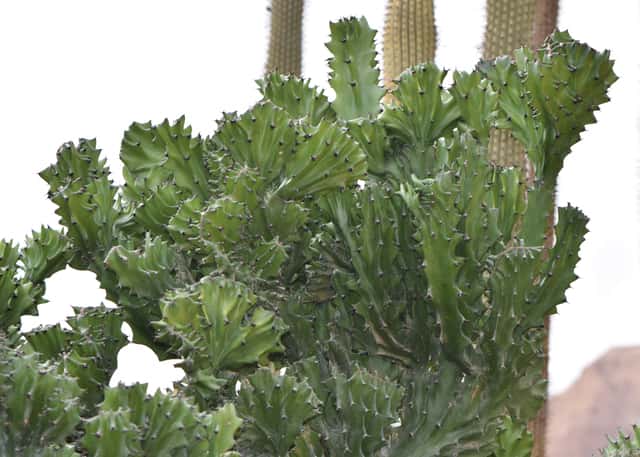
Euphorbiaceae
Coral Cactus: How to Care for Euphorbia lactea Cristata
Euphorbia lactea 'Cristata'
Grow in bright indirect to direct light, water sparingly allowing soil to dry fully between waterings, and use a fast-draining cactus/succulent mix. Handle with care: the milky latex sap is caustic and can cause skin and eye irritation.
Every 14 days
Bright indirect
10° - 35°C
30% - 60%
Categories
What is Coral Cactus?
Coral Cactus (Euphorbia lactea 'Cristata') is a medium-care plant from the Euphorbiaceae family. Euphorbia lactea 'Cristata', commonly called Coral Cactus, is a crested cultivar of the milk-striped euphorbia. It is typically sold grafted onto a Euphorbia neriifolia rootstock, producing a fan-like, wavy crest that resembles coral or brain coral, making it a striking sculptural houseplant.
Coral Cactus grows up to 60cm, spread of 30cm, watering every 14 days, 10°C – 35°C, 30–60% humidity. It is suitable for indoor environments and not safe for pets.
Without precautions, ingestion can cause irritation in pets. Keep out of reach of cats and dogs. Without adequate drainage, root rot can develop within 28 days.
How to Care for Coral Cactus?
TLDR: Coral Cactus needs Bright indirect, watering every 14 days, and temperatures between 10-35°C with 30-60% humidity.
How Often Should You Water Coral Cactus?
Water deeply but infrequently, letting the soil dry out completely between waterings; reduce watering significantly in winter to avoid rot.
How Much Light Does Coral Cactus Need?
Provide bright light with some direct sun; insufficient light causes weak, elongated growth on the crest.
What Is the Best Soil for Coral Cactus?
Use a well-draining cactus or succulent potting mix, ideally amended with extra perlite or pumice.
What Pot Should You Use for Coral Cactus?
Well-draining pot, terracotta preferred, to help excess moisture evaporate.
Care Schedule
Fertilize
Every 30 days
Rotate
Every 90 days
Repot
Every 730 days
What Is Coral Cactus and Where Does It Come From?
Euphorbia lactea 'Cristata', commonly called Coral Cactus, is a crested cultivar of the milk-striped euphorbia. It is typically sold grafted onto a Euphorbia neriifolia rootstock, producing a fan-like, wavy crest that resembles coral or brain coral, making it a striking sculptural houseplant.
How to Propagate Coral Cactus?
Grafting onto rootstock
Always wear gloves and eye protection; the latex sap is toxic and can burn skin/eyes.
- 1 Cut a healthy crest section
- 2 Let the cutting callus for several days
- 3 Graft onto compatible Euphorbia neriifolia rootstock
- 4 Secure and keep dry until union forms
Materials needed:
How Big Does Coral Cactus Grow?
TLDR: Coral Cactus can reach up to 60cm tall with Slow growth rate.
Max height
60cm
Spread
30cm
Growth rate
Slow
Foliage
Evergreen
Warning: Toxic Plant
This plant can be toxic if ingested. Keep out of reach of:
Plant Uses
Ornamental
Great for decoration
Is your plant showing symptoms?
Click on the symptom to discover possible causes:
What Diseases Commonly Affect Coral Cactus?
TLDR: Coral Cactus is susceptible to 11 known diseases. Monitor regularly for early detection.
Root Rot
Root rot is a serious fungal disease that affects the root system of plants, causing them to decay and die. It is primarily caused by overwatering, poor drainage, or soil-borne fungi such as Pythium, Phytophthora, Rhizoctonia, and Fusarium. The disease thrives in waterlogged conditions where roots are deprived of oxygen, making them susceptible to fungal infection.
Spider Mites
Spider mites are tiny arachnids (less than 1/20 inch long) related to spiders and ticks that feed on plant sap. They thrive in hot, dry conditions and can cause significant damage to ornamental and vegetable plants. During severe infestations, crop losses can reach 14% or higher as these pests disrupt vital plant processes including photosynthesis, carbon dioxide absorption, and transpiration.
Mealybugs
Mealybugs are small, soft-bodied insects covered with a white, waxy, cottony material. They are common pests of houseplants and outdoor plants in mild climates. These sap-sucking insects feed on plant tissue, causing damage, stunted growth, and can lead to plant death if left untreated. They produce sticky honeydew which attracts sooty mold.
Fungus Gnats
Fungus gnats are small, gray-to-black mosquito-like insects (1/8 to 1/10 inches long) commonly found in indoor plants. Adult gnats are mostly a nuisance, but their larvae feed on plant roots and organic matter in soil, potentially causing serious damage to young or vulnerable plants. The larvae are translucent white with distinctive black heads and can leave slime trails on the soil surface in heavy infestations.
Meaning & Symbolism
Often associated with uniqueness and resilience due to its unusual crested form.
Fun Facts
Its wavy crest shape is caused by a genetic mutation called fasciation.
It cannot survive on its own roots and is always sold grafted onto a rootstock.
The milky sap is toxic and was historically used as a fish poison in some regions.
Frequently asked questions
Is Coral Cactus toxic?
How much light does Coral Cactus need?
How often should I water Coral Cactus?
Why is my Coral Cactus grafted onto another plant?
Compare with similar plants
| Attribute | Difficulty | Light | Watering | Pet Safe |
|---|---|---|---|---|
| Dark Fieldcap | Medium | Low light | 2d | ⚠️ |
| Azalea | Medium | Partial shade | 3d | ⚠️ |
| Muriel's Bamboo | Medium | Partial shade | 3d | ✓ |
| Bougainvillea | Medium | Direct sun | 7d | ⚠️ |




