Complete Plant Guide
Explore plants by difficulty, season and more. Find the perfect plant for you.
Difficulty
Categories
Plants by City
🗺️ Plants by City3751 plants found
Showing 3421-3456 of 3751
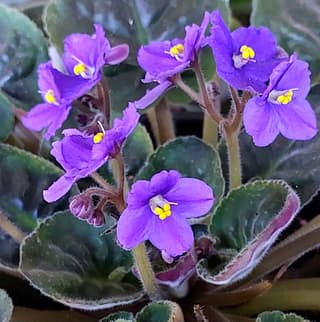
African violet
Streptocarpus sect. Saintpaulia
African violet (Streptocarpus sect. Saintpaulia, formerly genus Saintpaulia) is a compact, rosette-forming perennial from the Gesneriaceae family, native to the Eastern Arc Mountains and coastal forests of Tanzania and Kenya. Prized for its fuzzy, deep-green leaves and near-continuous clusters of purple, pink, blue, or white flowers, it is one of the most popular flowering houseplants worldwide.
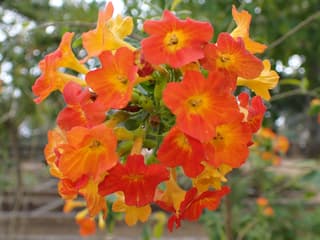
Marmalade bush
Streptosolen jamesonii
The marmalade bush (Streptosolen jamesonii) is an ornamental perennial, semi-woody, and scrambling shrub native to the Andean regions of Colombia, Ecuador, Peru, and Bolivia in South America. Belonging to the Solanaceae family, it can reach 1.5 to 2 meters in height, featuring long, flexible, and arching branches. Its leaves are ovate to elliptical, dark green, glossy, and deeply veined. The trumpet-shaped flowers bloom in clusters and change color as they mature—starting yellow and evolving into shades of orange and red—an effect reminiscent of orange marmalade, which gives the plant its popular name. It flowers intensely during spring and summer, attracting hummingbirds, bees, and butterflies to the garden.
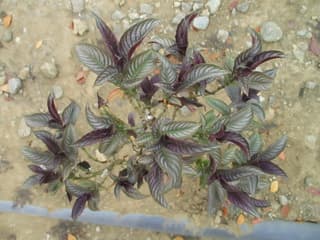
Persian shield
Strobilanthes dyeriana
Strobilanthes dyeriana, commonly known as Persian Shield, is a stunning tropical evergreen subshrub native to Myanmar. It is highly prized for its lance-shaped leaves that feature a brilliant iridescent purple sheen with silver highlights and dark green veins. The underside of the foliage is a deep maroon. While it can produce small violet flowers in winter, it is primarily grown for its spectacular foliage which adds a dramatic touch to any plant collection.
Old-man-of-the-woods
Strobilomyces strobilaceus
Strobilomyces strobilaceus, commonly known as Old-man-of-the-woods, is a distinctive mycorrhizal fungus found in deciduous forests. It is easily recognized by its cap, which is covered in large, dark, woolly scales resembling a pine cone. The flesh stains pinkish then black when cut, and the underside features a greyish pore surface rather than gills.
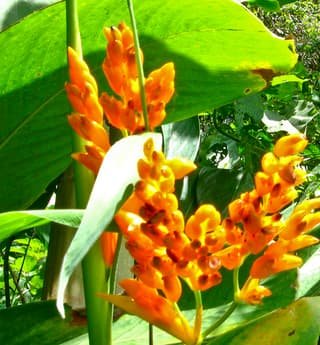
Stromanthe
Stromanthe
Stromanthe is a genus of approximately 13 tropical plant species in the family Marantaceae, native to the rainforests of South America, particularly Brazil. Celebrated for their stunning variegated foliage in shades of green, white, pink, and red, they are among the most visually spectacular houseplants available. The most famous species is Stromanthe sanguinea 'Triostar', whose tricolored leaves make it a standout specimen. Like other prayer plants, Stromanthe leaves move throughout the day in response to light.
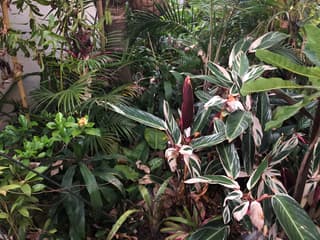
Tricolor Stromanthe
Stromanthe sanguinea
Stromanthe sanguinea, commonly known as the Tricolor Stromanthe or Triostar, is a stunning tropical plant native to the rainforests of Brazil. Its long, lance-shaped leaves display a breathtaking palette of dark green, pink, cream, and deep burgundy on the undersides, making it one of the most visually striking houseplants available. A member of the Marantaceae family and relative of Calathea and Maranta, this species exhibits nyctinastic leaf movements — folding its leaves upward at dusk in response to changing light conditions.
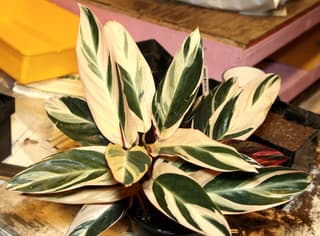
Tricolor Stromanthe
Stromanthe thalia
Tricolor Stromanthe (Stromanthe thalia) is a stunning Brazilian tropical plant from the Marantaceae family, celebrated for its spectacular tricolor foliage in shades of green, pink, and cream with deep magenta-purple undersides. As a prayer plant, its leaves fold upward at dusk and reopen at dawn. It thrives indoors with bright indirect light and high humidity.
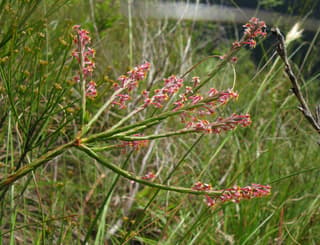
Cape Sprays
Struthiola
Struthiola is a genus of approximately 31 species of ericoid shrubs in the family Thymelaeaceae, native to the fynbos biome of South Africa's Cape Floral Region. These evergreen shrublets are renowned for their sweetly scented tubular flowers at dusk and their remarkable drought tolerance in sandy, well-drained soils.
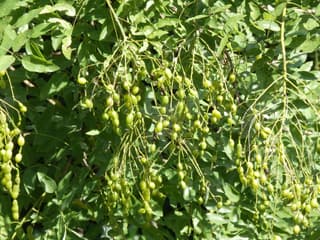
Japanese Pagoda Tree
Styphnolobium japonicum
The Japanese Pagoda Tree (Styphnolobium japonicum), formerly known as Sophora japonica, is a large deciduous tree native to China and widely cultivated across East Asia. Belonging to the Fabaceae family, it can reach up to 25 meters in height and is highly valued for its generous shade and fragrant creamy-white flowers produced in summer. It is a hardy tree, adaptable to poor soils and urban pollution, frequently used in parks, avenues, and historic gardens.
Larch bolete
Suillus grevillei
The larch bolete is an edible and highly flavorful mushroom from the Suillaceae family. It is characterized by its bright yellow to orange cap, which becomes very slimy when wet. It grows exclusively in symbiosis (mycorrhiza) with larch trees, making it a species that cannot be commonly cultivated at home without the presence of a host tree. It features a yellow stem with a ring and pores that are covered by a veil when young.
Velvet bolete
Suillus variegatus
Suillus variegatus, known as the velvet bolete or variegated bolete, is an edible mushroom from the Suillaceae family. It is characterized by a sandy-yellow or olive cap with a granular, felt-like surface that, unlike other Suillus species, is not slimy. It forms a mycorrhizal relationship primarily with pine trees, preferring sandy and acidic soils.
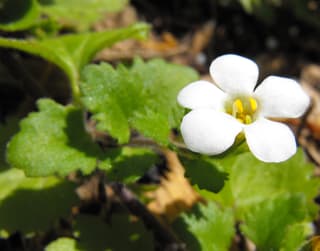
Bacopa
Sutera cordata
Sutera cordata (syn. Chaenostoma cordatum) is a fast-growing ornamental plant from the Scrophulariaceae family, native to South African wetlands. It is characterized by small, dark green, opposite leaves with slightly serrated edges and tiny white star-shaped flowers with yellow-orange centers. It is ideal for hanging baskets, containers, and as a groundcover due to its trailing growth habit. It is known for its rapid growth and profuse blooming throughout summer and fall.
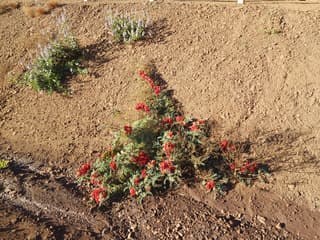
Sturt's Desert Pea
Swainsona formosa
Sturt's Desert Pea is one of Australia's most striking wildflowers, a low, sprawling groundcover native to the arid interior of every mainland state except Victoria. Its trailing stems of soft grey-green, pinnate leaves are studded with large, waxy blood-red blooms, each marked with a glossy black boss at the base of the standard petal. Adopted as the official floral emblem of South Australia in 1961, it thrives in harsh, sun-baked, well-drained conditions and is famously difficult to keep alive in humid or overly generous garden settings.

Queen Palm
Syagrus romanzoffiana
The Queen Palm (Syagrus romanzoffiana) is a stately feather palm native to Brazil and South America, belonging to the family Arecaceae. Prized for its graceful arching fronds and slender trunk, it is one of the most popular landscape palms in subtropical and tropical regions worldwide. It can reach heights of 10-15 meters and produces clusters of bright orange fruits that attract wildlife.
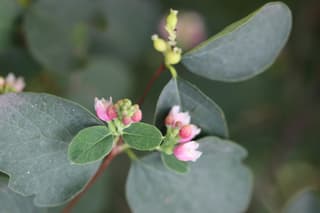
Common Snowberry
Symphoricarpos albus
Common snowberry (Symphoricarpos albus) is a deciduous shrub in the honeysuckle family (Caprifoliaceae), native to North America. It is known for its characteristic snow-white berries that cling to the branches long into the winter season after the leaves have fallen. The shrub grows up to 6 feet (180 cm) tall and wide, forming dense thickets through root suckers, and is extremely hardy down to -40 °F (-40 °C). The flowers are small, bell-shaped, and whitish-pink, blooming in the summer. Snowberry is an excellent garden and wildlife plant that attracts birds, bumblebees, and butterflies.
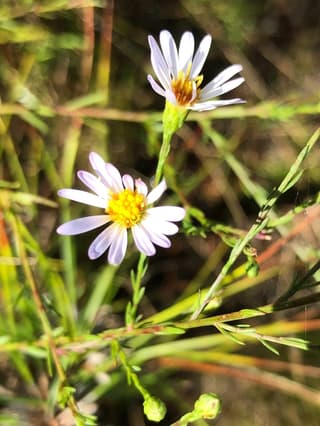
Rice Button Aster
Symphyotrichum dumosum
Symphyotrichum dumosum is a herbaceous perennial native to eastern North America. It forms bushy, branching clumps about 60 to 90 cm tall, covered in late summer and fall with masses of small daisy-like flowers with white to pale lilac rays and yellow centers that age to reddish purple. It is a valuable late-season nectar source for bees, butterflies and skippers.
White Panicle Aster
Symphyotrichum lanceolatum
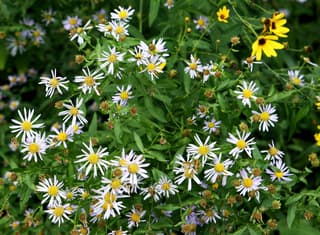
Symphyotrichum lanceolatum, commonly known as White Panicle Aster, is a native North American perennial wildflower in the Asteraceae family. Formerly classified as Aster lanceolatus, it produces masses of small daisy-like white flowers with yellow disc centers from mid-summer through fall, reaching up to 1.5 meters tall. A vital late-season pollinator plant, it thrives in moist, sunny conditions and spreads via rhizomes.

New York Aster
Symphyotrichum novi-belgii
Symphyotrichum novi-belgii, commonly called the New York aster or Michaelmas daisy, is a hardy herbaceous perennial native to eastern Canada and the northeastern United States, often found in wet meadows and abandoned fields near the coast. Valued for its abundant daisy-like flower heads in shades of purple, pink, and white surrounding bright yellow centers, it blooms from late summer through fall, often peaking around Michaelmas (September 29). Growing 3-5 feet (90-150cm) tall, it thrives in sunny garden borders and wildlife gardens, attracting bees, butterflies -- including Pearl Crescents, for which it is a host plant -- and seed-eating songbirds.
Shore Aster
Symphyotrichum tradescantii
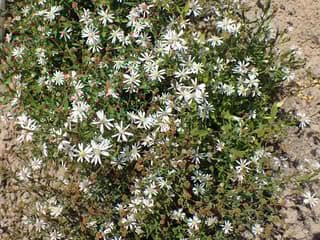
Symphyotrichum tradescantii, commonly known as Shore Aster or Tradescant's Aster, is a native perennial wildflower of northeastern North America. This deciduous herbaceous plant produces an abundance of small, daisy-like flowers with white ray florets and pale yellow to purple disk florets in late summer and fall. It grows naturally along rocky shores, riverbanks, and freshwater estuaries, thriving in full sun to partial shade and moist soils. An excellent choice for naturalistic gardens, rain gardens, and native plant landscapes.
Russian Comfrey
Symphytum × uplandicum
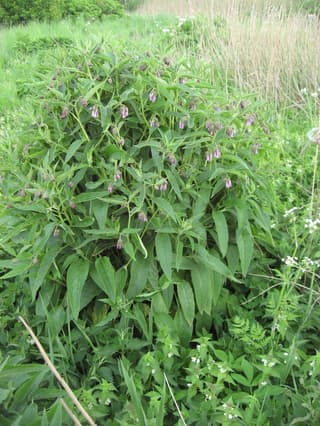
Russian comfrey (Symphytum × uplandicum) is a vigorous, hardy herbaceous perennial in the borage family (Boraginaceae), arising as a natural hybrid between common comfrey (Symphytum officinale) and rough comfrey (Symphytum asperum). It forms large clumps of coarse, bristly, lance-shaped leaves and sends up branching stems topped with nodding, bell-shaped flowers that open pink-blue and mature to violet-purple, blooming from late spring through summer. Prized by organic gardeners as a "dynamic accumulator," its deep taproot draws potassium and other minerals up from the subsoil, making the leaves an excellent source material for compost activators, liquid feeds, and mulch. Note that comfrey contains pyrrolizidine alkaloids that are toxic to the liver if ingested, so its historical internal medicinal use has been discouraged in favor of external, topical applications only.
common comfrey
Symphytum officinale
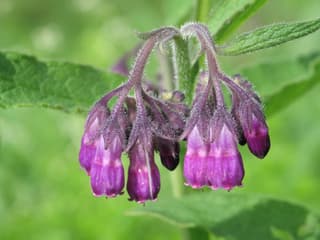
Symphytum officinale, commonly known as comfrey, is a robust perennial herb famous for its large, hairy, lanceolate leaves and clusters of bell-shaped flowers. It is a 'dynamic accumulator' with a deep taproot that mines minerals from the subsoil, making its foliage an excellent organic fertilizer and compost activator.
African Milk Bush
Synadenium grantii
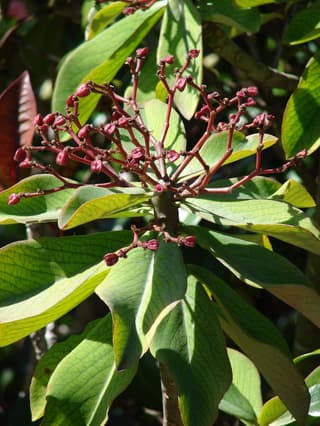
The African Milk Bush (Synadenium grantii, synonym of Euphorbia umbellata) is a perennial succulent shrub native to East Africa—specifically the Great Lakes region, including the Democratic Republic of the Congo, Tanzania, Kenya, Uganda, Burundi, and Rwanda—where it grows on rocky slopes between 950 and 2,100 m in altitude. In Brazil, it is widely cultivated as an ornamental plant and in folk medicine, known primarily for the abundant milky latex that flows from any wound on the stem or leaves. In nature, it can reach 2 to 10 m in height, but in pots, it tends to remain much more compact. The leaves are fleshy, green or reddish-purple (as seen in the ornamental cultivar 'Rubra'), and the flowers are small, greenish, and inconspicuous, surrounded by purplish bracts. WARNING: All plant latex is toxic and extremely irritating—contact with skin or eyes can cause burning, dermatitis, and blisters, and ingestion is dangerous for humans and animals. Always cultivate with protective gloves and keep out of reach of children and pets.
Yellow hatpins
Syngonanthus flavidulus
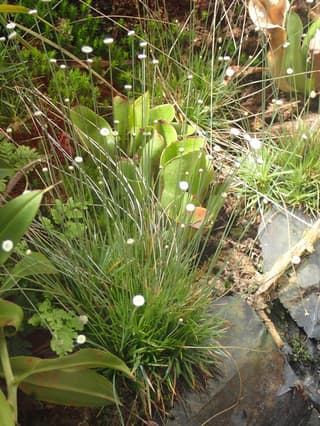
Syngonanthus flavidulus, commonly known as yellow hatpins, is a small, perennial herb in the pipewort family (Eriocaulaceae), endemic to the southeastern United States (Alabama, Florida, Georgia, Mississippi, North Carolina, and South Carolina). It grows in moist, sandy pine savannas, pond margins, bogs, and ditches, in areas with constant groundwater seepage maintained by natural fires. It forms dense tufts of narrow, grass-like leaves from which thin stems (scapes) emerge, topped with tiny, spherical, white-to-yellowish inflorescences resembling pinheads—hence the name "yellow hatpins." It blooms from spring to early summer.
Arrowhead Vines
Syngonium
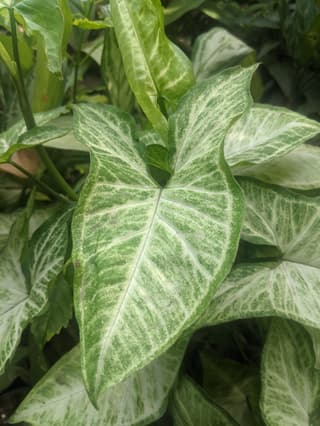
Syngonium is a genus of tropical climbing and trailing plants in the family Araceae, native to the rainforests of Central and South America. Its young leaves display a distinctive arrowhead shape that gradually transforms into multi-lobed forms as the plant matures. Widely grown as a houseplant for its lush ornamental foliage, Syngonium comes in dozens of cultivars with green, variegated, pink, and silvery leaves. Important: the plant is toxic to cats, dogs, and humans due to calcium oxalate crystals present throughout its tissues.
Five Fingers
Syngonium angustatum
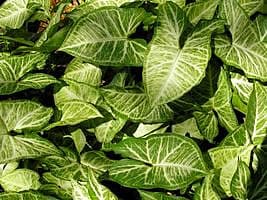
Syngonium angustatum, commonly known as Five Fingers or Climbing Arrowhead Vine, is a tropical climbing plant native to Mexico and Central America. It belongs to the Araceae family and is prized for its distinctive foliage that transforms dramatically as the plant matures — juvenile leaves are simple arrowhead-shaped, while adult leaves develop deep lobes resembling spread fingers, hence the name Five Fingers. It is a versatile houseplant that thrives as a trailing vine or trained climber.
Five-Fingered Philodendron
Syngonium auritum
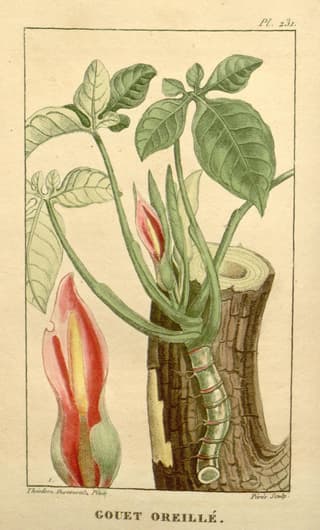
Syngonium auritum, commonly known as Five-Fingered Philodendron or Five Fingers, is a tropical climbing plant from the Araceae family, native to the Caribbean and Central America. Its juvenile leaves are arrow-shaped, but as the plant matures, they develop into divided leaflets resembling an open hand with five fingers — hence the popular name. It is a vigorous climber widely used in interior decoration and tropical gardens.
Red Arrow Syngonium
Syngonium erythrophyllum
Syngonium erythrophyllum, commonly known as the Red Arrow Syngonium, is a climbing aroid native to the tropical rainforests of Central America, particularly Panama. Its young arrow-shaped leaves display striking reddish to copper tones that mature into a deeper green as the plant ages. A versatile vine, it can be grown trailing or trained up a moss pole, and is highly prized by aroid collectors for its unusual foliage coloration.
Arrowhead Plant
Syngonium podophyllum
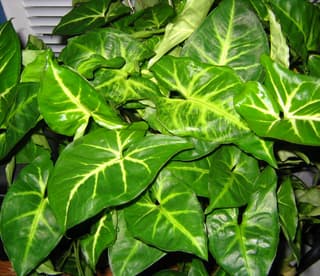
Syngonium podophyllum is a tropical climbing plant from the Araceae family, native to the humid forests of Central America. Known for its arrow-shaped leaves that change form as they mature, it is an extremely popular houseplant due to its ease of care and ornamental beauty.
Miracle Berry
Synsepalum dulcificum
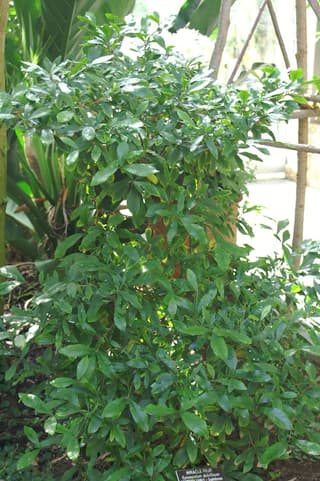
Synsepalum dulcificum, known as the Miracle Berry, is an evergreen shrub native to West Africa. Its most notable feature is the production of small red berries containing miraculin. This glycoprotein temporarily alters taste buds, causing sour or bitter foods to be perceived as extremely sweet. The plant has glossy dark green leaves and exhibits slow, elegant growth.
Japanese Tree Lilac
Syringa reticulata
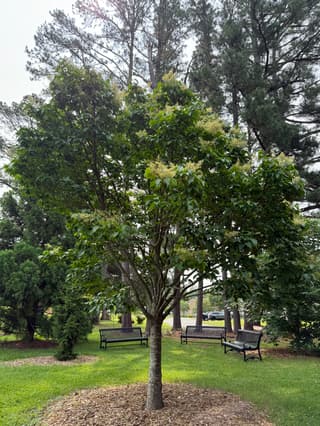
Japanese Tree Lilac (Syringa reticulata) is a small to medium-sized ornamental tree native to Japan and northeastern Asia. It stands out for its enormous creamy-white fragrant flower panicles that appear in early summer, blooming up to six weeks after most other lilacs have finished. With cherry-like bark and exceptional urban tolerance, it is one of the most versatile and low-maintenance ornamental trees for gardens and streetscaping.
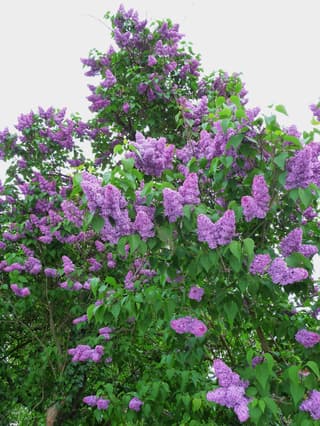
Common Lilac
Syringa vulgaris
Syringa vulgaris, the common lilac, is a hardy deciduous shrub native to the Balkans and widely cultivated for its spectacular spring display of highly fragrant flower clusters. Growing up to 5 meters tall, it produces dense panicles in shades ranging from classic purple-lavender to white, pink, and magenta. It is a beloved garden staple in temperate climates and thrives in cold winters with full sun exposure.
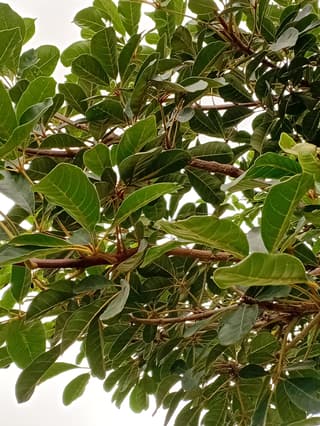
Syzygium (genus)
Syzygium
Syzygium is a large genus of tropical and subtropical evergreen trees and shrubs in the family Myrtaceae, comprising over 1,000 species native to Asia, Australia, and Africa. The genus includes economically and culturally significant species such as clove (S. aromaticum), jambolan (S. cumini), and rose apple (S. samarangense). These are hardy plants with dense, glossy foliage that produce edible fruits and aromatic flowers.
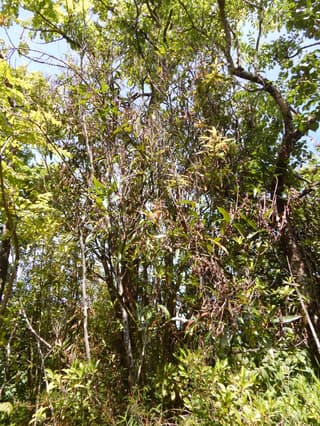
Rose Apple
Syzygium jambos
Syzygium jambos, popularly known as Rose Apple or Wax Apple, is a tropical fruit tree native to Southeast Asia. It features evergreen foliage, fragrant white to cream-colored flowers, and rounded fruits that range from yellow to pale pink, with a rose-like aroma. It is widely cultivated for its edible fruits and also as an ornamental plant.
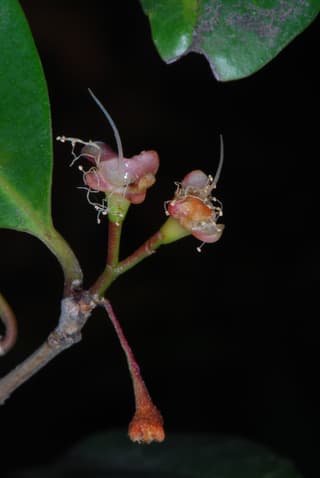
Magenta Cherry
Syzygium paniculatum
Syzygium paniculatum, known as Magenta Cherry or Brush Cherry, is an evergreen shrub and small tree native to the rainforests of eastern Australia (New South Wales). It bears glossy dark green leaves with attractive bronze-red new growth, clusters of white flowers in spring and summer, and distinctive magenta-coloured edible berries. Formerly classified as Eugenia paniculata, it is widely grown as a hedging plant, topiary subject, and ornamental specimen across subtropical and warm temperate regions worldwide.
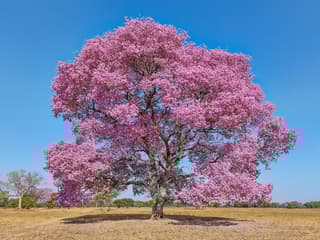
Pink Trumpet Tree
Tabebuia impetiginosa
Tabebuia impetiginosa, commonly known as the Pink Trumpet Tree or Pau d'Arco, is one of South America's most spectacular flowering trees. Native to the tropical and subtropical forests of Brazil and neighboring countries, it produces breathtaking displays of purple to pink trumpet-shaped flowers in late winter and early spring, typically when the tree is leafless. A member of the Bignoniaceae family, it can reach up to 30 meters tall in the wild and is widely planted as an ornamental street and garden tree in warm climates worldwide.
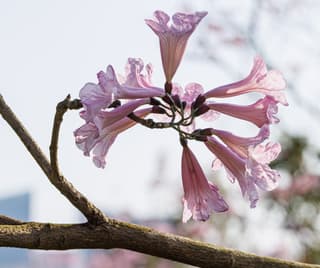
Pink Trumpet Tree
Tabebuia rosea
The Pink Trumpet Tree (Tabebuia rosea) is a majestic tropical tree native from Mexico to Colombia and Venezuela.
Find the Perfect Plant
Our plant guide helps you find ideal species for your experience level and time of year.
Browse by Difficulty, Season & More
Use the filters below to narrow this catalog by care difficulty, season, environment, or search directly by name. Each filter leads to a focused list tailored to your specific growing conditions.