Complete Plant Guide
Explore plants by difficulty, season and more. Find the perfect plant for you.
Difficulty
Categories
Plants by City
🗺️ Plants by City3767 plants found
Showing 2809-2844 of 3767
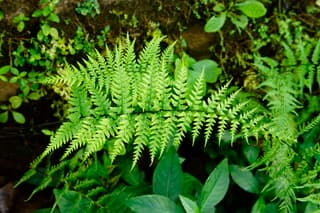
Silverback Fern
Pityrogramma calomelanos
Pityrogramma calomelanos, commonly known as the Silverback Fern, is a tropical perennial fern native to the Americas. Its most distinctive feature is the white or yellowish waxy powder coating the underside of its fronds, giving them a striking silver appearance. It thrives in warm, humid environments and adapts well to both indoor and outdoor cultivation.
Black Felt Lichen
Placynthium nigrum
Placynthium nigrum is a crustose lichen that develops on calcareous substrates. It is characterized by a granular black or dark brown thallus, often forming rosettes or extensive patches on rocky outcrops.
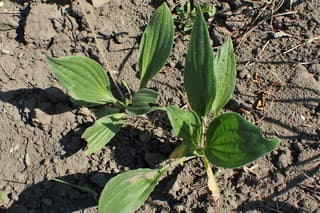
Asian Plantain
Plantago asiatica
Asian Plantain (Plantago asiatica) is a perennial herb of the Plantaginaceae family, native to East Asia — China, Japan, and Korea. It forms a basal rosette of broadly ovate to elliptic leaves measuring 4–12 cm, deep green with prominent veins. It produces erect flower spikes of 20–45 cm bearing numerous small white flowers. Exceptionally resilient, it colonizes disturbed habitats such as roadsides and vacant lots. Revered in Traditional Chinese Medicine for millennia as Cheqiancao (车前草), it possesses well-documented diuretic, anti-inflammatory, and expectorant properties.
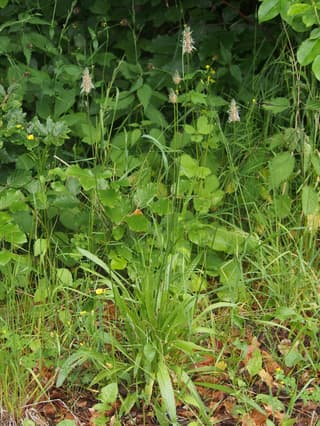
Ribwort Plantain
Plantago lanceolata
Ribwort plantain is a low-growing perennial herb native to Europe and western Asia, now naturalized worldwide. It forms a basal rosette of lance-shaped, ribbed leaves and sends up slender, leafless flower stalks topped with small brownish flower spikes from spring through summer. Extremely hardy and adaptable, it thrives in meadows, lawns, and disturbed ground, and has a long history of use as a medicinal herb.
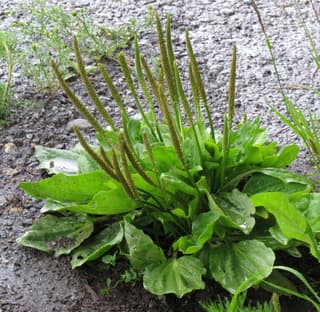
Broadleaf Plantain
Plantago major
Broadleaf Plantain (Plantago major) is a robust, perennial wild plant from the Plantain family (Plantaginaceae). It forms a flat rosette of broad, oval leaves with characteristic parallel veins and grows in meadows, pastures, roadsides, and compacted soil worldwide. From May to September, narrow, upright flower spikes appear with small, inconspicuous yellowish-green flowers. As one of the best-known medicinal herbs in folk medicine, it has been used for centuries for skin wounds, insect bites, coughs, and respiratory complaints. The young leaves are edible and rich in silicic acid, mucilage, tannins, and flavonoids.
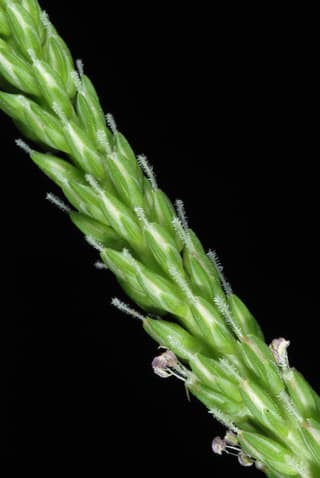
Blackseed Plantain
Plantago rugelii
Blackseed plantain (Plantago rugelii) is a hardy native perennial herb of eastern and central North America. It forms a compact basal rosette of broad, oval leaves with distinctive reddish-purple petiole bases. Often found in lawns, roadsides, and disturbed habitats, it is both a common "weed" and a valued medicinal and edible plant with a long history of traditional use.
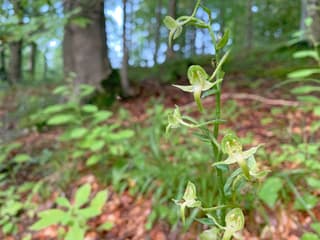
Greater Butterfly-orchid
Platanthera chlorantha
The Greater Butterfly-orchid (Platanthera chlorantha) is a tuberous orchid native to European forests, calcareous meadows, and marshy areas. Growing 30-60 cm tall, it features two shiny, elliptical basal leaves and smaller, oblong stem leaves. Its greenish-white, vanilla-scented flowers are arranged in a sparse inflorescence and feature a long spur adapted for pollination by nocturnal moths, such as noctuids and hawkmoths. Unlike the closely related Platanthera bifolia, its pollinaria attach between the pollinator's eyes rather than to the proboscis. The plant is specialized for calcareous and neutral soils and depends on mycorrhizal fungi for both germination and growth.
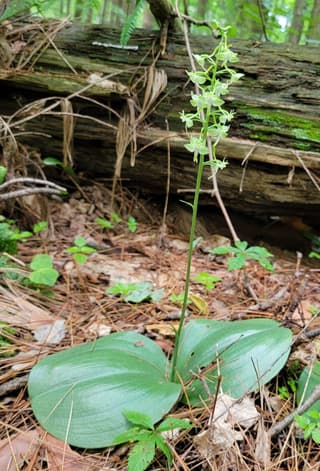
Large Round-leaved Orchid
Platanthera orbiculata
A native North American terrestrial orchid found in moist coniferous and deciduous forests from Canada down to the eastern and northern United States. Easily recognized by its pair of large, glossy, rounded basal leaves lying flat on the forest floor and a tall spike of up to 30 greenish-white flowers with long spurs, pollinated mainly by noctuid moths.
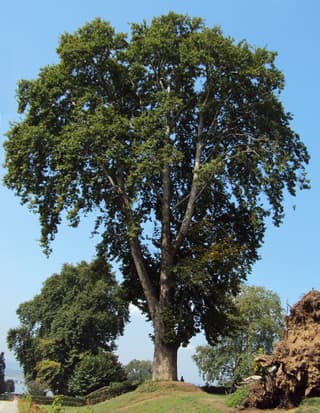
Plane Tree
Platanus
Platanus is a genus of approximately 10 species of large, deciduous trees comprising the sole living genus of the family Platanaceae. Native to the Northern Hemisphere — spanning North America, Mexico, southeastern Europe, and Asia — plane trees are instantly recognizable by their distinctive exfoliating bark that peels away in irregular patches to reveal a mosaic of cream, green, and grey tones. The broadly palmate leaves and spherical seed balls that hang on the branches through winter are equally distinctive. The London plane (Platanus × hispanica), a hybrid between the Oriental and American planes, has become one of the most widely planted ornamental trees in the world, renowned for its exceptional tolerance of urban pollution, soil compaction, and drought.
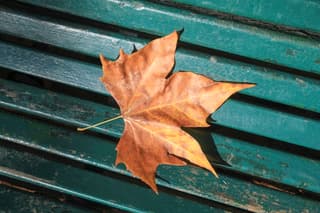
London plane
Platanus × hispanica
The London plane (Platanus × hispanica) is a large deciduous hybrid tree, a cross between the Oriental plane (P. orientalis) and the American sycamore (P. occidentalis). It is instantly recognizable by its distinctive bark that peels away in patches to reveal cream, olive, and grey mottled patterns beneath, and by its large maple-like leaves. One of the most widely planted urban trees in the world, it is prized for its exceptional tolerance of air pollution, compacted soils, and drought once established.
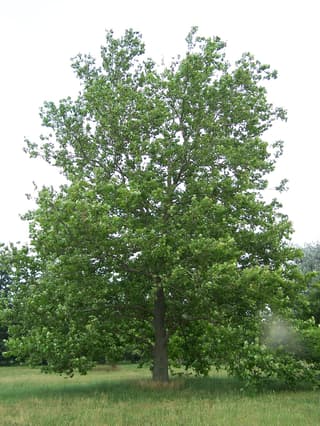
American Sycamore
Platanus occidentalis
The American sycamore is one of the largest native hardwood trees in eastern North America, commonly reaching 75-100 ft (23-30 m) tall with a broad, spreading crown. It is best known for its distinctive exfoliating bark, which sheds in irregular gray-brown plates to reveal smooth, creamy-white inner bark. Native to riverbanks, floodplains and bottomlands, it tolerates wet soils as well as periods of drought once established. Small monoecious flowers appear in early spring (green male clusters, burgundy-red female clusters), followed by distinctive ball-shaped seed heads that persist through winter.
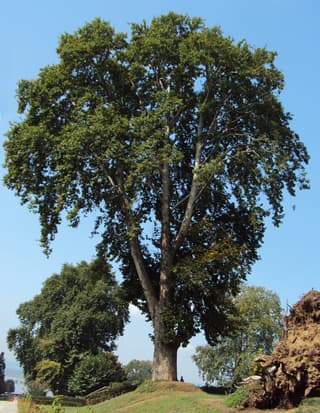
Oriental Plane
Platanus orientalis
The Oriental plane (Platanus orientalis) is a large deciduous tree native to southeastern Europe and southwestern Asia, prized for its flaking, cream-and-gray bark and deeply lobed, maple-like leaves. Long-lived and fast-growing, it can exceed 30 m in height and is historically linked to Hippocrates, who reportedly taught medicine beneath a specimen on the island of Kos.
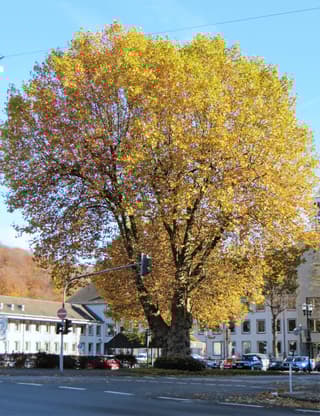
London Plane Tree
Platanus x hispanica
The London Plane Tree (Platanus x hispanica) is a magnificent hybrid deciduous tree believed to be a cross between the Oriental Plane (Platanus orientalis) and the American Sycamore (Platanus occidentalis). Originating in Europe, it has become one of the most widely planted urban trees in the world, celebrated for its extraordinary tolerance of pollution, compacted soils, and drought. Its striking exfoliating bark—revealing creamy, olive, and tan patches—makes it a year-round ornamental standout. It can grow up to 30 meters tall with a wide canopy reaching 24 meters across, providing abundant shade in parks, avenues, and urban squares.
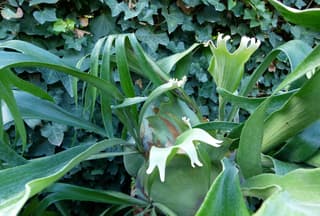
Elkhorn Fern
Platycerium alcicorne
Platycerium alcicorne, commonly known as the Elkhorn Fern, is an epiphytic fern native to Madagascar and East Africa (including Kenya, Mozambique, Tanzania, Zimbabwe, and neighboring islands such as the Comoros, Mauritius, Reunion, and Seychelles). Like other staghorn ferns, it produces two distinct types of fronds: rounded, shield-shaped sterile fronds that clasp its mounting surface and protect the root ball, and antler-like fertile fronds that arch outward and carry spore patches on their undersides. In the wild it grows attached to tree trunks and branches, absorbing moisture and nutrients from the air, rainfall, and decaying organic debris trapped behind its shield fronds. It never produces flowers or seeds, reproducing instead through spores and by forming offsets (pups) that can be divided from the parent plant.
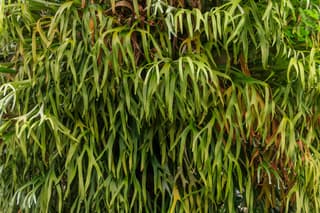
Staghorn Fern
Platycerium bifurcatum
Platycerium bifurcatum is a striking epiphytic fern native to the rainforests of Australia, Java, and New Guinea. Known for its unique antler-shaped fronds, this plant naturally grows on trees and rocks, absorbing nutrients and moisture from the air. It produces two types of fronds: sterile shield fronds that anchor the plant and fertile fronds that resemble deer antlers. With proper care, staghorn ferns can live for over 50 years and become impressive living sculptures.
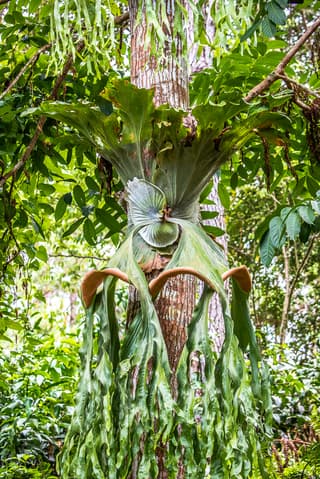
Philippine Staghorn Fern
Platycerium grande
Platycerium grande is a magnificent epiphytic fern native to the Philippines, renowned for its enormous bifurcated fronds resembling elk antlers. One of the largest species in the Platycerium genus, it can reach up to 4 feet in height. In nature, it grows on tree trunks and rocks, absorbing nutrients and moisture through its basal shield fronds.
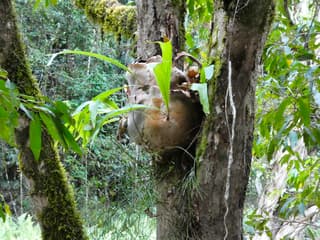
Hill's Elkhorn Fern
Platycerium hillii
Platycerium hillii, commonly known as Hill's Elkhorn Fern or Green Staghorn Fern, is an Australian epiphytic fern from the family Polypodiaceae. Native to tropical and subtropical Queensland, it grows on trees and rocks, developing two types of fronds: flat shield fronds that anchor the plant and collect nutrients, and upright antler-shaped fertile fronds that give it its distinctive staghorn appearance. It is one of the most compact Platycerium species, making it well-suited for indoor cultivation.
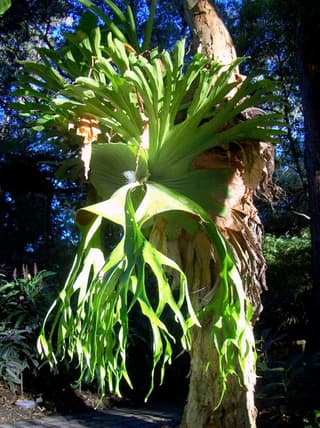
Giant Staghorn Fern
Platycerium superbum
Platycerium superbum, the Giant Staghorn Fern, is a majestic epiphytic fern native to subtropical and tropical eastern Australia. It grows anchored to tree trunks and rocks, producing spectacular antler-shaped fertile fronds up to 2 meters long and circular shield fronds reaching 1 meter across. It is one of the largest and most impressive ferns in the world.
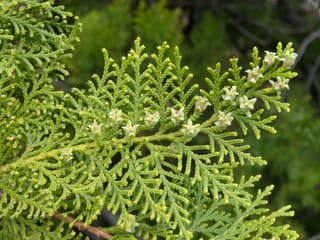
Oriental Arborvitae
Platycladus orientalis
Platycladus orientalis, commonly known as Oriental Arborvitae or Chinese Arborvitae, is an evergreen conifer in the Cupressaceae family, native to China and Korea. It grows slowly with a columnar to conical form, reaching up to 10 meters tall. Its scale-like leaves form flattened, vertical sprays of yellow-green foliage that bronze in winter. Widely used as hedges, privacy screens, and ornamental specimens. WARNING: contains thujone in leaves and seeds — toxic to pets and humans if ingested.
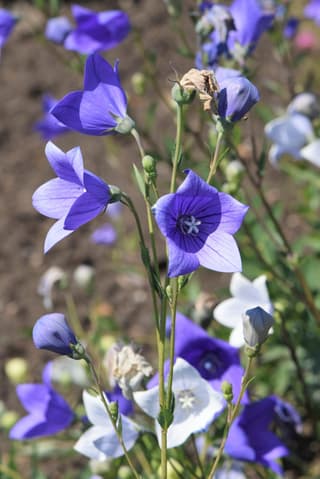
Balloon flower
Platycodon grandiflorus
The balloon flower (Platycodon grandiflorus) is a perennial herb in the bellflower family (Campanulaceae), native to East Asia—China, Korea, Japan, and Siberia. It is famous for its swollen flower buds that resemble balloons, which puff up before opening into bell-shaped, five-pointed flowers in shades of blue, purple, pink, or white. The plant grows to a height of 30–60 cm, blooms from July to October, and is popular in flower beds, rock gardens, and containers.
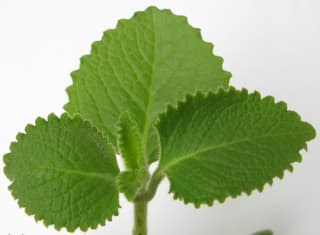
Cuban Oregano
Plectranthus amboinicus
Plectranthus amboinicus, commonly known as Cuban oregano or Indian borage, is an aromatic semi-succulent herb in the Lamiaceae family. Native to tropical Africa and widely naturalized across the tropics, it features thick, fleshy, velvety leaves with a bold oregano-mint fragrance. Widely grown as a culinary herb and medicinal plant.
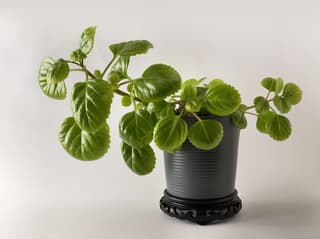
Swedish Ivy
Plectranthus australis
Swedish Ivy (Plectranthus australis) is a fast-growing, trailing houseplant native to South Africa and Australia. Beloved for its lush, round, glossy leaves and cascading stems, it is an ideal plant for hanging baskets, window sills, and outdoor ground cover in frost-free climates. Its ability to thrive with minimal care makes it a popular choice for both beginners and experienced gardeners.
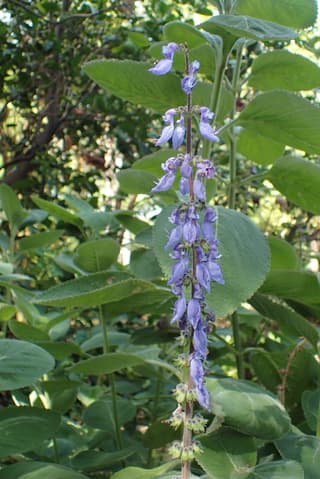
Indian Coleus
Plectranthus barbatus
Indian Coleus (Plectranthus barbatus) is a perennial shrub of the Lamiaceae family, native to the paleotropical regions of Africa and India. It is widely cultivated for its aromatic, slightly fuzzy leaves and striking blue-purple flower spikes. A fast-growing and drought-tolerant plant, it thrives in warm climates and is prized both as an ornamental and for its medicinal roots, which contain the bioactive compound forskolin.
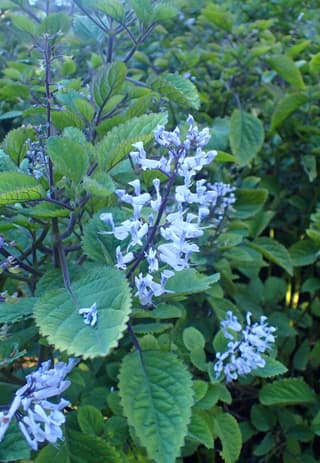
Speckled Spur-Flower
Plectranthus ciliatus
The Speckled Spur-Flower (Plectranthus ciliatus) is a trailing, semi-succulent perennial in the mint family (Lamiaceae), native to the moist forests and shaded slopes of South Africa's Western Cape, KwaZulu-Natal, and Eswatini. Its broadly oval, scalloped leaves are edged with fine hairs that give an eyelash-like fringe (hence "ciliatus", Latin for "fringed with hairs"), and the undersides often flush deep purple. From late summer into winter it sends up slender spikes of small white to lilac-pink flowers above the foliage. In its native habitat it forms dense, shade-loving carpets under trees, which makes it a natural fit for hanging baskets, window boxes, and groundcover plantings in frost-free gardens.
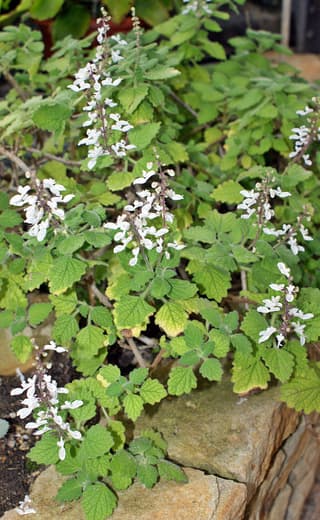
Mintleaf
Plectranthus madagascariensis
Mintleaf (Plectranthus madagascariensis) is a popular trailing houseplant native to Madagascar and South Africa. It features aromatic, slightly fuzzy leaves with white or cream margins in its variegated form, releasing a mild mint-like scent when touched. It is prized for its easy care, fast growth, and adaptability to indoor conditions.
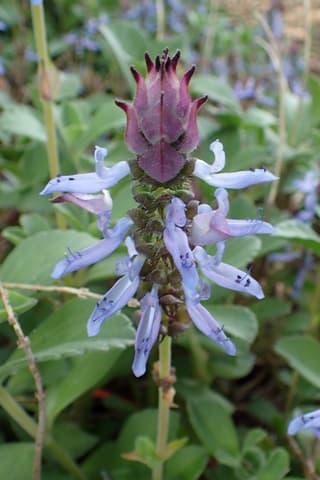
Lobster Flower
Plectranthus neochilus
Plectranthus neochilus is an aromatic groundcover native to South Africa, known for its pungent skunky scent that repels insects, cats, and snakes. It produces attractive blue-purple flowers in spring and summer and is prized for both ornamental and medicinal uses.
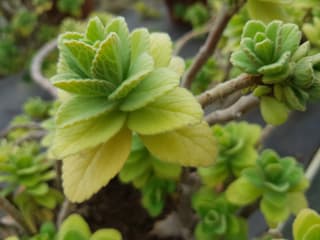
Vicks Plant
Plectranthus ornatus
Plectranthus ornatus, commonly known as the Vicks Plant, is a fast-growing aromatic groundcover native to East Africa (Ethiopia and Tanzania). Belonging to the Lamiaceae family, it is widely grown as both a medicinal herb and ornamental plant, prized for its menthol-like fragrance and digestive health benefits.
Purple Swedish Ivy
Plectranthus purpuratus
Plectranthus purpuratus, commonly known as Purple Swedish Ivy, is a trailing evergreen perennial in the mint family (Lamiaceae), native to eastern South Africa. It is prized for its soft, fleshy, aromatic dark green leaves with a purple-tinted underside, and its freely branching, spreading habit makes it a popular choice for hanging baskets. Tiny bluish-white tubular flowers appear in summer and intermittently throughout the year.
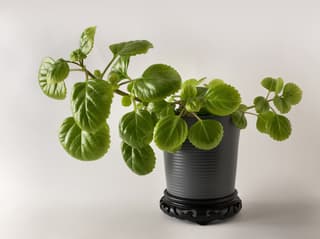
Plectranthus
Plectranthus sp
Plectranthus is a diverse genus in the Lamiaceae family, native to Africa and Asia. With over 350 species, many are cultivated as ornamental, aromatic, and medicinal plants. Their textured leaves and tubular flowers in shades of purple, lilac, or white make them a favorite for gardens and balconies. They adapt well to indoor containers as well as outdoor planting in tropical and subtropical climates.
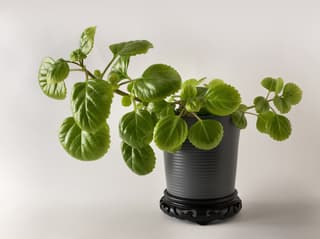
Swedish Ivy
Plectranthus verticillatus
Plectranthus verticillatus, commonly known as Swedish Ivy or Money Plant, is a fast-growing trailing perennial native to South Africa. It features oval, glossy green leaves with slightly serrated edges and a pleasant aromatic scent when touched. Widely grown as a houseplant, it thrives in hanging baskets and on shelves where its cascading stems create a lush, decorative display.
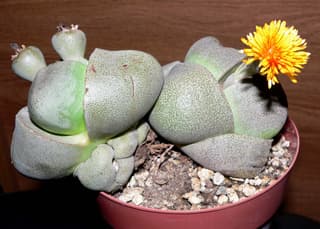
Split rock
Pleiospilos nelii
Pleiospilos nelii is a small, stemless succulent from the Aizoaceae family, native to the semi-arid Karoo regions on the border of the Western and Eastern Cape Provinces in South Africa. The plant produces only one or two pairs of thick, nearly spherical leaves in gray-green to reddish hues, covered with tiny dots that perfectly imitate the surrounding stones and quartz gravel—hence the common name 'living stones.' In autumn, a new pair of leaves emerges between the old ones, while the old leaves wither and dry up, transferring their water to the new growth. From July to August, the plant produces large, fragrant, yellow-salmon daisy-like flowers that turn orange over time.
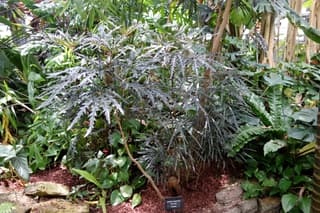
False Aralia
Plerandra elegantissima
Plerandra elegantissima, commonly known as False Aralia, is an elegant evergreen shrub native to the rainforests of New Caledonia. Prized for its finely divided, dark green to coppery leaves with serrated edges, this tropical plant brings a sophisticated, feathery texture to any indoor space. While it can grow up to 15 meters tall in its native habitat, indoors it typically stays between 1.5 and 2 meters, making it a striking yet manageable houseplant.
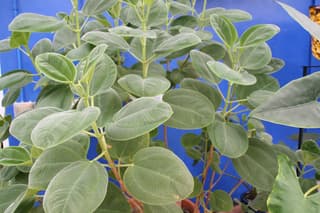
Pink Princess Flower
Pleroma granulosum
Pleroma granulosum (syn. Tibouchina granulosa), commonly known as Pink Princess Flower or Purple Glory Tree, is a fast-growing flowering tree native to Brazil's Atlantic Forest, belonging to the family Melastomataceae. It produces spectacular clusters of large violet-purple to magenta blooms mainly in late summer through autumn. Widely planted as a street tree and garden ornamental in tropical and subtropical regions worldwide.
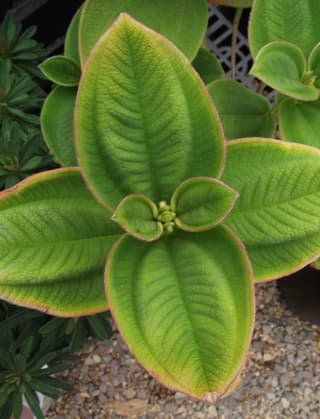
Silver-leaved Princess Flower
Pleroma heteromalla
Pleroma heteromalla, commonly known as Silver-leaved Princess Flower, is a shrub native to the Brazilian Cerrado, belonging to the family Melastomataceae. Previously classified as Tibouchina heteromalla, this species is prized for its velvety silver-gray foliage and vibrant purple flowers. Well-adapted to the challenging conditions of the Cerrado savanna, it is a resilient and ornamentally striking plant.
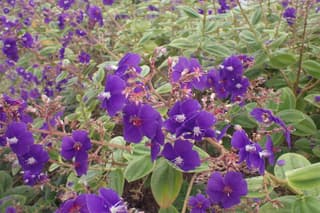
Glory Bush
Pleroma urvilleanum
Glory Bush (Pleroma urvilleanum, synonym Tibouchina urvilleana) is a stunning evergreen shrub native to Brazil's Atlantic Forest (Mata Atlântica). It produces brilliant violet-purple flowers up to 10 cm (4 in) across with distinctive dark stamens, blooming prolifically in summer and fall. Growing 3–6 m tall, it belongs to the family Melastomataceae and has earned the Royal Horticultural Society's Award of Garden Merit.
Oyster mushroom
Pleurotus ostreatus
The oyster mushroom is an edible, wood-decaying fungus that grows in clusters. It has oyster-shaped caps, ranging in color from light gray to dark brown. It is highly valued for its meaty texture and its ability to grow on various cellulose-rich substrates, such as straw or wood.
Find the Perfect Plant
Our plant guide helps you find ideal species for your experience level and time of year.
Browse by Difficulty, Season & More
Use the filters below to narrow this catalog by care difficulty, season, environment, or search directly by name. Each filter leads to a focused list tailored to your specific growing conditions.