Complete Plant Guide
Explore plants by difficulty, season and more. Find the perfect plant for you.
Difficulty
Categories
Plants by City
🗺️ Plants by City3797 plants found
Showing 1621-1656 of 3797
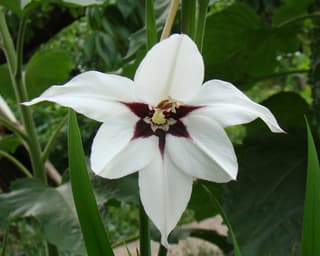
Abyssinian Gladiolus
Gladiolus murielae
Gladiolus murielae, commonly known as Abyssinian Gladiolus or Peacock Orchid, is a stunning bulbous perennial native to the highlands of East Africa, particularly Ethiopia. It produces elegant, star-shaped white flowers adorned with a distinctive deep purple blotch at the center. Blooming in late summer to fall, the fragrant blooms are especially aromatic at dusk and dawn, making it a favorite for evening gardens and cut flower arrangements.

Garden Verbena
Glandularia x hybrida
Garden verbena (Glandularia x hybrida, synonym Verbena x hybrida) is an ornamental plant of hybrid origin, resulting from crosses between South American species of the genus Glandularia. With a low-growing, trailing, or slightly upright habit, it forms compact mounds covered by dense, colorful flower clusters from early summer through fall. It is widely cultivated in gardens, window boxes, hanging baskets, and flower beds for its abundant and prolonged blooming, as well as its ability to attract butterflies and pollinators.
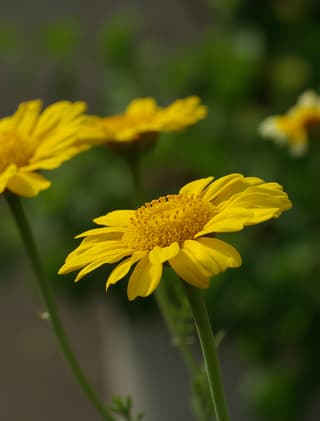
Garland chrysanthemum
Glebionis coronaria
Glebionis coronaria, the garland chrysanthemum, is an annual herb in the Asteraceae family native to the Mediterranean. It features aromatic, deeply serrated leaves and yellow to white daisy-like flowers. While grown as an ornamental garden plant, it is highly valued in East Asian cuisine as a leafy vegetable (Japanese shungiku, Chinese tong hao, Korean ssukgat) added to soups, stews, and salads.
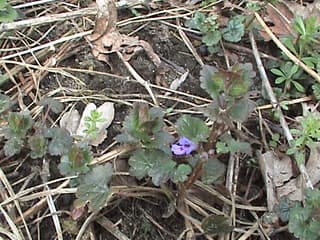
Creeping Charlie
Glechoma hederacea
Glechoma hederacea, commonly known as Creeping Charlie or Ground Ivy, is a fast-growing evergreen perennial native to Europe and Asia. It belongs to the mint family (Lamiaceae) and produces small, rounded, aromatic leaves with scalloped edges on trailing stems. In spring, it blooms with delicate lavender-blue flowers that attract pollinators. It thrives as both a ground cover outdoors and a trailing houseplant indoors, adapting well to partial shade.

Honey Locust
Gleditsia triacanthos
Gleditsia triacanthos, commonly known as the Honey Locust, is a fast-growing deciduous tree native to North America. It is celebrated for its feathery, compound foliage, fragrant spring flowers, and remarkable adaptability to urban conditions, drought, salt, and pollution. The tree can reach 18–24 m tall and features distinctive branched thorns along its trunk and branches, though thornless cultivars are widely available.

Coral Fern
Gleichenia polypodioides
Gleichenia polypodioides, commonly known as the coral fern, is an evergreen climbing fern native to southern and east tropical Africa. It is recognized by its dichotomously forked fronds, dark wiry stipes, and vigorous scrambling habit. It colonizes moist slopes, stream banks, road embankments, and eroded ravines in regions of high rainfall and frequent mist.
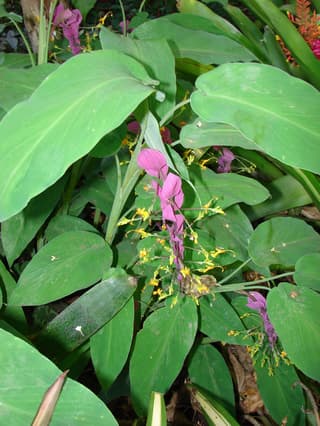
Dancing Lady Ginger
Globba winitii
Globba winitii, commonly known as Dancing Lady Ginger, is a stunning tropical plant native to Thailand. It belongs to the Zingiberaceae family and produces elegant drooping sprays of small yellow flowers with showy purple or white bracts that resemble dancing ladies. The plant is deciduous, dying back in winter and re-emerging in spring with lush green foliage.
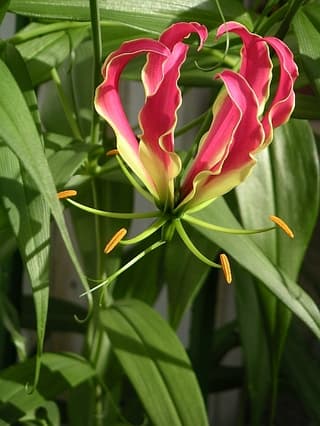
Gloriosa Lily
Gloriosa rothschildiana
Gloriosa rothschildiana, commonly known as the Gloriosa Lily or Flame Lily, is a spectacular climbing plant native to Tropical Africa. It produces stunning flame-like flowers with reflexed red and yellow petals, making it one of the most exotic and eye-catching flowering plants available. Growing from a V-shaped tuber, this vigorous climber uses leaf-tip tendrils to scale supports, reaching up to 2 meters in height. It is the national flower of Zimbabwe and Sri Lanka.
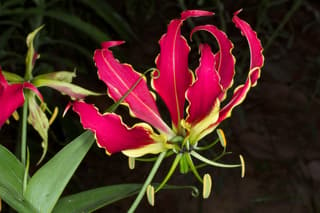
Flame lily
Gloriosa superba
The Flame lily (Gloriosa superba) is a perennial climbing tuberous plant from the Colchicaceae family, native to tropical Africa and Asia. Slender stems, usually 3 to 10 feet long, grow from an underground tuber and cling to supports using thin tendrils at the leaf tips. The striking flowers, with wavy, reflexed petals, change color from yellow through orange to deep red. The plant is extremely toxic, as all its parts—especially the tuber and seeds—contain the alkaloid colchicine. Grow it only where children and pets cannot reach it.
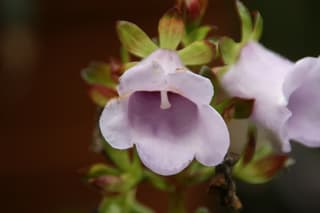
Canterbury Bell
Gloxinia perennis
Gloxinia perennis, commonly known as Canterbury Bell or Perennial Gloxinia, is a tropical rhizomatous herbaceous plant from the family Gesneriaceae, native to the Andes of South America. Unlike the Florist's Gloxinia (Sinningia speciosa), this is the true Gloxinia — a robust, long-lived perennial. It produces stunning tubular lavender-purple flowers with a distinctive mint fragrance, blooming from summer through fall.
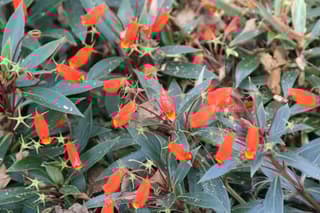
Bolivian Sunset Gloxinia
Gloxinia sylvatica
Gloxinia sylvatica, commonly known as Bolivian Sunset Gloxinia or Hardy Gloxinia, is a rhizomatous perennial native to the Andean forests of Bolivia and Peru. A member of the Gesneriaceae family, it produces striking tubular flowers in vivid orange-red hues with yellow throats, blooming primarily in fall and winter. Compact and versatile, it thrives both indoors and in subtropical outdoor gardens.

Soybean
Glycine max
An annual legume from the Fabaceae family. Glycine max is a photoperiod-sensitive short-day plant cultivated worldwide in temperate to subtropical climates. The plant forms nitrogen-fixing root nodules, enabling sustainable soil use. It produces seeds rich in protein and oil, which are of great economic importance.
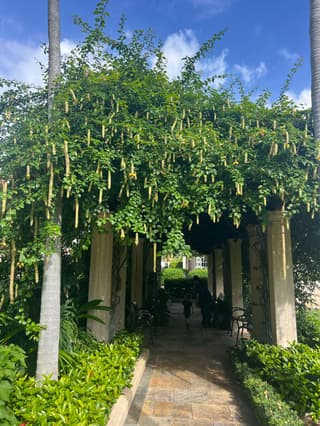
Parrot's Beak
Gmelina philippensis
Gmelina philippensis, commonly known as Parrot's Beak or Philippine Gmelina, is a tropical shrub or small tree native to the Philippines, belonging to the Lamiaceae family. It can reach between 5 and 8 meters in height, with drooping, thorny branches that give it a unique appearance. Its bright yellow flowers, grouped in pendant inflorescences with overlapping reddish-brown bracts, resemble a parrot's beak—hence its common name. The leaves are oval, 5 to 10 cm long, dark green on the upper surface and light green on the lower. The fruit is small, pear-shaped, and contains a single seed. Widely cultivated as an ornamental in tropical and subtropical regions worldwide, it is also an important resource for pollinators such as butterflies and hummingbirds.
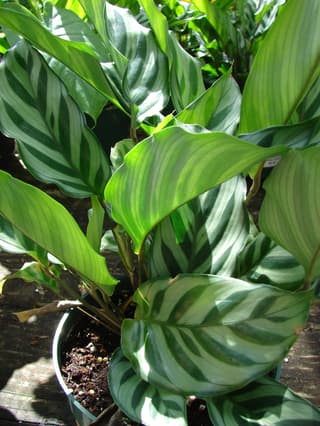
Freddie Calathea
Goeppertia concinna
Freddie Calathea (Goeppertia concinna) is a stunning tropical houseplant from Brazil, belonging to the Marantaceae family. It is celebrated for its striking striped foliage — pale green stripes over deep green leaves — that resemble a leopard's pattern. A popular choice for bringing lush, tropical vibes indoors.
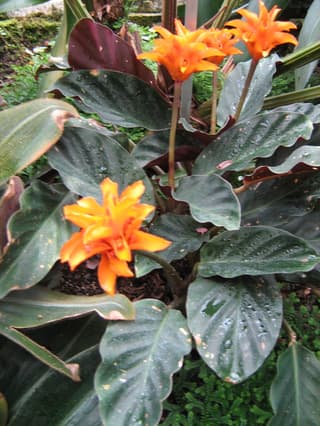
Eternal Flame
Goeppertia crocata
The Eternal Flame plant (Goeppertia crocata) is a rhizomatous herbaceous species in the Marantaceae family, native to the tropical rainforests of Brazil (Bahia and Espírito Santo states). It is prized for its glossy dark green leaves with purple undersides and its striking saffron-orange flower spikes that resemble small flames, remaining showy for weeks to months.

Vittata Prayer Plant
Goeppertia elliptica
Goeppertia elliptica, commonly sold under its older name Calathea vittata or the Vittata prayer plant, is a foliage houseplant in the Marantaceae family native to humid rainforests of Brazil, Colombia, French Guiana, Guyana, Suriname, and Venezuela. Its broad, elliptical leaves are a rich green marked with pale green to creamy pinstripes radiating from the midrib, giving the plant a hand-painted look prized by collectors. Like other prayer plants, it lifts and folds its leaves at dusk and unfurls them again at dawn, tracking the daily light cycle.

Prayer Plant
Goeppertia fasciata
Goeppertia fasciata (syn. Calathea fasciata) is a rhizomatous perennial native to the humid tropical forests of northeastern Brazil. Its rounded, leathery leaves display alternating stripes of dark and light green radiating from the midrib, with a rich purple underside. Like other members of the Marantaceae family, it shows nyctinastic movement, its leaves folding upward at night and opening during the day, resembling praying hands.
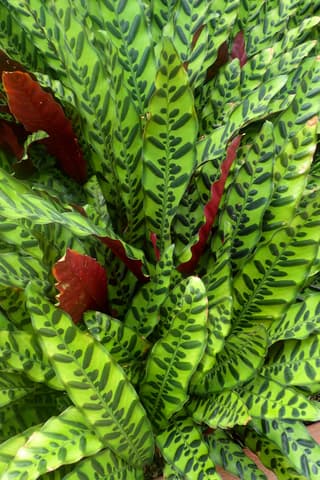
Rattlesnake Plant
Goeppertia insignis
Goeppertia insignis, commonly known as the Rattlesnake Plant (formerly Calathea lancifolia), is a tropical evergreen perennial native to the state of Rio de Janeiro, Brazil. It features long, wavy lance-shaped leaves in pale green with alternating dark green elliptical spots on top and a striking purple underside. Like other prayer plants, it folds its leaves upward at nightfall in a movement called nyctinasty.
Leopard Calathea
Goeppertia leopardina
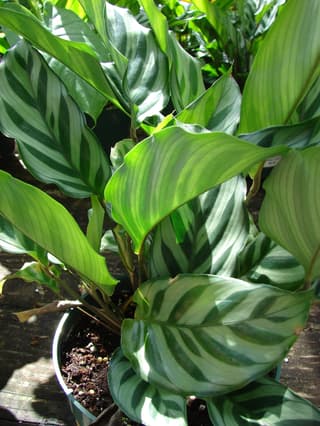
The Leopard Calathea (Goeppertia leopardina, syn. Calathea leopardina) is a compact foliage plant in the Marantaceae family, prized for its glossy oval leaves marked with dark leopard-like blotches along the veins. Like other calatheas, its leaves rise during the day and fold together at night in a movement called nyctinasty, earning the group the nickname "prayer plants." It is a popular indoor houseplant that thrives in bright, filtered light and high humidity.
Thai Beauty Calathea
Goeppertia louisae
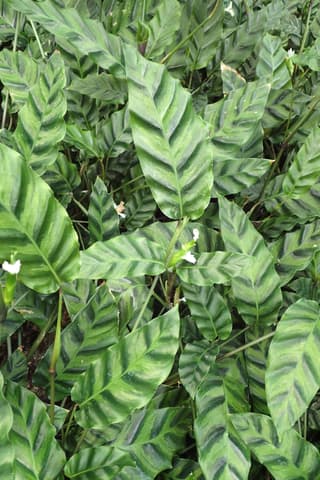
Goeppertia louisae, commonly known as Thai Beauty Calathea, is a tropical houseplant native to the rainforests of southeastern Brazil. A member of the Marantaceae family, it captivates with its glossy, oblong leaves featuring brush-stroke patterns of creamy yellow or pale green against a deep green surface, with striking purple undersides. One of its most enchanting traits is nyctinastic movement — the leaves open at dawn and close at dusk, sometimes producing a soft, audible rustling sound.

White Star Calathea
Goeppertia majestica
The White Star Calathea (Goeppertia majestica), formerly classified as Calathea majestica or Calathea ornata 'Majestica', is a tropical foliage plant in the Marantaceae family, closely related to the popular prayer plants. Its large, oval to lance-shaped leaves display fine white or cream pinstripes radiating from the central vein against a glossy dark-green background, with undersides flushed deep purple — a dramatic contrast that earns it the "white star" nickname. Native to the humid tropical forests of South America, the plant follows the circadian rhythm typical of the genus Goeppertia, raising and folding its leaves in the evening in a movement called nyctinasty, as if in prayer. It is a highly popular indoor choice for its lush ornamental form and because it is completely non-toxic to cats, dogs, and humans, though it demands close attention to air humidity, water quality, and temperature stability to keep its leaves lush and free of crispy tips.
Peacock Plant
Goeppertia makoyana
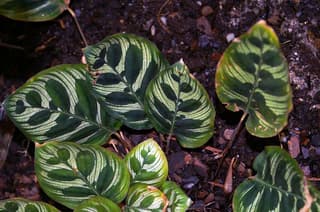
Goeppertia makoyana, commonly known as the Peacock Plant, is a stunning tropical species native to the rainforests of eastern Brazil. Its leaves are a natural work of art: the upper surface displays light and dark green patterns resembling stained-glass cathedral windows, while the underside is painted in deep purple. Like other prayer plants, its leaves move throughout the day in response to light.
Round-leaf Calathea
Goeppertia orbifolia
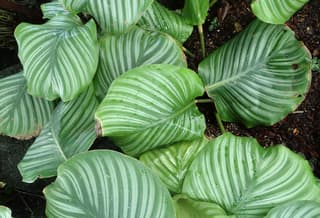
Goeppertia orbifolia, commonly known as Round-leaf Calathea and previously classified as Calathea orbifolia, is a stunning tropical houseplant from the Marantaceae family, native to the forests of Bolivia. Its large, rounded leaves adorned with bold silver-green stripes make it one of the most sought-after indoor plants. Like other prayer plants, it folds its leaves upward at night in a movement called nyctinasty.
Pinstripe Calathea
Goeppertia ornata
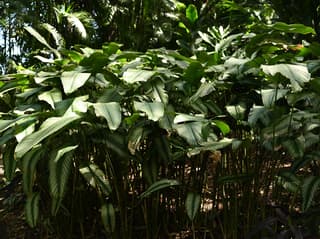
Goeppertia ornata, popularly known as Calathea ornata, is a perennial herbaceous plant native to South America. It is famous for its deep dark-green oval leaves, adorned with thin, elegant lateral stripes that vary from pink to white, resembling brushstrokes. The underside of the leaves features a vibrant burgundy or purple hue. Like other plants in the Marantaceae family, it exhibits nyctinastic movement, closing its leaves vertically at night as if in prayer.
Calathea Picturata
Goeppertia picturata
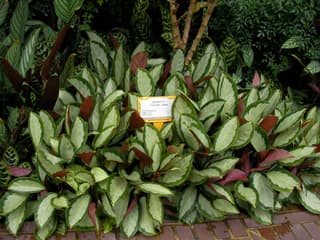
Goeppertia picturata, commonly known as Calathea Picturata, is a tropical houseplant native to northern Brazil in the Marantaceae family. It is prized for its stunning foliage — dark green leaves adorned with silvery stripes along the midrib and margins, and deep purple undersides. Like all prayer plants, it performs nyctinasty: leaves fold upward at night and open again during the day.
Rose Painted Calathea
Goeppertia roseopicta
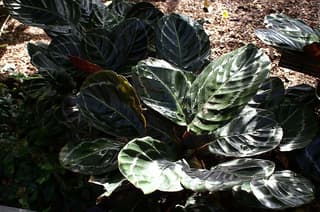
Goeppertia roseopicta, commonly known as the Rose Painted Calathea or Rose-painted Prayer Plant, is a tropical foliage plant native to the Atlantic Forest of Brazil. Previously classified as Calathea roseopicta, it belongs to the family Marantaceae and is celebrated for its stunning oval leaves featuring dark green surfaces with rose-pink and silver brushstroke patterns and deep purple undersides. Famous for cultivars such as Medallion, Dottie, and Rosy, it folds its leaves upward at dusk in a behaviour called nyctinasty.
Furry Feather Calathea
Goeppertia rufibarba
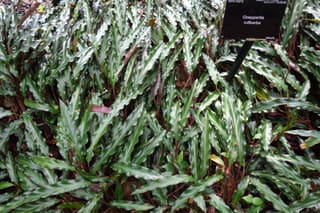
Goeppertia rufibarba, commonly known as the Furry Feather Calathea or Velvet Calathea, is a tropical houseplant native to Brazil. It is prized for its long, wavy leaves with a glossy green upper surface and a distinctive purplish underside covered in soft reddish hairs. A member of the Marantaceae family, it is among the most elegant calatheas for indoor growing.
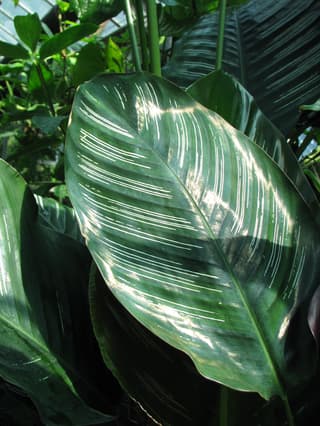
Sander's Calathea
Goeppertia sanderiana
Goeppertia sanderiana, commonly known as Sander's Calathea or Cigar Calathea, is a tropical foliage plant native to the rainforests of Ecuador and Peru in South America. It features large, striking leaves with decorative pink or white pinstripe patterns on a deep green background. A member of the Marantaceae family, it is celebrated for its nyctinastic leaf movement — leaves open during the day and fold upward at night, earning it the nickname 'prayer plant'.
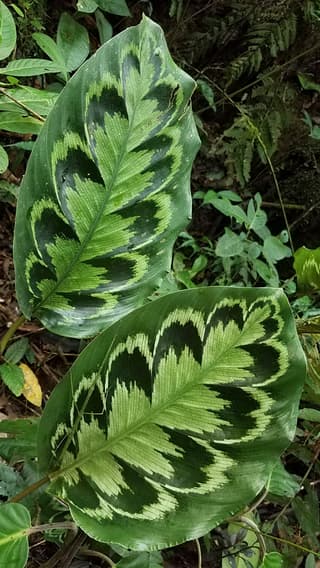
Medallion Calathea
Goeppertia veitchiana
Goeppertia veitchiana, popularly known as Medallion Calathea, is a tropical plant native to the rainforests of Ecuador. Its leaves are true works of art: large, rounded, and adorned with patterns in shades of dark and light green, with a wine-red underside. Like other prayer plants in the Marantaceae family, it moves its leaves throughout the day in response to light.
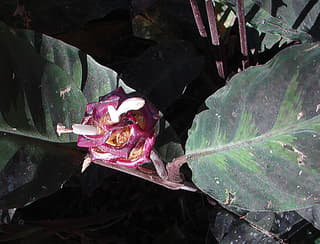
Jungle Velvet Calathea
Goeppertia warszewiczii
Goeppertia warszewiczii, popularly known as the Jungle Velvet Calathea, is a striking tropical houseplant native to the rainforest understory of Costa Rica and Nicaragua. Prized for its oversized, velvety dark-green leaves marked with a feathery light-green midrib pattern and deep purple undersides, it is one of the larger and more dramatic members of the prayer-plant family (Marantaceae). Like other Calatheas, its leaves fold upward at night in a nyctinastic movement, giving the plant its 'prayer plant' nickname.

Zebra Plant
Goeppertia zebrina
Goeppertia zebrina, commonly known as the Zebra Plant or Zebra Calathea, is a stunning tropical plant native to the southeastern rainforests of Brazil. It is prized for its large, velvety leaves adorned with alternating dark and light green stripes reminiscent of a zebra pattern.
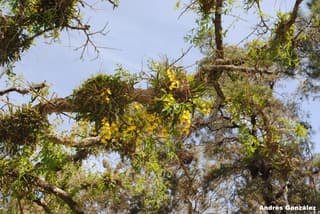
Dancing-lady orchid
Gomesa bifolia
Gomesa bifolia (synonym Oncidium bifolium) is a small epiphytic orchid native to riparian forests and high-altitude woodlands of southern Brazil (Paraná, Santa Catarina, and Rio Grande do Sul), as well as Bolivia, Uruguay, and Argentina, occurring at altitudes between 100 and 1,300 m. It forms clustered ovoid pseudobulbs, from which usually a single linear-elongated leaf grows (rarely two). Between late winter and early spring, it produces arched flower spikes up to 35 cm long with several small flowers (2 to 2.5 cm), featuring yellow sepals and petals spotted with brown and a smooth, showy yellow lip, which are sometimes fragrant.

Balloon Plant
Gomphocarpus physocarpus
Gomphocarpus physocarpus is a perennial subshrub native to Southern Africa, now widely naturalized and cultivated as an ornamental worldwide. It reaches about 1.5 to 2 meters (5 to 6.5 feet) in height, with narrow, lanceolate, light green foliage. Its distinctive feature is its spectacular fruiting: inflated, spherical, pale green follicles covered with soft bristles, resembling small spiky balloons, which open at maturity to release seeds topped with a silky tuft. The small, white flowers tinged with pink are slightly fragrant. The entire plant contains a milky sap rich in cardiotonic glycosides, making it toxic if ingested and irritating upon contact with skin and eyes.
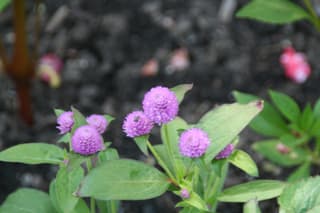
Globe Amaranth
Gomphrena globosa
Gomphrena globosa, commonly known as Globe Amaranth, is an annual flowering plant native to Central America, belonging to the Amaranthaceae family. It produces striking globe-shaped flower heads in shades of purple, pink, white, red, and orange that retain their color long after cutting. Highly tolerant of heat and drought, it thrives in full sun and is an excellent choice for garden borders, containers, and dried flower arrangements.

Giraffe's Knees
Gonatopus boivinii
Gonatopus boivinii, commonly known as Giraffe's Knees, is a rare tuberous aroid native to East Africa (Kenya and Tanzania). Its distinctive stem features swollen knobby nodes that resemble a giraffe's knobbly knees, making it one of the most visually unique houseplants available. A single large marbled leaf emerges from the flat tuber, reaching up to 90 cm tall. It is a deciduous plant that goes dormant in winter, dropping its leaf.
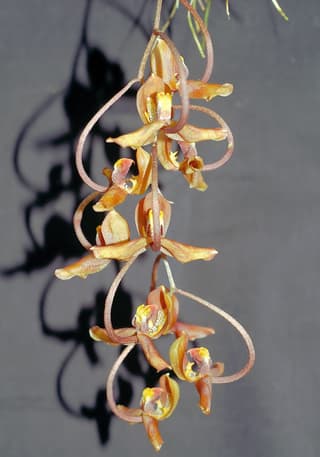
Helmet Orchid
Gongora galeata
Gongora galeata is a medium-sized epiphytic orchid endemic to southern Mexico, where it grows naturally in montane cloud forests and cloud forests between 600 and 1,800 meters in altitude, frequently associated with sweetgum (Liquidambar) trees. Its ovoid-pyriform, longitudinally furrowed pseudobulbs support two plicate leaves per plant. It produces basal, pendent floral racemes 15 to 20 cm long, with numerous fragrant flowers about 5 cm in size, mottled in shades of orange, yellow, brown, and purple, with a shape reminiscent of a helmet (hence its epithet 'galeata', meaning 'helmeted'). It blooms in summer and fall.
Find the Perfect Plant
Our plant guide helps you find ideal species for your experience level and time of year.
Browse by Difficulty, Season & More
Use the filters below to narrow this catalog by care difficulty, season, environment, or search directly by name. Each filter leads to a focused list tailored to your specific growing conditions.