Complete Plant Guide
Explore plants by difficulty, season and more. Find the perfect plant for you.
Difficulty
Categories
Plants by City
🗺️ Plants by City3779 plants found
Showing 1153-1188 of 3779
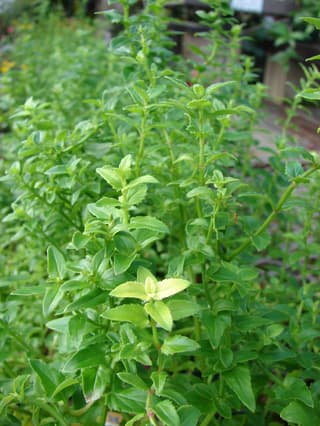
Twinspur
Diascia spp
Diascia, commonly known as Twinspur, is a genus of around 70 species of herbaceous annual and perennial flowering plants native to South Africa, belonging to the family Scrophulariaceae. These charming low-growing plants are celebrated for their dainty, spurred flowers in shades of pink, red, orange, and white, blooming prolifically from spring through autumn. They thrive in well-draining soil with full sun and are popular in garden borders, hanging baskets, and containers.
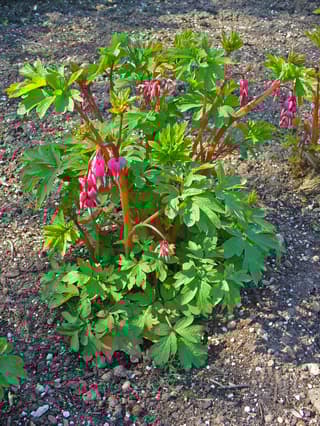
Bleeding Heart
Dicentra spectabilis
Dicentra spectabilis, commonly known as Bleeding Heart, is a shade-loving perennial native to northeastern China, Japan, and Korea. It produces stunning arching stems adorned with heart-shaped pink, red, or white flowers in spring, before going dormant in summer heat.
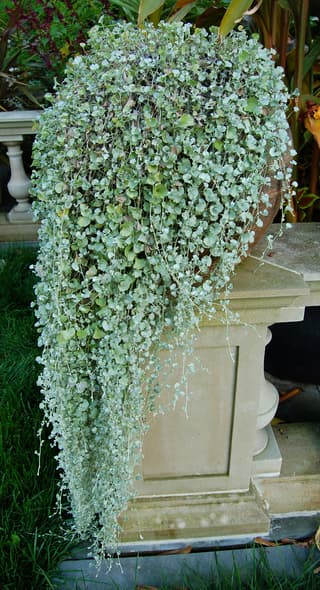
Silver Falls
Dichondra argentea
Dichondra argentea, commonly known as Silver Falls or Silver Ponysfoot, is a trailing and cascading ornamental plant in the Convolvulaceae family, native to the southwestern United States and northern Mexico. Its small, fan-shaped leaves coated in fine silver hairs create stunning metallic cascades up to 120 cm long, making it a favourite for hanging baskets, window boxes, and container gardens. The evergreen silvery foliage remains attractive throughout the growing season.
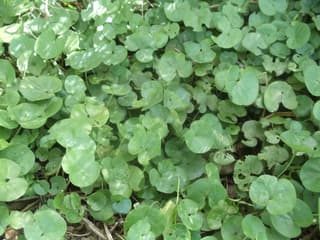
Asian Ponysfoot
Dichondra micrantha
Dichondra micrantha, commonly known as Asian Ponysfoot or Kidney Weed, is a low-growing creeping groundcover native to East Asia (Japan, China, Korea). It features small, kidney-shaped leaves on slender stems that hug the ground, forming a dense, lush carpet. It is widely used as a lawn alternative, between stepping stones, or as a trailing plant in hanging baskets.
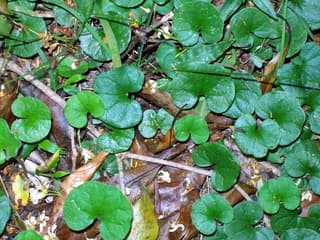
Kidney weed
Dichondra repens
Low-growing perennial groundcover with small, kidney-shaped leaves. Native to tropical and cool temperate regions. Forms dense mats with vigorous spreading habit, rooting at leaf nodes.
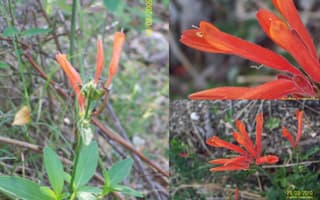
Hummingbird plant
Dicliptera squarrosa
Dicliptera squarrosa is a perennial subshrub in the Acanthaceae family, native to central South America—occurring in Peru, Bolivia, Paraguay, northern Argentina, Uruguay, and the south, southeast, and midwest of Brazil, including Cerrado areas. Also known as the hummingbird plant and firecracker plant, it owes its nicknames to its tubular orange-red flowers, which are highly sought after by hummingbirds and butterflies. It is a low to medium-sized subshrub with an upright to trailing habit and thin stems, reaching about 24 inches (60 cm) in height by 18 inches (45 cm) in width (potentially reaching 3 feet in more vigorous cultivation). The leaves are opposite, ovate, soft, and velvety, covered by a fine grayish down that gives them a characteristic gray-green tone. The flowers, 0.8 to 1.5 inches (2 to 4 cm) long, appear in axillary and terminal clusters and bloom from spring to fall, peaking between summer and early autumn.
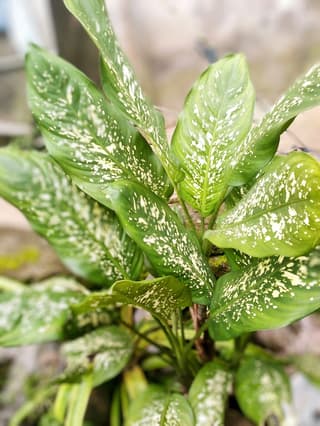
Dumb Cane
Dieffenbachia
Dieffenbachia is a genus of tropical foliage plants in the Araceae family, native to the tropical Americas. Widely grown as indoor ornamentals for their large, variegated leaves in shades of green, cream, and white. Data represents the genus as a whole (D. seguine, D. amoena, D. picta). All parts are toxic due to calcium oxalate crystals.
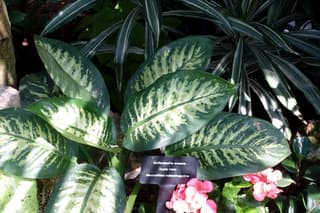
Giant Dumb Cane
Dieffenbachia amoena
Dieffenbachia amoena, commonly known as Giant Dumb Cane, is a tropical houseplant native to the tropical Americas. It is prized for its large, bold leaves featuring deep green coloration with creamy white variegation. WARNING: this plant is severely toxic to humans, cats, and dogs due to calcium oxalate raphides present in all plant tissues.
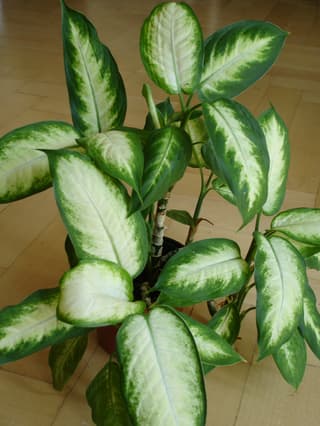
Bowmann Dumb Cane
Dieffenbachia bowmannii
Dieffenbachia bowmannii is one of the largest species in the genus, native to tropical regions of Central and South America. Its impressive leaves can reach up to 60 cm in length, displaying unique patterns of dark green with pale green to cream-white markings, making it a stunning centrepiece for indoor spaces.
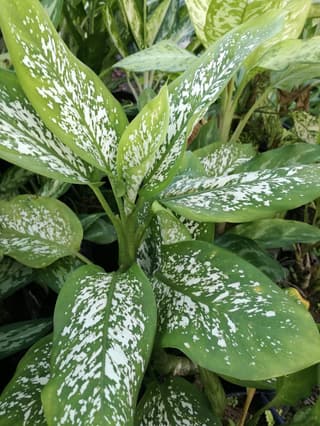
Spotted Dumb Cane
Dieffenbachia picta
Dieffenbachia picta, widely sold simply as "dumb cane" or "spotted dieffenbachia," is a striking tropical foliage houseplant in the arum family (Araceae), native to the humid forests of the Caribbean and Central and South America. Its broad, glossy leaves are marbled with irregular cream, white, or pale-green blotches over a dark green background, making it a long-standing favorite for adding jungle texture to shaded interiors. Botanically, "picta" is most often treated today as a synonym or a spotted cultivar group within Dieffenbachia seguine (=D. maculata), and nursery tags reading "D. picta" typically refer to this same variegated horticultural type. All parts of the plant are HIGHLY TOXIC: the sap contains needle-shaped calcium oxalate crystals (raphides) that, when chewed or bitten, pierce the soft tissue of the mouth and throat, causing intense burning pain, excessive drooling, and swelling severe enough to temporarily impair speech — the origin of the common name "dumb cane."
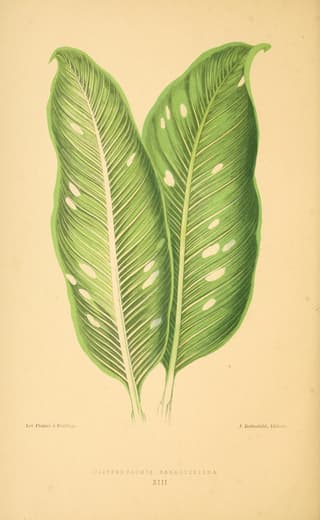
Dumb Cane
Dieffenbachia seguine
Dieffenbachia seguine is a tropical plant from the Araceae family, native to the Caribbean and Central America. It is known for its large decorative dark green leaves with white or cream spots. It can reach up to 3 meters in height under optimal conditions. It is extremely toxic due to calcium oxalate crystals in its sap, which can cause severe irritation and throat swelling if ingested.
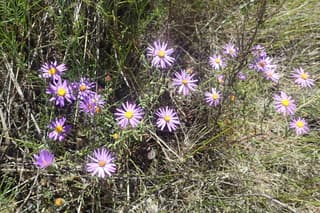
Hoary Tansyaster
Dieteria canescens
Dieteria canescens (formerly Machaeranthera canescens) is a herbaceous plant in the daisy family, native to western North America: from southern British Columbia to Baja California and Chihuahua, at elevations between 300 and 3,400 m. It is typically a biennial or short-lived perennial, though it sometimes behaves as an annual. It forms branched clumps from 6 to 80 cm (rarely 1 m) tall, with stems and leaves covered in grayish hairs and a strong-smelling sticky resin; hence the name 'canescens', meaning hoary or gray-haired. From June to November, it produces dozens or hundreds of flower heads with bluish-violet rays (sometimes pink or white) and golden-yellow centers. Blooming in late summer and fall when few other flowers remain, it is a valuable nectar source for native bees, honeybees, bee flies, and butterflies; the Sagebrush Checkerspot butterfly (Chlosyne acastus) feeds almost exclusively on it. It grows on open slopes, roadsides, prairies, sagebrush scrub, and pine forests, in sandy or gravelly soils.
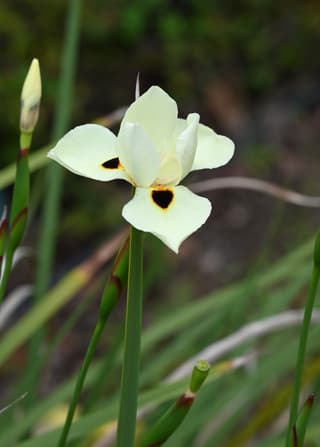
Yellow Wild Iris
Dietes bicolor
Dietes bicolor, commonly known as the Yellow Wild Iris or Butterfly Iris, is a striking evergreen perennial native to the Eastern Cape of South Africa. It forms graceful clumps of long, sword-like pale-green leaves from which elegant pale yellow flowers emerge in spring and summer. Each bloom features distinctive brown and violet markings at the base of the outer petals, giving the flower a butterfly-like appearance. It is prized in landscaping for its toughness, drought tolerance once established, and its ability to thrive in a wide range of conditions.
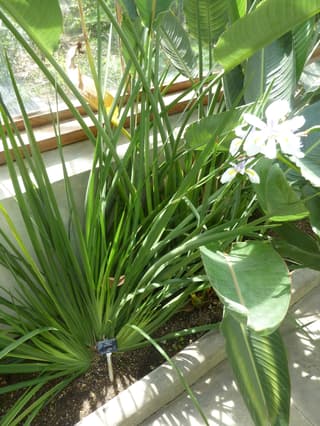
Fairy Iris
Dietes grandiflora
Dietes grandiflora, commonly known as Fairy Iris or Large Wild Iris, is an evergreen perennial native to South Africa. It produces beautiful white flowers with yellow and brown markings resembling orchids, blooming continuously throughout summer in two-week cycles. Highly drought-tolerant once established, it is an excellent low-maintenance plant for gardens, borders, and mass plantings.
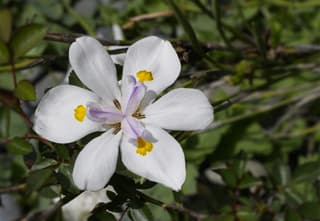
African Iris
Dietes iridioides
Dietes iridioides, commonly known as African Iris or Fortnight Lily, is a tough, evergreen perennial native to South Africa. It produces elegant white flowers adorned with violet and yellow markings that bloom in two-week intervals during spring and summer. Its sword-shaped leaves form attractive, low-maintenance clumps.
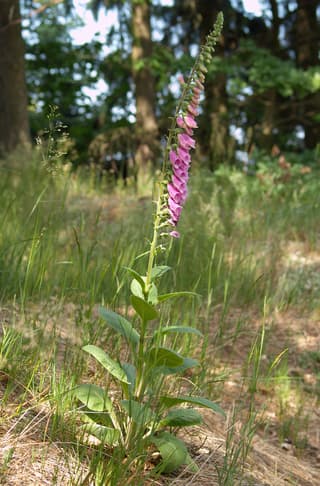
Common Foxglove
Digitalis purpurea
Common Foxglove (Digitalis purpurea) is a striking European biennial renowned for its tall spires of tubular flowers in shades of purple, pink, white, and cream. In its first year it forms a low rosette of leaves; in the second year it sends up dramatic flowering stalks reaching 1.5 meters tall. Beloved in cottage gardens, it is highly toxic yet historically invaluable as the source of cardiac glycosides used in modern medicine.

Crabgrass
Digitaria
Digitaria is a large genus of annual and perennial grasses in the family Poaceae, comprising roughly 300 species found across tropical, subtropical, and warm temperate regions worldwide. The genus name comes from the Latin "digitus" (finger), referring to the finger-like arrangement of the flowering spikes that radiate from a central point atop each stem. Most species are low-growing and sprawling, rooting readily at the nodes where stems touch the soil, which gives them a crab-like spreading habit and the common name "crabgrass." While several species, such as Digitaria sanguinalis (large crabgrass) and Digitaria ischaemum (smooth crabgrass), are considered aggressive lawn and garden weeds valued for their toughness and drought tolerance, others are cultivated purposefully: Digitaria exilis (white fonio) and Digitaria iburua (black fonio) are ancient West African cereal crops, among the oldest cultivated grains in the world, prized for their fast maturation and ability to thrive in poor, dry soils.
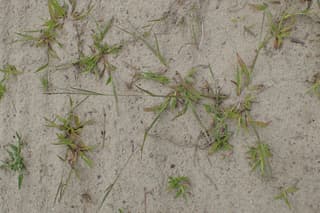
Smooth Crabgrass
Digitaria ischaemum
Smooth crabgrass is a warm-season annual grass in the Poaceae family, native to Eurasia and now widespread throughout temperate regions as an introduced species and common lawn and garden weed. It displays a ground-hugging clumping habit, with flat, hairless leaves up to 4 inches long. The plant frequently roots at the leaf nodes, making it difficult to remove. A single plant can produce over 140,000 seeds.
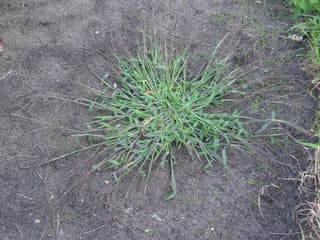
hairy crabgrass
Digitaria sanguinalis
Digitaria sanguinalis is a summer-annual weedy grass native to Eurasia, now naturalized worldwide, belonging to family Poaceae. It develops several branching, hairy stems from the base that sprawl horizontally and root at nodes, bearing linear leaves 3–6 inches long with hairy sheaths. The inflorescence consists of up to nine long, radiating finger-like raceme spikes bearing tiny spikelets that may appear reddish or purplish at maturity.
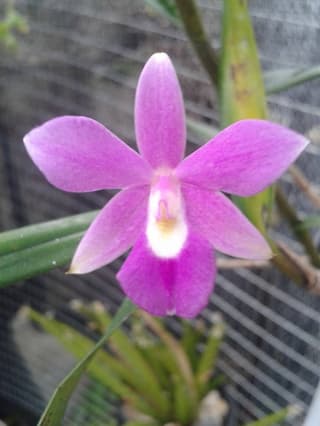
Pink Butterfly Orchid
Dimerandra emarginata
Dimerandra emarginata is a medium-sized epiphytic orchid native to the rainforests of Central America, northern South America, and the Caribbean, from Mexico south to Brazil. It grows on tree bark or rocks, producing slender, cane-like stems with leathery, notch-tipped leaves. From summer through fall, it bears clusters of small but vivid pink flowers with a white-and-pink lip, blooming successively over weeks. Commonly called the Pink Butterfly Orchid, it thrives mounted or in open, well-draining bark mixes that mimic its natural epiphytic habitat.
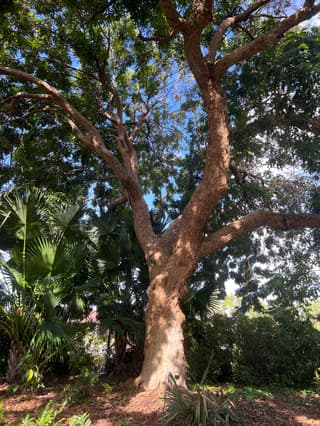
Longan
Dimocarpus longan
Dimocarpus longan, commonly known as longan or 'dragon's eye,' is an evergreen fruit tree belonging to the soapberry family (Sapindaceae), native to Southeast Asia. It grows up to 12 meters tall, forming a spreading crown with paripinnate, leathery leaves. Small, yellowish-white flowers appear in spring in abundant panicles and are faintly aromatic. The fruits—round, with a brown, brittle skin—contain a translucent, sweet pulp surrounding a single shiny, dark brown seed, resembling an eye. Longan is closely related to lychee and rambutan. It is primarily cultivated in China, Thailand, Vietnam, and other tropical countries for its delicious fruits, timber, and numerous medicinal uses.
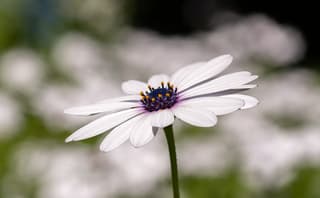
Cape Marguerite
Dimorphotheca ecklonis
The African Daisy (Dimorphotheca ecklonis) is a perennial shrub native to South Africa, famous for its daisy-like flowers with white, pink, or purple petals and an intense dark blue center. Widely cultivated in gardens and pots, it blooms abundantly from spring to fall and is highly appreciated by bees and pollinators.
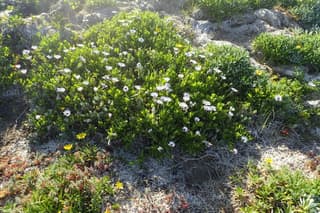
Trailing African Daisy
Dimorphotheca fruticosa
Trailing African Daisy (Dimorphotheca fruticosa, syn. Osteospermum fruticosum) is a fast-growing, evergreen perennial native to South Africa. It forms a dense, spreading mat of semi-succulent, mid-green leaves and produces abundant daisy-like flowers with white or pale lilac petals surrounding a deep purple center. Widely planted as a groundcover on slopes, embankments and along roadsides, it is prized for its drought tolerance, salt tolerance and long bloom period from spring through fall.
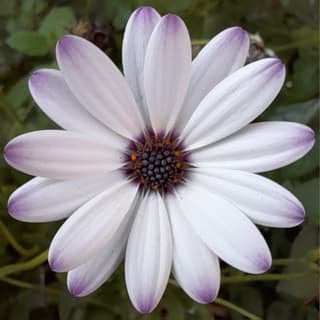
Cape Marigold
Dimorphotheca pluvialis
Dimorphotheca pluvialis, commonly known as Cape Marigold or Rain Daisy, is a South African annual daisy with striking white ray flowers, yellow-brown disc centers, and purple-tinged petal bases. True to its common name, the flowers close before rain and at dusk, making it a natural weather indicator. It is drought-tolerant and thrives in full sun with poor, well-drained soils.
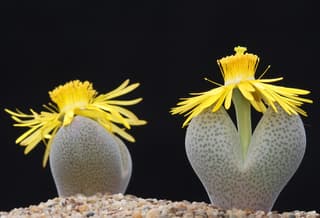
Dinteranthus
Dinteranthus
Dinteranthus is a small genus of six "living stone" succulents in the ice plant family (Aizoaceae), native to the arid north-west of South Africa's Northern Cape and south-eastern Namibia, where they grow among quartz pebbles in very dry, sandy ground. Each head is a single pair of thick, fused leaves 2.5-6 cm long, chalky white, grey, blue-grey or violet-tinged and often dotted, that mimics the stones around it. The plants stay solitary or form small clumps of a few heads. Daisy-like flowers 1.5-4.5 cm wide, golden yellow or white with a yellow centre, open from the slit between the leaves, mostly from late summer to autumn. The most grown species are D. wilmotianus (blue-grey, dotted), D. pole-evansii (chalk-white, like a golf ball) and D. microspermus. Compared with Lithops they have a keel under the leaves, a shallow fibrous root system instead of a taproot and very small, dust-like seeds.
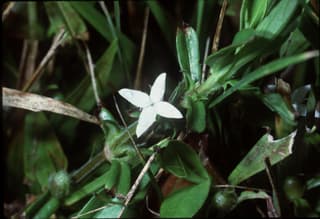
Virginia buttonweed
Diodia virginiana
Virginia buttonweed is a low-growing, mat-forming perennial in the coffee family (Rubiaceae), native to wetlands and disturbed wet ground across the southeastern and south-central United States, Mexico, Cuba, and Nicaragua. Square, sprawling stems creep along the ground and root at the nodes, bearing opposite, lance-shaped leaves and small, four-petaled white (occasionally pink-streaked) star-shaped flowers from early summer through fall. It naturally colonizes swamps, ditches, marsh edges, and pond margins, and is notorious in the southern U.S. as one of the most persistent, hard-to-eradicate broadleaf weeds of lawns and turfgrass, since even small root or stem fragments can re-sprout into new plants.
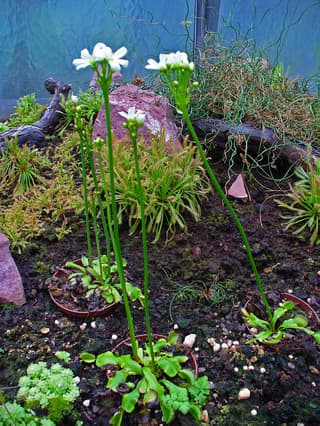
Venus Flytrap
Dionaea muscipula
The Venus Flytrap is one of the most fascinating carnivorous plants in the world, native to the subtropical wetlands of North and South Carolina, USA. Its iconic hinged traps snap shut when trigger hairs are stimulated by unsuspecting insects, digesting prey over 4-10 days. Despite its exotic appearance, it is a surprisingly compact rosette plant that rarely exceeds 30 cm in height.
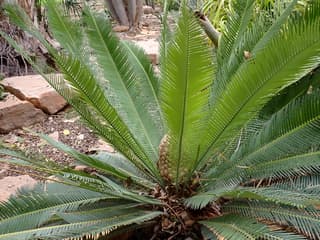
Virgin's Palm
Dioon edule
Dioon edule, commonly known as the Virgin's Palm, is a prehistoric cycad native to Mexico. This plant resembles a palm tree but is botanically closer to conifers. It features stiff, pinnate, matte blue-green leaves that grow in a symmetrical rosette from a short central trunk. It is an extremely long-lived 'living fossil,' capable of living for hundreds of years, and is highly valued in xeriscaping for its resilience and sculptural form.
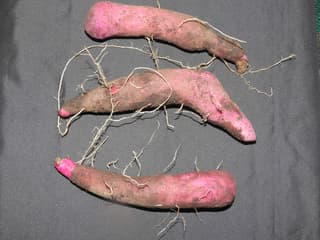
Yam
Dioscorea
Dioscorea is a large genus of over 600 species of twining vines in the family Dioscoreaceae, found across tropical and subtropical regions worldwide. The genus includes important food crops such as D. alata (water yam/purple yam), D. rotundata (white yam), and D. cayenensis (yellow yam), as well as the ornamental D. elephantipes (elephant's foot). Plants produce starchy, edible tubers and vigorous climbing vines that die back to dormancy in cooler or dry seasons.
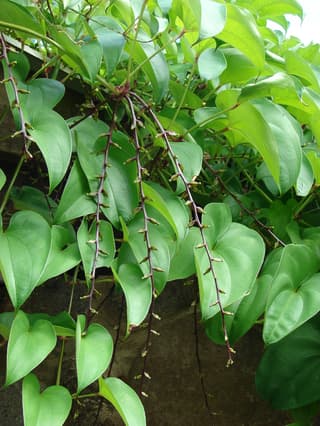
Purple Yam
Dioscorea alata
Purple Yam (Dioscorea alata) is a vigorous tropical climbing vine grown for its starchy, purple-to-white tubers. Native to Southeast Asia, it has spread throughout tropical Africa, the Americas, and the Pacific. It is one of the most widely cultivated yam species in the world, prized for its culinary versatility and cultural significance.

Elephant's Foot
Dioscorea elephantipes
Elephant's Foot (Dioscorea elephantipes) is a slow-growing caudiciform from South Africa, prized for its huge, corky, cracked caudex that resembles an elephant's foot or a tortoise shell. From the caudex, slender twining vines with heart-shaped leaves emerge in the growing season and die back during dormancy. It is a long-lived collector's succulent that can live for decades.
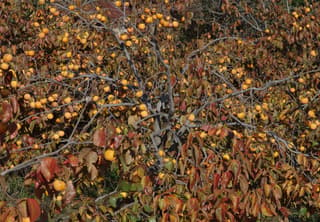
Japanese Persimmon
Diospyros kaki
The Japanese persimmon (Diospyros kaki) is a deciduous fruit tree native to China and Japan, widely cultivated across temperate regions worldwide. Belonging to the family Ebenaceae, it can grow up to 9 meters tall and is prized for its spectacular autumn foliage in shades of gold, orange, red and burgundy, as well as its glossy orange-red fruits that cling to the bare branches well into winter. The persimmon fruit, with its honeyed, floral flavor reminiscent of mango and apricot, is one of the oldest cultivated fruits in East Asia, with records of its cultivation dating back over 2,000 years.
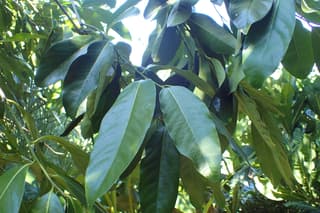
Black Sapote
Diospyros nigra
Black Sapote (Diospyros nigra) is a tropical fruit tree native to Mexico and Central America, belonging to the Ebenaceae (ebony) family. Nicknamed the "chocolate pudding fruit," its ripe pulp develops a deep dark-brown color with a mild, sweet flavor reminiscent of chocolate. It is a slow-growing, evergreen tree that can reach up to 25 meters in its natural habitat, though cultivated specimens are typically kept at 5–10 meters through regular pruning.

American Persimmon
Diospyros virginiana
The American persimmon (Diospyros virginiana) is a slow-growing deciduous fruit tree native to central and eastern North America, prized for its sweet, honey-flavored fruit that ripens only after the first frost. Reaching 30 to 80 feet tall in the wild, it has deeply furrowed, alligator-hide bark, glossy dark green leaves that turn yellow to reddish-purple in fall, and small bell-shaped white to greenish-yellow flowers. Trees are dioecious, meaning separate male and female trees are typically needed for fruit set. Hardy and low-maintenance, it tolerates poor soils, drought, heat, and urban conditions once established.
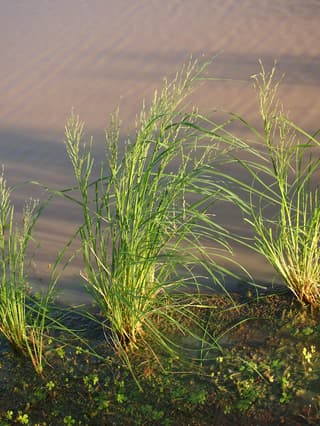
Kallar grass
Diplachne fusca
Diplachne fusca (syn. Leptochloa fusca) is a robust, fast-growing grass, either annual or short-lived perennial, native to tropical and subtropical regions of the Americas, Africa, Asia, and Australia. It grows in dense, erect clumps that can reach up to 1.5 m in height. Its leaves are long, narrow, and slightly rough in texture, with a prominent midrib. The floral panicles are airy, branched, and take on green, brown, and yellow tones as they mature. It is a notable halophyte, capable of thriving in saline, sodic, and waterlogged soils where most grasses cannot survive. It is widely used in bioremediation programs to recover agricultural lands degraded by excess salt.

Mandevilla
Dipladenia sanderi
Mandevilla (Dipladenia sanderi, synonym Mandevilla sanderi) is an ornamental climbing vine from the Apocynaceae family, native to Brazil. It is widely cultivated in pots, trellises, and planters for its showy trumpet-shaped flowers, which bloom abundantly from spring to fall in shades of pink, red, white, or yellow. Its leaves are dark green, glossy, and slightly leathery in texture. It is a vigorous, fast-growing plant when well-cared for, frequently used to cover fences, pergolas, and trellises in warm climates.
Find the Perfect Plant
Our plant guide helps you find ideal species for your experience level and time of year.
Browse by Difficulty, Season & More
Use the filters below to narrow this catalog by care difficulty, season, environment, or search directly by name. Each filter leads to a focused list tailored to your specific growing conditions.