Complete Plant Guide
Explore plants by difficulty, season and more. Find the perfect plant for you.
Difficulty
Categories
Plants by City
🗺️ Plants by City3752 plants found
Showing 649-684 of 3752
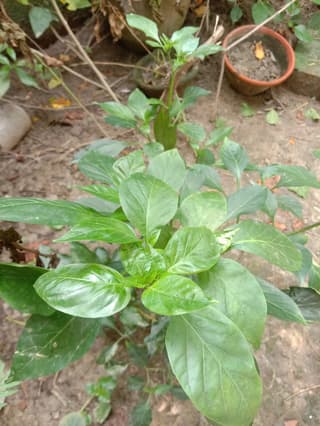
Peppers & Chili Peppers
Capsicum
Capsicum is a genus of warm-season, frost-tender flowering plants in the nightshade family (Solanaceae), native to tropical Central and South America and cultivated worldwide for their edible fruits. The genus spans everything from mild sweet peppers and bell peppers to fiery hot chilies like jalapeno, habanero, and ghost pepper - all sharing the same basic growth habit: a bushy, woody-based shrub or subshrub with simple oval leaves, star-shaped white (occasionally purple) flowers, and hollow, seed-filled fruits that ripen from green through yellow, orange, red, or purple. Grown as annuals in temperate climates and as short-lived perennials in the tropics, peppers thrive with full sun, warm days, consistently moist well-draining soil, and protection from frost.
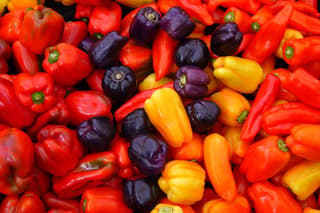
Chili pepper
Capsicum annuum
Capsicum annuum is an extremely versatile species that includes everything from sweet bell peppers to spicy peppers like Jalapeño and Cayenne. It is a perennial shrubby plant in tropical climates but is often grown as an annual in cooler regions. Its flowers are small and white, giving rise to fruits that vary drastically in color, size, and capsaicin level.
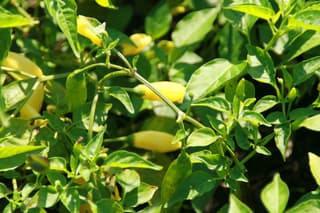
Aji Amarillo Pepper
Capsicum baccatum
Capsicum baccatum, commonly known as aji amarillo, is a South American chili pepper native to Peru and Bolivia. It produces elongated yellow-orange fruits with a fruity flavor and moderate heat, belonging to the Solanaceae family. It can be grown in containers or directly in garden beds and is prized both for culinary use and ornamental appeal.
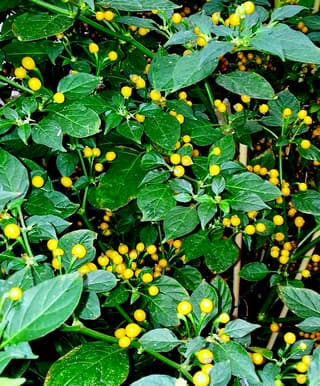
Habanero Pepper
Capsicum chinense
Capsicum chinense is the species that unites the world's most iconic hot peppers — Habanero, Scotch Bonnet, Carolina Reaper, Bhut Jolokia (Ghost Pepper), and the mild Brazilian Biquinho pepper. Native to the tropical Americas, it has been cultivated by indigenous peoples for millennia. The species produces fruits with very high concentrations of capsaicin, ranging from mild (like Biquinho and Aji Dulce) to world-record hot (Carolina Reaper, over 2 million SHU). It is a robust, ornamental plant with exceptional culinary and medicinal value.
Tabasco Pepper
Capsicum frutescens
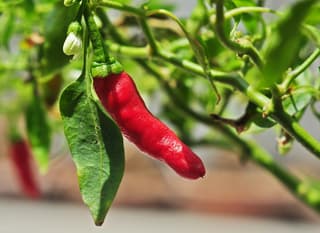
Capsicum frutescens, commonly known as the Tabasco Pepper or Bird's Eye Pepper, is a species of chili pepper in the Solanaceae family, native to tropical Americas. This iconic hot pepper species produces small, extremely pungent fruits that ripen from green to bright red. It includes famous cultivars such as Tabasco and Malagueta, and is distinct from the more common Capsicum annuum. Prized worldwide for its intense heat and fruity flavor, it is a cornerstone of hot sauces and spicy cuisines globally.
Bittercress
Cardamine
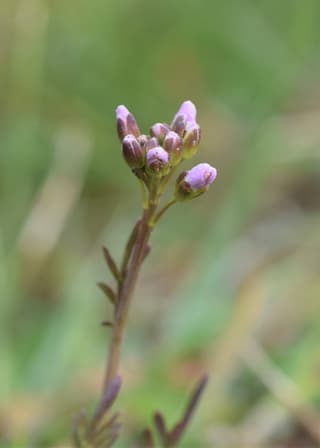
Cardamine is a large genus of herbs in the mustard family Brassicaceae, comprising over 200 annual and perennial species distributed across temperate and cool regions worldwide. Notable species include C. pratensis (cuckoo flower / lady's smock) and C. hirsuta (hairy bittercress). These low-maintenance plants are valued in wildflower gardens, moist borders, and as ground cover.
Hairy Bittercress
Cardamine hirsuta
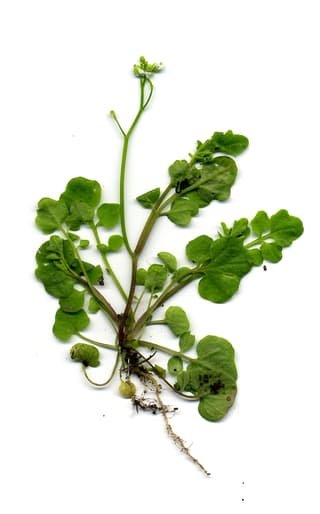
Cardamine hirsuta, commonly known as hairy bittercress, is a small, fast-growing annual (occasionally biennial) herb in the mustard family (Brassicaceae). Native to Europe, Asia and parts of Africa, it now grows almost worldwide as a common garden weed, favoring moist, disturbed soil in beds, containers and pavement cracks. It forms a low rosette of pinnately compound leaves and sends up slender flowering stems topped with tiny four-petaled white flowers. Its slender seed pods (siliques) ripen explosively, catapulting seeds several feet to spread the plant quickly. Despite its weedy reputation, the young leaves are edible and prized for a peppery, cress-like flavor similar to watercress or arugula.
Nursery bittercress
Cardamine occulta
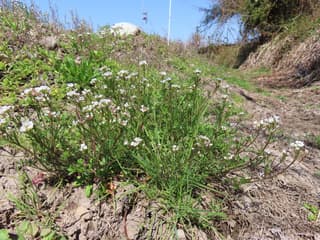
Cardamine occulta, commonly called nursery or hidden bittercress, is a small annual weed in the mustard family (Brassicaceae) native to East and South Asia. It is best known as a persistent hitchhiker weed in nursery container stock, thriving in the moist, shaded, nutrient-rich conditions of greenhouses and irrigated pots. The plant forms a low rosette of pinnately divided leaves and sends up slender branching stems topped with tiny four-petaled white flowers, followed by narrow seed pods (siliques) that explode open at the slightest touch, flinging seeds well away from the parent plant.
Thistle
Carduus
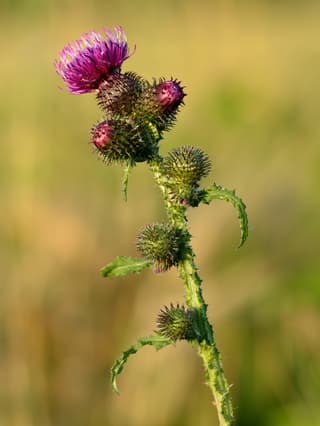
Carduus is a genus in the family Asteraceae comprising around 90 species of spiny thistles, commonly known as "plumeless thistles" because they lack the feathery pappus found in the related genus Cirsium. Native to Europe, North Africa and Asia, many species have naturalized as ruderal or invasive weeds elsewhere, including North America and Australia. This profile describes the genus generally; traits such as height, bloom time and cold hardiness vary among species (e.g., C. nutans, C. acanthoides, C. crispus).
Musk Thistle
Carduus nutans
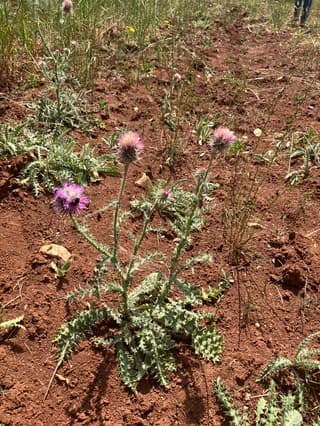
Musk thistle (Carduus nutans) is a biennial weed native to Europe, western Asia, and North Africa, now widely naturalized and declared a noxious invasive species across North America, Australia, New Zealand, and South Africa. In its first year it forms a low, spiny rosette of deeply lobed, grey-green leaves with wavy white margins. In its second year it bolts to 30–170 cm (occasionally up to 270 cm), producing branched, spine-winged stems topped with large, solitary, nodding flowerheads 3–6 cm across in shades of reddish-purple to violet — giving the plant its "nodding" character. Flowers emit a sweet musk-like fragrance that attracts bees, butterflies, and hoverflies in abundance. A single plant can produce up to 20,000 seeds that remain viable in soil for up to 20 years, making it an aggressive colonizer of pastures, roadsides, disturbed ground, and waste areas. Despite its invasive reputation, it has a long history of limited edible and medicinal use in its native range.
Sedge
Carex
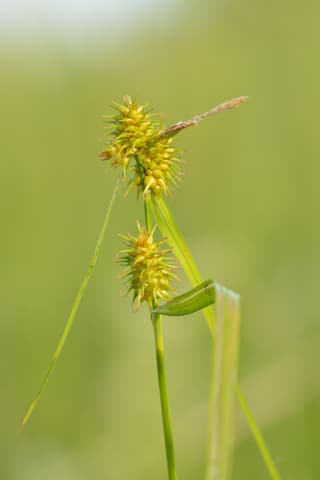
Carex is a vast genus of sedges in the family Cyperaceae, comprising over 2,000 species worldwide. Widely grown as ornamental grasses for their graceful, arching foliage in borders, containers, and water gardens.
Eastern Woodland Sedge
Carex blanda
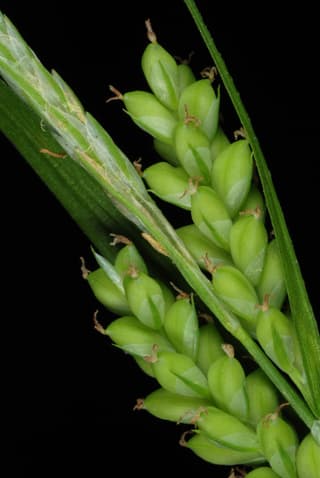
Carex blanda is a delicate native sedge from eastern North America, prized as a graceful shade groundcover. It forms soft, arching mounds of light green semi-evergreen foliage up to 50 cm tall and 60 cm wide. Exceptionally adaptable, it thrives in clay, loam, or rocky soils across a wide pH range, making it a top choice for woodland gardens, rain gardens, and low-maintenance landscapes.
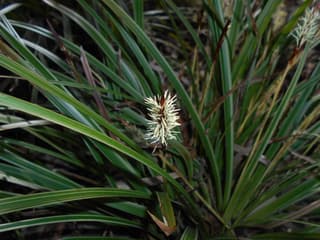
Japanese Sedge
Carex morrowii
Carex morrowii, commonly known as Japanese Sedge or Morrow's Sedge, is an evergreen ornamental grass-like perennial native to Japan. It forms graceful, arching clumps of narrow, often variegated leaves that add texture and movement to shaded gardens. Exceptionally shade-tolerant and low-maintenance, it thrives under trees, in borders, and in containers.
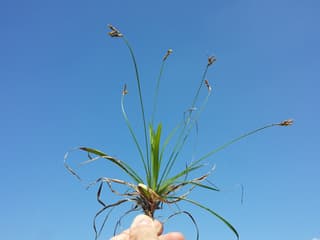
Bird's-foot Sedge
Carex ornithopoda
Carex ornithopoda, commonly called bird's-foot sedge, is a small, slow-growing, evergreen perennial sedge native to Europe and Anatolia. It forms neat, compact tufts of narrow leaves and produces brownish flower spikes resembling a bird's claw in mid-to-late spring. Popular as a low-maintenance edging, ground cover, or rock garden plant.
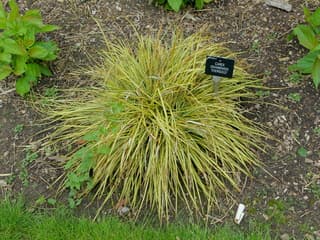
Japanese Sedge
Carex oshimensis
Carex oshimensis, commonly known as Japanese sedge, is an evergreen, clump-forming ornamental grass-like perennial in the sedge family (Cyperaceae), native to the woodlands and rocky slopes of Honshu Island, Japan, particularly the Izu Oshima region from which its species name derives. In cultivation, it is best known through its popular variegated cultivar 'Evergold', prized for narrow, arching leaves striped with a bright creamy-yellow center band bordered by fine dark-green margins. Forming low, fountain-like mounds roughly 30 cm tall and 45 cm wide, it spreads slowly via short rhizomes and produces inconspicuous brown flower spikes in spring. Thriving in part shade to filtered sun, where its variegation stays richest, and in consistently moist, well-drained, slightly acidic soil, Carex oshimensis is prized by gardeners for its low-maintenance, four-season structure. It works beautifully as edging, in mixed containers, along woodland borders, or as a bright groundcover beneath larger shrubs and trees, tolerating occasional drought once established but never thriving in full shade or standing water.
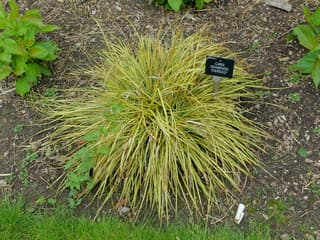
Evergold Sedge
Carex oshimensis 'Evergold'
Carex oshimensis 'Evergold' is a perennial ornamental grass native to Japan, appreciated worldwide for its narrow, variegated foliage featuring golden-yellow centers and dark green margins. Forming compact, arching clumps up to 12 inches (30 cm) tall, this grass-like plant is evergreen, maintaining its visual appeal throughout the year. It is extremely versatile—ideal for borders, groundcover, containers, and Asian-style or contemporary gardens. Deer-resistant, salt-tolerant, and very low-maintenance, it is one of the most reliable ornamental plants for temperate gardens and indoor environments with indirect light.
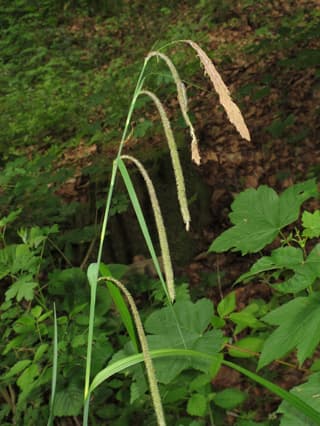
Pendulous Sedge
Carex pendula
Pendulous sedge is a vigorous, evergreen perennial in the Cyperaceae family, native across western, central and southern Europe. It forms large arching clumps of dark green, pleated, grass-like foliage, above which tall stems carry several slender, drooping flower spikes from spring into summer. A tough, adaptable plant, it is a favourite for bog gardens, pond margins and damp shaded borders where few other plants thrive.
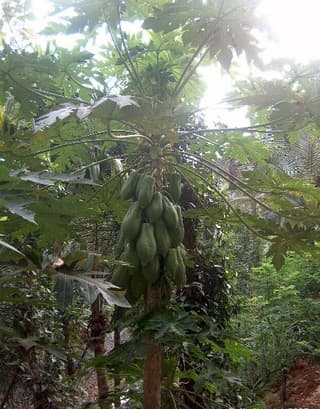
Papaya
Carica papaya
Papaya (Carica papaya) is a fast-growing tropical fruit tree native to Central America and Mexico. One of the most widely cultivated tropical fruits in the world, it can begin bearing fruit within 4–8 months of planting. Its large, deeply lobed leaves, creamy-white flowers, and sweet orange fruits make it a striking presence in tropical and subtropical gardens.
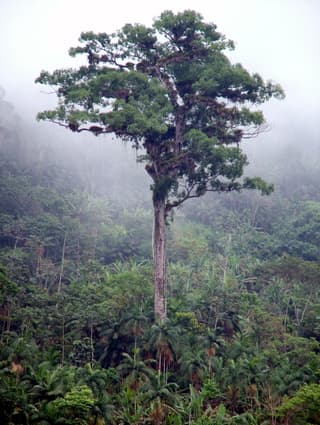
Pink Jequitibá
Cariniana legalis
The Pink Jequitibá (Cariniana legalis) is one of the largest and longest-lived trees native to the Atlantic Forest, capable of exceeding 40-50 meters in height and 7 meters in trunk diameter when mature. An emergent and climax species, it occurs in humid lowlands and slopes of rainforests and semi-deciduous forests, where some individuals exceed 1,000 years of age. It has a straight trunk, thick and deeply furrowed bark, a wide semi-deciduous canopy, and creamy-white flowers gathered in terminal panicles between December and February. Its fruits are woody pyxidia (capsules with a lid) that open to release winged seeds, dispersed by wind and monkeys. It is considered a keystone species for the restoration of native forests and is classified as Vulnerable by the IUCN due to historical logging and habitat loss.
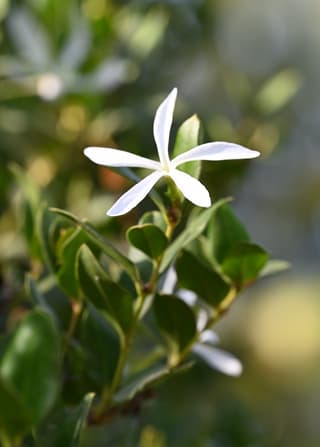
Natal Plum
Carissa macrocarpa
Natal Plum (Carissa macrocarpa) is an evergreen shrub native to the coastal regions of South Africa. It produces fragrant, star-shaped white flowers and edible red berries resembling small plums. Widely used in landscaping for its exceptional tolerance to salt spray, wind, and drought, along with its glossy dark green foliage.
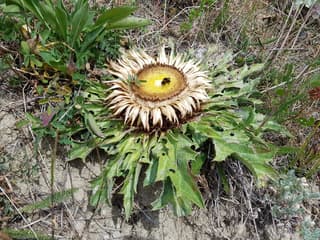
Acanthus-leaved carline thistle
Carlina acanthifolia
The Acanthus-leaved carline thistle (Carlina acanthifolia) is a stemless perennial native to European mountains, forming a rosette of large, spiny, pinnatifid leaves pressed against the ground. Its large solitary flower head, which can reach 15 cm in diameter, features pale golden-yellow inner bracts that act as a natural hygrometer: they close when bad weather approaches and open in dry weather, earning it the nickname 'barometer thistle.' A protected species in France, it is typical of dry limestone grasslands, rocky areas, and mountain meadows up to 1,800 meters in altitude.
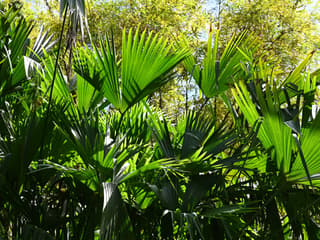
Panama hat plant
Carludovica palmata
Carludovica palmata, popularly known as the Panama hat plant or toquilla palm, is a perennial herbaceous plant in the Cyclanthaceae family, native to the tropical rainforests stretching from southern Mexico to Bolivia. Despite its palm-like appearance, it does not belong to that family: it lacks a woody trunk and grows in clumps from a short or underground stem, with large fan-shaped leaves that can reach up to 1 meter in width and a total height between 1.5 and 4 meters. Its flowers, grouped in a spadix, are cream or whitish in tone, and its ripe fruits acquire orange or reddish hues. It is world-famous because the fibers extracted from its young leaves are hand-woven to create traditional jipijapa hats, erroneously called "Panama hats."
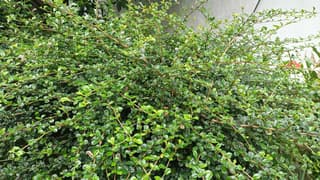
Fukien Tea Tree
Carmona retusa
Carmona retusa, commonly known as the Fukien Tea Tree, is a tropical evergreen shrub highly valued in the art of bonsai. It features small, glossy dark green leaves with a slightly rough texture due to fine hairs. It produces delicate white flowers that can appear year-round in warm climates, followed by small, decorative red berries.
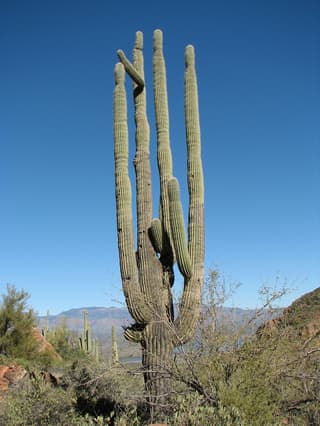
Saguaro
Carnegiea gigantea
The Saguaro (Carnegiea gigantea) is the largest cactus in North America, native to the Sonoran Desert of the United States and Mexico. Recognizable by its towering height of up to 60 feet (18 m) and iconic branching arms, it is the symbol of the American Southwest and the state of Arizona. Saguaro grows extremely slowly — only about 1–1.5 inches per year — and can live for over 200 years.
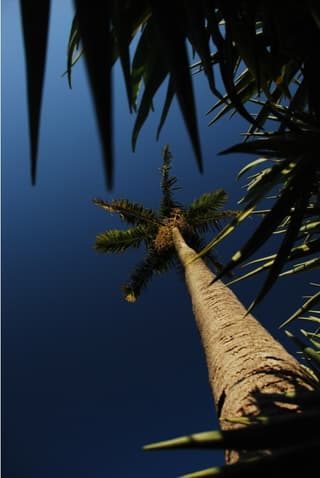
Carpentaria palm
Carpentaria acuminata
Carpentaria acuminata is a solitary palm with a slender, ringed trunk, native to the gallery forests and swamps of northern Australia, in the Carpentaria Gulf region. It can reach 10 to 20 meters in height, with dark green pinnate leaves on the upper side and bluish-green on the underside, and produces pendulous inflorescences with creamy-white flowers followed by showy red fruits.
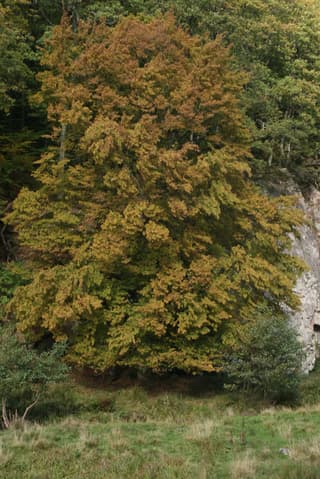
European Hornbeam
Carpinus betulus
The European hornbeam (Carpinus betulus) is a hardy deciduous tree native to Europe and parts of western Asia, prized for its dense, fine-textured foliage and smooth, fluted grey bark. It responds exceptionally well to clipping, which is why it is one of the most popular species for formal hedges and topiary, and its small leaves and compact root system also make it a favorite subject for bonsai.
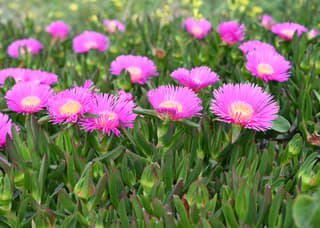
Sally-my-handsome
Carpobrotus acinaciformis
Carpobrotus acinaciformis is a fast-growing, mat-forming succulent native to the coastal dunes of South Africa. It produces spectacular magenta flowers up to 15 cm wide and features thick, sickle-shaped leaves. Widely used as ground cover in coastal and Mediterranean gardens.
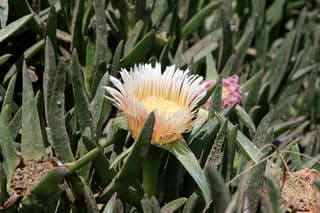
Hottentot Fig
Carpobrotus edulis
Hottentot Fig (Carpobrotus edulis) is a fast-spreading succulent groundcover native to the coastal regions of South Africa. Its fleshy, triangular leaves form dense mats that can extend several meters. It produces showy daisy-like flowers in yellow, purple, or pink during spring and summer, followed by edible fig-like fruits. Considered highly invasive in Mediterranean climates, California, and coastal Australia.
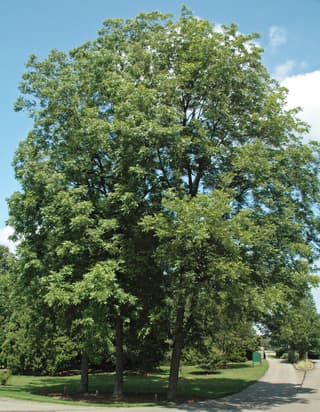
Pecan
Carya illinoinensis
The Pecan (Carya illinoinensis) is a large, majestic deciduous tree native to the southern United States and northern Mexico. It is the most economically important nut tree native to North America, prized for its sweet, buttery nuts and high-quality wood. The tree features a massive canopy with pinnately compound leaves and produces inconspicuous green catkins in the spring. It is a long-lived species that can reach heights of over 100 feet in ideal conditions.
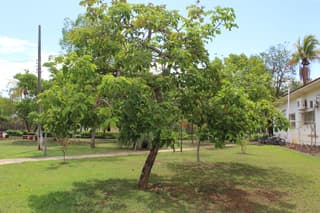
Pequi Tree
Caryocar brasiliense
The Pequi Tree (Caryocar brasiliense) is a native tree of the Brazilian Cerrado savanna, iconic to the culture of Central Brazil. With deciduous leaves and fragrant white flowers pollinated by bats, it produces the famous pequi fruit, rich in carotenoids, vitamin C and fatty acids. It can reach 6 to 11 meters in height, with slow growth, taking 4 to 8 years to produce fruit. It is a keystone species for Cerrado biodiversity, serving as food for birds, mammals and bats.
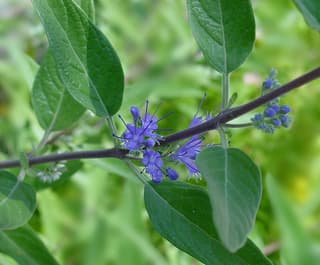
Bluebeard
Caryopteris × clandonensis
Bluebeard (Caryopteris × clandonensis) is a low-growing, deciduous ornamental shrub from the mint family (Lamiaceae), which covers itself with vibrant blue, fragrant flowers from late summer to autumn. Its grayish-green, aromatic leaves when crushed, and compact size of 60-120 cm, make it a popular choice for sunny gardens, as a bee pasture, and for low hedges.
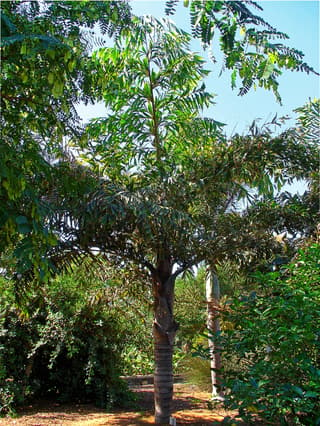
Fishtail Palm
Caryota mitis
Caryota mitis is a fascinating and distinct palm, known for its unique leaves that resemble fish fins or tails. Native to Southeast Asia, it grows in dense clumps, making it excellent for creating natural privacy screens or as a dramatic focal point in spacious interiors. Its leaves are dark green and bipinnate, providing a rich, tropical texture to the environment. It is important to note that its fruits contain calcium oxalate crystals that can cause skin irritation.
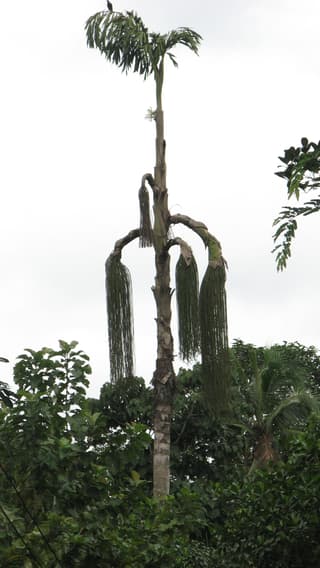
Jaggery Palm
Caryota urens
Caryota urens, commonly known as the Jaggery Palm or Solitary Fishtail Palm, is a tall tropical monocarpic palm native to India, Sri Lanka, and Southeast Asia. It is distinguished by its unique bipinnate leaves with fishtail-shaped leaflets. The plant flowers just once in its 20 to 25 year lifespan. The sap and fruit contain stinging calcium oxalate crystals that irritate skin and mucous membranes.
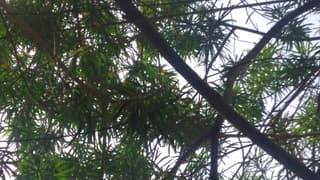
Yellow Oleander
Cascabela thevetia
Yellow Oleander (Cascabela thevetia, syn. Thevetia peruviana) is an evergreen tropical shrub or small tree native to Mexico and Central America, now cultivated worldwide as an ornamental for its glossy, willow-like foliage and fragrant, funnel-shaped yellow to apricot flowers that bloom from summer through fall. WARNING: every part of this plant — leaves, flowers, stems, sap, and especially the seeds — contains potent cardiac glycosides (thevetin A and B, peruvoside, neriifolin) and is SEVERELY TOXIC to humans, cats, and dogs if ingested, potentially causing life-threatening heart arrhythmias. Keep away from children and pets, and always wear gloves when handling it — the sap can also irritate skin.
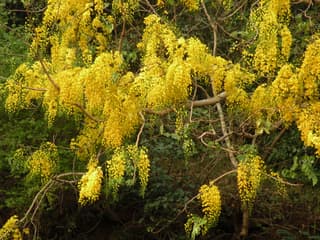
Golden shower tree
Cassia fistula
The golden shower tree (Cassia fistula) is a deciduous tree in the Fabaceae family, native to South Asia. It reaches 10 to 15 m in height and is famous for its spectacular hanging clusters of golden-yellow flowers that appear in spring and summer. After flowering, it produces long, dark brown cylindrical pods. It is the national tree of Thailand and one of the most prized tropical ornamental species in the world.
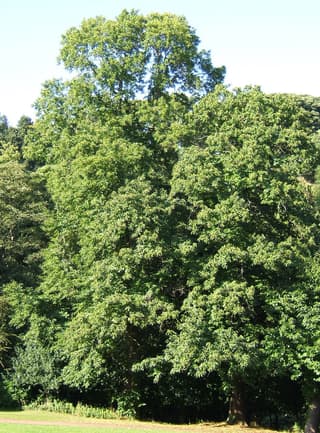
Sweet Chestnut
Castanea sativa
The Sweet Chestnut (Castanea sativa) is a large deciduous tree native to southern Europe and Asia Minor. Cultivated since antiquity for its edible nuts and durable timber, it is one of Europe's most iconic trees. It can live for centuries and grow to impressive heights, making it a majestic feature in rural landscapes and large parks.
Find the Perfect Plant
Our plant guide helps you find ideal species for your experience level and time of year.
Browse by Difficulty, Season & More
Use the filters below to narrow this catalog by care difficulty, season, environment, or search directly by name. Each filter leads to a focused list tailored to your specific growing conditions.