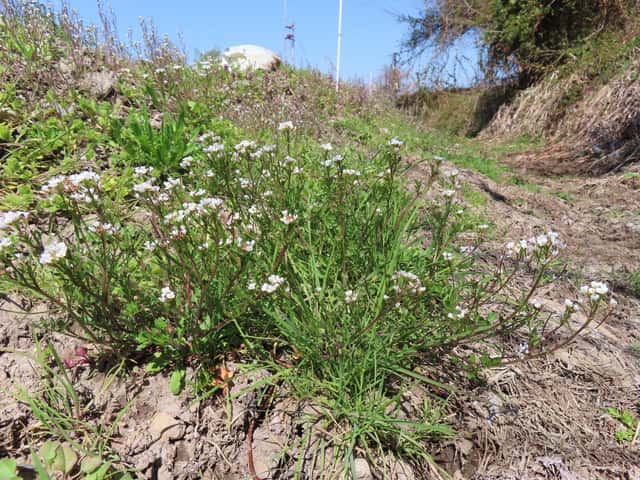
Brassicaceae
Nursery bittercress: Edible Plant
Cardamine occulta
An unfussy, fast-growing annual that needs almost no deliberate care: keep the growing medium consistently moist and give it partial to full shade, and it will complete its life cycle from seed to seed in just a few weeks. Because it self-seeds explosively once pods ripen, it is best removed while still young if you don't want it spreading into other pots.
Every 3 days
Low light
° - °C
% - %
Categories
What is Nursery bittercress?
Nursery bittercress (Cardamine occulta) is a easy-care plant from the Brassicaceae family. Cardamine occulta, commonly called nursery or hidden bittercress, is a small annual weed in the mustard family (Brassicaceae) native to East and South Asia. It is best known as a persistent hitchhiker weed in nursery container stock, thriving in the moist, shaded, nutrient-rich conditions of greenho...
Nursery bittercress grows up to 25cm, watering every 3 days. It is not suitable for indoor environments and safe for pets.
Unlike many tropical plants, Nursery bittercress tolerates watering mistakes. Best for beginners. Unlike many popular species, Nursery bittercress is safe to keep around pets.
How to Care for Nursery bittercress?
TLDR: Nursery bittercress needs Low light, watering every 3 days, and temperatures between 15-30°C with 40-70% humidity.
How Often Should You Water Nursery bittercress?
Keep the soil evenly moist at all times; the shallow, fibrous roots make the plant wilt quickly if it dries out, though it does not tolerate waterlogged, airless soil either.
How Much Light Does Nursery bittercress Need?
Give it bright indirect light or partial to full shade; it struggles in hot, direct full sun, especially once the soil also dries out.
What Is the Best Soil for Nursery bittercress?
Grows best in moist, humus-rich, free-draining potting mix or garden soil; it is adaptable to a wide range of soil textures as long as moisture is reliable.
What Pot Should You Use for Nursery bittercress?
Not typically cultivated intentionally; it usually turns up as a volunteer in the pots of other nursery plants and is pulled out rather than potted on its own, though any well-draining container would suit it if kept.
Care Schedule
Fertilize
Every 14 days
Misting
Every 3 days
Rotate
Every 7 days
Repot
Every 365 days
What Is Nursery bittercress and Where Does It Come From?
Cardamine occulta, commonly called nursery or hidden bittercress, is a small annual weed in the mustard family (Brassicaceae) native to East and South Asia. It is best known as a persistent hitchhiker weed in nursery container stock, thriving in the moist, shaded, nutrient-rich conditions of greenhouses and irrigated pots. The plant forms a low rosette of pinnately divided leaves and sends up slender branching stems topped with tiny four-petaled white flowers, followed by narrow seed pods (siliques) that explode open at the slightest touch, flinging seeds well away from the parent plant.
How to Propagate Nursery bittercress?
Seed sowing / self-seeding
Seeds need almost no assistance; plants self-sow so readily that the main challenge is controlling spread rather than encouraging germination.
- 1 Collect ripe brown seed pods carefully before they burst, or let them dehisce naturally onto soil
- 2 Scatter seeds over moist, humus-rich soil or potting mix, pressing lightly without covering deeply
- 3 Keep the medium consistently moist and in partial shade
- 4 Seedlings emerge within about a week and form a basal rosette before bolting to flower
Materials needed:
How Big Does Nursery bittercress Grow?
TLDR: Nursery bittercress can reach up to 25cm tall with Fast growth rate.
Max height
25cm
Growth rate
Fast
Plant Uses
Edible
Can be consumed
Culinary Uses
- Young leaves and shoots can be eaten raw in salads or cooked like watercress, with a mild peppery, mustard-like flavor
Is your plant showing symptoms?
Click on the symptom to discover possible causes:
What Diseases Commonly Affect Nursery bittercress?
TLDR: Nursery bittercress is susceptible to 5 known diseases. Monitor regularly for early detection.
Whiteflies
Whiteflies are small, soft-bodied, winged insects closely related to aphids and mealybugs. They are moth-like in appearance, about 1/16 inch long, triangular in shape, and gray-white in color. These sap-sucking pests feed on plant tissue, causing yellowing, stunted growth, and wilting. They also excrete honeydew, which attracts ants and promotes sooty mold growth. Whiteflies can transmit serious plant viruses.
Spider Mites
Spider mites are tiny arachnids (less than 1/20 inch long) related to spiders and ticks that feed on plant sap. They thrive in hot, dry conditions and can cause significant damage to ornamental and vegetable plants. During severe infestations, crop losses can reach 14% or higher as these pests disrupt vital plant processes including photosynthesis, carbon dioxide absorption, and transpiration.
Powdery Mildew
Powdery mildew is a common fungal disease caused by various fungi species including Erysiphe, Podosphaera, Oïdium, and Leveillula. It affects over 10,000 plant species worldwide. The disease thrives in warm, dry climates with high humidity and appears as a distinctive white powdery coating on plant surfaces.
Downy Mildew
Downy mildew is a fungal-like disease caused by oomycetes (water molds) that thrives in cool, wet conditions. It affects a wide range of plants, causing yellowing leaves with fuzzy white-gray growth underneath, leading to defoliation and reduced yields if left untreated.
Meaning & Symbolism
As a common garden and nursery weed, it carries no significant cultural symbolism; cresses in general have loosely been associated in folk tradition with resilience and vitality thanks to their ability to sprout almost anywhere.
Compare with similar plants
| Attribute | Difficulty | Light | Watering | Pet Safe |
|---|---|---|---|---|
| Field Maple | Easy | Bright indirect | 14d | ✓ |
| Silver Birch | Easy | Direct sun | 14d | ✓ |
| Common Blanketflower | Easy | Direct sun | 10d | ✓ |
| Cushion Bush | Easy | Direct sun | 14d | ✓ |





