279 Hard Plants | 2026 Guide - Page 2
Discover 279 hard plants for your garden. Complete care guide.
279 Hard Plants
Showing 37-72 of 279
Scaly Stalked Puffball
Battarrea phalloides
Battarrea phalloides, commonly known as the Scaly Stalked Puffball, is a rare and distinctive gasteroid fungus. It is characterized by a tall, woody, and shaggy stalk that can reach up to 40cm, topped by a spore-bearing cap. Initially, the spore mass is covered by a volva, which ruptures to reveal a brownish gleba. It is typically found in dry, sandy soils, often in association with hedgerows or ancient trees. This species is a saprobic fungus, meaning it derives nutrients from decaying organic matter, and it is highly specialized to arid or semi-arid microhabitats.
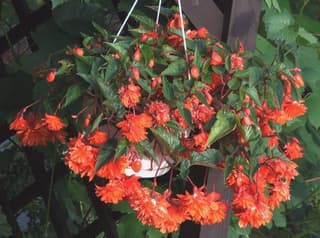
Tuberous Begonia
Begonia × tuberhybrida
Tuberous Begonia (Begonia × tuberhybrida) is a stunning ornamental hybrid with Andean ancestors, prized for its large, ruffled blooms in shades of white, pink, red, yellow, and orange. It is a deciduous plant that goes dormant in winter and re-emerges vigorously in spring. It demands careful attention to watering, humidity, and temperature.
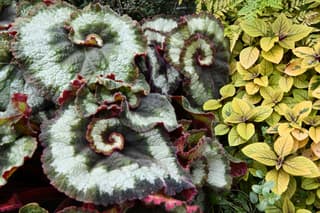
Rex Begonia
Begonia rex
Rex Begonia (Begonia rex) is a striking rhizomatous perennial native to the rocky, forested valleys and slopes of northeastern India. Prized for its spectacular foliage rather than flowers, the leaves display extraordinary patterns with combinations of silver, purple, pink, red, and green colors. The dramatic leaf textures and metallic sheens make it one of the most ornamental houseplants available.
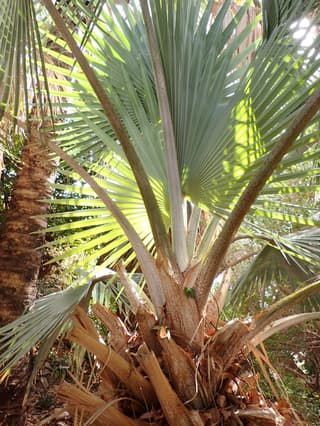
Bismarck Palm
Bismarckia nobilis
Bismarckia nobilis, commonly known as the Bismarck Palm, is one of the most majestic and sculptural palms in the world. Native to Madagascar, it stands out for its massive fan-shaped leaves with a unique silvery-blue hue. It is a slow-to-moderate growing plant that becomes the focal point of any garden due to its imposing stature and dense foliage.
Porcini and Allies
Boletus
Boletus is a genus of mushroom-producing fungi, including the famous King Bolete (Boletus edulis). These fungi are mycorrhizal, meaning they form a symbiotic relationship with the roots of specific trees, primarily in temperate forests. They are characterized by a fleshy cap and a pore surface instead of gills on the underside.
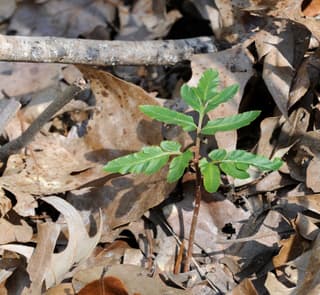
Southern grape fern
Botrychium biternatum
Botrychium biternatum, now often treated as Sceptridium biternatum, is a perennial fern of the adder's-tongue family (Ophioglossaceae) native to the eastern and southern United States, from Texas to the Atlantic coast. It grows to about 30 cm tall and bears a thin-textured, twice to three times divided sterile blade alongside a separate fertile stalk carrying clusters of spore cases that resemble tiny grapes. In autumn the fronds turn a reddish-brown or bronze, which earned it the local name red fern. It grows wild in low woods, hardwood and pine forests, fields and roadsides, and it depends on an underground mycorrhizal fungus partnership to survive.
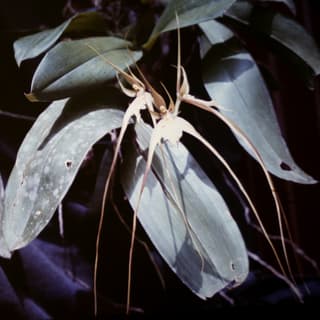
Spider Orchid
Brassia caudata
Brassia caudata, commonly known as the Spider Orchid, is a neotropical epiphytic orchid native to southern Mexico, Central America, the Caribbean, and northern South America. Its striking flowers feature long, spider-leg-like sepals and petals in yellow with brown markings, reaching up to 15 cm in length. It is a slow-growing evergreen perennial that blooms primarily in spring and summer.

Candelabra cactus
Browningia candelaris
Browningia candelaris is a large columnar cactus endemic to the arid slopes of the Andes in southern Peru and northern Chile, where it grows between 1,600 and 3,000 meters above sea level in the heart of the Atacama Desert, one of the driest places on Earth. Young specimens form a single, heavily spined columnar trunk with straight brown spines up to 15 cm long; with age, the upper part of the trunk develops a crown of slender, cylindrical, and nearly spineless branches, giving the plant the characteristic candelabra-like appearance for which it is named. It can reach between 5 and 7 meters in height, with a trunk up to 50 cm in diameter. Its white, tubular flowers, measuring 8 to 12 cm, bloom at night on the upper branches and last barely 24 hours, followed by fleshy, yellow, edible fruits up to 7 cm long.
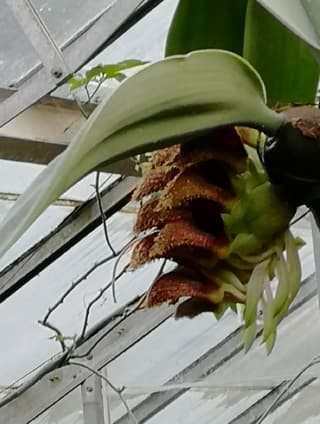
Stinking Orchid
Bulbophyllum phalaenopsis
Bulbophyllum phalaenopsis is one of the largest orchids in the Bulbophyllum genus, native to the tropical rainforests of New Guinea. It is notorious for its massive leaves, which can exceed 60 cm in length, and for its flowers that emit a powerful putrid odor — an evolutionary strategy to attract fly pollinators. Despite its unusual smell, it is a prized specimen among serious orchid collectors.
Black Bulgur
Bulgaria inquinans
Bulgaria inquinans, commonly known as the 'black rubber fungus,' is an ascomycete fungus that grows in clusters on recently felled oak logs and other hardwoods. It features a cup-shaped or disc-like fruiting body, shiny black in color with a gelatinous texture when moist, becoming leathery when dry. Its upper surface is smooth and produces black spores that can stain the hands upon contact.
Oak Bolete
Butyriboletus appendiculatus
Butyriboletus appendiculatus, known as the Oak Bolete or Butter Bolete, is a highly sought-after edible mushroom found in deciduous forests, particularly under oak and beech trees. It is characterized by its leathery brown cap, bright yellow pores on the underside that bruise slightly blue when touched, and a stem that is often rooting or tapered toward the base. It is a mycorrhizal fungus, meaning it lives in a complex symbiotic relationship with tree roots, making it nearly impossible to cultivate artificially.
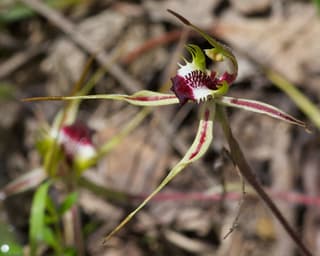
Small Spider-orchid
Caladenia parva
Caladenia parva is a small terrestrial orchid endemic to southeastern Australia, found in scattered areas of southern Victoria and the far southeast of South Australia. It is a deciduous perennial herb with a single underground tuber and a single narrow leaf 3 to 10 cm long, usually with small red spots at the base. Between September and November (southern spring), it produces one or two greenish flowers with red stripes on a 5 to 15 cm stem, featuring a greenish-white labellum with a curled dark red tip. It grows in open forests, woodlands, and coastal vegetation in well-drained sandy-clay soils.
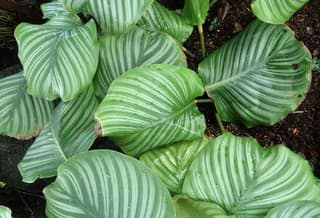
Calathea / Prayer Plant (genus)
Calathea
Calathea is a genus of tropical foliage plants in the family Marantaceae, native to the tropical forests of South America. They are prized for their strikingly patterned leaves in shades of green, purple, and silver. Many species were reclassified into the genus Goeppertia in 2012, but Calathea remains the widely used common name.
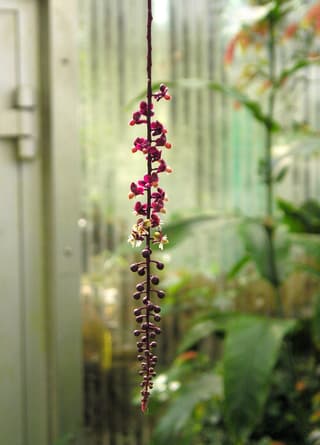
Peacock Plant
Calathea makoyana
Calathea makoyana is a tropical plant native to Brazil, famous for its striking leaf pattern that resembles peacock feathers. It belongs to the Marantaceae family and is known as a "prayer plant" because it moves its leaves throughout the day, opening them to capture light and closing them at night.
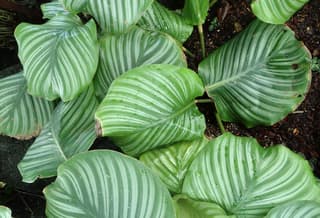
Round-leaf Calathea
Calathea orbifolia
Calathea orbifolia is a tropical plant native to Bolivia, known for its stunning large, rounded leaves with silver and green stripes. It is one of the most popular calatheas but also one of the most demanding in terms of care, especially regarding ambient humidity.
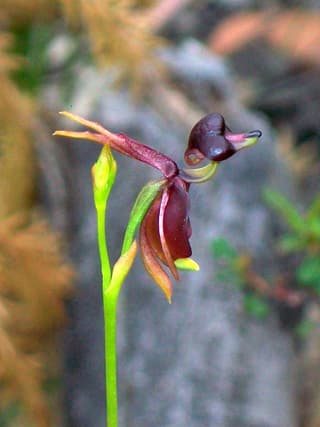
Flying Duck Orchid
Caleana major
The Flying Duck Orchid (Caleana major) is one of the most extraordinary flowering plants in the world. Native to eastern and southern Australia, this small terrestrial orchid produces remarkable reddish-brown flowers whose labellum bears a striking resemblance to a duck in flight. It grows 20–40 cm tall and flowers from spring through summer. Pollination occurs via male sawflies that are deceived into pseudocopulation with the duck-shaped labellum.
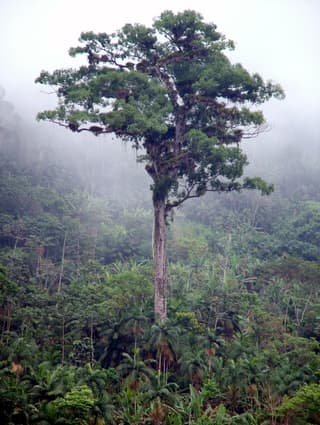
Pink Jequitibá
Cariniana legalis
The Pink Jequitibá (Cariniana legalis) is one of the largest and longest-lived trees native to the Atlantic Forest, capable of exceeding 40-50 meters in height and 7 meters in trunk diameter when mature. An emergent and climax species, it occurs in humid lowlands and slopes of rainforests and semi-deciduous forests, where some individuals exceed 1,000 years of age. It has a straight trunk, thick and deeply furrowed bark, a wide semi-deciduous canopy, and creamy-white flowers gathered in terminal panicles between December and February. Its fruits are woody pyxidia (capsules with a lid) that open to release winged seeds, dispersed by wind and monkeys. It is considered a keystone species for the restoration of native forests and is classified as Vulnerable by the IUCN due to historical logging and habitat loss.
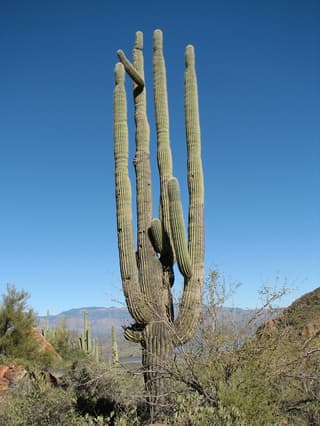
Saguaro
Carnegiea gigantea
The Saguaro (Carnegiea gigantea) is the largest cactus in North America, native to the Sonoran Desert of the United States and Mexico. Recognizable by its towering height of up to 60 feet (18 m) and iconic branching arms, it is the symbol of the American Southwest and the state of Arizona. Saguaro grows extremely slowly — only about 1–1.5 inches per year — and can live for over 200 years.
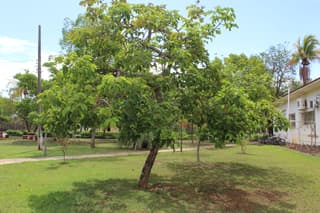
Pequi Tree
Caryocar brasiliense
The Pequi Tree (Caryocar brasiliense) is a native tree of the Brazilian Cerrado savanna, iconic to the culture of Central Brazil. With deciduous leaves and fragrant white flowers pollinated by bats, it produces the famous pequi fruit, rich in carotenoids, vitamin C and fatty acids. It can reach 6 to 11 meters in height, with slow growth, taking 4 to 8 years to produce fruit. It is a keystone species for Cerrado biodiversity, serving as food for birds, mammals and bats.
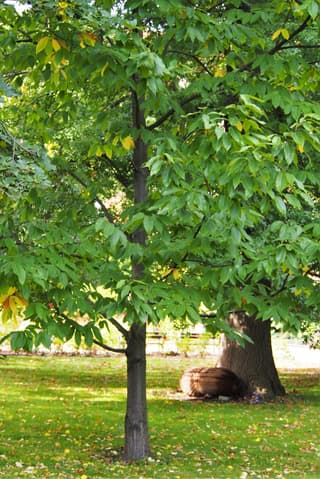
American chestnut
Castanea dentata
Castanea dentata is a large deciduous tree in the beech family (Fagaceae), native to the forests of eastern North America. It once reached about 30 m and made up a large share of Appalachian forests, but chestnut blight, a fungus brought in around 1904, killed an estimated 4 billion trees. Today it survives mostly as shoots from old roots that grow a few metres before the blight kills them back. The leaves are long and narrow, 10 to 23 cm, with coarse bristle-tipped teeth, and turn gold in autumn. In early summer it carries long, fragrant creamy-white catkins, and in autumn spiny burs open to drop two or three sweet, edible nuts.
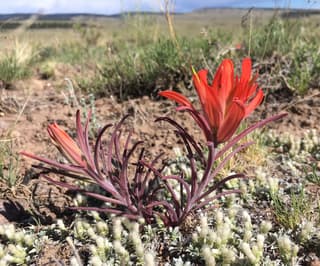
Wholeleaf Indian Paintbrush
Castilleja integra
Castilleja integra (Wholeleaf Indian Paintbrush) is a perennial wildflower native to the southwestern United States and northern Mexico. Its vivid scarlet-to-orange bracts resemble a paintbrush dipped in red paint, while the true flowers hide within. A facultative root hemiparasite, it taps into neighboring plant roots to extract water and nutrients.
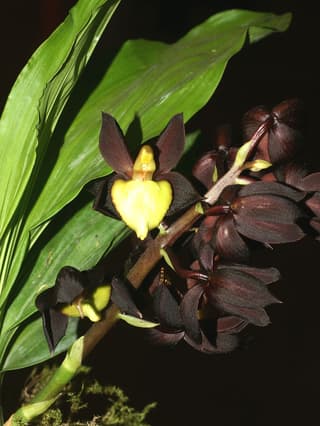
Catasetum
Catasetum
Catasetum is a genus of roughly 166 species of deciduous, epiphytic orchids native to the tropical forests of Mexico, Central America, the Caribbean, and South America as far south as Argentina. Plants form clusters of ribbed, fleshy pseudobulbs topped with pleated leaves that are shed completely once each year. Catasetum is famous among orchid growers for producing separate male and female flowers, sometimes even on the same inflorescence, and for its explosive pollination mechanism: brushing the antennae-like appendages on a male flower triggers the column to catapult a sticky pollen packet onto a visiting insect.
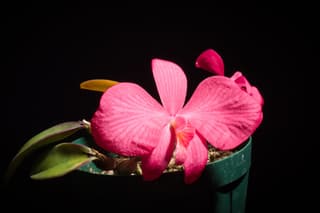
Wittig's Cattleya
Cattleya wittigiana
Cattleya wittigiana is a mini-miniature epiphytic orchid native to the misty cloud forests of the Mata Atlantica in Espirito Santo and Minas Gerais, Brazil, where it clings to mossy, rough-barked trees at elevations of 700-2000 m. Formerly classified as Sophronitis wittigiana (and closely related to Cattleya coccinea), it produces tiny globular pseudobulbs, each topped with a single stiff leathery leaf, yet surprises growers with rose-pink to magenta flowers 4-6.5 cm across during the winter months. In habitat it is pollinated by hummingbirds and thrives in cool, bright, windy, humid conditions typical of exposed mountain ridges.
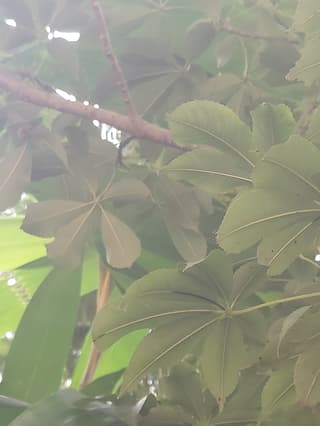
Kapok Tree
Ceiba pentandra
The Kapok Tree (Ceiba pentandra) is one of the tallest trees in the Amazon rainforest, capable of exceeding 60 meters in height and living for more than 300 years. Known for its thorny trunk in youth and the massive buttress roots that anchor its umbrella-shaped crown above the forest canopy, it is revered as the "Queen of the Forest" and holds a central place in the cosmology of many Amazonian peoples, as well as in Maya mythology, where it was regarded as the sacred World Tree (Yax Che) connecting the underworld, earth, and sky. Its cream-to-pink flowers open at night when the tree is leafless, attracting bat pollinators, and its seed pods release the soft, buoyant fiber known as kapok, historically used to stuff mattresses, pillows, and life jackets.
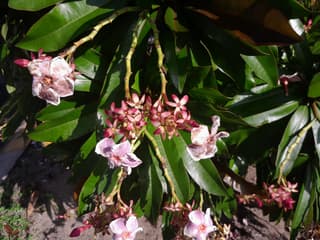
Suicide tree
Cerbera odollam
Cerbera odollam, also known as the suicide tree or pong-pong, is an evergreen tree in the Apocynaceae family, native to the coastal swamps and mangroves of southern India, Madagascar, and Southeast Asia. It can reach 10-12 meters in height, featuring glossy leaves and fragrant white flowers with a yellow center. The fruits, which turn from green to red as they ripen, contain a single extremely toxic seed rich in cardiac glycosides (cerberin), capable of stopping the heartbeat even in very small quantities: hence the tragic nickname by which it is known in India.
Green Elfcup
Chlorociboria aeruginascens
Chlorociboria aeruginascens, known as the Green Elfcup, is a saprobic fungus famous for its ability to stain the wood it decomposes a deep, blue-green shade. The fruiting bodies are small, often only 2-5 mm wide, and have a characteristic cup or funnel shape. They typically grow on moist, barkless hardwood, especially oak and beech. The green color in the wood is caused by the pigment xylindein, and this stained wood has been sought after for centuries for use in decorative woodwork such as marquetry.
Devil's Cigar
Chorioactis geaster
Chorioactis geaster, known as the 'Devil's Cigar' or 'Texas Star', is one of the rarest fungi in the world. It is found almost exclusively in Texas and Japan. This saprophytic fungus grows on the dead roots of cedar or elm trees. It initially has a dark brown cylindrical shape similar to a cigar, which upon maturing opens into a star shape with 4 to 7 rays, releasing its spores with an audible hissing sound.
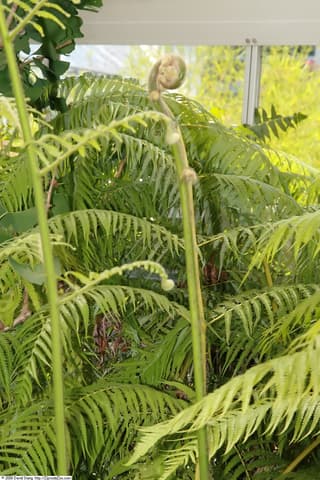
Mexican Tree Fern
Cibotium schiedei
Cibotium schiedei, commonly known as the Mexican Tree Fern, is an extremely slow-growing tree fern native to the cloud forests of Mexico. Its fibrous trunk, covered in soft reddish-gold hairs, supports silky light-green fronds that can reach 8–11 feet in length, forming an arched and sculptural canopy. Evergreen and without a dormancy period, it is a highly valued species in tropical gardens and as an indoor architectural plant, though it requires patience: it takes several years just to form a visible trunk.
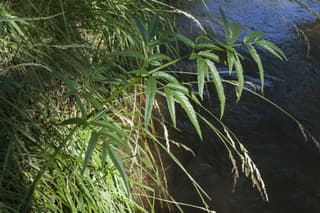
Water Hemlock
Cicuta
Cicuta is a small genus of about four herbaceous perennial (often behaving as biennial) species in the carrot family (Apiaceae), native to wet meadows, marshes, streambanks and ditches across temperate North America and Europe. Plants form stout, hollow, branching stems that reach up to 2.5 m tall, topped with umbrella-shaped clusters (umbels) of small white flowers in summer. The chambered, tuberous rootstock exudes a yellowish oily sap with a smell resembling raw parsnip when cut. Cicuta is widely regarded as one of the most acutely toxic plants native to North America and Europe: every part of the plant contains cicutoxin, a violent convulsant most concentrated in the roots in early spring. This genus is a wild wetland species, not a cultivated ornamental or houseplant, and is documented here strictly for identification and safety reference.
British Soldiers
Cladonia macilenta
Cladonia macilenta is a fruticose lichen characterized by its slender, grayish podetia (stalks) that terminate in vibrant red reproductive structures (apothecia), resembling burnt matches. It is a symbiotic relationship between a fungus and an alga, frequently growing on decaying wood, acidic soil, or peat.
Lattice Stinkhorn
Clathrus crispatus
Clathrus crispatus is a saprophytic fungus in the Phallaceae family, known for its cage-like or spherical net-shaped fruiting body that is reddish or pinkish in color. It emerges from an egg-like structure and, when mature, emits a foul odor of decaying meat to attract flies, which assist in the dispersal of its spores contained in a slimy substance called gleba.
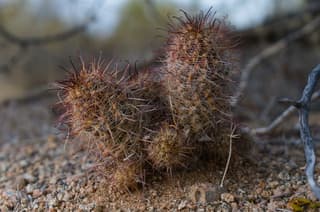
Thornber's Nipple Cactus
Cochemiea thornberi
Cochemiea thornberi, commonly known as Thornber's Nipple Cactus or Thornber's Fishhook Cactus, is a small clustering cactus native to the Sonoran Desert of Arizona and Sonora, Mexico. It forms dense clumps of cylindrical stems adorned with hooked central spines and produces delicate white to pink flowers with lavender midstripes, making it a prized gem among cactus collectors.
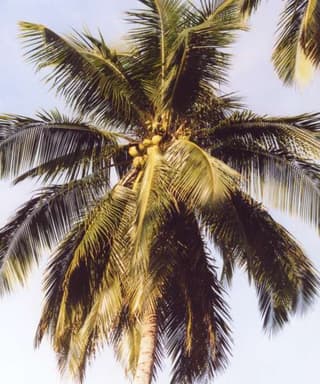
Coconut Palm
Cocos nucifera
The coconut palm (Cocos nucifera) is a majestic tropical palm, iconic along coastlines worldwide. It can reach up to 30 meters in height and produces fruit year-round in ideal climates. One of the most versatile plants in the world, with uses ranging from food to construction materials.
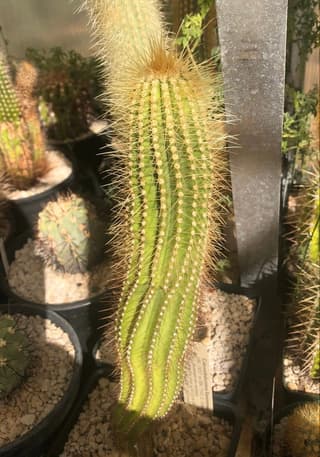
Fluminense Column Cactus
Coleocephalocereus fluminensis
Coleocephalocereus fluminensis is a columnar cactus endemic to the rocky inselbergs (isolated rocky hills) of southeastern Brazil, particularly in Rio de Janeiro and Espírito Santo states. It grows on exposed crystalline rock outcrops, forming dense clusters of erect ribbed stems covered in sharp spines. Adult plants develop a distinctive white woolly cephalium at the apex from which white to yellowish nocturnal flowers emerge.
Golden Everlasting
Comanthera elegans
Comanthera elegans, popularly known as the golden everlasting or congonha, is a rupicolous herb endemic to the rocky fields (campos rupestres) of the Espinhaço Range in Minas Gerais, Brazil. It forms clumps of narrow basal leaves from which erect, unbranched stems emerge, topped with small flower heads of golden to cream bracts that maintain their color and shape for a long time after drying—hence the name "everlasting." It is one of the most commercially exploited Eriocaulaceae species in Brazil, with inflorescences harvested for handicrafts and floral arrangements since the 20th century. Today, it is listed as Endangered (EN) due to predatory harvesting, poorly managed fires, and climate change, which reduce the rocky field areas suitable for the species.
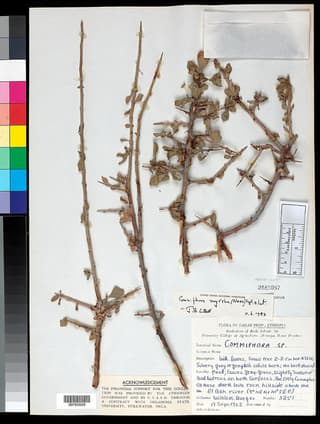
Myrrh
Commiphora myrrha
Commiphora myrrha is a large shrub or small thorny deciduous tree native to the arid regions of Northeast Africa (Ethiopia, Somalia, Kenya) and the Arabian Peninsula (Oman, Yemen, Saudi Arabia). It features twisted, zigzagging gray branches often ending in sharp spines, light papery bark that peels in strips, and small, aromatic trifoliate leaves. It is famous for exuding an aromatic, brownish-yellow oleoresin—myrrh—when wounded, which has been used for millennia in incense, perfumes, cosmetics, and traditional medicine. It tolerates poor, stony soils, extreme heat, and long periods of drought.
What are Hard Plants?
Hard Plants are challenging and reward experienced gardeners. They require specific light, humidity, and temperature conditions, plus constant attention. Perfect for enthusiasts seeking a challenge.
Tips for Growing Hard Plants
For hard plants, success is in the details. Monitor air humidity, use filtered water when needed, maintain stable temperature, and be ready to adjust care as the plant responds.