1434 Easy Pet Safe | 2026 Guide - Page 33
Find 1434 easy pet safe. Complete guide for your garden.
1434 Pet Safe with easy level
Showing 1153-1188 of 1434
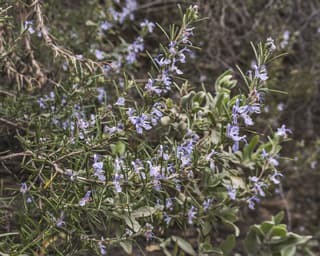
Rosemary
Rosmarinus officinalis
Rosemary (Rosmarinus officinalis) is a fragrant, evergreen perennial shrub native to the Mediterranean region. It features needle-like, dark green leaves with silvery undersides and produces small tubular flowers in shades of blue, violet, white, or pink. It is prized as a culinary herb, medicinal plant, and ornamental shrub.
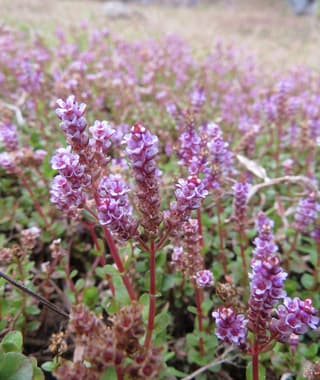
Dwarf Rotala
Rotala rotundifolia
Rotala rotundifolia is a stem plant from the Lythraceae family, native to South and Southeast Asia, where it grows as a common weed in rice paddies and wetlands across India, China, Taiwan, Thailand, Laos, and Vietnam. It exhibits two distinct forms depending on the cultivation method: in its emersed form (above water), it develops rounded leaves, while submerged in an aquarium, its leaves are narrow and lanceolate. Under intense lighting, the stem tips and upper leaves take on hues ranging from pale pink to orange-red, whereas in low light, the plant remains a deep green.
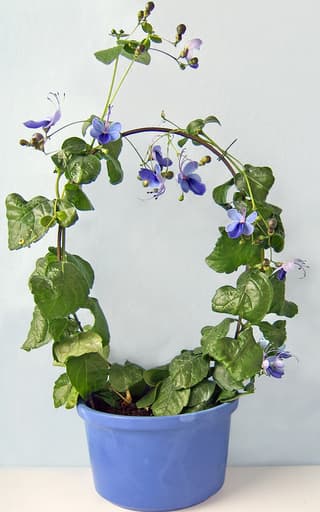
Blue Butterfly Bush
Rotheca myricoides
Rotheca myricoides, commonly known as the Blue Butterfly Bush, is an evergreen shrub native to East Africa. It produces stunning pale violet-blue, butterfly-shaped flowers with a distinctive darker blue lower petal and long curved stamens, making it a showstopper in tropical and subtropical gardens. Previously classified as Clerodendrum ugandense, it belongs to the mint family Lamiaceae.
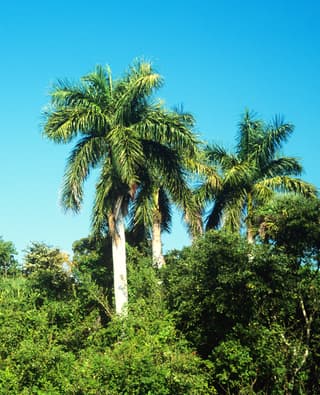
Cuban Royal Palm
Roystonea regia
The majestic Cuban Royal Palm, Roystonea regia, is a large-sized palm tree native to the tropical regions of the Americas. It is characterized by its single, smooth, light gray trunk that widens slightly at the base and is crowned by a dense canopy of large, arching pinnate leaves. It is widely used in landscaping to create a dramatic visual impact in avenues, parks, and gardens.

Madder
Rubia tinctorum
Madder (Rubia tinctorum) is a perennial, scrambling-climbing plant in the Rubiaceae family, native to the Mediterranean region and Western Asia. It can also be found growing wild in Hungary, primarily in the floodplains of the Danube and Drava rivers as a remnant of historical cultivation. Its square-shaped stems are covered in hooked hairs and branch across multiple levels, featuring whorls of lanceolate leaves with prickly margins. In early to mid-summer, it produces tiny, honey-yellow flowers that develop into black, fleshy berries. Its long, fleshy, orange-red roots contain a pigment called alizarin, which has been used for millennia to dye textiles red—from the Middle Ages until the emergence of synthetic dyes in the 19th century, it was the most important source of natural red dye.
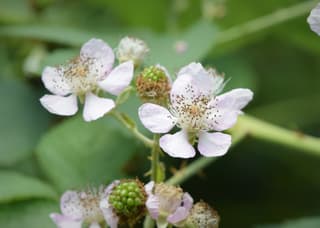
Himalayan Blackberry
Rubus armeniacus
Rubus armeniacus, commonly known as Himalayan Blackberry, is a vigorous, fast-growing, semi-evergreen shrub native to Armenia and northern Iran. Its arching biennial canes can reach 3–10 metres in length and are lined with stout thorns. Despite its common name, it is not native to the Himalayas; it was introduced to North America in 1885 and has since become one of the most widespread invasive shrubs in temperate regions worldwide. The plant produces attractive white to pale pink flowers in late spring and early summer, followed by large, sweet, jet-black berries that are prized for eating fresh, making jams, pies, and beverages. Its root bark and leaves also have a long history of medicinal use as an astringent remedy.
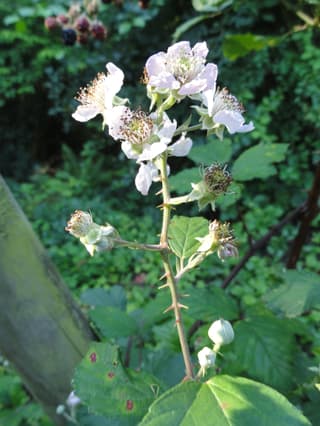
Himalayan Blackberry
Rubus bifrons
Himalayan Blackberry (Rubus bifrons) is a thorny, sprawling shrub in the Rosaceae family, native to Europe and western Asia. It grows vigorously, forming dense thickets with arching canes reaching several meters, producing white to pale pink flowers in late spring/summer followed by glossy black, sweet fruit in summer. Extremely hardy, it has become invasive in many regions outside its native range.
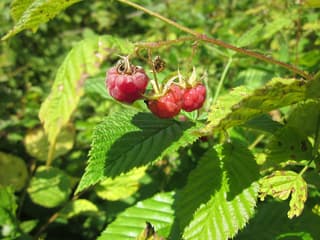
Red Raspberry
Rubus idaeus
Red Raspberry (Rubus idaeus) is a deciduous fruiting shrub native to Europe and northern Asia, belonging to the Rosaceae family. It produces arching, thorny canes that bear delicious, bright red aggregate berries in summer. Widely cultivated for both its edible fruit and ornamental hedging value, it thrives in temperate climates with cool winters and mild summers.
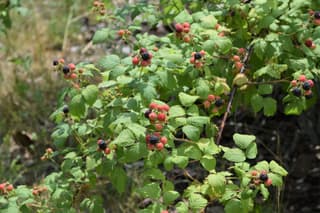
Black Raspberry
Rubus occidentalis
Rubus occidentalis, commonly known as black raspberry or blackcap, is a thorny, deciduous cane fruit native to eastern North America. Distinguished by its arching purple-tinged canes covered in a waxy white bloom, this vigorous bramble produces small, dome-shaped black berries prized for their deep, tart-sweet flavor and high antioxidant content. Unlike red raspberries, black raspberry canes root at the tip where they touch soil, forming new plants naturally. It thrives in sunny hedgerows, woodland edges, and cultivated berry patches.
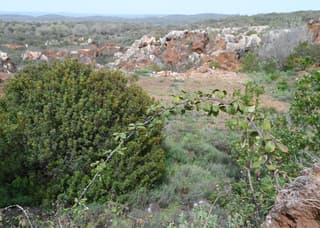
Elm-leaved Blackberry
Rubus ulmifolius
Rubus ulmifolius, commonly known as the Elm-leaved Blackberry or Silverleaf Bramble, is a vigorous semi-evergreen shrub native to Europe and the Mediterranean region. It forms dense, thorny thickets and produces edible blackberries widely used in cooking and traditional medicine. Introduced beyond its native range, it is considered invasive in parts of Australia, Chile, and New Zealand.
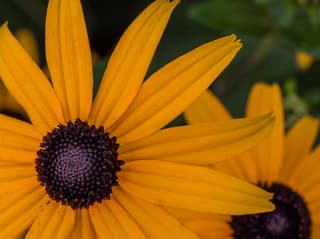
Black-eyed Susan
Rudbeckia
Rudbeckia is a genus of flowering plants in the family Asteraceae, native to North America. Widely known as black-eyed Susan or coneflower, it features cheerful golden-yellow daisy-like blooms with dark brown or black centers, blooming from summer through fall.
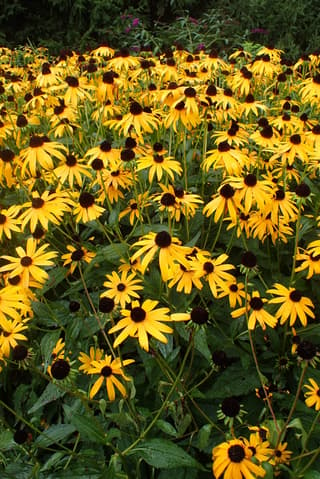
Orange Coneflower
Rudbeckia fulgida
Rudbeckia fulgida is a clump-forming herbaceous perennial native to eastern North America, prized for its cheerful daisy-like flowers with golden-orange petals surrounding a dark brown-black central cone. Blooming from late summer into fall, it forms a tidy basal rosette of hairy, toothed leaves and spreads slowly by rhizomes to create informal drifts in borders, meadows, and pollinator gardens. Popular cultivars such as Goldsturm are valued for a long bloom season and reliable performance across a wide range of climates.
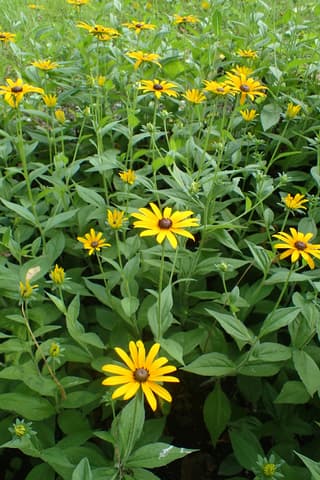
Black-eyed Susan
Rudbeckia hirta
Rudbeckia hirta, commonly known as Black-eyed Susan, is a native North American wildflower beloved for its bright yellow-orange petals surrounding a dark brown center. It blooms prolifically from summer through fall, attracting butterflies, bees, and songbirds.
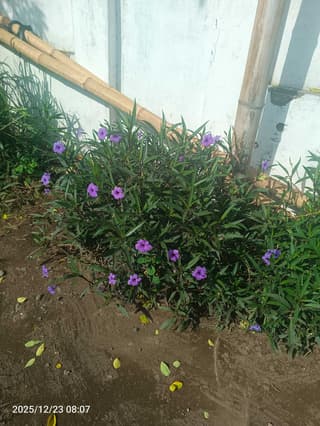
Wild Petunia
Ruellia
Ruellia, commonly known as wild petunia or Mexican petunia, is a fast-growing herbaceous perennial in the Acanthaceae family, native to Mexico and Central and South America. It forms upright, multi-stemmed clumps with slender, dark-green leaves and trumpet-shaped flowers that last only a day but bloom continuously from spring through fall. Once established it is highly drought-tolerant and low-maintenance, making it a popular choice for borders, beds, and mass plantings in warm climates.

Mexican Petunia
Ruellia brittoniana
Ruellia brittoniana (Mexican Petunia), also classified as Ruellia simplex, is a fast-growing evergreen perennial native to Mexico, prized for its petunia-like lavender-purple flowers that bloom continuously from early summer through fall. It thrives in full sun and readily adapts to both moist and drought conditions, spreading via rhizomes and self-seeding. Because of this vigorous growth habit, it is classified as an invasive species in Florida and several other warm-climate regions, so gardeners should plant it with caution or choose sterile cultivars.
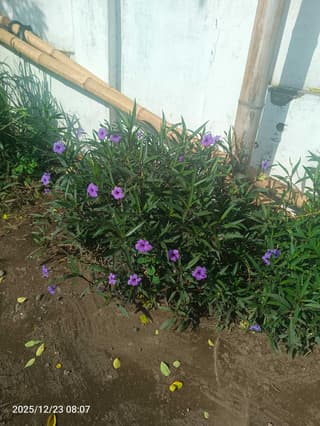
Mexican Petunia
Ruellia simplex
Ruellia simplex, commonly known as the Mexican Petunia, is a vigorous perennial herbaceous plant native to Mexico, the Caribbean, and South America. It is characterized by its long, narrow, dark green leaves and trumpet-shaped flowers that bloom in shades of purple, pink, or white. It is a fast-growing and low-maintenance plant, ideal for gardens, borders, and containers, especially in warm climates where it can bloom for much of the year. While ornamental, it is important to note that it can be invasive in some regions.
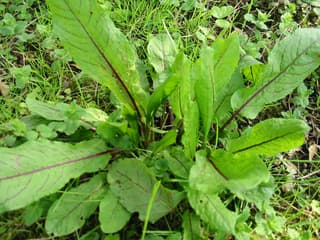
Bloody dock
Rumex sanguineus
Bloody dock (Rumex sanguineus) is an evergreen perennial herb in the Polygonaceae family, native to Europe, Southwest Asia, and North Africa. It is prized for its striking leaves with deep, blood-red veins against dark green foliage, providing a dramatic ornamental look in gardens and on tables. The plant forms compact rosette-shaped clumps and thrives in moist, well-drained soil in full sun to partial shade.
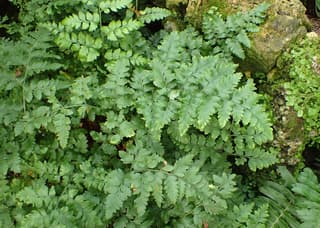
Leatherleaf fern
Rumohra adiantiformis
Rumohra adiantiformis, commonly known as the leatherleaf fern, is a robust and perennial species prized for its triangular, leathery, deep green fronds. It is extremely popular in the floral industry due to the incredible durability of its leaves after being cut, remaining fresh in arrangements for several weeks. In nature, it grows both as an epiphyte and on the forest floor.
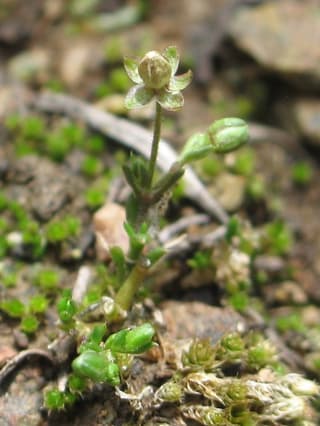
Annual Pearlwort
Sagina apetala
Sagina apetala is a small annual or biennial herbaceous plant that forms low, dense tufts. It is frequently found in urban environments, growing in sidewalk cracks, walls, and compacted sandy soils. Its leaves are linear and its flowers are tiny, usually greenish and without visible petals, which gives it the specific name 'apetala'. It is an extremely resilient and colonizing plant.
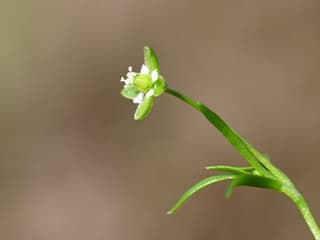
Procumbent pearlwort
Sagina procumbens
Sagina procumbens (procumbent pearlwort) is a perennial, creeping herb from the pink family (Caryophyllaceae), native to Europe, Western and Central Asia, and Northwest Africa. It forms dense, hairless, moss-like mats thanks to stems that root at the nodes and spread rapidly vegetatively. The leaves are linear, 1-2 cm long. Small, solitary flowers have 4-5 sepals and 4-5 small white petals (sometimes absent) with 4 free stigmas. The plant tolerates trampling exceptionally well, which is why it is commonly found in lawns, cracks between paving stones, and in moist flower pots.
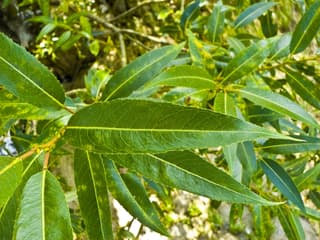
Crack willow
Salix × fragilis
Salix × fragilis, the crack willow, is a fast-growing deciduous tree native to Eurasia, common along rivers, marshes and wet ground. It reaches around 15 m and is named for its twigs, which snap off cleanly and readily root where they land.
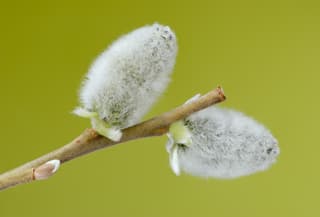
goat willow
Salix caprea
Salix caprea, commonly known as goat willow or pussy willow, is a robust deciduous tree or large shrub native to Europe and Western Asia. It is most famous for its soft, silky-grey catkins that emerge in early spring, which eventually turn yellow with pollen, providing a vital early nectar source for bees and other pollinators. The leaves are broader than most other willows, with a felt-like underside.
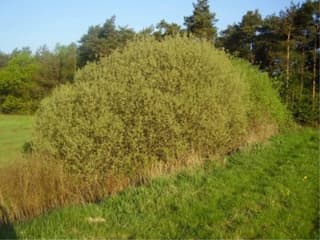
Grey Willow
Salix cinerea
Salix cinerea, the grey willow (also called grey sallow), is a fast-establishing deciduous shrub or small tree native to Europe and western Asia. It thrives in wet, poorly drained soils along riverbanks, ditches and marshes, producing fuzzy grey-to-yellow catkins in early spring before the leaves emerge. Its dense, downy grey-green foliage and tolerance of waterlogged ground make it a valuable pioneer species for wetland restoration and a key early-season nectar source for bees.
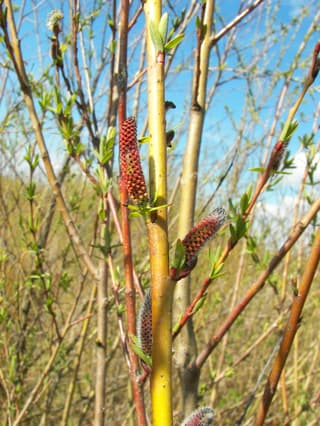
Purple Willow
Salix purpurea
Salix purpurea, the purple willow or purple osier, is a fast-growing deciduous shrub native to Europe, North Africa, and temperate Asia. It forms dense thickets of slender, purple-tinted stems and narrow grey-green leaves arranged in an unusual near-opposite pattern for a willow. Purple-red catkins appear on bare branches in early spring before the leaves emerge, turning golden as they release pollen. Long prized by basket weavers for its flexible, colorful osier rods, it is equally valued in modern landscapes for erosion control along streambanks and as a fast, low-maintenance ornamental hedge or screen.

Basket Willow
Salix viminalis
Salix viminalis, commonly known as basket willow or common osier, is a fast-growing deciduous shrub or small tree native to Europe and western/central Asia. Prized for centuries for its long, flexible, unbranched shoots, it is the classic species used in traditional basket weaving and wickerwork. It thrives in damp, wet ground along riverbanks and wetlands, forming dense thickets of slender silvery-green leaves and, in early spring, soft grey catkins that appear before the foliage. Its vigorous growth and tolerance of coppicing make it a popular choice for biomass production, erosion control on riverbanks, and living willow structures in gardens.
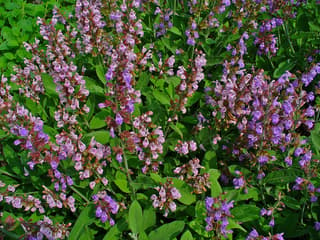
Sage
Salvia
Salvia is one of the largest genera in the mint family Lamiaceae, comprising over 900 species native to regions spanning the Mediterranean, the Americas, and Asia. The genus encompasses culinary herbs such as S. officinalis, brilliant ornamentals like S. splendens (scarlet sage), and hardy perennials like S. nemorosa (woodland sage). All species are aromatic, typically featuring soft or velvety foliage and tubular flowers highly attractive to pollinators.
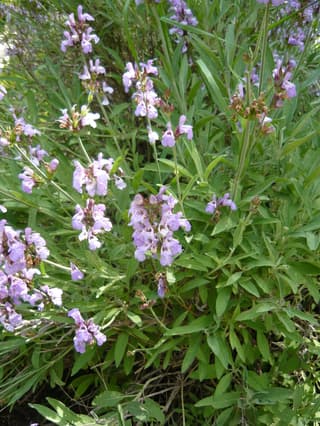
Lavender Sage
Salvia × lavandulacea
Lavender Sage (Salvia × lavandulacea) is an aromatic evergreen sub-shrub in the mint family, closely related to Spanish sage (Salvia lavandulifolia). It has narrow, grey-green, downy leaves with a rosemary-like scent and produces spikes of violet-blue flowers in summer. Drought-tolerant and sun-loving, it thrives in Mediterranean-style gardens, sunny containers, and herb beds.
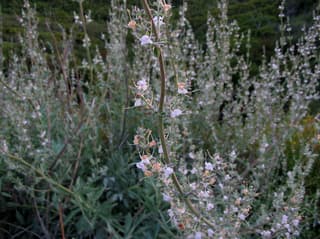
White Sage
Salvia apiana
Salvia apiana, commonly known as white sage, is an aromatic evergreen shrub native to the coastal sage scrub of Southern California and northern Baja California. It forms a rounded mound of silvery-white, felted leaves and sends up tall flowering spikes of pale lavender-white blossoms in late spring. Deeply drought-adapted, white sage thrives in poor, rocky, well-drained soil and full sun, asking for little water once established. Beyond its garden appeal, it is one of the most culturally significant plants of California, long tended and used ceremonially by Indigenous peoples including the Cahuilla, Kumeyaay, Chumash, and Luiseno.
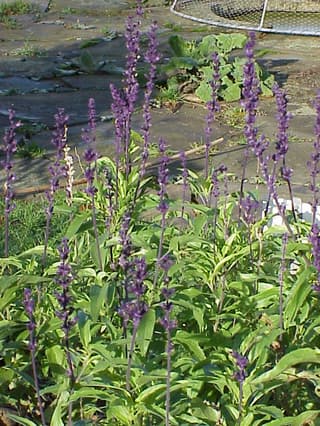
Mealycup Sage
Salvia farinacea
Salvia farinacea, commonly known as Mealycup Sage or Blue Sage, is a tender perennial native to the prairies and meadows of south-central Texas, Oklahoma, and northeast Mexico. It produces tall, elegant spikes of vivid blue-to-violet flowers from late spring through autumn, making it a favorite in pollinator gardens. The plant is deer-resistant, drought-tolerant once established, and attracts bees, butterflies, and hummingbirds.
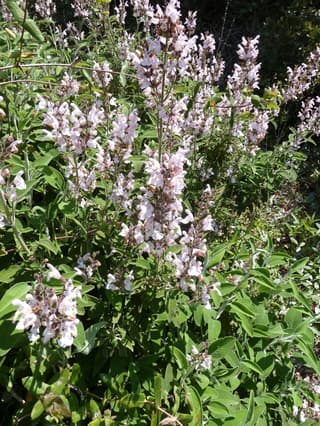
Greek Sage
Salvia fruticosa
Salvia fruticosa, commonly called Greek sage or three-lobed sage, is an aromatic, evergreen shrub native to rocky hillsides of the Eastern Mediterranean, including Greece, Crete, Turkey, Cyprus, and the Levant. Its soft, silvery-green, three-lobed leaves release a warm, resinous fragrance milder than common sage, and its pink-to-lilac flower spikes attract bees and butterflies through late spring and summer. Grown for centuries as a culinary herb and folk remedy, it thrives in poor, dry, sun-baked soil and needs almost no attention once established.
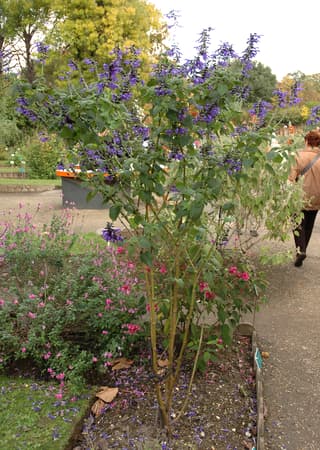
Anise-Scented Sage
Salvia guaranitica
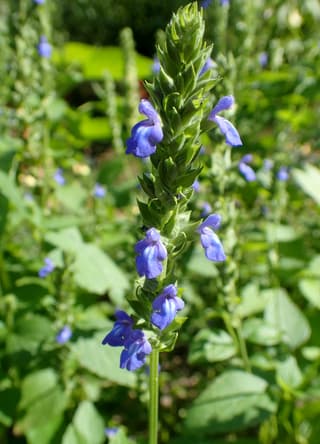
Salvia guaranitica, commonly known as anise-scented sage or hummingbird sage, is a bushy herbaceous perennial native to Brazil, Paraguay, Uruguay, and Argentina, belonging to the Lamiaceae family. Its fresh mint-green, ovate leaves release a soft anise scent when crushed, and its upright stems bear spikes of deep blue tubular flowers (with dark calyces in the 'Black and Blue' cultivar) from summer into fall. It is a favorite of hummingbirds and butterflies in warm-climate gardens.
Chia
Salvia hispanica
Chia (Salvia hispanica) is an annual herb in the Lamiaceae family, native to central and southern Mexico. Cultivated for centuries by the Aztecs, it is now known worldwide for its fiber- and omega-3-rich seeds. The plant grows upright stems with dark green leaves and small purple or white flowers clustered in spikes during summer and fall.
Baby Sage
Salvia microphylla
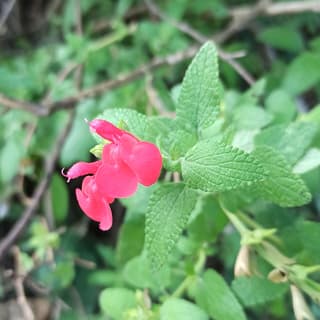
Salvia microphylla, commonly known as Baby Sage or Little Leaf Sage, is a compact perennial shrub native to Mexico and the southwestern United States. It produces abundant tubular flowers in shades of red, pink, purple, and white, making it a magnet for hummingbirds, bees, and butterflies. Hardy, drought-tolerant, and easy to grow, it thrives in sunny gardens with minimal care.
Woodland Sage
Salvia nemorosa
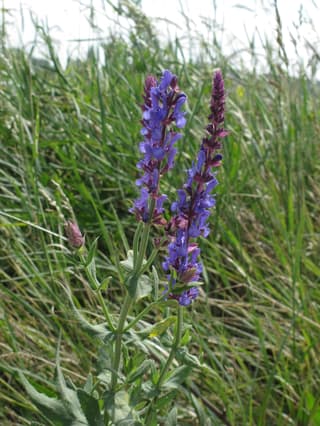
Salvia nemorosa, commonly known as Woodland Sage or Violet Sage, is a hardy herbaceous perennial in the Lamiaceae family, native to Europe and Western Asia. It produces dense, upright spikes of lavender-violet to deep blue-purple flowers from late spring through summer. Exceptionally drought-tolerant and cold-hardy (USDA zones 4–8), it is a low-maintenance staple in cottage, pollinator, and xeriscape gardens.
Garden Sage
Salvia officinalis
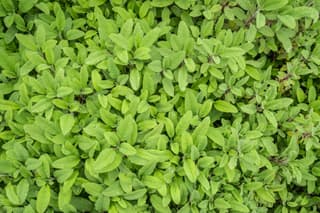
Salvia officinalis, commonly known as Garden Sage or Common Sage, is a perennial aromatic herb native to the Mediterranean region. It features soft, gray-green velvety leaves and vibrant purple-blue flower spikes in summer. A staple in kitchens and apothecaries for over 2,000 years, it belongs to the Lamiaceae (mint) family.
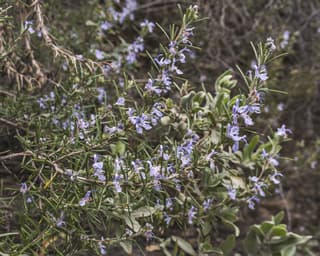
Rosemary
Salvia rosmarinus
Salvia rosmarinus, commonly known as rosemary, is a woody, perennial herb with fragrant, evergreen, needle-like leaves and white, pink, purple, or blue flowers. Native to the Mediterranean region, it is a member of the sage family Lamiaceae. It is highly valued for its aromatic foliage and culinary versatility.
Easy Care Pet Safe
Our selection of 1434 easy pet safe combines the characteristics of this category with reduced care needs. Perfect for beginners who love this category.
Why Choose Easy Pet Safe?
Combining the beauty of pet safe with easy difficulty level lets you enjoy this category without excessive maintenance worries. Each plant was selected to offer the best characteristics of the category at the care level you are looking for.