Succulent Pests: How to Remove Mealybugs Without Ruining Your Plant
That white cottony fuzz in your succulent's crevices is mealybugs. Learn how to tell pests apart from natural echeveria farina, how to use rubbing alcohol safely, why soap and oils harm jade, how to spot root mealybugs, and when a plant cannot be saved.
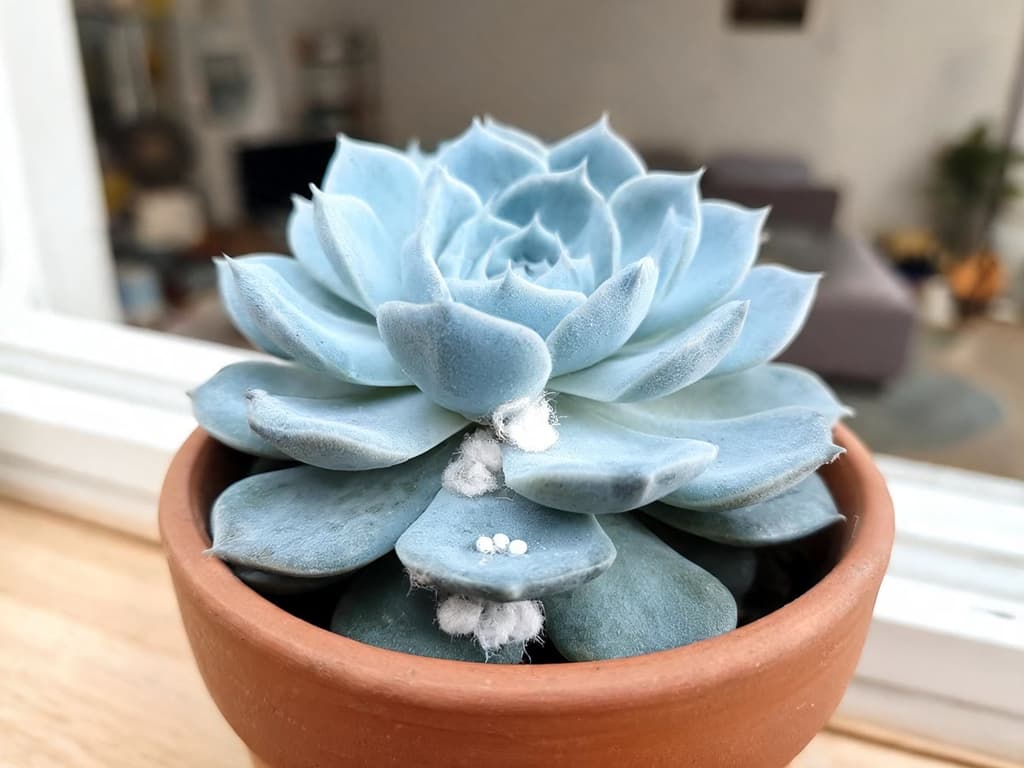
The most common succulent pest is the mealybug, a white cottony blob hiding in the crevices between leaves. It moves slowly when you poke it and leaves foliage sticky. In most cases, you can save the plant. Isolate the pot today, dab each insect with a cotton swab dipped in 70% isopropyl alcohol, and repeat weekly until two consecutive inspections turn up nothing.
On echeveria and other succulents coated in bluish-white powder, never spray soap, oil, or alcohol across the entire plant. That powder is a natural protective wax called farina, and those products can strip it right off the leaves.
Quick summary:
Mealybugs appear as tufts of cotton in crevices and at leaf bases. Farina is a smooth, powdery film that evenly covers the whole leaf.
A cotton swab dipped in 70% or lower isopropyl alcohol, touched only to the insect itself, is a safe treatment for almost every succulent.
Spot-test any treatment on a single leaf and wait 1 to 2 days before treating the whole plant.
Jade plants and certain other succulents are sensitive to insecticidal soaps and horticultural oils.
A wilted plant sitting in moist soil with white cotton poking through drainage holes points to root mealybugs: slide the plant out of its pot and inspect the roots.
Mealybugs on succulents: how to spot them
The mealybug is a soft-bodied, oval sucking insect measuring up to 3 mm, according to the NC State Extension. A white wax, resembling flour or cotton, covers its body. It sucks plant sap and excretes honeydew, a sugary liquid that leaves foliage sticky and shiny. Sooty mold, a fungus that forms black spots, grows on the honeydew.
Succulents are among this pest's favorite targets. The Royal Horticultural Society (RHS), the UK's gardening charity, lists cacti and succulents among the plants most frequently attacked. The University of Wisconsin Extension notes jade plants and cacti among the preferred hosts of citrus mealybugs, a common mealybug species.
Search these specific spots using your phone's flashlight:
Deep in the rosette (the flower-shaped cluster of leaves, as on an echeveria), down in the tight crevices where leaves overlap near the stem.
In leaf axils, the junction where the leaf meets the stem. This is the primary hiding spot on jade plants and other thick-stemmed succulents in the same genus, Crassula.
On dry lower leaves resting flat against the soil surface.
Along the pot rim, in the saucer, and around drainage holes.
Three telltale signs confirm the pest. The white tuft has an oval body underneath. It crawls slowly when prodded with a toothpick. And the foliage beneath it feels sticky, sometimes showing black patches of sooty mold. A patch of cotton with no visible body inside is usually an egg sac. Iowa State University describes it as a waxy mass containing 300 or more yellowish to orange eggs.
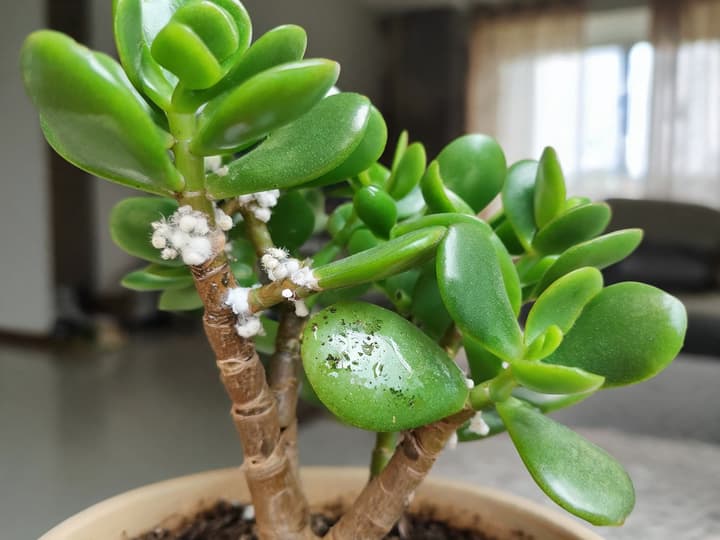
Many plant owners refer to this pest as "white aphids," but aphids are pear-shaped and lack the cottony wax coating. On echeveria, mealybugs come with distinct symptoms and specific treatment needs:
White powder on echeveria or mealybugs?
The bluish-white powder coating many echeverias is farina, also called epicuticular wax: a natural powdery barrier the plant produces on its foliage. NC State describes Echeveria elegans, for instance, as having leaves with a powdery white coating. Farina is not a disease and needs no treatment.
The most reliable way to tell the two apart is to check the shape and the location of the white substance.
Sign | Farina (natural wax) | Mealybugs |
|---|---|---|
Shape | Smooth, thin, continuous coating | Loose, fluffy clumps with wispy edges |
Location | Across the entire leaf, evenly distributed on both sides | In tight crevices, leaf axils, and leaf bases |
Underneath | The bare leaf surface | An oval body up to 3 mm long |
When poked | Does not move | The body crawls slowly away |
Sticky residue | No | Yes, from secreted honeydew |
On new growth | Present as soon as the leaf emerges | Appears suddenly in isolated patches |
Caring for echeveria requires caution about what touches the foliage. UConn Extension, part of the University of Connecticut, warns that dish detergent can strip the protective wax layer off plant leaves. The same bulletin notes that insecticidal soaps can alter similar waxy coatings on other plants. For that reason, on farina-coated succulents, apply alcohol strictly to the bugs with a cotton swab, and never spray the entire plant.
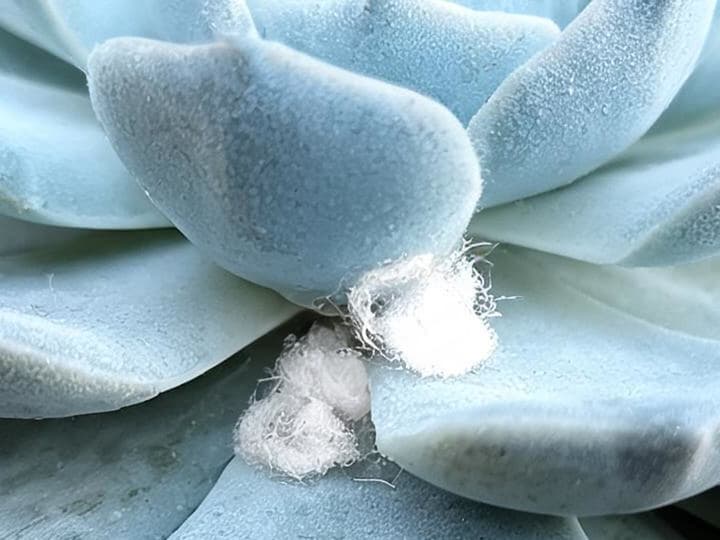
None of our extension sources have tested whether rubbed-off farina ever regenerates on that same leaf. To be safe, avoid rubbing the foliage and assume that removed farina is gone permanently from that leaf. Fresh leaves emerging from the center of the rosette will grow in with their own waxy shield.
How to remove mealybugs from succulents, step by step
Gather isopropyl alcohol (from a pharmacy or electronics store), cotton swabs, a wooden toothpick, a soft paintbrush, and a trash bag. The first session takes 15 to 30 minutes. After that, budget 10 minutes each week.
Isolate the plant today. Mealybugs crawl from plant to plant whenever foliage touches, according to the University of Wisconsin. Move the pot off the shelf, pull it away from shared saucers, and relocate it to another room.
Spot-test a single leaf. Touch the alcohol to one leaf and wait 1 to 2 days. Wisconsin Extension recommends this test because tissue damage can take a day or two to show up.
Dab insects off with a cotton swab. Dip the swab in 70% or lower isopropyl alcohol and press it directly against every bug and egg sac. For deep crevices in tight rosettes, use a toothpick with its tip wrapped in a bit of cotton. NC State, Iowa State, and Wisconsin all recommend alcohol-dipped swabs for light infestations.
Prune heavily infested parts. Snip away dry lower leaves or stem tips encrusted with tufts. Discard them in a sealed trash bag: Wisconsin notes that mealybugs survive on cut plant tissue as long as any moisture remains.
Clean the outside of the pot. Wipe a swab around the rim, across the drainage hole, and through the saucer, which can harbor hidden eggs.
Treat in early morning or late afternoon. Keep the plant out of direct sun until its foliage dries completely. UConn advises against applying insecticidal soap in temperatures above 90 °F (32 °C) or during bright sunny afternoons, as leaves burn much more easily under those conditions. Take the same precaution with alcohol. Once dry, keep the plant isolated in a spot with appropriate light as detailed in our guide to succulent light requirements.
Repeat weekly. Cotton swabs cannot reach eggs buried deep in waxy coatings, and NC State points out that a new generation takes 6 to 10 weeks to mature into adults. Stop only after two consecutive weekly checks reveal zero pests.
Our guide to mealybugs on houseplants details the complete life cycle from egg to adult and explains why a single treatment never solves the problem.
Alcohol, soap, or oil: what each succulent can tolerate
When an infestation spreads too far for swab treatments, you might consider a spray, though expert recommendations vary. An answer published by Ask Extension, the US cooperative extension network, advised spraying 70% alcohol directly onto an entire jade plant. Conversely, the University of California Statewide Integrated Pest Management Program (UC IPM) recommends diluting alcohol to 10% to 25% in water for foliage sprays. This guide follows the dilution approach: it kills mealybugs on contact while minimizing leaf damage risks.
Spraying is only suitable for smooth-leaved succulents without farina, such as jade plants. On bluish echeverias, stick to cotton swabs, even if the process takes longer.
Insecticidal soaps and horticultural oils demand even greater caution. UConn places jade and "some succulents" on its list of plants vulnerable to soap injury. In an Ask Extension inquiry, a grower reported that a neem oil spray caused about a third of their jade plant's leaves to drop. The answering specialist confirmed that neem can injure succulents like jade. Mississippi State University Extension confirms that certain plants suffer injury from horticultural oils.
If you already sprayed neem oil and mealybugs persist, the oil likely missed insects tucked into hidden folds. Soaps and oils only kill the pests they physically coat, and Wisconsin warns that reaching every hiding spot requires repeated thorough applications. Discontinue the oil, let the plant recover for several days, and switch to an alcohol-tipped swab.
Dish soap is not a substitute for insecticidal soap. UConn explains that dish detergent is formulated to strip grease and can dissolve protective leaf waxes, which strips the farina right off an echeveria.
Root mealybugs: when pests attack beneath the soil
Root mealybugs live underground feeding on roots, which means infestations often go unnoticed until damage is severe. According to NC State, they measure 1.5 to 3 mm long, have bluish-white bodies dusted with powdery white fluff, and turn surrounding soil slightly blue-gray. When you water, pests can wash out through drainage holes and crawl into neighboring pots.
Suspect root mealybugs whenever a succulent wilts or yellows without an obvious explanation, even though your watering is dialed in. Other indicators include:
white cottony fuzz collecting around pot drainage holes;
white powdery speckling clinging to roots or inner pot walls;
a plant that stalls completely during its active growing season.
The University of Wisconsin states that in many situations, the only reliable way to confirm root mealybugs is unpotting the root ball and inspecting the roots directly. On succulents, this is simple. Wait until the soil dries out, tip the pot sideways, and gently slide the plant out by the base of its stem.
Wisconsin also warns that subterranean infestations are notoriously difficult to control, making plant disposal the most practical choice in many cases. If you want to attempt a rescue, none of the extension services we reviewed outline a guaranteed protocol for succulents. The safest approach involves these steps:
shake all old soil off the roots and seal it in a trash bag, keeping it away from other pots;
trim away any roots coated in white powder or showing soft rot;
let the bare-root plant air-dry in a bright, shaded, well-ventilated spot until all cut surfaces callus over;
repot into a fresh pot, or scrub the original pot thoroughly with soap and water, using fresh, completely dry potting mix;
keep the succulent quarantined and inspect the drainage holes weekly.
To choose the right mix and time your first soak, consult our guide on how to water succulents, which shows how to check whether soil has dried completely.
Systemic insecticides: when they make sense
A systemic insecticide is absorbed through the root system and circulates throughout plant tissue. NC State considers systemics the most dependable mealybug treatment because they reach hidden insects that topical sprays miss. Mississippi State notes that soil drench applications work slowly, but provide extended protection.
The RHS ranks systemics among the most environmentally damaging pesticides because they remain active for a long time and kill beneficial insects. In its response regarding the jade plant, Ask Extension advised against using systemics. For an indoor succulent, use a systemic only after weeks of cotton-swab treatments produce no results, and only use a product registered for ornamental plants, following the label.
When a succulent cannot be saved
Discard the plant if cottony clusters encrust the base of the stem and nearly every leaf axil, or if the succulent has dropped most of its foliage. The RHS, Iowa State, Wisconsin, and Mississippi State all observe that with severe infestations, discarding the plant is often far easier and safer than attempting total eradication. Pitching the plant protects the rest of your indoor collection.
With succulents, you can often preserve the variety by propagating clean growth. Snip off an unaffected stem tip or healthy leaf with zero visible fuzz, inspect it thoroughly under a bright flashlight, and wipe the crevices with an alcohol swab before planting. Then discard the parent plant along with its potting soil. Find specific instructions for each plant type in our guide on how to propagate succulents.
Keep the cutting isolated and inspect it closely every week for at least 4 weeks. A single egg tucked in a fold can restart the entire infestation.
Other common succulent pests
Mealybugs top the list, but other pests strike succulents too. Find broader indoor plant pest profiles in our guide to houseplant pests; the pests highlighted below frequently attack succulents. NC State cites aphids, scale insects, spider mites, and mealybugs as occasional pests on jade plants (Crassula ovata). On Echeveria elegans, it advises monitoring for mealybugs, aphids, and black vine weevils.
Scale insects
Scale insects form hard, immobile, brown or tan shells anchored to stems and foliage. NC State notes brown scale as a pest on kalanchoe and jade plants. The protective shell shields the insect from contact sprays, so dislodging them with a fingernail or toothpick is the most effective removal method. Our scale insect guide compares both mealybugs and scale side by side.
Aphids
Aphids are small, pear-shaped insects that appear green, black, or pink, gathering in dense clusters on tender new growth. On kalanchoe, NC State reports aphids infesting flowers and foliage. They also secrete sticky honeydew. Find control measures in our guide to aphids on houseplants.
Spider mites
Spider mites, including two-spotted spider mites, are nearly invisible without magnification. According to the RHS, infested foliage develops fine, pale speckling on upper leaf surfaces, occasionally accompanied by delicate webbing. The RHS points out that warm, dry air and crowded plants encourage outbreaks. Our spider mite guide details treatment steps.
Fungus gnats
Fungus gnats are small dark flies, about 3 to 4 mm long, that dart around the soil surface. The RHS explains that they breed in moist soil, where larvae feed primarily on decaying organic matter and dead root tissue without harming established plants. On succulents, their presence almost always signals overwatering: let soil dry completely between drinks. Our fungus gnat guide covers eradication steps.
Weevils
Weevils are beetles whose curved, white, C-shaped larvae feed on roots inside containers. The RHS lists sedum among vulnerable plants, and NC State includes weevils among pests affecting Echeveria elegans. If a succulent wilts and lifts cleanly out of the soil with severed roots, sift through the mix for white, C-shaped grubs.
How to prevent mealybugs from returning
Quarantine new plants for at least 1 month. The RHS recommends this window because eggs and young nymphs take weeks to become visible. The University of Wisconsin suggests about 1 week; this guide follows the longer RHS duration to account for full egg hatch cycles. Mealybugs almost always enter homes hitchhiking on newly purchased plants.
Inspect root systems before buying or integrating plants. Slide the root ball out of the pot and look for telltale white powdery residue along root tips and inner container walls.
Avoid over-fertilizing. Wisconsin explains that mealybugs thrive on lush, rapid growth and recommends avoiding excess nitrogen. Learn proper feeding rates in our guide on how to fertilize succulents.
Strip dead bottom leaves regularly. Old dried leaves trap moisture and conceal mealybugs and egg sacs right at the soil line.
Control household ants. According to NC State, ants actively farm and transport mealybugs between plants to harvest honeydew.
Once clean, check plant crevices every 2 weeks. Catching a small colony early saves effort: a quick swab clears out pests before egg sacs spread.
If you are unsure of your succulent's species, identifying whether it bears delicate farina or has the soap-sensitive foliage of a jade can be challenging. Snap a photo using the Bloom app for iPhone: it identifies species instantly and delivers tailored care advice. To recognize succulents by their blooms, see how to identify succulents by their flowers. Find a complete routine covering light, water, and soil in our succulent care guide.
Frequently asked questions
Does dish soap kill mealybugs on succulents?
Dish detergent is not insecticidal soap and is not recommended for succulents. UConn Extension explains that dish soap strips grease and easily dissolves protective leaf waxes, which removes the farina on echeverias. For mealybugs, use a cotton swab dipped in 70% or lower isopropyl alcohol, applied directly to individual pests.
Does rubbing alcohol kill mealybugs?
Isopropyl alcohol kills mealybugs on contact, according to NC State, Iowa State, and the University of Wisconsin. It must make direct contact with the bug and cannot penetrate the waxy coating protecting eggs. That is why treatments must be repeated weekly until two consecutive checks reveal no live pests. Test on a single leaf first and wait 1 to 2 days.
Do mealybugs go away on their own?
No. Indoors, mealybugs breed year-round and crawl between plants whenever foliage touches. The RHS notes that while a plant can tolerate small numbers briefly, populations explode quickly if left untreated. Catching an infestation early makes control simpler, but weekly swab treatments must continue until two consecutive inspections find nothing.
Is it harmful to touch mealybugs?
Extension sources report no human health risks from touching mealybugs. The real danger is to your other plants: your fingers easily transfer eggs and microscopic nymphs between pots. Wash your hands thoroughly after handling an infested succulent before touching any other greenery.
Are white aphids on succulents actually mealybugs?
Almost always. The term "white aphids" is commonly used to describe mealybugs, which are oval insects dusted with white wax hiding in leaf folds. True aphids are pear-shaped, lack cottony wax, and feed in exposed clusters on flower stems and fresh shoots. White cottony fluff and slow movement point to mealybugs. Clusters of green, black, or pink insects on shoots indicate aphids.
Related articles
How to Care for a Goldfish Plant: Light, Watering, and Blooms
How to care for a goldfish plant: bright light without strong sun, water when the soil surface dries, and humid air. Learn how to tell a Nematanthus from a Columnea, why it drops leaves, and how to get it to bloom again.
Lavender Leaves Turning Yellow: Where the Yellowing Starts Shows the Cause
Lower leaves turning yellow with moist soil means overwatered roots, the most common cause. Old leaves drying one by one on woody stems is normal. Take the stem and root test, see if your plant can still be saved, and find out what to do today.
How to Propagate Lavender: Where to Cut and Why Cuttings Rot
A lavender cutting comes from a non-flowering branch tip, about 4 inches long, planted in sandy soil that never stays soggy. Learn where to cut, rooting times, seasonality in Brazil, and what to do if the base turns black.