How to Propagate Lavender: Where to Cut and Why Cuttings Rot
A lavender cutting comes from a non-flowering branch tip, about 4 inches long, planted in sandy soil that never stays soggy. Learn where to cut, rooting times, seasonality in Brazil, and what to do if the base turns black.
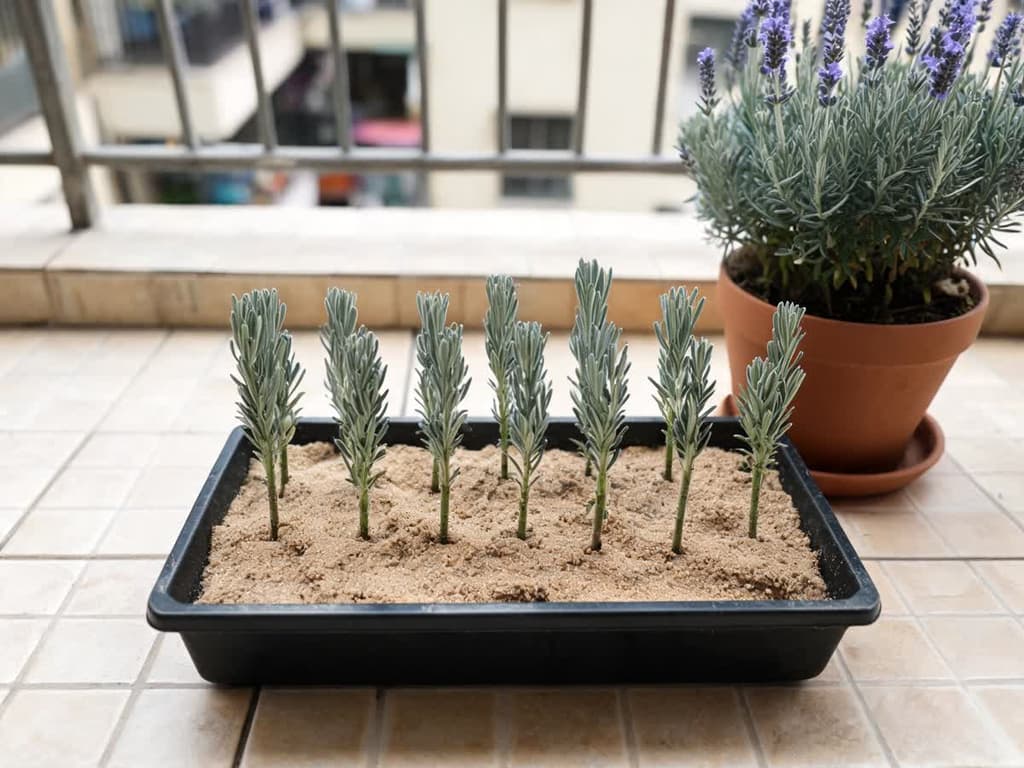
How to propagate lavender, in brief: cut a 4-inch tip of new growth from this year, without flowers or buds. Strip the leaves from the bottom half and bury that section in a mix of coarse sand and potting soil. Keep the pot in bright, indirect light, with soil that is moist but never soggy. Roots take 3 to 10 weeks, depending on the lavender variety and warmth.
Cuttings, the severed tips of branches, are the most common method used in Brazil to propagate lavender, according to researchers at the Federal University of Paraná (UFPR) (Revista Brasileira de Plantas Medicinais, 2017). Seeds and layering (covering a branch with soil while still attached to the plant until it roots) also work. In Brazil's humid heat, the factor that most determines success is water: waterlogged soil rots the base of the cutting.
Quick summary:
Branch: this year's tip, no flowers, firm base and soft tip, about 4 inches long.
Cut: right below a node, the point on the stem where leaves emerge.
Soil: half washed coarse sand, half standard potting mix. Leave out worm castings.
Water: moist soil, never waterlogged. Always empty the saucer.
Rooting hormone (powder that stimulates roots): helps some lavenders and makes no difference for others. It is optional.
Time: 3 to 10 weeks until rooting.
Timing in Brazil: from September to November, or in March and April.
Which lavender do you have: each type propagates differently
Lavender varieties sold in Brazil root differently. The difference is large enough to change how many cuttings you should take.
Lavender | Cutting | Seed | What to expect |
|---|---|---|---|
French or fringed lavender (Lavandula dentata), comb-like toothed leaves | Roots easily | Possible, but plants differ from the parent | Over 96% rooted cuttings with rooting hormone and misting in a nursery (UFPR) |
English lavender (Lavandula angustifolia), smooth narrow leaves | Roots, with results varying from plant to plant | Slow and uneven | Take twice as many cuttings as you need |
Spanish lavender (Lavandula stoechas), two purple "ears" atop the flower spike | Semi-ripe cutting | Possible | Same cutting method as English lavender |
Lavandin (Lavandula × intermedia), hybrid with long flower spikes | Cutting or layering | Does not produce viable seeds | Sterile hybrid: only propagates by cuttings or layering |
French lavender is the easiest. In a UFPR study, Lavandula dentata cuttings about 4 inches long rooted in over 96% of cases using rooting hormone (IBA at 2,000 or 3,000 mg per liter), in a nursery mist bed (Ciência Rural, 2010). The authors concluded that the species roots easily.
English lavender roots less predictably. Researchers from IAPAR (the agricultural research institute of Paraná) and UFPR tested eight different plants of the same species, and each one reacted differently (Semina: Ciências Agrárias, 2012). Rooting hormone made no difference in three of them, helped in three others, and hindered two. For that reason, with English lavender, take twice as many cuttings as you want. No study has measured the right number for home use: doubling is this guide's margin of safety.
Lavandin is a cross between English lavender and broadleaved lavender (Lavandula latifolia). This hybrid is sterile and does not reproduce by seed, according to a 2023 scientific review (Molecules, 2023). Every lavandin plant comes from cuttings or layering.
If the pot label is gone and you do not know which of the four you have, Bloom identifies lavender from a photo of the leaf and flower.
Where to cut lavender branches for propagation
The right stem is a tip that grew this season and has no flowers or buds. The Royal Horticultural Society (RHS) is the British gardening charity. It describes the ideal stage by touch: the base of the stem is already firm and the tip is still soft (RHS, semi-ripe cuttings). This stem is called a semi-ripe cutting, halfway between soft green growth and hard wood.
The length ranges between 10 and 15 cm, according to the RHS. UFPR also tested cutting size in French lavender. Branch tips of at least 10 cm rooted better than 5 and 8 cm pieces (Revista Brasileira de Plantas Medicinais, 2012). The tips also formed more roots than pieces taken from the base of the branch: 13.2 roots per cutting, compared to 2.98.
Make the cut just below a node. A node is the point on the stem where leaves emerge; in lavender, it is where a pair of leaves attaches to the branch. The Utah State University Extension service, which guides the public on planting, instructs to cut there and strip 3 to 4 bottom leaves (Utah State University Extension). The step-by-step guide below strips those from the bottom half, like Colorado State, and keeps the top ones.
Avoid flowering stems. Colorado State University recommends taking only cuttings without flower buds, right after blooming (Colorado State Extension, via Ask Extension). Do not use the hard gray wood from the base of the plant either: old lavender wood does not regrow, as explained in this guide on how to care for lavender.
The lavender is drying out: can you still take cuttings?
You can, as long as there are still stems with firm, green leaves. The cutting needs living leaves to develop roots. In French lavender, cuttings that kept two-thirds of their leaves produced longer and heavier roots than those left with one-third (Revista Ceres, 2010).
Pick the greenest tips that are at least 4 inches long. Stems with brown, brittle leaves all the way to the tip will not work for cuttings. Take more cuttings than the number of plants you want, as not all of them will take root.
How to propagate lavender from cuttings, step by step
Propagation by cuttings means taking a piece of stem that grows roots once planted in soil.
Prepare the pot before cutting. Mix equal parts washed coarse sand and regular potting soil, and fill a pot with drainage holes.
Cut a 4-to-6-inch branch tip right below a node, using clean, sharp pruners.
Strip leaves only from the section that will sit underground, about the bottom half. Keep all the top leaves intact.
If using powdered rooting hormone, dip the cut end and tap off any excess.
Make a hole in the soil with a pencil and bury the bare stem. Do not bury any leaves.
Press the soil around the cutting with your fingers to hold it upright.
Water once until water drains through the bottom hole, and empty the saucer.
Keep the pot in a bright spot away from direct sunlight. The RHS recommends bright light without direct sun hitting the cuttings.
Multiple cuttings can fit in the same pot, as long as the leaves of one do not touch those of another. Touching leaves trap moisture. The RHS warns that damping off, a fungal disease that rots the cutting at the base, appears in humid, poorly ventilated environments (RHS, propagating herbs).
Soil and watering for cuttings: moist, never soggy
The soil for lavender cuttings needs to hold a little moisture and let the rest drain away. The University of Florida Extension (UF/IFAS) recommends coarse builder's sand. Fine sand robs the soil of air and slows root development, according to the same source (UF/IFAS, herb cuttings). This guide uses half sand and half potting soil. UF/IFAS also accepts half potting soil and half perlite (light, white volcanic rock grains sold at garden centers).
Leave out worm castings and fertilized potting mix. Colorado State and Utah State call for a sterile, well-draining growing medium.
The watering rule comes from Utah State: keep the soil moist but not wet. The RHS says the same thing in different words: remove excess moisture and keep the compost just moist. In practice, stick your finger an inch into the sand: water when this top layer feels dry to the touch and the layer below is just damp. No study has evaluated home watering frequency for lavender cuttings.
A report from TV Rio Sul shows how to root cuttings in worm castings with sand and says: "keep the soil always moist." The report does not explain what "always moist" means and uses worm castings. This guide follows Utah State and the RHS, which call for moist, but not wet, soil in a well-draining mix. Neither source recommends worm castings.
UF/IFAS writes for Florida's humid climate, which is similar to much of Brazil. It warns that, in high-humidity areas, fungal root rot is a problem in lavender (UF/IFAS Extension Nassau County). The cutting, rootless and with an open wound, is the plant's most vulnerable part.
Plastic bag over the cutting: yes or no?
The RHS suggests covering the pot with a clear plastic bag to retain air humidity. That same RHS guidance reminds growers to remove excess moisture. During a Brazilian summer, a closed bag turns into a greenhouse: foliage stays wet day and night.
Use a bag only during periods of dry air, propped up with sticks so it does not touch the leaves, as advised by UF/IFAS. Open the bag once a day to ventilate. If drops start running down the inside of the plastic or white mold appears on the soil, remove the bag entirely.
Rooting hormone for lavender: is it necessary?
Rooting hormone helps with some lavenders and makes no difference with others. Expert sources disagree:
Colorado State University notes that rooting hormone is unnecessary for lavender.
Utah State instructs dipping the tip in hormone. UF/IFAS notes that lavender and rosemary may benefit from it.
In the IAPAR and UFPR study involving eight English lavender plants, the response varied by plant. The authors concluded that the need for rooting hormone and the proper dosage cannot be generalized.
With French lavender, rooting rates improved with rooting hormone. A dose of 2,000 mg per liter of IBA (indole-3-butyric acid, the active ingredient in most rooting powders) produced the best results.
This guide follows the studies, as they measured the effect: rooting hormone is not required. For English lavender, results depend on the plant; if you have powder hormone, treat half of your cuttings and leave half untreated. For French lavender, it raises the overall rooting percentage.
Cinnamon, honey, cloves: do homemade rooting aids work on lavender?
Nobody has tested this. There are no published studies examining cinnamon, honey, or clove-and-cinnamon water on lavender cuttings. If you want to test them, treat half of your cuttings with the remedy and leave half untreated within the same pot. That way you can evaluate the results on your own lavender.
Can you propagate lavender in water?
You can try, but soil remains the safer choice. Colorado State University cautions that water-rooted cuttings often struggle to adjust to soil, where moisture levels are much lower. No studies have measured whether lavender roots well in water or how many cuttings survive the move to soil.
Cuttings buried in a sand-and-potting-mix medium develop roots in the environment where they will grow. Stick with soil. If you want to try water, use a clear glass, keep only the leafless part submerged, and change the water whenever it turns murky. Move the cutting to soil as soon as the first roots appear.
How long lavender cuttings take to root
Lavender cuttings take 3 to 10 weeks to develop roots, depending on the variety and the temperature:
Source | Lavender | Time to root |
|---|---|---|
Colorado State University | Lavender in general | About 3 weeks |
Utah State University | English, soil at 70°F (21°C) | 30 to 40 days |
UF/IFAS | Herbs in general, including lavender | 4 to 10 weeks |
UFPR, in a mist-equipped nursery (fine misting spray at short intervals) | French | Assessed at 60 days (roots may have formed earlier) |
Do not pull up cuttings to inspect roots. Three signs show that a cutting has rooted: fresh green growth at the tip, roots emerging from the drainage hole, and light resistance when you tug upward gently starting at week 3. If it slides out freely, it has not rooted yet.
The high rooting rates seen in Brazilian studies came from nursery mist beds, systems that spray fine water droplets every few minutes. At home without that setup, expect a lower success rate.
Best time to take lavender cuttings in Brazil
In Brazil, take lavender cuttings from September to November or in March and April. Gardening sources are from the Northern Hemisphere, where the seasons fall in opposite months to those in Brazil. The RHS indicates semi-ripe cuttings in summer for English lavender (RHS, English lavender profile). For the 'Hidcote' variety, it indicates softwood cuttings in early summer or semi-ripe cuttings in late summer (RHS, 'Hidcote' lavender). For Spanish lavender, it indicates semi-ripe cuttings in summer.
In Brazil, the beginning of summer falls in December and the end of summer in February and March. Spring runs from September to November and fall from March to May.
Lavender roots in more than one season. In a Turkish greenhouse study with lavandin, spring cuttings rooted at 88.6% and fall cuttings at 78.4% (Anadolu Journal of Agricultural Sciences, 2024). No one has measured the best time for lavender in Brazil.
For that reason, the safest option falls outside the peak heat and rain of the Brazilian summer. This shifts the RHS timing (December and February to March in Brazil) away from the humid heat, which is what rots the cutting. These are the months from September to November, in spring, and March and April, in early fall. In any month, avoid taking cuttings during a week of continuous rain.
Lavender cuttings with a black, soft base
A soft, black stem base signals rot. The decay progresses upward from below, and blackened tissue will not turn green again.
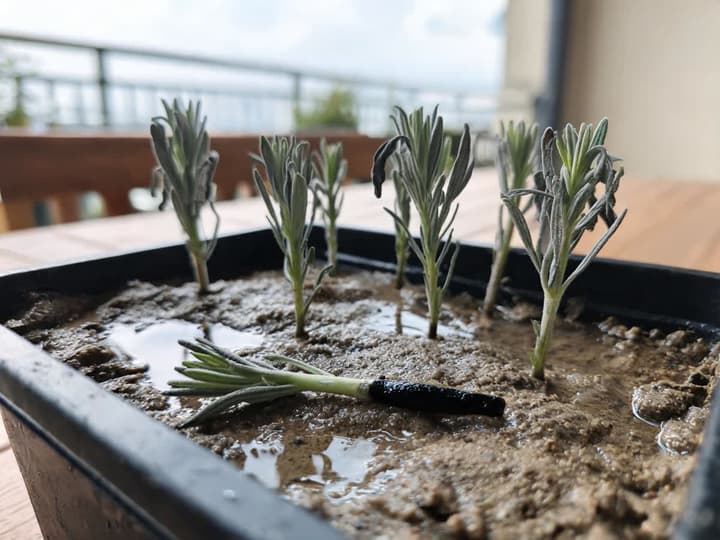
No studies have measured what causes a black base on lavender cuttings. NC State Extension points to overwatering as the cause of root rot in mature lavender (NC State Extension), and UF/IFAS links rot to high humidity. Standing water around the cutting is therefore the main suspect. Fine sand, fertilized soil, a saucer of water, and a closed plastic bag in the heat all add moisture and make the problem worse.
What to do with the cutting:
If the black section is roughly 1/2 to 1 inch long (1 to 3 cm), as pictured, and the stem above remains firm and green, cut 1/2 inch (1 cm) above the rot. Remove another pair of leaves, insert into fresh, merely damp mix, and water lightly just to settle the substrate.
If the blackening has reached the leaves or the remaining stem is shorter than 2 inches (5 cm), discard it. Short cuttings root poorly: in the UFPR study, 2-inch and 3-inch cuttings lagged behind those 4 inches or longer.
In both situations, discard the sand from the pot where the cutting rotted. Do not reuse that sand for new cuttings.
No studies have evaluated recutting rotted lavender stems. The logic matches taking a fresh cutting: what matters is having healthy stem tissue below the leaves.
Rot can also affect the parent plant. If its crown turns dark and branches wilt even when soil is damp, root rot has already set in.
Layering: propagate lavender without cutting the branch
Layering makes the branch form roots while still attached to the parent plant. The RHS describes a version called stool layering (mound layering), where you cover the base of the plant with soil, recommended specifically for lavender that has become woody (RHS, propagating herbs). According to them, lavender, sage, and thyme are short-lived and can be renewed this way.
The step-by-step method from the RHS, adjusted to Brazilian calendar seasons:
In spring (September through November), mix equal parts compost and sand.
Mound this mixture over the base of the plant until only branch tips remain exposed.
Keep the mound watered without saturating it.
By late summer (February to March), covered stems should have roots along their length.
Sever each rooted stem below the root mass and pot it up or plant it into garden beds.
Layering is practical for filling garden beds with lavender. A large mature specimen provides multiple rooted plants at once without managing individual pots of cuttings.
Propagating lavender from seed
Seeds work, but they are the slowest route. Utah State notes that English lavender germination usually begins within 14 to 21 days at 70°F (21°C). The extension also reports low germination rates, taking 100 to 200 days from sowing to transplant.
Seed-grown plants also differ from the parent. UFPR researchers observed that seedlings showed wide variation in size and essential oil concentrations. Cuttings, conversely, produce an exact clone of the mother plant.
Cold before sowing helps. A French study with seeds from several lavender species showed that storing moist seeds between 3°C and 5°C increased germination (Acta Horticulturae, 1978). The longer the time in the cold, the higher the percentage of normal seedlings. No technical source gives the exact number of weeks in the refrigerator.
Lavandin is omitted here: it does not produce viable seed.
Once lavender cuttings root: potting, sunlight, and planting out
Colorado State recommends potting rooted cuttings into individual 2-to-4-inch containers (5 to 10 cm). Transplant outdoors into garden beds or permanent containers once roots fill this small pot. Use the same sand and potting mix blend.
The cutting spent weeks protected from direct sun, and tender leaves will scorch if moved straight into bright light. The RHS recommends a 2-to-3-week hardening-off period for cuttings rooted in greenhouses. Start with gentle morning sun and increase exposure hours gradually.
After hardening off, the lavender cutting needs the same care as a mature plant: 6 to 8 hours of direct sun daily and soil that dries quickly between waterings, as detailed in the guide on how to care for lavender.
Frequently asked questions
Can you stick lavender cuttings directly into outdoor garden beds?
You can, though no study has compared the difference. In a garden bed, cuttings remain exposed to strong sun, wind, rain, and soil that may waterlog. It is safer to root cuttings in containers first and plant them out later. To fill outdoor beds quickly, mound layering directly on the parent plant produces plants that are already rooted.
Can you propagate lavender from flowering stems?
It is not ideal. Colorado State recommends shoots without flower buds, cut right after flowering. If only flowering stems are available, cut off the spike and use the rest of the stem, as long as at least 4 inches (10 cm) with leaves remain.
Do lavender and "alfazema" propagate the same way?
Yes. In Brazil, "alfazema" is usually the name for English lavender (Lavandula angustifolia), as in the IAPAR and UFPR study. The alfazema cutting is the same semi-hardwood cutting in this guide. Take double the cuttings you want, because its rooting varies from plant to plant.
How many cuttings should you take to get one rooted lavender?
French lavender rooted in over 96% of cases in the UFPR nursery, with misting and rooting hormone. At home the rate is lower, and no study has measured by how much. Take one or two more cuttings than the plants you want. With English lavender, take double, because its results vary from plant to plant, according to the IAPAR and UFPR study.
Where to start today
Check your lavender plant and look for three non-flowering branch tips with green foliage and a firm lower stem. Mix half coarse sand and half potting soil in a pot before making your cuts. After watering, mark a date 4 weeks out on your calendar to check for new growth.
If you are unsure whether yours is French, English, or lavandin, Bloom (iOS-only) identifies it from a photo and displays the care steps for each one.
Related articles
How to Care for a Goldfish Plant: Light, Watering, and Blooms
How to care for a goldfish plant: bright light without strong sun, water when the soil surface dries, and humid air. Learn how to tell a Nematanthus from a Columnea, why it drops leaves, and how to get it to bloom again.
Lavender Leaves Turning Yellow: Where the Yellowing Starts Shows the Cause
Lower leaves turning yellow with moist soil means overwatered roots, the most common cause. Old leaves drying one by one on woody stems is normal. Take the stem and root test, see if your plant can still be saved, and find out what to do today.
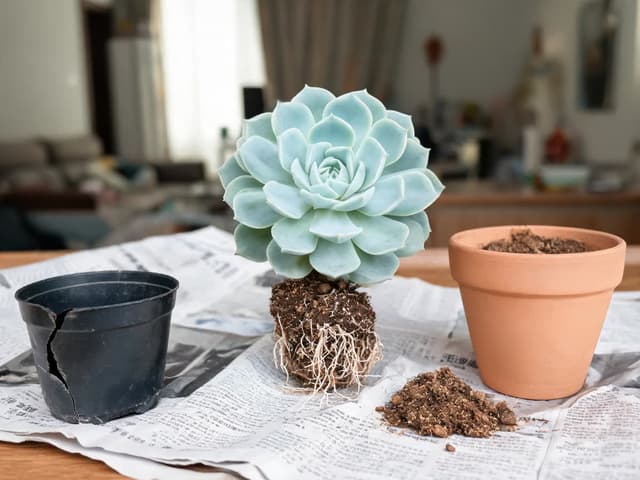
How to Repot a Succulent: When to Change Pots and When to Water After
Repot your succulent in dry soil, using a pot with drainage that is only slightly larger than the roots, and time the watering correctly: the same day if no roots broke, or after 7 days if any were cut. In the southern hemisphere, spring is September to November.