Lavender Leaves Turning Yellow: Where the Yellowing Starts Shows the Cause
Lower leaves turning yellow with moist soil means overwatered roots, the most common cause. Old leaves drying one by one on woody stems is normal. Take the stem and root test, see if your plant can still be saved, and find out what to do today.
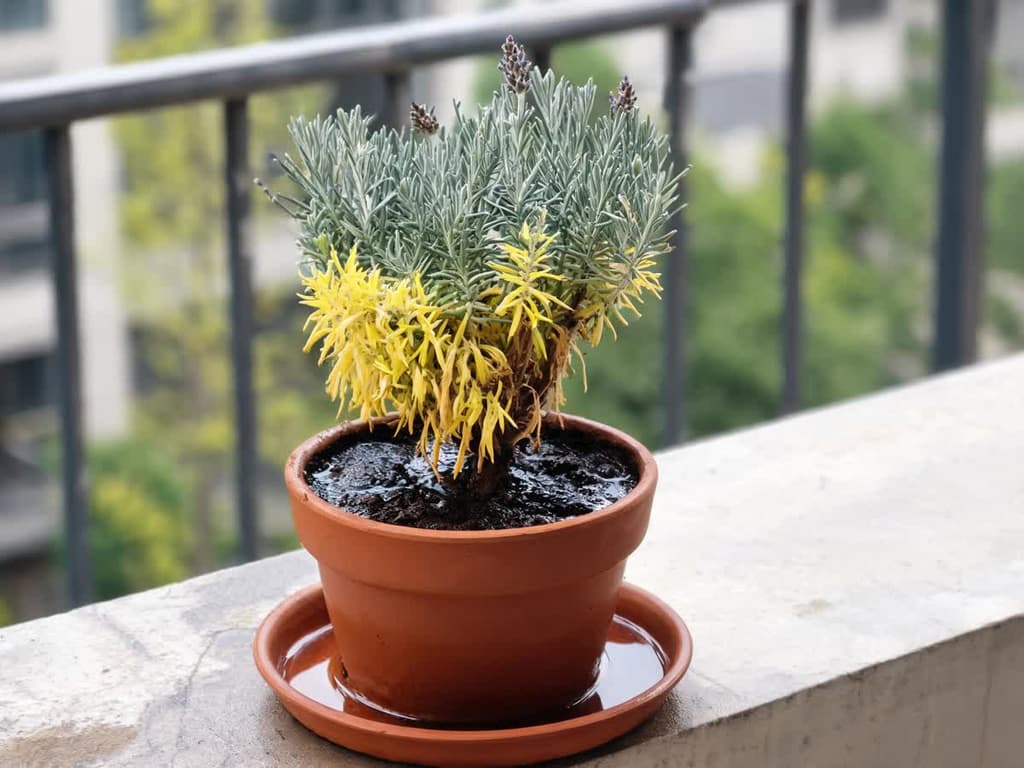
Lavender leaves turning yellow almost always point to roots that are too wet. The telltale sign is yellowing that begins on the lowest leaves, climbs quickly, and appears while the soil is still moist. Watering again in this situation makes the problem worse. There are three other causes, and the exact spot where the yellowing starts separates each one.
The plant can still be saved as long as you have firm white roots and the inside of the stem stays pale near the soil line. To find out where your plant stands, run the test in the root section before you water, fertilize, or move the pot.
Quick summary:
Lower leaves yellow, soil moist, yellow climbing in a few days: rotting roots or stem base. Stop watering and inspect the roots today.
Old interior leaves turning yellow one at a time, tips firm: normal leaf shedding. Remove only the dry leaves at the base.
Entire plant pale green: lack of sun or acidic soil.
Only lower leaves yellowing evenly and slowly, healthy roots: nitrogen deficiency.
New leaves yellow with green veins: soil pH is too high (pH measures whether soil is acidic or alkaline), locking up iron.
Yellow leaves with pale speckles or fine webbing: pests, almost always spider mites.
Lavender leaves turning yellow: diagnosis at a glance
Yellowing on lavender stems from four sources: waterlogged roots, natural shedding of old foliage, insufficient light or nutrients, and pests. What separates the four is where the yellowing starts, the moisture in the soil, and how fast it spreads. The table below compares these three signs.
Where and how it turns yellow | Soil at 1 inch (3 cm) | Probable cause | What to do today |
|---|---|---|---|
Bottom leaves, spreading upward in days; wilted stems | Moist | Rotting roots or stem base | Stop watering and run the stem and root test |
Old interior leaves, one by one; firm tips | Dry between waterings | Normal shedding of old leaves | Just remove the dry leaves at the base |
Entire plant pale green, stretched stems | Any | Not enough direct sun | Move to a spot with 6 to 8 hours of direct sun |
Bottom leaves evenly yellow, slow, white roots | Dry between waterings | Nitrogen deficiency | A light fertilizer application, only after checking roots |
Entire plant yellowed and weak, white roots | Any | Acidic soil | Test pH; if below 6.5, add dolomitic lime |
New leaves yellow with green veins | Any | High pH locking up iron | Test pH before amending |
Pale speckles, webbing, insects on shoot tips | Any | Mites, aphids, or whiteflies | Rinse with a stream of water and inspect every 3 days |
Yellow lower leaves appear in three rows of the table. The soil separates these three rows. Moist soil points to roots. Dry soil points to normal shedding or nutrients, but only if roots are healthy. That is why the root test comes before any fertilizer.
Yellowing from the bottom up with moist soil: roots and stems
Lower leaves yellowing quickly with moist soil are the classic sign of root rot. The waterlogged root runs out of oxygen and a group of soil microorganisms begins attacking it. The Pacific Northwest Plant Disease Handbook is written by the universities of Oregon and Washington. It lists four groups in rotted lavender roots: Fusarium, Rhizoctonia, and two fungus-like soil organisms, Phytophthora and Pythium (PNW Plant Disease Handbook).
The same handbook outlines the sequence on the plant. The root darkens inside, turns black, and rots. The foliage changes color first, and then the plant wilts and dies completely. The handbook also notes that Phytophthora climbs from the roots into the stem, while Pythium generally does not. That is why the test examines the crown, the base of the stem where it meets the soil, and not just the roots.
Phytophthora causes the most concern for lavender growers. Researchers at Clemson University in the United States tested several of its species in a greenhouse. They call Phytophthora root and crown rot "a major threat to the lavender industry worldwide." The team confirmed six new cases where a Phytophthora species infects a lavender species (Dlugos, Bridges, and Jeffers, Plant Disease, 2024).
When rot reaches the crown, water no longer travels from the roots up to the leaves.
The 5-minute stem and root test
Feel the soil down to 1 inch (3 cm). Soil that stays moist several days after watering points to standing water in the container.
Check the base of the stem right at the soil line. Using your thumbnail, gently scratch back a small 1 cm section of bark. Firm, light green or cream tissue underneath means live stem. Brown, dark, or mushy tissue means crown rot.
Slide the plant out of the pot. Turn the pot on its side, hold the plant by its base, and slide out the entire root ball.
Squeeze the roots around the outer edge of the root ball. Healthy roots are firm and white or light tan. Rotten roots are brown or black, mushy, and the outer sheath slides right off when pulled, leaving a thin inner thread behind.
If the roots are white and firm and the stem is pale on the inside, the problem is not root rot. Put the plant back into its pot and check the other rows in the table.
Why lavender rots so quickly in hot, humid weather
Lavender comes from dry Mediterranean hillsides, where summers are hot and dry. In much of Brazil, summer is hot and rainy at the same time. In São Paulo, the IAG-USP weather station records 618.0 mm of rain between December and February, the warmest quarter of the year.
North Carolina State University Extension warns that lavender prefers regions with cool summers and "may struggle in the southeast" of the United States. This region has hot, humid summers, like much of Brazil (NC State Extension, Lavandula genus). University of Florida Extension cites root rot as a risk in high-humidity areas (UF/IFAS Extension Nassau, 2017).
Four common habits in Brazil leave roots wet without you noticing:
Cachepot with no drainage hole. A cachepot is a decorative outer pot with no drainage holes holding the inner nursery pot. Drain water gathers in the bottom out of sight. Remove the inner pot to water, and only return it once it finishes dripping.
A saucer full of water after rain. An outdoor pot on a porch gets the full force of summer downpours. Empty the saucer after every heavy rain.
Pine bark or other organic mulch on the soil surface. This mulch holds moisture around the base of the plant. UF/IFAS warns that this encourages rot. Small gravel or pea gravel works better.
Dead leaves accumulated at the base. Dead foliage around the base traps moisture near the roots. The New York Botanical Garden recommends removing these leaves (NYBG, Mertz Library).
The species also matters. English lavender (Lavandula angustifolia) struggles the most with hot, humid air. French lavender adapts the best. The guide on how to care for lavender includes a comparison table for English, French, and Spanish lavender.
How to save lavender with root rot
A lavender plant with rotted roots can bounce back if you still have white roots left and the stem stays pale inside near the base. The fix involves removing soggy soil, cutting away dead tissue, and repotting in fast-draining potting mix.
Take the plant out of the pot and loosen the old soil with your fingers, without washing it aggressively.
Trim away every brown, black, or mushy root using clean shears, until you reach firm, white tissue.
Prune back dry or completely yellow stems. Always cut right above green leaves, never into bare woody parts, which do not regrow.
Repot in fresh, well-draining soil. Use this blend: 2 parts potting soil, 1 part coarse washed sand, and 1 part perlite or rice hulls.
Use a pot matched to the remaining root system, with bottom drainage holes, preferably terracotta. Too much soil around too few roots stays soggy for days.
Do not water right away. Wait to water until the top 1 inch (3 cm) of soil dries out, then water until it drains out the bottom.
Place the plant in direct sun with good airflow, away from walls and other pots.
Leaves that have already yellowed will not turn green again. The sign that your plant took root is stem tips growing back green and firm over the following weeks.
A plant cannot recover once the base of the stem turns dark all the way around. Water can no longer travel from the roots to the upper foliage. If healthy green stems remain up top, snip 4 to 6-inch (10 to 15 cm) cuttings to propagate before they dry out as well.
Old base leaves turning yellow one by one: it is normal
Lavender is an evergreen plant (it keeps leaves year-round), and every plant of this type sheds old leaves little by little. The Royal Horticultural Society, from the United Kingdom, explains that these old leaves usually turn yellow before dropping. It adds that losing young leaves is a cause for concern (RHS, Chlorosis).
On lavender, this shedding shows up toward the center of the plant on stems that have turned woody, hard, and gray like timber. Lower, inner leaves turn yellow, dry to a straw color, and drop. Branch tips stay firm with normal coloration.
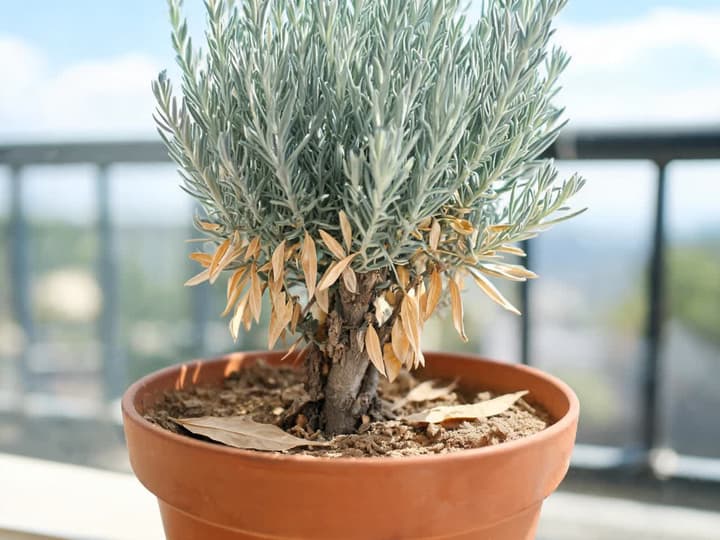
Three signs confirm normal shedding: dry soil between waterings, slow-spreading yellowing, and new branch tips that continue growing. If the tips also yellow, or if the yellowing sweeps upward in days, something else is going on. In that case, start with the root test.
A bare, woody base stems from a different issue: lack of pruning. Old lavender wood does not sprout new growth, and our guide on how to care for lavender explains the pruning routine that keeps woody sections compact.
Narrow leaves, a strong herbal aroma, and purple blossoms also describe rosemary, and people who inherit one of these plants do not always know which one they have. Both drop older bottom leaves, and the troubleshooting in this article applies strictly to lavender. If you are unsure of your plant, Bloom can identify it from a photo of its foliage and flowers.
Pale yellow over the whole plant: light, pH, or nutrients
Pale lavender without root rot points to three potential causes: low light, acidic soil, or nitrogen deficiency. Stem shape, the location of the yellowing, and soil pH separate the three.
Long, thin branches with wide spacing between leaves indicate a lack of sunlight. Lavender needs 6 to 8 hours of direct sun per day to grow compact, according to the Iowa State University Extension. With less sun, the branches stretch searching for light and the foliage loses its color. Move the pot to the sunniest spot in the house, preferably outdoors.
Normal-sized stems, with the lower leaves yellowing evenly and slowly can indicate a lack of nitrogen. The RHS describes this pattern: general yellowing that starts on the oldest leaves, usually with the plant lacking vigor. The University of Maryland Extension addressed a lavender case with a caveat. Old lower leaves turning yellow is sometimes a nitrogen deficiency, but only if the roots are healthy (Ask Extension, 2024).
Fertilizing lavender with root rot does not solve the problem, because diseased roots do not absorb fertilizer. Too much fertilizer also causes harm: weak stems, fewer flowers, and more disease (Utah State University Extension). For lavender potted for more than a year in the same soil, with roots checked, a light fertilization is enough. Use slow-release fertilizer at the label rate, only once, and do not repeat.
An entirely yellow and weak plant with healthy roots may be in acidic soil. pH measures soil acidity, and lavender prefers a pH between 6.5 and 7.5 (Utah State University Extension). NC State notes that the genus dislikes acidic soil. Measure the pH with a garden center kit. Below 6.5, mix dolomitic limestone into the soil at the package rate, and measure again before repeating.
Yellow new leaves with green veins show the opposite pattern. It is called interveinal chlorosis: the tissue between the veins turns yellow while the veins stay green. It appears on new leaves when iron is deficient, and high-pH soil binds iron. That is what the Washington State University Extension explains (WSU Hortsense). If you already mixed lime into the soil, test the pH before adding more. Above 7.5, do not add more lime. If the new leaves stay yellow, replace the soil with the fresh, well-draining mix from the root rot section.
Stippled yellowing, webs, or bugs: pests
Pests are the least common cause of yellow leaves on lavender. When they strike, the yellowing comes with speckling, webbing, or visible insects.
Spider mites: UF/IFAS describes fine webbing and leaves with light speckling (UF/IFAS Extension Pasco, 2024). Tap a stem over a sheet of white paper: specks that move are spider mites.
Aphids: small, soft-bodied insects clustering at stem tips and flower buds, sometimes curling the leaves. The guide on aphids on plants shows how to spot them.
Whiteflies: a cloud of white insects that rises when you touch the plant. NC State lists whiteflies, aphids, spider mites, and thrips as pests to monitor on lavender (NC State Extension, Lavandula stoechas).
For aphids, Iowa State University recommends a strong spray of water on infested branches (Iowa State Extension). For spider mites and whiteflies, the safest first step is the same spray of water, without any product. Repeat the inspection every 3 days. If the pest returns, use insecticidal soap or neem oil, always at the label rate, as UF/IFAS recommends.
Silvery gray foliage is not yellow foliage
English lavender naturally has gray-green leaves, and NC State classifies the species as a silver-foliaged plant (NC State Extension, Lavandula angustifolia). This tone is uniform across the entire plant, and the leaves stay firm.
Unhealthy yellowing looks distinct: lime green, pale yellow, or straw-colored, either in patches or over the entire plant. If you are uncertain about foliage color, compare a tip leaf to a bottom leaf. If both share the same gray tone, your plant is fine.
Frequently asked questions
Will yellow lavender leaves turn green again?
No. Older leaves that turn yellow from natural shedding or root rot will not regain their color. The true mark of recovery is fresh stem tips growing green and firm. Clear away dry, yellow foliage at the base so it does not trap moisture against the stem.
Do coffee grounds help lavender with yellow leaves?
It does not help. A review from Washington State University found that the pH of coffee grounds ranges between 4.6 and 8.4. Because of this, it does not correct soil acidity in a predictable way (WSU, Linda Chalker-Scott). The same review shows that a layer of grounds compacts and blocks the movement of air and water.
Does indoor lavender get yellow leaves?
Yes, frequently. Indoors, lavender receives less direct sun than the 6 to 8 hours it requires, and potting soil takes longer to dry out. Together, these two factors lead to pale leaves and waterlogged roots. Keep the pot on your sunniest windowsill and water only when the top 1 inch (3 cm) dries.
How long does it take for lavender to recover from yellow leaves?
It depends on the cause, and none of the sources cited in this article provide a set timeframe. With insufficient sun, fresh growth emerges with healthy color once the plant moves to brighter light. With root rot, recovery only starts after repotting into fresh mix, and yellow leaves never green up again. The reliable indicator is always firm, green new tips.
What to do now
Before you water, feed, or relocate your lavender, poke your finger 1 inch (3 cm) into the soil and check the base of the stem. Moist soil paired with yellowing spreading upward calls for the root test today. Dry soil with yellowing confined to old interior leaves indicates normal shedding: clear the dry base leaves and keep to your watering schedule.
If your lavender's yellow leaves do not match any row in the table, Bloom can identify the plant from a photo. The Premium plan also diagnoses symptoms through photos. The app is available for iPhone.
Related articles
How to Care for a Goldfish Plant: Light, Watering, and Blooms
How to care for a goldfish plant: bright light without strong sun, water when the soil surface dries, and humid air. Learn how to tell a Nematanthus from a Columnea, why it drops leaves, and how to get it to bloom again.
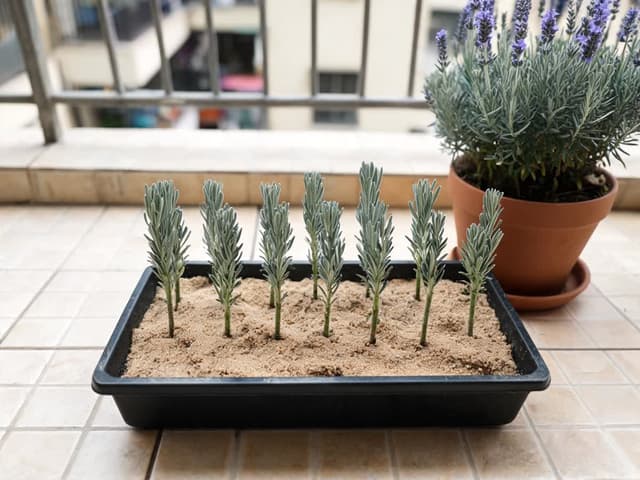
How to Propagate Lavender: Where to Cut and Why Cuttings Rot
A lavender cutting comes from a non-flowering branch tip, about 4 inches long, planted in sandy soil that never stays soggy. Learn where to cut, rooting times, seasonality in Brazil, and what to do if the base turns black.
How to Repot a Succulent: When to Change Pots and When to Water After
Repot your succulent in dry soil, using a pot with drainage that is only slightly larger than the roots, and time the watering correctly: the same day if no roots broke, or after 7 days if any were cut. In the southern hemisphere, spring is September to November.