Propagating Chinese Evergreen: Cuttings, Division, and How Long Roots Take
Cut the top with 4 to 5 leaves, divide a rooted basal shoot, or use bare stem pieces. Learn where to cut a Chinese evergreen, rooting times by temperature, and how to save a rotting plant.
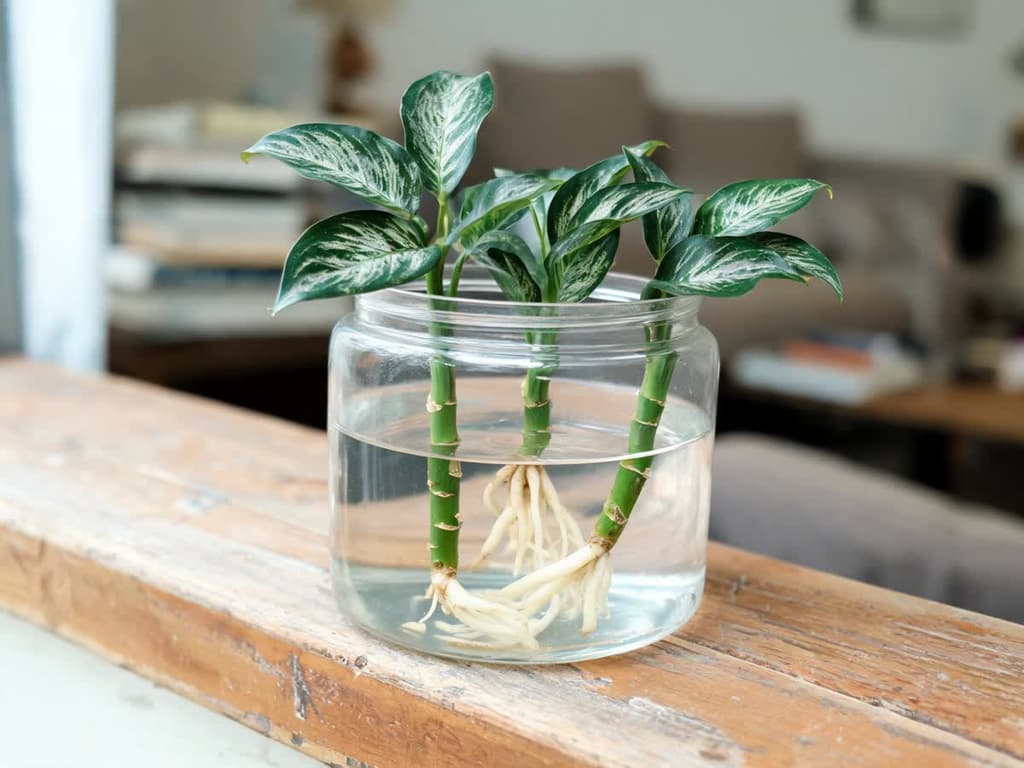
To propagate a Chinese evergreen (aglaonema), cut the top of a stem with 4 to 5 leaves and root it in water or potting soil. Another option is dividing the clump, the cluster of stems emerging together from the soil: separate an offset that already has roots. The third is burying pieces of bare stem. Roots begin emerging in about 2 weeks at 21 °C (70 °F), and the new plant forms in about 10 weeks.
Cold slows rooting. In one cultivar (a named aglaonema variety) tested at 20 °C (68 °F), roots took nearly twice as long as they did at 30 °C (86 °F). The mother plant survives after cutting. The stem left in the pot has nodes (the rings where leaves once grew), and the nodes on a bare aglaonema stem can sprout again.
Quick summary:
A tip cutting is the severed top of the stem with the youngest leaves. It needs 4 to 5 leaves and a section of leafless stem to bury.
The stub left in the pot can sprout again from its nodes, provided it has 1 or more nodes.
Division only works if the offset has its own roots and leaves. Some cultivars produce almost no basal shoots.
Red and pink aglaonemas propagate from stem cuttings just like green and silver ones.
Roots begin forming in about 14 days at 21 °C (70 °F). The plant is established in about 10 weeks at 19–23 °C (66–73 °F).
In Brazil, the best time runs from September to March. Below 13 °C (55 °F), some aglaonemas already suffer cold damage to their leaves.
The silver evergreen (Aglaonema commutatum) is also called café-de-salão. This guide applies to it and to the colorful hybrids sold in Brazil.
Which method to use for propagating Chinese evergreen
The propagation method depends on the shape of your aglaonema. The University of Florida (UF/IFAS) notes that tip cuttings and dividing basal shoots are the two primary ways to propagate aglaonema. The North Carolina State University (NC State) handbook adds leafless stem cuttings. Clemson University also lists air layering.
Method | When to use | What the cutting needs | Time until established |
|---|---|---|---|
Tip cutting | Leggy plant with a bare lower stem | 4 to 5 leaves and a leafless stem section to bury | About 10 weeks at 20–23 °C (68–73 °F) |
Leafless stem piece | Bare stem remaining after cutting off the top | 5 to 7.5 cm (2 to 3 in) of stem with 1 or 2 nodes | Until roots and a new shoot emerge |
Clump division | Pot with multiple stems emerging from the soil | Own roots and leaves | Immediate: the offset already has roots |
Air layering | You do not want to cut the top before it develops roots | A firm stem section to wrap in moss | Until the moss fills with roots |
Division is the fastest method because the offset already has roots. A tip cutting is best for a tall plant that is bare at the bottom, which is the most common indoor scenario.
Where to cut a leggy aglaonema with a bare base
Cut the aglaonema stem 10 to 15 cm (4 to 6 in) below the tip. The top portion keeps the 4 to 5 youngest leaves and a leafless section of stem. This leafless section goes into the water or soil. Cut with a clean knife or pruners in a single motion.
An aglaonema node is the ring on the stem where a leaf grew. On a bare stem, the node looks like a circular scar around the cane, sometimes with a small swelling. This bump is a bud, a shoot that has not opened yet.
Clemson says that when an aglaonema loses its lower leaves and the stem becomes bare, the top can be cut off and rooted. The NC State manual teaches propagating from bare aglaonema stem pieces, and the nodes on this stem sprout. The stub has these nodes, so it can sprout again. No source in this guide measured the stub.
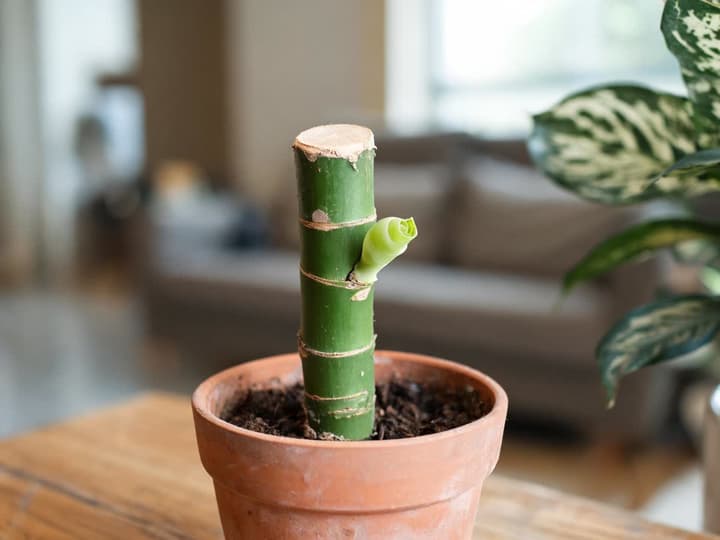
Leave 1 node or more on the stub. On a plant with multiple stems, cut one stem at a time and wait for that cutting to root before cutting the next. That way, the pot never loses all its foliage at once.
How to propagate aglaonema from tip cuttings
A tip cutting is the top of the stem carrying the newest leaves. UF/IFAS commercial production guidelines state that an aglaonema tip cutting should have 4 to 5 leaves. This guide follows that number, based on commercial nursery standards. None of the sources explain the underlying reason.
Put on gloves before you begin. NC State notes that aglaonema sap causes skin irritation due to calcium oxalate crystals.
Choose a firm stem showing no soft or dark spots.
Cut the top with 4 to 5 leaves and 10 to 15 cm (4 to 6 in) of stem.
Strip off any leaves that would sit underwater or beneath the soil. Keep the top 4 to 5 leaves.
Root the cutting in water or potting soil, following the two sections below.
Place the cutting in a warm, bright spot out of direct sunlight.
Rooting aglaonema cuttings in water
Place the cutting in a container of water, keeping the bare stem submerged and the leaves dry. Change the water once a week. When the new roots measure 2.5 to 5 cm (1 to 2 in), pot the cutting into a container with drainage holes and moist potting soil.
The cutting may go several weeks without visible roots. One or two lower leaves might turn yellow during this period. Remove any yellow leaf and keep the rest intact.
Rooting aglaonema cuttings in potting soil
Bury the bare stem section in a small container with drainage holes and moist potting soil. Firm the soil around the stem so the cutting stands upright. Do not bury the petiole, the stalk connecting the leaf blade to the stem. Grower reports indicate it rots quickly in wet soil.
Keep the soil moist without letting it dry out completely until new leaves appear. To preserve humidity, cover the pot with a clear plastic bag propped up on sticks, leaving the bottom open.
Water or soil: which roots aglaonema better?
Aglaonema cuttings root in both water and potting soil. Some growers report that water roots struggle when moved into soil. University of Illinois Extension recommends growing aglaonema in either water or potting soil and mentions no issues with water roots. No formal study has compared the two rooting media for aglaonema.
This guide relies on University of Illinois Extension rather than online forums: water rooting works. If given the choice, use potting soil, as it provides the safest transition for the root system. Water lets you observe root development directly. Soil eliminates the stress of repotting later. If you root in water, keep the fresh potting mix moist during the first few weeks.
Rooting hormone is optional. None of the sources cited in this guide require hormone for aglaonema. When discussing air layering, the NC State handbook notes it is not always necessary.
Propagating aglaonema from leafless stem pieces
The bare cane left behind after cutting off the top can also produce new plants. The NC State manual details this method, listing aglaonema alongside dieffenbachia and dracaena as plants that propagate from bare stem sections.
Cut the leafless cane into sections measuring 5 to 7.5 cm (2 to 3 in).
Check that each section contains 1 or 2 nodes.
Lay the section flat on moist potting soil, or bury half of it upright with the bud facing upward.
Move the cutting to its own pot once roots and a new shoot emerge.
Use a pen to mark the upper end before planting the section upright. The bud grows upward, so do not plant the cutting upside down. The same technique appears in the dracaena propagation guide, another thick-stemmed plant.
Dividing an aglaonema clump
Division separates stems emerging from the soil into independent plants. Divide when repotting, since the plant is already out of the container. Every division must have its own roots and foliage, as a rootless shoot cannot survive on its own.
Water the plant the day before so the root ball slides out intact.
Remove the plant from the pot and gently shake the soil from the base.
Use your hands to separate stems that already have established roots. Use a clean knife only where roots are tightly tangled.
Trim off any dead, mushy, or darkened roots.
Pot each division into a container with drainage holes and fresh potting soil, planting at the same depth as before.
Water thoroughly until water drains from the bottom, and keep the divisions out of direct sun.
If your aglaonema has only a single stem, division is not possible. UF/IFAS notes that cultivars vary widely: some produce more than four basal shoots, while others produce none. In that case, use tip cuttings instead. The peace lily division guide illustrates the same process on a clump-forming plant.
Air layering aglaonema
Air layering induces root formation along the stem while it remains attached to the parent plant. This serves as an alternative if you hesitate to sever the top before seeing roots. Both Clemson and Illinois suggest this technique for leggy aglaonemas.
Aglaonema is a monocot, the botanical group that includes dracaenas and palms. For monocots, the NC State manual instructs making an upward cut into the stem rather than peeling off a bark ring:
Along a firm section of bare cane, make an upward cut slicing one-third into the stem thickness.
Prop the slit open with a toothpick.
Wrap the cut in moistened sphagnum moss (sold dry at garden centers).
Wrap the moss in plastic film and secure both ends with twist ties or tape.
Once the moss ball fills with roots, sever the stem directly below the moss and pot the new plant.
Air layering takes longer than rooting tip cuttings, though none of the cited sources provide an exact timeframe. In the meantime, the top retains all its foliage, preserving the appearance of the original plant.
How long aglaonema cuttings take to root
The aglaonema cutting begins developing roots in about 2 weeks at 21 °C (70 °F). It is fully formed in about 10 weeks at 19–23 °C. These numbers come from patent data sheets for three cultivars registered in the United States. The patent sheet describes how the cultivar propagates, with time and temperature.
Cultivar | Leaf color | Root emergence | Fully rooted |
|---|---|---|---|
'Cassandra' (patent USPP11306, 2000) | Silver-green | 21 days at 30 °C; 40 days at 20 °C | 30 days at 30 °C; 60 days at 20 °C |
'KKAG201301' (patent USPP25379, 2015) | Red and green | About 14 days at 21 °C | About 10 weeks at 20–22 °C |
'KKAG1201' (patent USPP24626, 2014) | Pink and cream | About 14 days at 21 °C | About 10 weeks at 19–23 °C |
'Cassandra' took 40 days to begin rooting at 20 °C (68 °F) and 21 days at 30 °C (86 °F). These measurements come from climate-controlled greenhouses. In a cooler home environment, expect the longer timelines shown in the table.
You know the cutting has established (rooted and resumed growth) once it unfurls a new leaf. Roots form before top growth begins: the cutting establishes below ground first, then resumes growing above. Aglaonemas grow slowly, so the first new leaf may appear well after the timeframe listed in the table.
Do red aglaonemas propagate the same way?
Red and pink aglaonemas propagate from stem cuttings exactly like green varieties. Plant patents for 'KKAG201301', a red Aglaonema commutatum, and 'KKAG1201', a pink hybrid, both document stem cuttings as the propagation method used. Rooting time was identical for both: about 14 days at 21 °C (70 °F).
Cultivars differ primarily in how many basal shoots they produce. A colorful aglaonema that produces no offsets cannot be divided, making tip cuttings the solution. Because a stem cutting is vegetative tissue from the parent plant, the cutting emerges with the exact coloration of the mother plant.
Best time to propagate aglaonema in Brazil
The best time to propagate aglaonema in Brazil runs from September to March, during spring and summer. That is when the house stays warmer, and roots emerge faster in the heat. In the Southern Hemisphere, spring begins in September.
Avoid taking cuttings from June to August, during the Brazilian winter, if the house drops below 13 °C at night. UF/IFAS records cold damage below 13 °C, especially on 'Silver Queen', and Clemson directs avoiding temperatures below 13 °C. UF/IFAS fact sheet FP025 cites damage starting at 7 °C. This guide follows 13 °C, the safest value for a cutting with few leaves. In a UF/IFAS test, the cultivar 'Silver Queen' had 30% of its leaves damaged after 24 hours at 13 °C. A cutting, having few leaves, loses a lot with each damaged leaf.
Aglaonema cuttings failing to root or rotting
If your aglaonema cutting has not rooted after 6 weeks, check the temperature first. At 20 °C (68 °F), 'Cassandra' took 40 days just to start forming roots. Move the cutting to the warmest, brightest spot in the home out of direct sunlight and wait up to 60 days in total, matching the timeline of 'Cassandra' at 20 °C.
Cuttings that rot usually suffer from one of these issues:
Too few leaves. A cutting with only 1 or 2 leaves falls below the 4 to 5 leaves recommended by UF/IFAS per cutting.
Buried petiole or submerged leaf. The petiole and leaf blade rot when kept wet. Keep only the bare stem in water or soil.
Stagnant water. Change the water once a week, or sooner if it becomes cloudy.
Waterlogged soil. Moist soil is helpful, but the container requires drainage holes so excess water drains freely.
If the base of the cutting turns soft and dark, slice away the mushy section until you reach firm stem tissue. Root the healthy top section again with its remaining foliage.
Saving a rotting aglaonema by taking cuttings
If the base of your aglaonema turns mushy and the foliage droops, immediately cut off the firm top portion and propagate it. A firm, green stem section above the rot will still strike roots. Clemson recommends this same rescue strategy when root pests attack: take a cutting and start a fresh plant.
Root rot occurs when roots decay in overwatered soil. Healthy roots remain firm and pale, while rotted roots turn dark and soft.
Disinfect your blade with rubbing alcohol before the first cut and between cuts to avoid spreading rot to healthy tissue.
Sever the stem 2 to 3 cm (1 in) above the soft tissue.
Inspect the cut surface: the interior of the cane must be pale and firm. If it appears dark, cut higher up.
Root the cutting in water, following the tip cutting instructions above.
Discard the potting soil where the plant rotted, along with the mushy base.
Clean the pot and soak it for 5 minutes in diluted bleach: 1 part bleach to 9 parts water, as instructed by NC State.
Clemson stresses using a clean pot and fresh potting soil for any plant restarted from a cutting. Old soil can harbor root-rot fungi or bacteria.
Caring for young aglaonema cuttings in their first months
Keep the cutting in bright indirect light, with no direct sun hitting the foliage. UF/IFAS notes that mature green and silver aglaonemas tolerate low light well. Highly variegated varieties need bright indirect light to preserve their coloration. Keep red or pink cuttings close to a window.
Once new foliage appears, stop keeping the soil constantly moist. Clemson advises inserting two fingers 5 cm (2 in) deep into the soil: if dry, water; if cool and damp, wait. UF/IFAS warns that excess moisture rots aglaonema roots. Once established, the cutting requires standard mature plant care, following the watering, lighting, and fertilization outlined in the aglaonema care guide.
Plant multiple rooted cuttings together in the same pot to create a fuller specimen faster. Aglaonemas grow slowly, and a single stem takes a long time to fill a container. If your plant came unlabeled, the Bloom app identifies the species from a single leaf photo.
Aglaonema or dumb cane (Dieffenbachia)?
Aglaonema and dumb cane (Dieffenbachia) look similar, and both propagate from leafless stem pieces. NC State notes that aglaonema leaves generally feature only 5 to 8 main lateral veins, distinguishing them from Dieffenbachia. The dumb cane profile illustrates its foliage for comparison.
Aglaonema is toxic to dogs, cats, and horses, according to the ASPCA, the animal poison control center of the United States. The ASPCA lists oral irritation, drooling, and vomiting as signs. Keep cuttings and the water container away from animals.
Frequently asked questions
Can you propagate aglaonema from a leaf cutting?
There are no records of aglaonema propagating from an isolated leaf. The sources cited in this guide detail tip cuttings, leafless stem sections, division, air layering, and seed, but none list individual leaves. In the NC State handbook, single leaves propagate plants such as African violets and peperomias, but aglaonema is absent from that list.
Can aglaonema grow in water permanently?
Aglaonema can live in water indefinitely, according to University of Illinois Extension, which lists the plant as suitable for both water culture and potting soil. Change the water weekly and keep foliage above the waterline. If you intend to move the cutting into soil later, pot it up while the roots measure 2.5 to 5 cm (1 to 2 in).
Does an aglaonema stem stub sprout again after cutting?
An aglaonema stub can sprout again from dormant buds at the nodes remaining on the cane. While no cited sources measured stub regrowth rates, the NC State manual uses bare cane sections for propagation because these nodes sprout. Leave 1 or more nodes on the stub and keep the mother plant in bright light.
Do you need gloves to propagate aglaonema?
Wear gloves when propagating aglaonema. NC State states that the plant sap causes skin irritation, and UF/IFAS reports that all parts of the plant can induce dermatitis. Calcium oxalate crystals are the cause. Wash your hands and blade thoroughly after cutting.
Where to start today
Examine the base of your aglaonema. If multiple stems emerge from the soil, wait until your next repotting and divide the clump. If the plant has a single, tall, leggy stem, take a top cutting with 4 to 5 leaves. Root the tip cutting in a jar of water in a warm, bright spot, leaving the stub in the pot to resprout. The pothos propagation guide details the exact same water rooting method if you want to propagate another houseplant alongside it.
Sources
University of Florida IFAS Extension: Cultural Guidelines for Commercial Production of Interiorscape Aglaonema (EP160), Chilling Injury in Tropical Foliage Plants: II. Aglaonema (EP103) and Aglaonema spp.: Chinese Evergreen (FP025). Accessed on September 30, 2026.
NC State Extension, Extension Gardener Handbook: chapter 13, Propagation. Accessed September 30, 2026.
NC State Extension Gardener Plant Toolbox: Aglaonema. Accessed September 30, 2026.
Clemson Cooperative Extension, HGIC: Chinese Evergreen (Aglaonema) and Common Houseplant Insects & Related Pests (HGIC 2252). Accessed September 30, 2026.
University of Illinois Extension: Chinese Evergreen. Accessed September 30, 2026.
ASPCA: Chinese Evergreen. Accessed on September 30, 2026.
US plant patents: USPP11306, 'Cassandra', 2000; USPP25379, 'KKAG201301', 2015; USPP24626, 'KKAG1201', 2014.
Related articles
How to Care for a Goldfish Plant: Light, Watering, and Blooms
How to care for a goldfish plant: bright light without strong sun, water when the soil surface dries, and humid air. Learn how to tell a Nematanthus from a Columnea, why it drops leaves, and how to get it to bloom again.
Lavender Leaves Turning Yellow: Where the Yellowing Starts Shows the Cause
Lower leaves turning yellow with moist soil means overwatered roots, the most common cause. Old leaves drying one by one on woody stems is normal. Take the stem and root test, see if your plant can still be saved, and find out what to do today.
How to Propagate Lavender: Where to Cut and Why Cuttings Rot
A lavender cutting comes from a non-flowering branch tip, about 4 inches long, planted in sandy soil that never stays soggy. Learn where to cut, rooting times, seasonality in Brazil, and what to do if the base turns black.