How to Water Begonias: When, Where, and Tips for Every Type
How to water begonias: let the top 1.3 to 2 cm (1/2 to 3/4 inch) of soil dry out and water the soil, not the leaves. Drain excess water and empty the saucer. See care tips for maculata, rex, wax, elatior, and tuberous varieties.
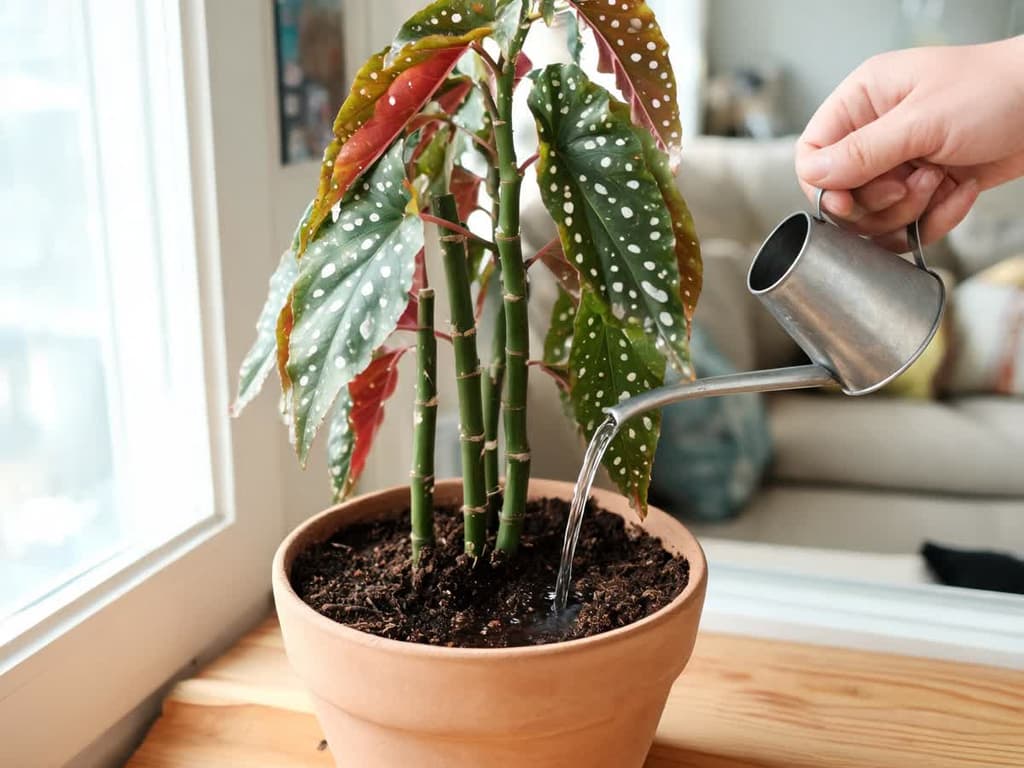
To water the begonia, stick your finger 1.3 to 2 cm deep into the potting soil. If the soil is dry at that depth, slowly pour water over the soil without wetting the leaves until water drains out through the bottom hole. Then, discard the water left in the saucer. The elatior and the tuberous begonia are the exception: they require constantly moist soil, without becoming waterlogged.
There is no fixed number of days between waterings. The interval changes with the type of begonia, the pot, and the season of the year. The RHS (the Royal Horticultural Society of the United Kingdom) receives reports of dead begonias. Most were overwatered or kept in air that was too dry.
Begonia type | When to water | In winter (June to August in Brazil) |
|---|---|---|
Cane (maculata, angel wing) | Barely dry soil surface | Water less |
Rex and rhizomatous begonias (with thick stems lying on the soil) | Potting soil surface almost dry | Rex in dormancy: water lightly until new leaves emerge |
Wax begonia | Soil dry to the touch | Water less |
Elatior | Constantly moist soil, without drying out | Moist soil, without drying out |
Tuberous | Moist soil, never waterlogged | In dormancy: no watering until it sprouts again |
How often to water the begonia
No university extension publishes an interval in days for indoor potted begonias. A university extension is a US university service that teaches the public how to care for plants. Iowa State University explains why. People who water on a fixed day of the week almost always give too much water to some plants and too little to others. That is why the finger test determines watering, not the calendar.
Gardening guides in French, from stores and blogs, give numbers that differ from one another. One tells you to water 1 time per week, another 1 to 2 times, and a third 2 to 3 times per week in the summer. None of them say where they got the number. The only interval published by a university applies to a different situation. Iowa State tells you to water the tuberous begonia 1 time per week, but in a garden bed and during dry weather.
The interval gets shorter when:
the pot is made of clay, which dries out faster than plastic or glazed ceramic (Iowa State);
the begonia is in a hanging basket, which dries faster because more air circulates around it. This is according to the American Begonia Society (an American association of begonia growers);
the pot is small, because a larger pot takes longer to dry (NC State);
it is summer and the plant is growing.
The interval gets longer in the winter, from June to August in Brazil. It also lengthens when the rex or the tuberous begonia enters dormancy, the stage in which they stop growing and lose leaves. Do the finger test every 2 or 3 days and water on the day it calls for it.
How to tell if the begonia needs water
The first test is the finger test. The American Begonia Society tells you to stick your finger 1.3 to 2 cm into the soil; in larger pots, use the 2 cm mark. If the soil feels cool to the touch at that depth, it still has water: do not water. If it is dry, water.
The second test is the weight of the pot. Lift the pot right after watering and again a few days later: with dry soil, it feels much lighter. The American Begonia Society recommends this test: with practice, you learn from the weight when the soil has dried out.
Can't get your finger 2 cm into the soil? According to the University of Maryland, the soil may be too compacted or the roots may have filled the entire pot. In both cases, the begonia needs fresh, looser soil.
How to water the begonia step by step
To water the begonia, slowly wet the soil until water drains out through the hole, without wetting the leaves, and empty the saucer afterward. In order:
Do the finger test and water if the soil is dry 1.3 to 2 cm deep. For the elatior and the tuberous begonia, water as soon as the surface begins to dry.
Use room temperature water, not cold water, as recommended by Illinois Extension and UF/IFAS.
Pour water onto the soil near the base of the plant, without wetting the leaves. NC State recommends watering the begonia at the base and avoiding the leaves.
Water slowly until water drains out through the hole in the bottom of the pot. Iowa State tells you to water thoroughly until it drains, so the soil in the entire pot gets wet.
Wait 30 to 45 minutes and discard the water from the saucer or cachepot (Iowa State). A cachepot is a decorative pot without drainage holes that covers the plant pot. Do not let the pot sit in water for more than 30 to 45 minutes.
Water in the morning. Iowa State recommends watering early so that water that fell on the leaves has time to dry. This helps prevent powdery mildew (a white powder that covers the leaf).
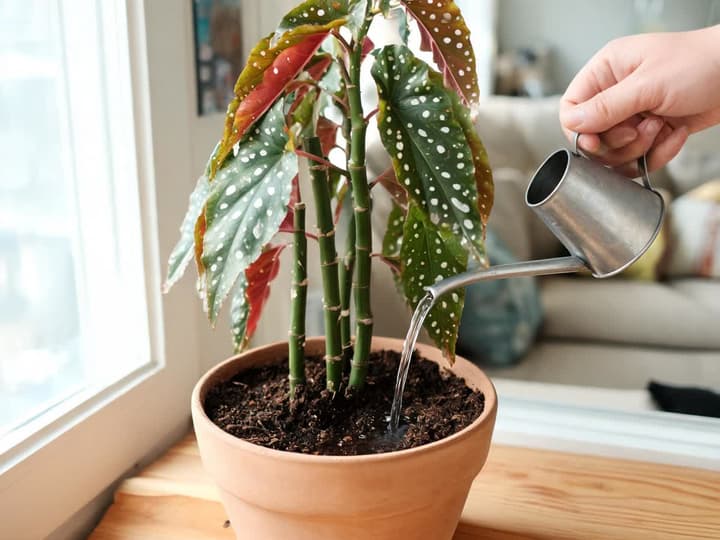
Why not wet begonia leaves
Wet leaves and humid air encourage three begonia diseases: bacterial leaf spot, powdery mildew, and botrytis. Penn State, Iowa State, and Texas A&M describe each one:
Bacterial leaf spot: water-soaked spots with a yellow halo around them. Penn State advises not wetting the leaves when watering, and the American Begonia Society says to avoid overhead watering.
Powdery mildew: a white powder on the leaf. According to Iowa State, cool and humid weather favors it.
Botrytis: a gray mold that causes brown spots and rot. Texas A&M says it is more severe in cool weather and high humidity.
In rex begonia, bacterial leaf spot can be treated by removing the diseased leaves, because the bacteria do not spread through the entire plant (Penn State):
Spraying water on the leaves is also not recommended. NC State tells you to avoid spraying rex begonias to prevent disease, and the RHS and Clemson Extension give the same advice. Iowa State says spraying does not raise humidity around the plant and can spread disease. NC State says humidity rises only for a short time.
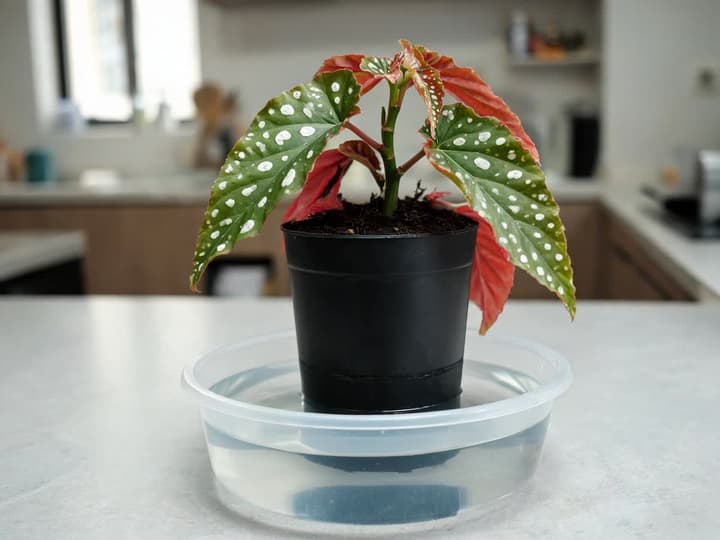
The begonia likes humid air, and the safe way to provide this is a pebble tray. Put pebbles in a tray, cover them with water until just below the surface of the stones, and rest the pot on top. The bottom of the pot cannot touch the water, as the NC State gardening manual warns. The guide on how to care for the begonia provides the ideal humidity for each type.
Watering the begonia from below or from above
In bottom watering, the pot sits in a basin with water and the soil draws water up through the bottom hole. Iowa State accepts this method for potted plants: leave the pot in the water for about 30 minutes and take it out of the basin. Empty the saucer or cachepot up to 45 minutes later.
The University of Maryland Extension points out the downside. Bottom watering does not wash away the salts that water and fertilizer leave in the soil, and they build up over time. The sign is a white crust on the surface of the soil or on the rim of the pot.
No source on begonias has tested one method against the other. Water from above for day-to-day care: the water that runs through the pot from top to bottom leaches salts from the soil (University of Maryland). Use bottom watering when the soil has dried out too much and water runs off without wetting it. Every 4 to 6 months, flush the soil from above with several times the pot's volume in clean water (University of Maryland). Watering peperomia follows the same routine. Those who water from below flush the soil from above every 4 to 6 months.
How to water each type of begonia
Begonia is a genus, a large group of related species, and watering changes from one group to another. Don't know which one is yours? Bloom identifies the plant by photo, and the free plan includes 2 identifications per month.
Cane begonia (maculata, angel wing)
The polka dot begonia is a cane begonia, with erect stems and nodes like bamboo. The American Begonia Society advises watering when the soil surface is almost dry to the touch. The RHS adds: do not let the soil dry out completely, but avoid overwatering. In winter, reduce watering.
Rex begonia and rhizomatous begonias
The Rex begonia and rhizomatous begonias require the soil surface to be almost dry between waterings, according to the American Begonia Society. The rhizome (the thick stem that lies across the soil) stores water, according to NC State. Small rhizomatous cuttings are even more sensitive to overwatering than mature plants (American Begonia Society).
Many rex begonias stop growing in the fall and winter, from March to August in Brazil, and can lose some of their leaves. The American Begonia Society tells you to water sparingly during this period, until new leaves appear. The RHS gives the same rule for the winter: water less and let the surface dry before watering again.
Wax begonia
The wax begonia and the wax begonia tolerate drought better than other begonias, but only in the garden bed and after they are established (Iowa State). The American Begonia Society instructs you to water only when the soil is dry to the touch. In a pot, water the wax begonia when the surface is dry to the touch. Unlike the succulent, it does not wait for the soil to dry all the way to the bottom.
Elatior begonia
The elatior (Begonia × hiemalis) is a flowering hybrid begonia, which the RHS calls semi-tuberous. The RHS advises keeping the soil moist, without letting it dry out. After flowering, the RHS advises letting the plant rest for about 6 weeks at 7 °C. During this time, water less, but without letting the soil dry out.
Tuberous begonia
The tuberous begonia grows from a tuber, a swollen base that stores reserves underground and rots easily. Iowa State tells you to keep the soil moist, but never wet. The American Begonia Society gives the test: if your finger feels the soil is moist, do not water; if it is dry, water a little.
The tuberous begonia goes dormant every year. In the fall, when the leaves start to turn yellow, gradually reduce watering, according to NC State. In Brazil, this happens around April or May. When the stems fall over and the top dries out, stop watering (American Begonia Society). Leave the pot in a spot where it will not get rained on, or lay the pot on its side so no one waters it by mistake.
Is the begonia overwatered or underwatered?
In the cane begonia, leaves that turn yellow and drop while the soil is moist are a sign of overwatering, according to the American Begonia Society. The University of Maryland gives the general rule for potted plants: with too much water, the plant loses leaves or turns yellow; with too little water, it wilts and turns grayish-green.
What you see | Probable cause | What to do |
|---|---|---|
Yellow leaves that fall off, wet soil | Overwatering | Wait for the soil to dry 1.3 to 2 cm deep before the next watering (elatior and tuberous: only the surface) |
Wilting leaves, dry soil, and a light pot | Lack of water | Water until it drains out through the hole |
Brown and crispy leaf edges | Dry air | Pebble tray; watering does not change |
Flower bud that drops before opening | Dry air or lack of water (RHS); in the tuberous begonia, also too much water or fertilizer (UF/IFAS) | Check the soil and the air humidity |
Soft, dark stem close to the soil | Rot | Check the roots (section below) |
A yellow leaf on its own does not confirm the diagnosis. The RHS notes that it can come from too little light, overwatering, or underwatering. That is why the finger test comes before any change in watering. The guide to yellow leaves separates the other causes.
Wilting also deceives. The peace lily wilts completely when it needs water, but the University of Maryland notes that a plant also wilts from too much water. A wilted begonia with moist soil is not asking for more water: take the plant out of the pot and check the roots, as explained in the section on soft stems.
I watered and the leaves are still drying out: the soil does not get wet on the inside
Does the begonia dry out when you do not water it and turn yellow when you water it more? Water might not be reaching the middle of the root ball (the soil with the roots inside the pot). The American Begonia Society explains that peat moss, the dark, fluffy material in store-bought soil, resists absorbing water when it dries out too much. A plant in this soil can be watered every day without the center of the pot receiving water.
Iowa State describes the same effect: soil that is too dry lets water run down the sides and exit through the hole without wetting the root ball.
To fix this, submerge the pot in a basin of water for about 30 minutes, as Iowa State directs, and let it drain. Afterward, return to normal watering using the finger test. If the begonia came from the store in soil full of peat, the American Begonia Society recommends repotting it in fresh soil.
Brown and soft stem at the base: can the begonia be saved?
A begonia with a brown, soft stem at the base can still be saved when part of the root is white and firm. If the entire root has rotted, save the healthy tips as a cutting, a piece of stem that grows roots and becomes a new plant.
A dark, soft, shiny stem close to the soil is a sign of rot. Penn State describes Pythium rot like this: black, shiny areas on the stem, right above the soil line, while the plant collapses. Iowa State says that root and lower stem rot is favored by heat and wet soil.
Do not wait for the soil to dry out in the same pot. Take the plant out of the pot and look at the roots:
White, firm root in part of the root ball: cut away the black, soft root and replace all the soil with fresh, loose soil. Water again only when the soil dries 1.3 to 2 cm deep.
Entire root black and mushy: save the plant by its tips. Cut firm, green stem tips, 7 to 10 cm long. Plant them as cuttings in sandy soil (RHS, for cane-like and fibrous-rooted begonias).
The begonia maculata also has its own page on root rot:
In cane begonias, a bare stem with no leaves at the bottom is solved with pruning. The guide on how to care for begonias explains when and how to prune each type.
Pot and soil that help with watering
Every begonia pot needs a hole in the bottom. Iowa State warns that a layer of gravel at the bottom does not replace the hole. If the decorative pot does not have a hole, use it as a cachepot: plant in a smaller pot with a hole and place it inside.
A pot that is too large also interferes with watering. The American Begonia Society explains that too much soil for too few roots stays wet for too long and rots the roots. When repotting, choose a pot only slightly larger than the previous one.
Frequently asked questions
How to water an indoor begonia?
Water when the soil is dry 1.3 to 2 cm deep. Pour room-temperature water over the soil, without wetting the leaves, until water comes out through the hole. Wait 30 to 45 minutes and discard the water in the saucer. The elatior and the tuberous begonia require constantly moist soil, without becoming waterlogged.
Can I mist water on the begonia?
It is not recommended. NC State advises against misting rex begonias to prevent diseases, and the RHS and Clemson Extension recommend the same. According to Iowa State, misting can spread diseases and does not increase air humidity. NC State states that the humidity rises only for a short time. To provide humid air, place the pot on a pebble tray with water, without letting the bottom touch the water.
Does the begonia like moist or dry soil?
It depends on the type. Cane, rex, and rhizomatous begonias require the surface to be nearly dry before watering; wax begonias require the soil to be dry to the touch. The elatior and tuberous begonia need moist soil, without becoming waterlogged. No begonia can tolerate a pot sitting in water all the time: the roots rot.
How to water the tuberous begonia in winter?
The tuberous begonia goes dormant in the fall and winter. Reduce watering when the leaves start to turn yellow, around April or May in Brazil. When the stems drop and the top part dries out, stop watering. Keep the pot away from the rain until the tuber sprouts again.
In summary
Watering the begonia means waiting for the soil to dry 1.3 to 2 cm deep and watering the soil, not the leaves. Let it drain through the hole and empty the saucer. The elatior and the tuberous begonia stay moist, without becoming waterlogged. In the winter, watering decreases for most begonias, the elatior continues with moist soil, and the tuberous begonia stops completely. A yellow leaf that drops while the soil is moist calls for less water.
In the Premium plan, Bloom compares the photo of your begonia with disease symptoms and tells you what to do. It is available for iPhone and iPad.
Sources
American Begonia Society: Storing tuberous begonias for the winter
NC State Extension Gardener Handbook, ch. 18: Plants Grown in Containers
Iowa State University Extension: How to care for houseplants
Iowa State University Extension: Two common diseases of houseplants (2005)
University of Maryland Extension: Mineral and fertilizer salt deposits on indoor plants
Related articles
How to Care for a Goldfish Plant: Light, Watering, and Blooms
How to care for a goldfish plant: bright light without strong sun, water when the soil surface dries, and humid air. Learn how to tell a Nematanthus from a Columnea, why it drops leaves, and how to get it to bloom again.
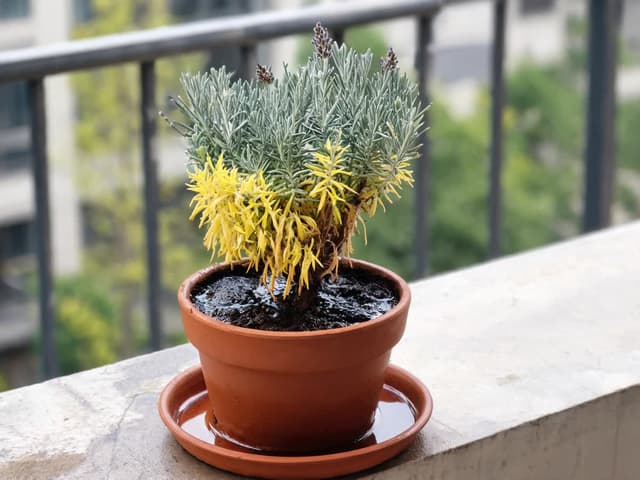
Lavender Leaves Turning Yellow: Where the Yellowing Starts Shows the Cause
Lower leaves turning yellow with moist soil means overwatered roots, the most common cause. Old leaves drying one by one on woody stems is normal. Take the stem and root test, see if your plant can still be saved, and find out what to do today.
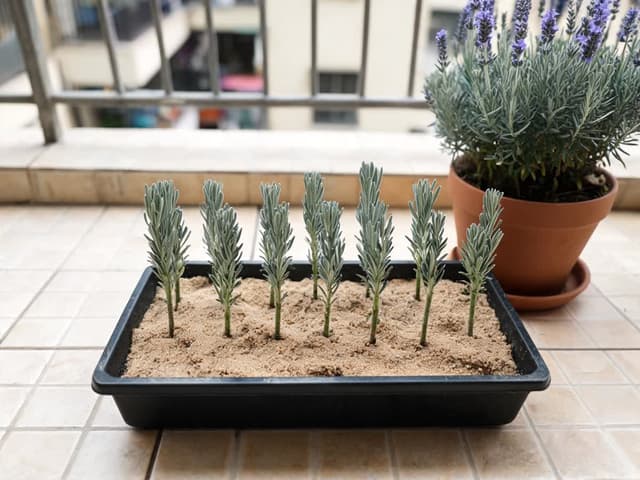
How to Propagate Lavender: Where to Cut and Why Cuttings Rot
A lavender cutting comes from a non-flowering branch tip, about 4 inches long, planted in sandy soil that never stays soggy. Learn where to cut, rooting times, seasonality in Brazil, and what to do if the base turns black.