How to Take Care of Tulips in a Pot: Light, Water, Cool Temps, and After Flowering
Potted tulip care: bright spot without direct sun, the coolest corner of the house, and water when the soil surface dries out. See how long blooms last, what to do when petals drop, and whether reblooming works in Brazil and other warm climates.
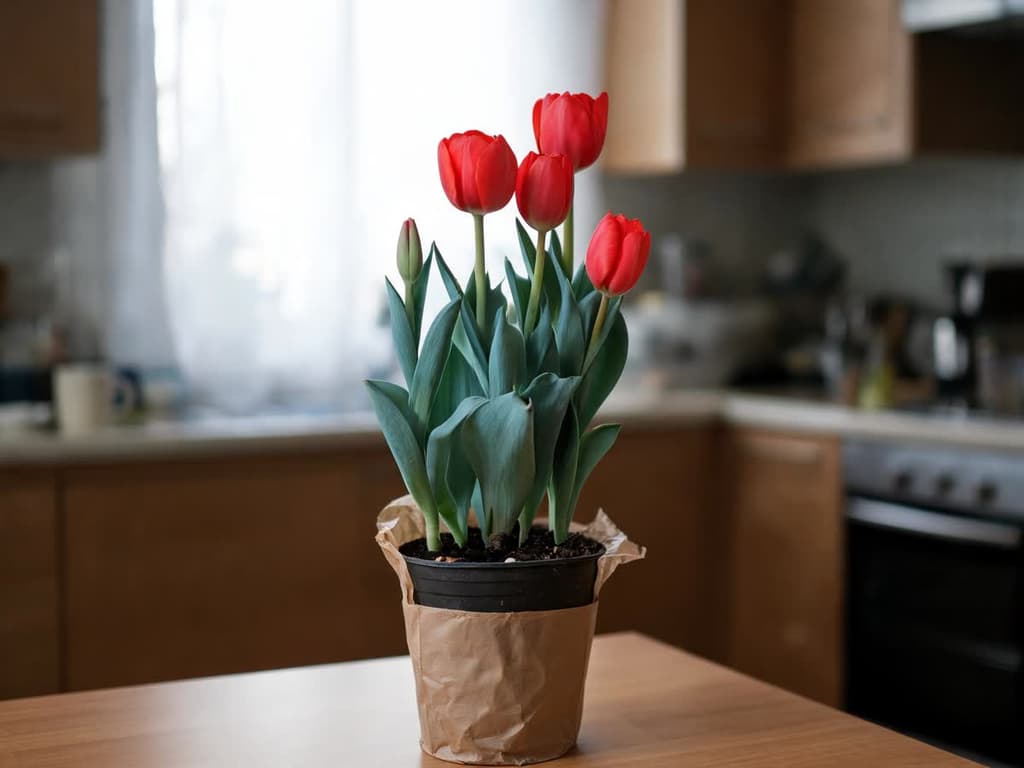
To care for a potted tulip, keep the plant in a bright spot without direct sun, in the coolest corner of the house. Water when the surface of the soil feels dry to the touch, until water drains from the pot hole. Turn the pot every day so the stems (the flower stalks) grow straight. With this care, tulip flowers last 6 to 10 days in Brazil.
After the petals drop, the tulip is not dying from disease: the bloom cycle is simply over. The bulb (the "little potato" buried in the pot) only blooms again after spending weeks in the cold. In Brazil, this cold only comes from the refrigerator, and even then the second bloom usually fails. For this reason, the safest option is to treat the potted tulip as a seasonal flower.
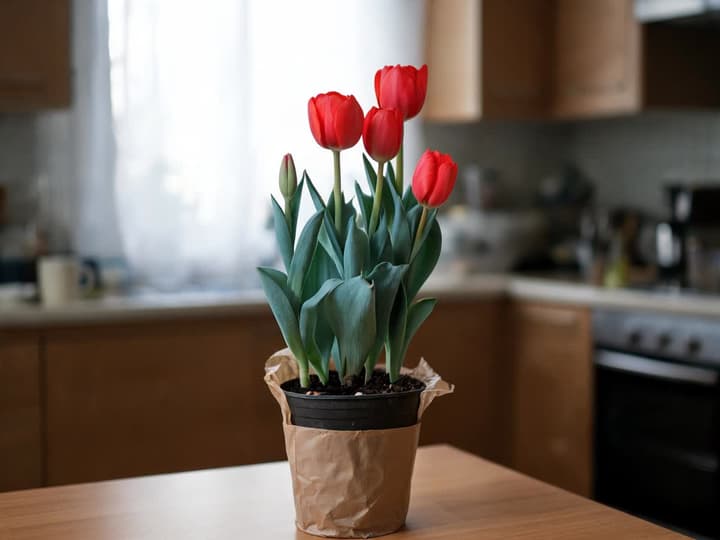
Potted tulip quick care guide
Care | What to do |
|---|---|
Light | Bright and indirect, no direct sun |
Temperature | The cooler it is, the longer blooms last (ideally between 15 and 18 °C) |
Water | When the soil surface dries out, until it drains from the hole |
Bloom lifespan | 6 to 10 days in Brazil |
After flowering | Discard the bulb or try chilling in the refrigerator (12 to 16 weeks of cold) |
Dogs and cats | Toxic; the bulb concentrates the toxin |
Store-bought potted tulips and planting bulbs require different care
The tulip (Tulipa, generally hybrids of Tulipa gesneriana) is a bulb plant that needs a cold winter to bloom. The blooming potted tulip you buy has already gone through this cold period. Tulip growers in Brazil import the bulbs from the Netherlands and use cold storage chambers, according to a grower from Holambra (São Paulo state) interviewed by Globo Rural.
Because of this, you may have two different situations on your hands, and each requires its own care:
The already-blooming pot: the goal is to make the flowers last. Where you place the pot and how you water determine how many days the bloom stays beautiful.
The bulb for planting (bought loose or saved after flowering): the goal is to give it the cold that the Brazilian winter does not provide. Without cold, the bulb sends out leaves and fails to form a flower.
Potted tulips appear in stores from March to September, according to grower Terra Viva, from Holambra. Pots usually come with 3 to 5 stems.
Where to place a potted tulip: bright light, no direct sun
Place the blooming tulip near a bright window, but out of reach of direct sunlight. Iowa State University Extension (the university service that guides plant growers) recommends bright indirect light for potted tulips that are already blooming. Direct sun heats the pot, and heat shortens the blooming period.
The tulip stem grows toward the light. If the pot stays in one position next to a window, the flowers bend toward the glass within a few days. The same extension advises turning the pot frequently to keep stems straight: give the pot a half-turn once a day.
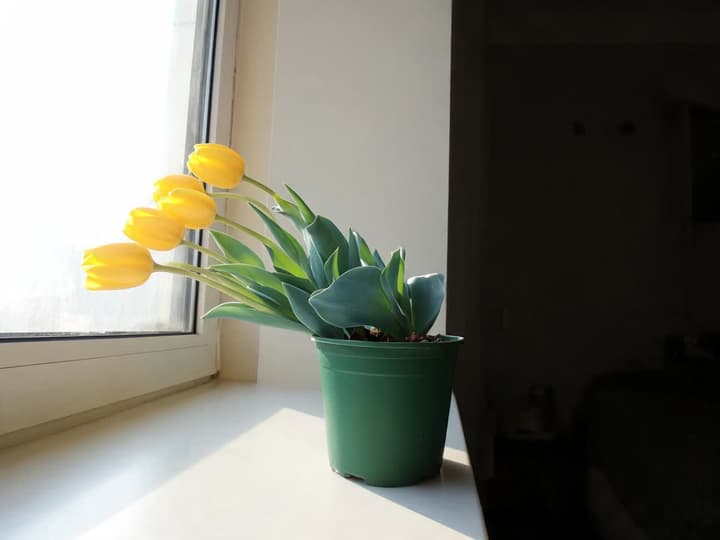
Veiling Holambra, the flower auction in Holambra, also advises keeping the pot away from drafts and strong sun. Avoid setting the pot on top of the refrigerator or near the stove because of the heat. Also avoid the area right in front of a balcony door with harsh sunlight.
Tulip flowers last longer in cool conditions
Iowa State recommends an environment between 15 and 18 °C for the tulip flower to last longer. The Mississippi State University Extension explains that a warm room hastens flower opening. A cool room keeps the flower open longer.
In most of Brazil, the living room stays above 18 °C almost year-round. Two steps help:
Nights in the coolest spot: Mississippi State suggests moving the pot to a cool place at night and bringing it back in the morning. Even just a few nights like this extend bloom life.
The refrigerator at night: the grower Terra Viva recommends placing the pot in the refrigerator overnight so the flower closes up. This is a grower tip that no university has tested. If you try it, remove any ripe fruit nearby, which releases ethylene, a gas that hastens flower senescence. Take the pot out in the morning and return it to a bright spot.
Between these two options, we recommend the first: a cool spot overnight has the backing of Mississippi State.
Placing an ice cube on the soil is a common tip in Brazil, and it comes from the growers themselves. Veiling Holambra instructs placing 1 or 2 ice cubes on the soil, in the morning and afternoon, without touching the plant. The grower Terra Viva mentions 1 cube per day. We found no university testing on ice, and the effect extensions confirm is that of coolness. If you want to use ice, start with 1 cube per day, without touching the plant, and count the melted water as part of your watering.
How to water a potted tulip
Water the tulip when the soil surface feels dry to the touch. Remove the plastic nursery pot from the paper wrap or cachepot (the decorative outer pot without drainage) and take it to the sink. Water slowly until moisture drains through the hole in the bottom. Wait until it stops dripping before placing the pot back in the wrap or cachepot.
Iowa State warns never to let the pot sit in standing water for prolonged periods. Kraft paper wrapping and cachepots trap water at the bottom, rotting the bulb without you noticing. Check the bottom after every watering and dump out any collected water.
Frequency varies with household warmth and pot size. In a warm apartment, potting soil dries out much faster than in a cool room. Because of this, check the soil daily when turning the pot, and water only when the surface feels dry to the touch.
Drooping or wilted tulip: what to check first
If your tulip wakes up with drooping stems, check three things before changing everything, in this order:
Is the soil dry? Water until it runs out the drainage hole, as described in the watering section.
Is the soil wet and the pot sitting in a warm spot? Do not water until the surface of the soil dries out to the touch. Move the pot to the coolest corner of the house and check whether standing water remains in the paper wrap or cachepot.
Did the stems lean to only one side? That is phototropism, bending toward the light source. Turn the pot daily so upcoming stems grow upright.
A stem that has already bent stays bent, even after getting water again. Iowa State University Extension notes this with cut tulips. A flower that loses its petals after 6 to 10 days in bloom is just the normal end of flowering, not a sign you made a mistake.
How long potted tulips last
In Brazil, the potted tulip flower lasts 6 to 10 days, depending on the region, according to Veiling Holambra. Pots purchased with closed buds last longer at home. Iowa State recommends choosing plants with a formed, colored bud that has not opened yet.
Cut tulips in a vase of water
Cut tulips continue to grow after harvest. Iowa State and the University of Maryland Extension measure up to 15 cm of stem growth over 5 to 7 days in a vase with water. Because of this, an arranged bouquet looks messy in just a few days.
To help the cut flowers last:
Cut 2 cm off the base of each stem before putting them in the vase, as Terra Viva instructs.
Keep the bouquet in a cool, bright spot, as Iowa State advises.
According to Iowa State, cut tulips last about one week.
What to do after tulip blooms fade
Once the petals drop, snip off the withered flower head. The green leaves still provide nutrients to the bulb, so keep the pot in a bright spot and keep watering as long as the foliage stays green. Leaves turning yellow over the following weeks is part of the natural bulb cycle and does not indicate disease.
From here, the decision is yours, and the safest choice is to discard the bulb. Iowa State and Mississippi State note that forced potted tulips (prompted into bloom out of season by commercial growers) almost never rebloom. Alternatively, you can store the bulb to try for another bloom, using the refrigerator chilling method explained in the next section.
Can tulips rebloom in Brazil?
You can try, but in warm climates the second bloom usually fails. The tulip bulb only forms a flower after 12 to 16 weeks at 40–45 °F (4–7 °C), according to Iowa State University Extension. Brazilian winters do not provide this cold. Globo Rural spoke with a gardening company from Santa Catarina, which stated that storing the bulb for replanting is unfeasible in a tropical climate, even in southern Brazil.
Sources disagree on the outcome. Veiling Holambra describes a replanting cycle that blooms again. However, UF/IFAS, the University of Florida Extension, describes a warm climate similar to much of Brazil. There, tulips bloom once and usually do not bloom again. We follow the university because it describes the result in a warm climate; the grower describes the method without stating how many bulbs rebloom. Treat the attempt as a gamble, with no guarantee of a flower.
If you want to try, follow these steps:
Keep the pot in a bright spot as long as foliage remains green. University of Wisconsin Extension instructs to water and fertilize during this phase, following label directions, because the nutrients feed next year's bulb.
Once the foliage turns completely yellow, taper off watering gradually.
Lift the bulb from the soil, clean off debris, and let it cure in the shade for 1 to 2 weeks, as Iowa State outlines.
Store the dry bulb in a paper bag in a cool, dark location until December.
Between the first half of December and early January, transfer the bag to the refrigerator vegetable crisper drawer, keeping it between 2 and 7 °C (sources vary within this range).
Do not store fruit in the same drawer. Texas A&M AgriLife explains that ripening fruit releases ethylene, a gas that kills the flower bud inside the bulb.
After 12 to 16 weeks in the refrigerator, plant the bulb in early April, as outlined in the planting section.
Chilling time also varies among references. UF/IFAS cites around 8 weeks for warm climates, while Veiling Holambra mentions 6 months. The 12 to 16 week window is the duration most frequently cited across extensions (Iowa State, Maryland, and Colorado State), which is why we follow it.
How to plant a tulip bulb in Brazil
Plant the tulip bulb in the fall, between March and June. That is the time frame Globo Rural recommends for Brazil. It corresponds to the fall period when the RHS, the British horticultural society, directs planting in the Northern Hemisphere. Loose bulbs bought individually also need chilling in the refrigerator beforehand, unless labeled "pre-cooled" on the package (bulbs that the grower already chilled). To plant in early April, place the bulb in the refrigerator between the first half of December and early January.
For container planting:
Use a container with drainage holes. Without drainage, water sits in the root zone and causes bulb rot.
Mix 3 parts potting mix with 1 part coarse grit, the blend recommended by the RHS for potted tulips.
Bury the bulb at a depth equal to 2 to 3 times its height, pointing upward. A 5 cm bulb sits 10 to 15 cm beneath the soil surface.
Space adjacent bulbs by at least twice the width of a bulb.
Fertilizer is not necessary when treating tulips as seasonal annuals. The RHS states that when bulbs are discarded after blooming, there is no need to fertilize. The energy reserves needed for flowering are already packed inside the bulb.
Tulip pests and diseases
The table matches what you see on your tulip to the likely cause and recommended action:
What you see | Likely cause | What to do |
|---|---|---|
Brown spotting, twisted leaves, and gray mold during humid spells | Tulip fire (Botrytis tulipae fungus; spots look like scorch marks) | Discard the plant and bulb; no home fungicide cures this fungus, per the RHS |
Petals and buds decaying with fuzzy gray mold | Gray mold (Botrytis cinerea fungus) | Promptly remove infected leaves, buds, and flowers, sealing them in a bag to prevent dispersing fungal spores (microscopic seed-like structures) |
Soft, dark bulb with a foul or sour smell | Fungal bulb rot | Discard the bulb and avoid watering while soil remains damp |
Plant fails to emerge or wilts in persistently soaked soil | Root rot from overwatering | Water only when the surface feels dry, and empty saucers and decorative wrappers |
Petals showing color breaking or flames and mottled leaves | Tulip breaking virus, vectored by aphids | Discard the plant; the virus cannot be cured |
Clusters of tiny green or black insects on tender foliage | Aphids | Spray insecticidal soap on aphids and tender foliage per label rates, repeating if they return |
Chewed holes in leaves and blooms with glistening trails | Slugs and snails | Handpick at night with a flashlight from outdoor pots; water in the morning, not in the evening |
Tulip fire is the disease that the RHS describes in the most detail. It causes brown spots and twisted leaves right after they sprout, and in wet weather the spots become covered in gray mold. The virus that stripes the petals is spread by aphids, according to the plant disease manual for the Pacific Northwest of the United States. Removing aphids early reduces the chance that the virus spreads to other tulips.
If your tulip spots do not match any row in the guide, snapping a photo of the foliage in the Bloom app (iPhone) identifies the suspected issue. Photo-based diagnosis comes with the Premium plan. The Botrytis genus, responsible for tulip fire and gray mold, includes dedicated tulip care files detailing signs and remedies:
Are tulips toxic to cats and dogs?
Yes. The ASPCA, an American animal protection association, lists the tulip as toxic to dogs, cats, and horses. The toxic substances are tulipalin A and B, and the highest concentration is in the bulb. Signs include vomiting, depression, diarrhea, and hypersalivation.
Store bulbs safely out of reach of pets, inside a cabinet or refrigerator, and dispose of dropped petals and foliage promptly. If an animal chews on a tulip, seek veterinary care immediately. Bulb sap can also trigger skin irritation in sensitive people, so the RHS suggests wearing gloves when handling bulbs. Check other common household varieties in the guide to toxic plants for dogs and cats.
Frequently asked questions
How many times do tulips flower?
Tulip bulbs bloom once per cycle, and each cycle requires a cold winter dormancy period. In warm climates, potted tulips almost always flower only once. Generating a new flower requires 12 to 16 weeks of cold chilling in the refrigerator, and even then blooming is never guaranteed.
Do tulips need fertilizer?
Tulips purchased already potted or planted for single-season display do not need fertilizer. The RHS explains that when bulbs are discarded post-bloom, feeding offers no advantage. The energy to produce the flower was stored within the bulb the previous season. Per Iowa State, fertilizer benefits next year's bulb development, making sense only where tulips remain planted in the ground across multiple years.
Can I plant a potted tulip out in the garden?
You can: plant the bulb outdoors in autumn, between March and June, with the pointed tip facing upward. The probability of reblooming remains low. According to University of Wisconsin Extension, forced potted bulbs can be transferred to the garden. They might bloom eventually, but typically spend the first season producing only foliage. In warm climates, UF/IFAS points out that tulips generally do not bloom again.
Why do tulips droop after just a few days?
Tulips droop from underwatering, excessive heat paired with waterlogged soil, or stems stretching toward light from a window. Check the soil before watering: dry soil requires thorough watering until it exits the bottom drainage hole; damp soil calls for shifting the pot to a cooler location. Rotate the pot daily to encourage straight, balanced stem growth.
Related articles
How to Care for a Goldfish Plant: Light, Watering, and Blooms
How to care for a goldfish plant: bright light without strong sun, water when the soil surface dries, and humid air. Learn how to tell a Nematanthus from a Columnea, why it drops leaves, and how to get it to bloom again.
Lavender Leaves Turning Yellow: Where the Yellowing Starts Shows the Cause
Lower leaves turning yellow with moist soil means overwatered roots, the most common cause. Old leaves drying one by one on woody stems is normal. Take the stem and root test, see if your plant can still be saved, and find out what to do today.
How to Propagate Lavender: Where to Cut and Why Cuttings Rot
A lavender cutting comes from a non-flowering branch tip, about 4 inches long, planted in sandy soil that never stays soggy. Learn where to cut, rooting times, seasonality in Brazil, and what to do if the base turns black.