How to Care for a Chinese Evergreen (Aglaonema): Light, Water and Cold
Learn how to care for a Chinese Evergreen indoors: proper light for green and colorful varieties, watering schedules, cold damage, and pet safety tips.
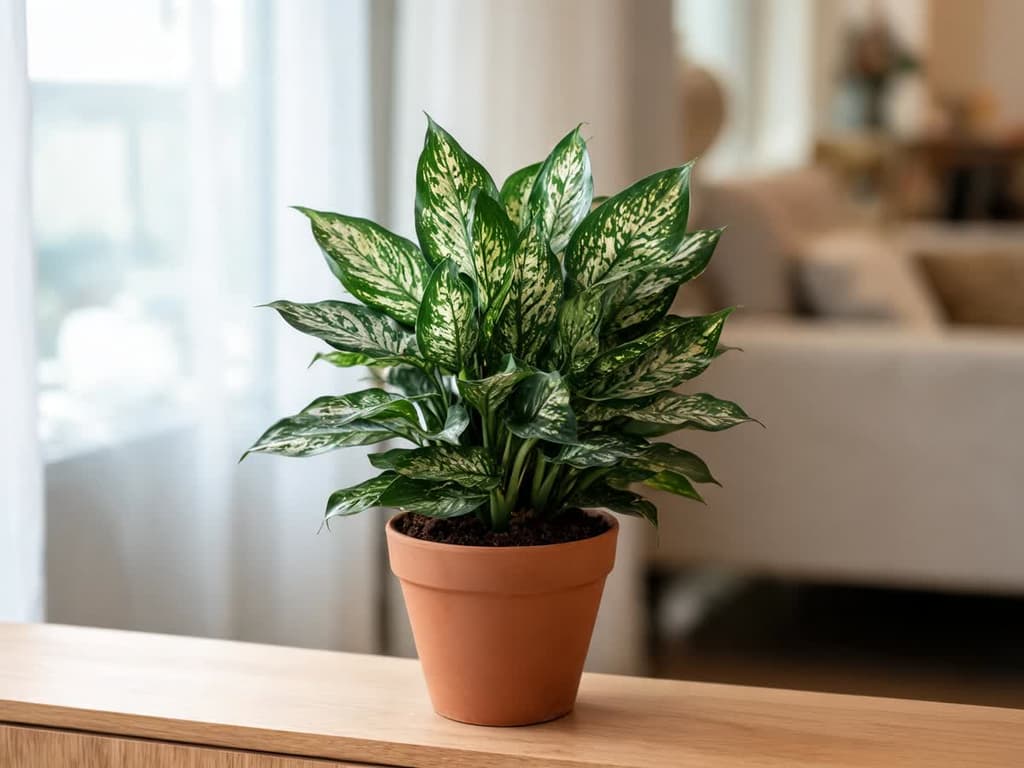
To care for Chinese evergreen, also called aglaonema, keep the pot in a bright spot without direct sunlight on the leaves. Water when the top 1 to 2 inches (2.5 to 5 cm) of soil are dry to the touch. Protect the plant from the cold, because some cultivars develop spots even at 55 °F (13 °C), and cut off the flower when it appears.
Chinese evergreen tolerates low light, which is why it often ends up in hallways and living room corners. It survives in these places, but stays attractive for less time and its leaves lose their color. Direct sun burns the leaves, and the cold spots them. Constantly soggy soil rots the roots.
The plant is also toxic to dogs and cats.
Care | What to do |
|---|---|
Light | Bright and indirect; the colorful ones require a bit more light than the solid green ones |
Watering | When the top 1 to 2 inches (2.5 to 5 cm) of soil are dry; less in winter |
Potting soil | Light potting mix, with organic matter, in a pot with a drainage hole |
Fertilizer | Water-soluble 20-20-20 fertilizer, well diluted, once a month |
Temperature | From 68 °F to 80 °F (20 °C to 27 °C); some cultivars spot at 55 °F (13 °C) |
Flower | Cut it off when it appears |
Dogs and cats | Toxic: keep out of reach |
How to recognize Chinese evergreen
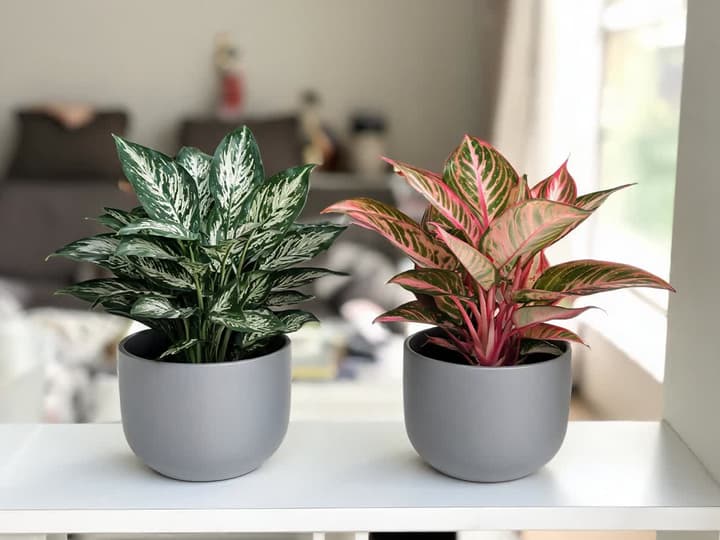
Chinese evergreen is a plant with long, pointed leaves, from 10 to 20 cm (4 to 8 inches). It grows in clumps: several stems emerge together from the same base at soil level. The leaves can be solid green, green with silver or white, or green with pink and red. NC State Extension counts 26 species in the genus (the group of plants called Aglaonema) and many cultivars. A cultivar is a variety selected and propagated for a specific trait, such as leaf color. Extension is the public outreach service that American universities maintain.
For care, aglaonemas fall into two color groups:
Green and silver: Aglaonema commutatum, Aglaonema modestum, and green and silver cultivars, such as 'Maria' and 'Silver Queen'. The leaf is green, solid or with silver spots.
Colorful: pink and red hybrids, such as 'Siam Aurora' and 'Lady Valentine'. Clemson Extension explains that these hybrids come from crossing several species in the genus.
The plant most similar to aglaonema is dumb cane (Dieffenbachia), which also has green leaves mottled with white. NC State distinguishes the two by their veins: aglaonema has only 5 to 8 main lateral veins, and dumb cane has more. Dumb cane belongs to the same family, Araceae (the same as monstera and anthurium). Dumb cane also turns yellow from excess water, as shown in the guide on yellow leaves on dumb cane.
If the plant arrived without a label, the Bloom app identifies the species from a photo of the leaf.
Where to place Chinese evergreen: light
Place the Chinese evergreen in a bright spot, near a window, where the sun does not hit the leaf. UF/IFAS, the University of Florida extension, notes that the plant tolerates light as low as about 270 lux. Lux is the unit that measures brightness. The same source warns that full sun burns the leaf.
NC State measured how long each plant continues to look good at each light level. At 160 to 215 lux, Chinese evergreen stays attractive for 12 months; at 270 to 540 lux, it lasts 36 months.
Does colorful aglaonema need more light?
It needs a little more than the solid green one. Clemson divides them by the amount of color on the leaf: solid green cultivars grow in low light, and variegated ones require low to moderate light. Variegated means a leaf with more than one color, and that includes silver, pink, and red aglaonemas. None of the consulted extensions evaluate red ones separately, so the general rule applies: the colorful one stays closer to the window than the green one.
The color fades at both light extremes:
Too little light: the University of Georgia notes that the color of variegated leaves tends to fade in low light. NC State adds that the plant may not bloom in low light.
Too much light: UF/IFAS observed the effect in nurseries. Under the strongest light the nursery uses, the leaves of most cultivars lose their color and stand erect.
If your aglaonema faded in a dark corner, move the pot closer to the window. If it faded near sunny glass, move the pot away. In Brazil, north-facing and west-facing windows get more sun.
Near these windows, keep the plant away from the glass or behind a sheer curtain. Chinese evergreen is among the plants that tolerate low light. The guide to low-light plants compares Chinese evergreen with other species at the same light levels.
How to water Chinese evergreen
Water Chinese evergreen when the top 1 to 2 inches (2.5 to 5 cm) of soil is dry. Clemson teaches the test of sticking two fingers into the soil: dry soil, you can water; cold and moist soil, wait. The plant likes moist, never soggy soil, and both too much and too little water damage the roots.
Water the soil until water runs out of the pot's drainage hole and discard the water from the saucer. Use room-temperature water: Clemson and NC State urge avoiding cold water. Do not water on a fixed day of the week. In a cool room with low light, the soil takes more days to dry out than near a window.
NC State calls for moist soil from spring to fall and less water in winter. In Brazil, that means watering less from June to August. The soil takes longer to dry, so check the soil with your fingers before each watering. Aglaonema does not go dormant (a resting period without growth), so watering decreases, but does not stop.
Root rot in Chinese evergreen usually comes from soil that does not drain water quickly or from overwatering, according to Clemson.
Soil and pot for Chinese evergreen
Plant Chinese evergreen in a lightweight potting soil (soil formulated for pots) rich in organic matter, in a pot with a drainage hole at the bottom. Clemson recommends commercial houseplant potting soil with extra humus. UF/IFAS grows the plant in mixes of peat, pine bark, vermiculite, or perlite, all lightweight and aerated.
Do not use plain garden soil in the pot: Clemson links root rot to soil that does not drain water quickly. When the clump fills the pot, UF/IFAS Gardening Solutions recommends moving the plant to a larger pot or dividing the clump in two.
Fertilizer for Chinese evergreen
Fertilize Chinese evergreen once a month with a balanced, well-diluted soluble fertilizer. For indoor plants, UF/IFAS recommends a 20-20-20 fertilizer, where the three numbers represent the percentage of nitrogen, phosphorus, and potassium. The dilution is weak: 50 ppm of nitrogen (ppm means parts per million). In practice, that is about 0.25 g of 20-20-20 fertilizer per liter of water.
UF/IFAS explains that fertilizer salt builds up in the soil and burns the edges and tips of the leaves. Clemson reports the same symptom. If the leaf tips dry out, soak the soil with plenty of clean water until it drains out the hole to flush out the excess salt. Then, increase the time between fertilizer applications.
UF/IFAS also warns that most cultivars tend to lack copper and other micronutrients. Micronutrients are the nutrients that the plant uses in small amounts. Choose a fertilizer that includes micronutrients in its formula.
Temperature: Chinese evergreen is sensitive to cold
Chinese evergreen grows best between 68 °F and 80 °F (20 °C and 27 °C) and tolerates lows down to 55 °F (13 °C), according to Clemson. The same source notes cold damage below 50 °F (10 °C). The UF/IFAS test, conducted cultivar by cultivar, found spotted leaves at 55 °F (13 °C) in some of them: follow the test, which measured each cultivar. In Brazil, the risk appears from June to August. It comes from keeping the pot on a balcony, placed against cold window glass at night, or in a cold draft.
UF/IFAS tested 12 cultivars for 24 hours at three cold temperatures. The result, in spotted leaves per cultivar:
Cultivar | Leaves spotted at 2 °C (35 °F) | at 7 °C (45 °F) | at 13 °C (55 °F) |
|---|---|---|---|
'Silver Queen' | 68% | 38% | 30% |
'Royal Queen' | 51% | 34% | 14% |
'Maria' | 32% | 8% | 0% |
'Silver Frost' | 80% | 5% | 0% |
'Emerald Star', 'Stars', and 'Jewel of India' | 0% | 0% | 0% |
'Silver Queen', one of the best-selling Chinese evergreens, already spots at 55 °F (13 °C). For the most sensitive cultivars, UF/IFAS recommends that nurseries keep the temperature above 60 °F (16 °C). The test did not include any red or pink Chinese evergreen, so no one measured the cold that the colorful ones tolerate. When in doubt, treat yours as the most sensitive and keep the room above 60 °F (16 °C).
Cold damage appears 2 days after the cold, as dark, greasy-looking spots between the central vein and the leaf margin. Mature and old leaves suffer more than new ones. If the spot covers less than half of the leaf, it stays alive for months; above that, the leaf yellows and drops.
Chinese evergreen flower: cut or leave it?
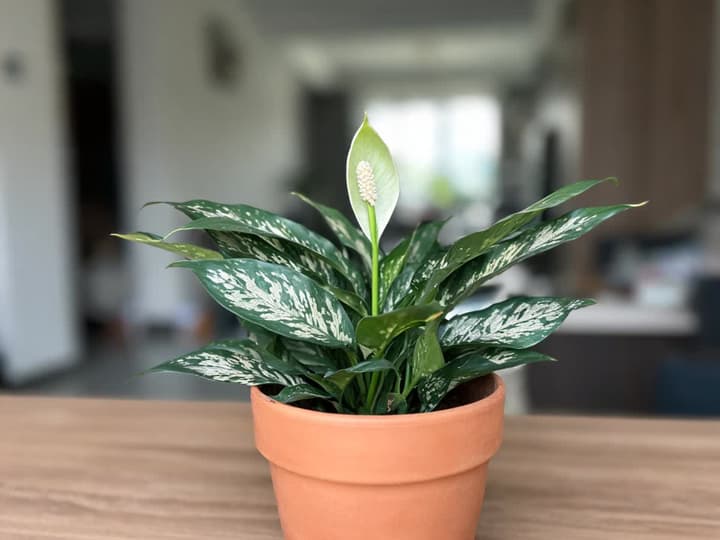
Cut off the aglaonema flower when it appears. The flower is a spathe (a modified leaf, white or light green) surrounding a white spadix, similar to that of a peace lily. UF/IFAS says that removing the flower extends the life of the plant and keeps the clump full. NC State says that cutting it directs energy toward the plant's growth.
Cut the flower stalk flush with the base, using clean shears. If the flower stays, little red fruits follow, which UF/IFAS Gardening Solutions calls unappealing. Since the flower and the fruits are also toxic, throw both in the trash, out of reach of children and pets.
Why Chinese evergreen loses its lower leaves
Chinese evergreen loses its lower leaves with age. NC State explains that the plant tends to stretch over time as the stem grows. The lower stem becomes bare, resembling sugarcane, and the leaves concentrate at the top.
Cold can accelerate leaf drop at the bottom: in the UF/IFAS test, mature and old leaves developed far more spots than new ones. If the bottom leaves turn yellow while the soil stays constantly wet, suspect root rot, described in the watering section.
A Chinese evergreen with a bare stem and a green top can be saved. Clemson recommends cutting off the top and rooting the tip, which becomes a new plant. Other ways to propagate are clump division and stem cuttings.
Yellow leaves and Chinese evergreen pests
An occasional old lower leaf that turns yellow is part of the aging process of Chinese evergreen: UF/IFAS just advises removing the yellow leaf. When several leaves turn yellow at once, check your watering and the cold. Cold damage that covers more than half of the leaf results in a yellow leaf, according to UF/IFAS.
Aglaonema belongs to the same family as anthurium, monstera, and philodendron. Excess water also turns the leaves of these aroids yellow, as shown in the yellow leaf guides for monstera, philodendron, and anthurium. The general guide on yellow leaves separates the causes by the position of the leaf on the plant.
Clemson lists four pests of aglaonema: mealybugs, aphids, scale insects, and spider mites. Two of them leave a white mark on the plant, and Clemson's guide on indoor pests teaches how to tell them apart:
White cotton where the leaf meets the stem and under the leaf: this is the mealybug, an insect covered in white wax.
Fine webbing and tiny light dots on the upper surface of the leaf: it is the spider mite. It is so small that the first sign is usually leaf damage. The webbing appears when the infestation is already severe.
For indoor plants, Clemson recommends removing mealybugs with a cotton swab dipped in alcohol and spraying insecticidal soap. Against spider mites, it advises a strong jet of water over the entire plant, including the underside of the leaves, repeated several times. Clemson recommends neem oil and insecticides only for plants moved outdoors. Separate the infested plant from the others until the pest is gone.
If you do not know what the problem is, the guide what is wrong with my plant organizes the diagnosis by symptom.
Is Chinese evergreen toxic to dogs and cats?
Yes. The ASPCA, an animal poison control center in the United States, lists Aglaonema modestum as toxic to dogs, cats, and horses. The toxic principle is insoluble calcium oxalate, a needle-shaped crystal. The ASPCA describes irritation and swelling of the mouth, tongue, and lips, excessive drooling, vomiting, and difficulty swallowing.
NC State records the same crystal throughout the genus, with low toxicity to people, and states that the sap can irritate the skin. NC State lists the crystal in all parts of the plant, including the flower and fruits. If a child chewed the leaf, remove the remains from their mouth and call the Poison Control Center, 0800 722 6001 (Anvisa, toll-free, 24 hours). If it was your pet, call the veterinarian.
Keep the pot out of reach of pets and pick up any fallen leaves. The guide to toxic plants for pets shows other houseplants with the same crystal.
Frequently asked questions
Does Chinese evergreen grow very large?
Not much. Clemson gives 30 to 90 cm in height and the same width for most aglaonemas. Aglaonema commutatum reaches 60 to 90 cm, and Aglaonema crispum can exceed 90 cm. For the clump to grow evenly, UF/IFAS recommends rotating the pot every 1 to 2 weeks.
Can I keep Chinese evergreen in the bathroom or bedroom?
Yes, if the spot has bright light. Clemson says that Chinese evergreen tolerates dry air and prefers moderate humidity: the bathroom and the bedroom work. NC State warns that the leaves turn brown in very dry air or in drafts. If the leaves turn brown, move the pot to a spot without drafts. The guides on bathroom plants and bedroom plants compare Chinese evergreen with other species.
Do you need to prune Chinese evergreen?
No. UF/IFAS says pruning is not necessary: just remove yellow or dead leaves, cutting the petiole close to the stem. To remove dust, the same source suggests wiping the leaves with a damp cloth from time to time. The only cut that changes the plant is taking the top off a stem that is bare at the bottom, which becomes a new cutting.
Does Chinese evergreen purify the air?
Not in a way that makes a difference in a home. In the 1989 NASA test, conducted in small, sealed chambers, aglaonema removed part of the benzene from the air. A review by researchers at Drexel University did the math for a home: it would take 10 to 1,000 plants per square meter. The guide on plants that purify the air provides the numbers from the test.
If your aglaonema has a symptom you do not recognize, the Bloom app for iPhone helps. It identifies the plant by photo and, on the Premium plan, diagnoses the disease from a photo of the leaf.
Related articles
How to Care for a Goldfish Plant: Light, Watering, and Blooms
How to care for a goldfish plant: bright light without strong sun, water when the soil surface dries, and humid air. Learn how to tell a Nematanthus from a Columnea, why it drops leaves, and how to get it to bloom again.
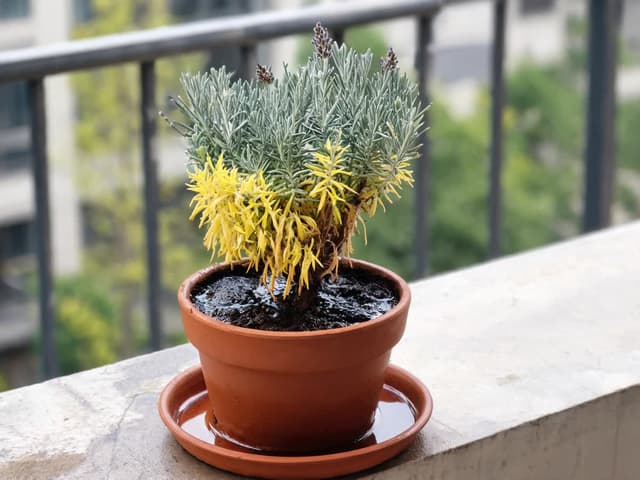
Lavender Leaves Turning Yellow: Where the Yellowing Starts Shows the Cause
Lower leaves turning yellow with moist soil means overwatered roots, the most common cause. Old leaves drying one by one on woody stems is normal. Take the stem and root test, see if your plant can still be saved, and find out what to do today.
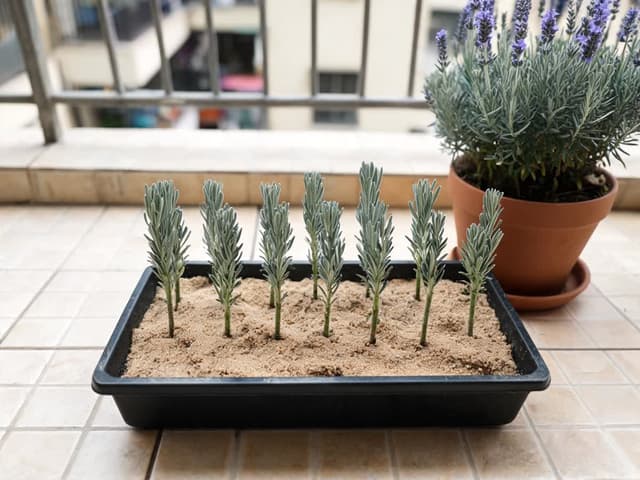
How to Propagate Lavender: Where to Cut and Why Cuttings Rot
A lavender cutting comes from a non-flowering branch tip, about 4 inches long, planted in sandy soil that never stays soggy. Learn where to cut, rooting times, seasonality in Brazil, and what to do if the base turns black.