Dracaena with Yellow Leaves: How to Spot the Cause by the Yellow Pattern
Dracaena with yellow leaves: one lower leaf at a time is natural aging. Learn how the location and pattern tell apart watering, cold, fluoride, nutrients, pests, and rot, and what to do in each case.
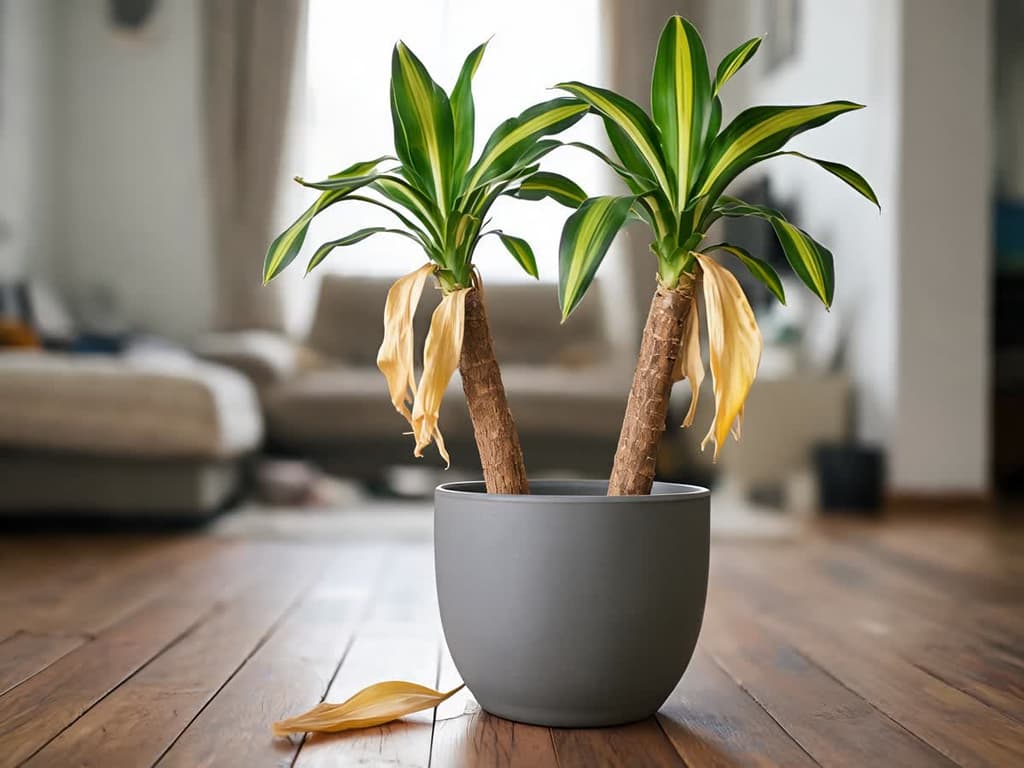
On a dracaena with yellow leaves, the location and pattern of the yellow show the cause. One lower leaf yellowing at a time is simply the age of the plant. The University of Maryland Extension states that it is normal for a dracaena to shed its oldest, lowest leaves as it grows. Multiple leaves at the same time, yellow new growth, or yellow patches indicate a different cause.
Before touching your watering routine, squeeze the stem close to the soil. A firm stem rules out stem rot. A soft, dark stem means rot, and the rescue steps are in the guide on how to care for a dracaena.
Which Dracaena You Have Changes What Is Normal
Dracaena is the common name for multiple species in the Dracaena genus, and each one has its own natural yellowing that is not a disease. Three types appear frequently indoors:
Corn plant (Dracaena fragrans 'Massangeana'): broad leaves with a yellow stripe down the center, according to Clemson Extension.
Madagascar dragon tree (Dracaena marginata): thin leaves with red or pink margins, growing in tufts atop slender stems.
Striped-leaf dracaenas, such as 'Lemon Lime' and 'Warneckii': cream, white, or lime-green stripes running lengthwise along the leaf.
The dracaena plant profile displays the genus species side by side. Anyone who inherited a plant and thinks it is a palm can distinguish it by its shape: dracaena features ribbon-like leaves emerging directly from the stem, without the long leaf stalk of a palm.
When a Yellow Dracaena Leaf Is Normal
A lower leaf that turns yellow, dries up, and drops, one at a time, is aging. The NC State Extension notes that Madagascar dragon tree loses its lower leaves with age. That is how the stem becomes bare, with a tuft at the top. The plant remains normal as long as it keeps producing new leaves at the top.
Three other yellow patterns are also not a disease:
The yellow stripe of the corn plant grows stronger with more light. The University of Florida (UF/IFAS) records that the yellow on 'Massangeana' increases with higher light.
The 'Limelight' cultivar has yellow-green leaves that lighten with age, according to NC State.
Tiny white or yellow spots on new Madagascar dragon tree leaves, near the tip, turn green as the leaf matures. UF/IFAS described this symptom in a 1991 research note and found neither fungi nor bacteria on the leaves.
A corn plant that loses its yellow stripe and produces narrower leaves than normal may have a nitrogen deficiency. UF/IFAS (2018) lists both symptoms together as a sign of nitrogen deficiency.
The Yellow Pattern on a Dracaena Shows the Cause
The cause of yellow leaves on a dracaena can be determined from three observations: which leaves turned yellow, what pattern the yellow makes, and whether the stem remains firm. Compare what you see against the table.
What you see | Most probable cause | What to do |
|---|---|---|
One lower leaf at a time, turning entirely yellow, plant producing new growth | Leaf aging | Nothing; remove the leaf once it turns completely yellow |
Multiple lower leaves turning yellow together, without spots | Watering issue, pot-bound roots, or nitrogen deficiency | Insert your finger 2 inches into the soil and check how many years the plant has been in the same pot |
Yellow, limp leaves, soil damp for days, soft stem at the base | Overwatering and rot | Stop watering and inspect the stem |
Yellow spots on new center leaves, with brown margins | Fusarium leaf spot, a fungus entering through water trapped in the center | Water the soil, not the leaf crown |
Yellow or brown tips and edges; on corn plant, pale patches in the middle of the leaf | Fluoride or fertilizer salts | Use fluoride-free water and flush the soil thoroughly with water |
Yellow crossbands across multiple leaves on Madagascar dragon tree | Cold temperatures of 32°F to 37°F (0°C to 3°C), weeks earlier | Move away from cold and drafts |
Entire new leaf pale or yellow | Iron deficiency, often caused by high pH (alkaline soil, which locks up nutrients), or manganese deficiency | Test soil pH |
Brown shells, white cottony fluff, or silvery markings on leaf undersides | Scale, mealybugs, thrips, or spider mites | Inspect the undersides of leaves and the stem |
Dry, rust-colored patches near the tip, following direct sunlight | Sunburn | Move away from direct sunlight |
Clemson lists five causes for the sudden loss of many leaves: temperature changes, drafts, overwatering, poor drainage, and insect infestations. If the leaves dropped all at once, start with the cold, watering, and pest rows in the table.
Multiple Lower Dracaena Leaves Yellowing at Once
Multiple lower leaves turning yellow together point first to watering and the pot. Clemson states that too much or too little water, along with insects and mites, are the primary problems for dracaenas. Root rot, according to the same fact sheet, comes from soil that does not drain quickly or from watering too frequently.
Overwatering and underwatering leave distinct clues:
Overwatering: soft, yellow leaves, soil wet to the touch days after watering, standing water in the saucer.
Underwatering: dry, yellow leaves, soil pulling away from the pot wall, pot feeling light when lifted.
Maryland Extension recommends feeling the soil 1 to 2 inches (2.5 to 5 cm) below the surface. NC State advises keeping corn plant soil moist during the growing season, while Maryland and Clemson advise letting it dry slightly between waterings. This guide follows the drying approach, because Clemson links root rot to frequent watering. Only water when the top 2 inches (5 cm) are dry, and then water until water runs out of the drainage hole. The guide on how to care for a dracaena explains why waiting for the top 2 inches (5 cm) to dry before watering is worthwhile. Clemson also advises against watering with ice-cold water.
Depleted Soil and Root-Bound Pots
A dracaena that has spent years in the same pot develops yellow lower leaves even with on-schedule watering. Maryland Extension points to two reasons. Roots crowd out the soil, and the pot dries out faster. Old soil accumulates salts from water and fertilizer, which damage the roots. NC State advises repotting into a larger container when the plant begins pushing upward out of the pot or sending roots through the drainage hole.
Nitrogen Deficiency: Yellowing Starts on Older Leaves
When roots cannot access nitrogen, dracaenas move this nutrient from older leaves to support new growth, according to Maryland Extension. That is why yellowing starts at the bottom. The same source notes that fertilizer cannot turn an already yellow leaf green again: it protects future leaves. The guide to yellow leaves explains why each nutrient deficiency affects leaves at different heights.
Clemson recommends liquid fertilizer for foliage plants once a month in spring and summer. In Brazil, these seasons run from September to March. The same fact sheet warns that too much fertilizer yellows and burns leaf tips and edges.
Limp Yellow Dracaena Leaves: Rot at the Base and Top
Limp yellow leaves paired with a soft stem indicate rot, and where softness appears shows where it began. At the base, against the soil line, it indicates root rot from overwatering. The guide on how to care for a dracaena explains how to test the stem and salvage firm upper portions.
At the top, the softness begins in the center of the leaf whorl, where new leaves emerge tightly furled. UF/IFAS describes Fusarium leaf spot, caused by the fungus Fusarium moniliforme, which enters through standing water in this center. The spots emerge on new leaves, expand, turn yellow, and develop a reddish-brown margin. In a severe infection, the entire plant center rots and the stem stops growing, according to a UF/IFAS report on Madagascar dragon trees.
UF/IFAS recommends keeping the leaf crown center dry as prevention. At home, that means watering directly into the soil and not misting into the leaf center. Clemson points out that disease is uncommon on indoor dracaenas, so verify your watering routine before suspecting a fungus.
If the center rots but the lower stem remains firm, the healthy section can still take root. The guide on dracaena cuttings explains how to root a healthy stem section.
Cold, Drafts, and Heat Yellow Dracaenas
Cold turns a dracaena yellow, and the damage may only show up weeks later. On the Madagascar dragon tree, a few hours between 0 °C and 3 °C in still air leave yellow or dead bands across several leaves. UF/IFAS (1991) warns that these bands only appear 2 weeks or more later. The damage happens inside the bud, and the leaf needs to grow out to show it.
In Brazil, winter runs from June to August. A dracaena that spent a 2°C (36°F) night on an open porch in July, in Southern Brazil, might not show bands until August. Sources give different numbers for the cold:
Source | Species | Temperature |
|---|---|---|
NC State | Corn plant | Keep above 50°F (10°C) |
UF/IFAS (1991) | Dracaenas in general | Damage at 55°F (13°C) for 1 week, or at 35°F (2°C) for 1 to 2 days; minimum 50°F (10°C), away from wind |
UF/IFAS (2018) | Dracaenas in general | Keep above 59°F (15°C) at all times |
Clemson | Dracaenas in general | 60°F to 70°F (15°C to 21°C) during the day, nights about 10°F (5°C) cooler |
This guide follows the safest threshold: keep dracaenas above 59°F (15°C). All four sources require at least 50°F (10°C), and UF/IFAS (1991) identifies wind as an aggravating factor.
Drafts make cold damage worse. On corn plants, cold wind below 50°F (10°C) gives leaf margins a water-soaked or grayish look, according to UF/IFAS. Within days, those edges turn brown or black. None of the cited sources mention air conditioning. An AC vent produces a cold air draft, so the safest practice is keeping the plant out of its airflow.
Heat also causes yellowing. Above 90°F (32°C), 'Janet Craig' dracaena develops yellowing foliage, according to UF/IFAS. During Brazilian summers, glass windows in afternoon sun and enclosed balconies can exceed 90°F (32°C). Pull the plant back from the glass and ensure proper room ventilation.
Direct Sun Scorches Dracaena Leaves
Direct sun burns dracaenas, and the scorch does not turn evenly yellow. UF/IFAS describes sunken, rust-colored areas, almost always near the leaf tip. Clemson notes dry round spots and streaks on the leaf. NC State says the same for corn plants: direct sun burns, and light that is too weak makes leaves narrower.
In Brazil, the window that gets the most sun faces north. The right spot is near a bright window, without sun hitting the leaf in the middle of the day. A burned leaf does not recover: UF/IFAS advises moving the plant out of strong light and trimming only the damaged part.
A dracaena kept in a dark corner for months that gets moved near a window produces visibly different new leaves. Clemson notes that leaves emerging after the move grow thicker and stronger. None of the consulted sources specify how many days the plant takes to acclimate, so transition lighting gradually and never move it straight into direct sun.
Fluoride and Fertilizer: Yellowing at Tips and Leaf Centers
Fluoride in tap water, perlite, and superphosphate fertilizers yellows leaf tips and edges on dracaenas. Clemson outlines this symptom and advises avoiding mixes high in perlite (the white mineral specks that aerate soil) and superphosphate fertilizer (a high-phosphorus fertilizer that frequently introduces fluoride). The guide on how to care for a dracaena covers Brazilian water fluoride legislation, monthly soil flushing, and proper pH targets.
On corn plants, fluoride damage also appears across the middle of the leaf. UF/IFAS (1991) describes the earliest sign as pale spots within green tissue, which are easiest to spot on leaf undersides. Over time, these spots turn yellow, then die off and spread to leaf edges.
UF/IFAS research confirms the role of fertilizer. In a 1975 study, fluoride from superphosphate increased yellowing and dead areas on 'Janet Craig' dracaena leaves. Limestone, which raises soil pH, reduced the damage. Even so, do not let the pH exceed 6.5, because above that iron locks up. According to UF/IFAS (1991), keeping soil pH above 6.0 usually prevents fluoride toxicity.
Pale or Yellow New Dracaena Leaves
Pale new growth alongside green mature leaves indicates nutrients failing to reach the top. According to UF/IFAS, this commonly stems from high soil pH.
On 'Warneckii' and 'Janet Craig', UF/IFAS (1991) records light green or yellow new leaves when soil pH sits between 7.5 and 8.0. That pH range locks up iron. On Madagascar dragon trees, UF/IFAS (2018) identifies another deficiency: pale young foliage with green veins running across, signaling manganese deficiency.
Optimal pH for dracaenas sits between 6.0 and 6.5, according to UF/IFAS and Clemson. Below 6.0, fluoride toxicity strikes, while above 6.5, iron becomes unavailable. A basic garden center pH test kit quickly reveals whether your soil sits below 6.0, between 6.0 and 6.5, or above 6.5.
Pests That Yellow Dracaenas: Shells, Fluff, and Silvery Marks
Scale and mites are the most common pests on dracaenas, according to Clemson. Both suck plant sap, leaving leaves yellowed or spotted. Examine leaf undersides and stems with your phone flashlight.
Mites: Clemson lists them among the most common dracaena pests. The guide on spider mites explains the white paper test to confirm an infestation.
Scale: brown, shell-like bumps clinging to the stem and leaf undersides.
Mealybugs: white cotton at the junction where the leaf meets the stem. NC State states that dracaena seems to be a favorite plant of the longtailed mealybug.
Thrips: silvery or grayish patches accompanied by curled foliage, according to UF/IFAS (1991).
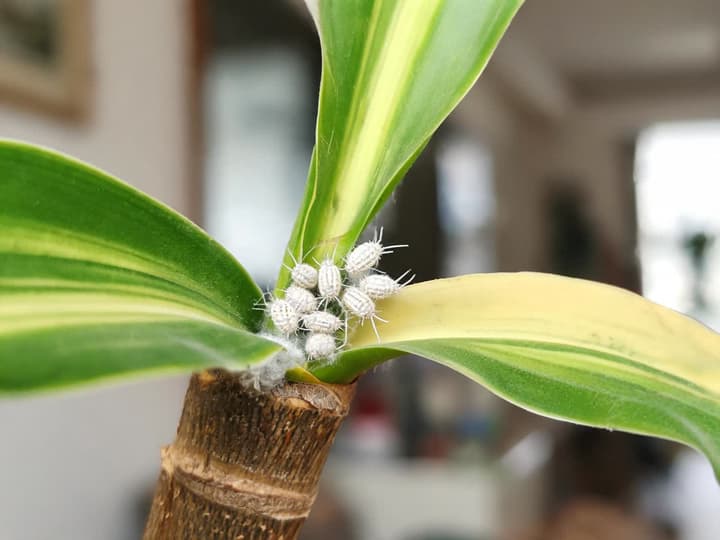
When only a few pests are present, NC State recommends removing mealybugs using a cotton swab dipped in rubbing alcohol. Afterward, wash the plant with a 2% soap solution (20 ml of mild soap per 1 liter of water), never using dishwashing detergent. Repeat 2 or more times, once per week. The guide to scale and mealybugs explains why treatment takes weeks. The dracaena yellow leaves troubleshooting page gathers the other pests and diseases that cause yellowing across this genus.
Pruning Yellow Leaves and Repotting Dracaenas
A leaf that has turned entirely yellow will not revert to green, so you can safely prune it. UF/IFAS notes that damaged leaf tissue does not recover. Once fully yellow, pull downward if it detaches easily, or snip it flush with the stem using clean shears.
Leaves that remain partly green should stay on the plant. In cases of nitrogen deficiency, dracaenas withdraw nutrients from older foliage to fuel new growth, according to Maryland Extension. Stripping leaves too early removes resources the plant is actively reclaiming. For leaves showing only a brown tip, trim solely the dead portion, as outlined in the guide on how to care for a dracaena.
Repotting in the middle of winter is only worth it if there is root rot. Below 18 °C, dracaenas barely grow, according to UF/IFAS (1991). A root-bound pot, without rot, can wait for the warmth of spring, from September to November in Brazil.
Checking Step by Step: Dracaena with Yellow Leaves
Follow this diagnostic sequence, moving from the easiest cause to rule out toward rarer issues:
Gently squeeze the stem near the soil line and at the crown. Soft tissue indicates rot.
Stick your finger 2 inches into the soil. Moist soil days after watering signals overwatering; loose, bone-dry soil points to underwatering.
Observe which leaves turned yellow: the lowest ones, new top growth, or the entire plant.
Reflect on the past 3 weeks: cold snaps, open windows, air conditioners, relocations, or harsh direct sunlight.
Examine leaf undersides and the main stem for brown shells, white cottony fluff, or silvery marks.
Track how long the plant has occupied its container, along with your fertilizer and water source.
If you are still unsure which dracaena you have, Bloom (available for iOS) identifies species from a single photo. Knowing the exact species clarifies which yellowing traits are completely natural.
Frequently Asked Questions
Do yellow dracaena leaves ever turn green again?
No. A dracaena leaf that has turned yellow will not regain its green color, even with fertilizer, according to University of Maryland Extension and UF/IFAS. Correcting the underlying issue shows up in new leaves forming at the top. Remove a yellow leaf once it is entirely yellow, either by gently pulling downward or by trimming it close to the stem.
Why do dracaena leaves turn yellow from the top down?
Yellowing that starts on tender young leaves at the top is not normal aging. Sources point to three main causes: iron deficiency (often due to high pH) or manganese deficiency, Fusarium leaf spot in the crown, and cold injury on Madagascar dragon trees. Inspect the center for soft rot and measure your soil pH.
Does lucky bamboo also turn yellow because of water?
Yes. Lucky bamboo is a dracaena (Dracaena sanderiana). The Michigan State University Extension states that it is sensitive to fluoride and chlorine in tap water. Fluoride can turn leaves yellow. Use rainwater or distilled water and keep the plant in bright, indirect light.
Are dracaenas toxic to cats and dogs?
Yes. The ASPCA, an American animal protection organization, lists the corn plant as toxic to dogs and cats due to saponins. The same organization lists dracaenas in general (Dracaena spp.) as toxic to both. Signs include vomiting, loss of appetite, and drooling. When you remove yellow leaves, discard them out of the animal's reach.
Dracaena with Yellow Leaves: Summary
Lower leaves turning yellow one at a time reflect normal aging on a dracaena. Multiple leaves turning yellow simultaneously point to watering, container constraints, or nitrogen deficiency. Yellow new foliage points to pH imbalances, Fusarium, or cold stress. Crusty bumps and white fluff signal pests, while yellowed tips indicate fluoride or fertilizer salt accumulation. Always start by gently squeezing the stem: a firm stem eliminates rot, directing you to the remaining causes in the table.
Related articles
How to Care for a Prayer Plant: Light, Water, Humidity, and Closing Leaves
To care for a prayer plant, provide bright indirect light, keep the soil moist without waterlogging, and maintain air humidity above 50%. Water with fluoride-free water. Leaves that rise and fold at night are the plant's normal movement.
Peonies in Winter: Can They Handle Frost? Care by Type and in Pots
Peonies in winter: the herbaceous type tolerates lows of −15 to −20 °C, dies back above ground in winter and returns in spring, and tree peonies keep their branches. Cut dead foliage down to the ground, mulch the soil only in the first winter, protect the roots in pots, and cover the buds on frosty nights.
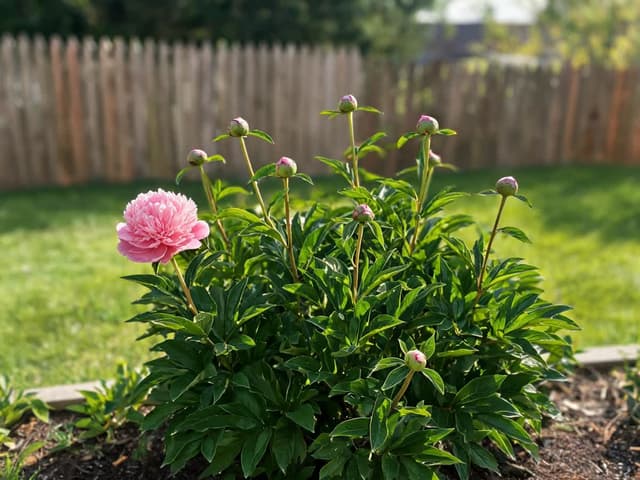
Peonies: How to Make Them Bloom and Why Buds Don't Open
Peonies: how to make them bloom. A peony that fails to bloom usually has buds buried too deep, too little sun, a warm winter, or is too young. Learn when it flowers, how long it takes to produce its first bloom, and how to identify the cause from the plant's symptoms.