How to Care for a Prayer Plant: Light, Water, Humidity, and Closing Leaves
To care for a prayer plant, provide bright indirect light, keep the soil moist without waterlogging, and maintain air humidity above 50%. Water with fluoride-free water. Leaves that rise and fold at night are the plant's normal movement.
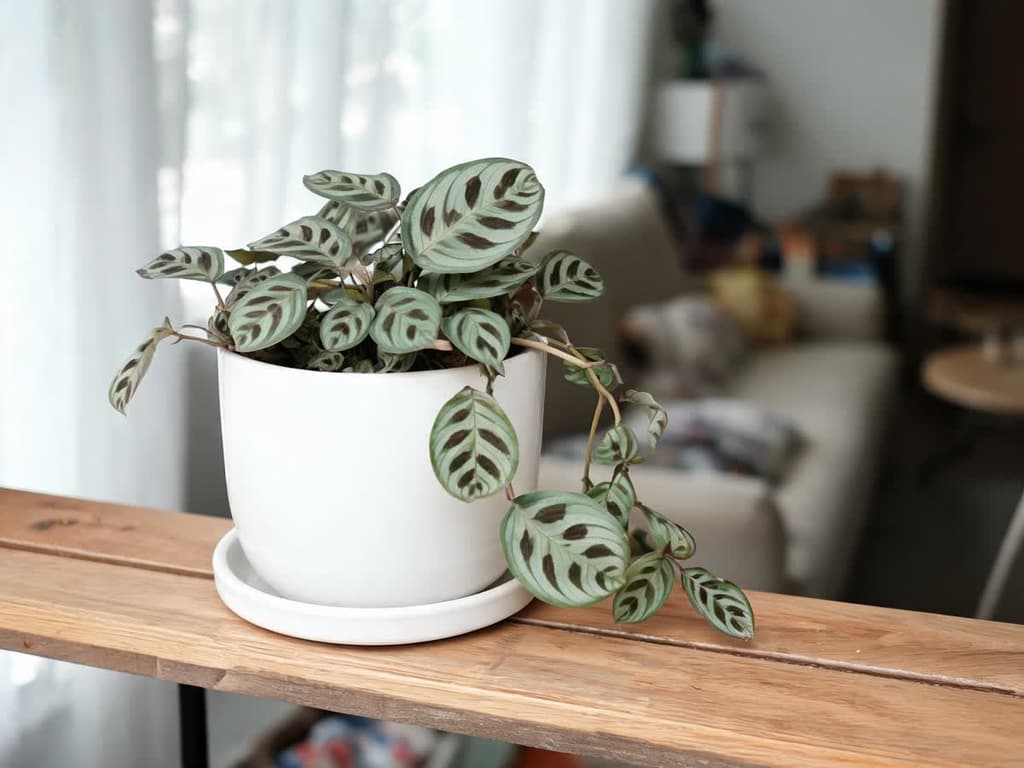
To care for a prayer plant: provide bright light without direct sun, keep the soil moist without waterlogging, and keep the air above 50% humidity. Water with rainwater or distilled water, because fluoride and chlorine in tap water can burn the leaf tips. Leaves rising and folding at night are no problem: it is the plant's natural movement.
If your prayer plant has brown tips or curling leaves, check the base of the stems before giving up on it. The plant grows from a short stem that sits flush with the soil, the rhizome. As long as the base of the stems remains firm, the plant is alive and can put out new leaves once you correct the cause.
Quick summary (Brazil months, Southern Hemisphere):
Item | What to do | Source |
|---|---|---|
Light | Bright all day, no direct sun on the foliage; at least around 800 lux | NC State, UF/IFAS |
Watering | From September to March, soil always moist; from April to August, water when the top 1 in (2.5 cm) dries out | NYBG, NC State |
Water | Rainwater or distilled water; fluoride and chlorine from the tap can burn the tips | Iowa State, NC State |
Air humidity | Well above 50%, measured with a hygrometer (humidity meter) | NYBG |
Temperature | 65 to 70 °F (18 to 21 °C); never below 55 °F (13 °C) | NYBG |
Fertilizer | Liquid fertilizer every 2 weeks, from September to March | NYBG |
Pets | The ASPCA entry for "Prayer Plant" is nontoxic to dogs and cats | ASPCA |
What is the prayer plant (Maranta leuconeura)
The prayer plant (Maranta leuconeura) is a Brazilian foliage plant known for its leaves with dark blotches and colored veins. According to Flora do Brasil, from the Rio de Janeiro Botanical Garden, it is native and endemic to the country. It occurs in the Atlantic Forest, the Cerrado, and the Caatinga, from Bahia and Ceará down to São Paulo and Mato Grosso do Sul.
Two types dominate nursery production. According to the University of Florida (UF/IFAS), they make up more than 95% of produced prayer plants:
'Kerchoviana': light green leaf with two rows of dark green blotches, one on each side of the midrib.
'Erythroneura': leaf with bright red midrib and lateral veins (UF/IFAS), in a herringbone pattern (NC State).
NC State Extension, the extension service of North Carolina State University, also notes two cultivated varieties. 'Lemon Lime' has a yellowish-green center and stripes, and 'Silver Band' has a silvery band down the center of the leaf.
The prayer plant stays low and grows outward. Stems run along the soil or spill over the edge of the pot and do not climb (UF/IFAS). That makes it well suited for hanging baskets, a use NC State describes for indoor settings.
Calathea belongs to the same family, Marantaceae, and NC State warns that the two are frequently confused. In Brazil, some calatheas share the common name maranta, such as the peacock plant (maranta-pavão) and the rattlesnake plant (maranta-cascavel). Calathea has its own set of numbers for light, humidity, and temperature, gathered in the guide how to care for calathea.
If your plant came without a tag, confirm the species before following any numbers. Bloom (available for iOS) identifies the plant from a leaf photo, and the free version gives you 2 identifications per month. The profile for maranta shows the growth habit and the most common symptoms for the species.
Why the prayer plant folds its leaves at night
The prayer plant raises its leaves in the late afternoon and lowers them again in the morning. According to NC State, the leaf sits parallel to the ground during the day and stands upright at night, in a "praying hands" posture. The common English name, prayer plant, comes from this movement.
This movement is called nyctinasty: the leaf stays nearly horizontal by day to catch light, and nearly vertical at night (Minorsky, Biological Reviews, 2018). In the prayer plant family, what moves the leaf is a joint at the end of the leaf stalk, called the pulvinus. The cells of the pulvinus take on or lose water, and the leaf rises or falls.
The movement follows the plant's internal clock, the circadian rhythm (a cycle of roughly 24 hours), set by light. No one knows for certain what purpose it serves. Minorsky's review compiles four hypotheses. Two of them are shedding water from the leaf surface and protecting the plant from insects that eat foliage at night.
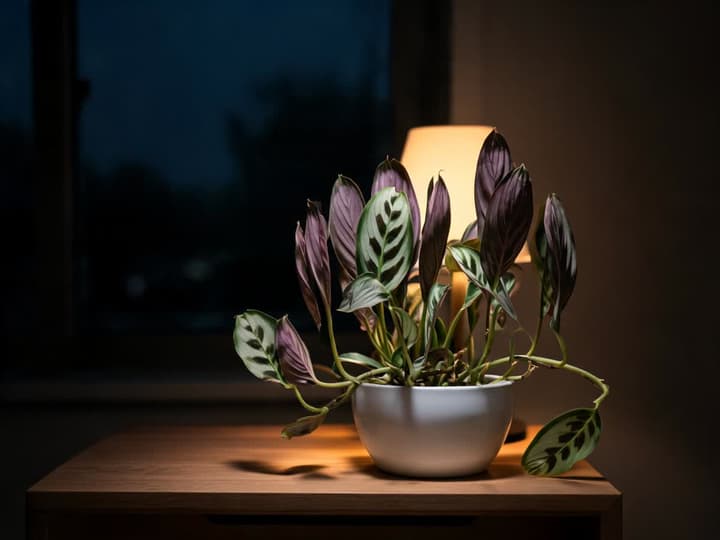
Do not confuse the nighttime movement with a new leaf, which emerges rolled up like a tube before unfurling (NC State). That tube appears in the center of the plant on new growth and is completely normal. The warning sign is an adult leaf staying rolled lengthwise during the day.
If your prayer plant stopped folding its leaves at night, none of the consulted sources explains what that indicates. The safest approach is checking light, watering, air humidity, and temperature against the figures in this guide. Once you adjust those factors, watch new leaves: if they emerge with normal markings, conditions have improved.
Light for prayer plants: where to put it
Place your prayer plant in the brightest spot in the house where direct sun does not hit the leaves. NC State recommends bright indirect light and notes that direct sun fades leaf colors. The New York Botanical Garden (NYBG) suggests a shaded window or a sheer curtain between the plant and the sun.
The pattern on the leaf (the blotches and colored veins) also fades when light is too low. NC State says that under low light and low fertilizer, both surfaces of the leaf lose their color. Faded leaves do not only mean too much sun: check whether the spot is too dark.
A prayer plant survives in a poorly lit corner, but it loses its leaf pattern. UF/IFAS recommends at least 75 foot-candles (about 800 lux) indoors. Lux is the unit that measures how much light reaches a surface.
A light meter app on your phone gives an approximate reading. At midday, place the phone where the pot sits, screen facing up. The list of low-light plants compares the prayer plant to species that tolerate darker corners.
The sources are from the United States, and window orientation reverses in Brazil. Here, a south-facing window receives little direct sun and an east-facing window receives only morning sun: both work. For a north- or west-facing window, use a sheer curtain or move the pot away from the sun.
How to water a prayer plant
Water the prayer plant according to the season. NYBG directs you to keep the soil thoroughly moist during the growing season, which in Brazil runs from September to March. In winter, from June to August, let the top 1 in (2.5 cm) of soil dry out before watering again (NYBG, NC State). The sources do not mention April and May: in those months, use the same winter test, which protects the roots from excess water.
In Brazil, from September to March, do not let the soil dry out completely: water when the surface starts to feel dry to the touch. To check in winter, stick your finger an inch (2.5 cm) into the soil: if the tip comes out dry, water; if it comes out moist, wait. There is no set watering schedule: the same prayer plant uses more water in a warm, airy apartment than in a cool room.
Water with lukewarm water (NYBG) until it drains through the hole at the bottom of the pot. Empty the saucer 15 minutes after watering (NYBG). NC State warns that soil that does not drain leads to root rot.
Tap water: fluoride and chlorine on prayer plants
Iowa State Extension lists the prayer plant among species sensitive to chlorine and fluoride in water. In these plants, prolonged tap water use causes brown tips. The recommendation is switching the water source. NC State also notes that prayer plant foliage scorches under high fluoride levels.
In Brazil, treated water receives fluoride by law. Law 6,050 of 1974 mandates fluoridation in public systems with a treatment plant. Iowa State does not state which water to use instead. The fluoride-free and chlorine-free options are rainwater and distilled water.
NYBG also advises against hard water (high in lime), which leaves mineral deposits on the foliage.
Air humidity for prayer plants
The prayer plant requires humid air, well above 50% humidity (NYBG). NC State notes that it does not tolerate dry air. The warmer the room, the more humid the air needs to be: NYBG warns that above roughly 60 °F (16 °C), humidity requirements rise.
Measure before changing anything. A hygrometer (humidity meter) near the pot shows the moisture level reaching the plant. Air conditioners and heaters drop humidity, and a plant right next to an air vent suffers most.
If humidity is not well above 50%, a room humidifier is the method NYBG indicates. A pebble tray with water divides sources: NC State recommends it, and NYBG says it may not be enough. This guide follows NYBG because the humidifier's effect shows on the hygrometer: if the number rises, it worked. The tray can stay as supplemental help.
Do not mist to raise humidity. NYBG says daily misting may still fall short for prayer plants. Furthermore, UF/IFAS explains that prayer plant leaf spot requires 6 hours of wet foliage to infect the plant.
Ideal temperature for prayer plants
The ideal indoor temperature for a prayer plant ranges between 65 and 70 °F (18 to 21 °C) (NYBG). Never let the plant drop below 55 °F (13 °C). Avoid abrupt temperature swings, as NC State states prayer plants tolerate neither cold nor chilly drafts.
In Brazil, the risk of cold weather appears from June to August, in the South and in the mountains of the Southeast. On the coldest nights, move the pot away from windows and doors. Heat is also an issue: on hot days, air humidity needs to rise along with the temperature.
Soil, pot, and fertilizer for prayer plants
Use a loose potting soil that holds moisture while letting excess water drain freely. NYBG suggests soil with some peat moss and coarse sand, and UF/IFAS calls for a pH between 5.5 and 6.0 (slightly acidic). The pot must have drainage holes at the bottom (NYBG).
Repot the prayer plant every 1 to 2 years in spring (NYBG), which in Brazil runs from September to November. Because the plant grows outward, a hanging basket, or a wide, shallow pot, accommodates the stems that run along the soil.
Fertilize with liquid houseplant fertilizer every 2 weeks, from September to March in Brazil (NYBG). Follow the label dosage. From April to August, do not fertilize. NC State warns that too much fertilizer burns the leaves.
Avoid fertilizers listing superphosphate on the label. UF/IFAS explains that this phosphorus fertilizer contains 1% to 2% fluoride and burns prayer plant leaves.
What prayer plant leaves tell you: symptoms and causes
Most prayer plant symptoms stem from watering, air humidity, water quality, or light. NYBG summarizes: brown tips and margins, leaf curling, or leaf drop usually signal overly dry soil or dry air.
What you see | Likely cause | What to do |
|---|---|---|
Adult leaf rolled lengthwise during the day, dry soil | Lack of water (NYBG) | Water until it runs through the hole and resume finger testing |
Leaf rolled up with moist soil and humidity below 50% | Dry air (NYBG, NC State) | Measure humidity and turn on a humidifier |
Yellow, wilting leaf with chronically waterlogged soil | Root rot (NC State) | Remove from pot and check the stem bases |
Brown, crispy tips | Fluoride or chlorine in water, dry air, soil drying out too much, or excess fertilizer (Iowa State, NC State, NYBG) | Switch water source, measure humidity, and check watering |
Faded pattern across both leaf surfaces | Low light and low fertilizer (NC State) | Move to a brighter spot without direct sun |
Faded, scorched leaf on the window-facing side | Direct sun (NC State) | Move away from the window or use a sheer curtain |
Yellowish or stippled leaf with fine webbing underneath | Two-spotted spider mites (UF/IFAS) | Isolate the plant and follow the spider mite guide in the pest section |
Brown tips on a prayer plant come from water with fluoride or chlorine, dry air, soil that dries out too much, or overfertilizing. The page on prayer plant with dry tips covers the causes individually.
Yellow leaves stem from a different set of issues, which the page on prayer plant with yellow leaves breaks down one by one. Wilting foliage with soggy soil points to roots, and the page on prayer plant with wilted leaves separates that issue from others.
To tell whether your prayer plant can still be saved, press the base of the stems near the soil surface. A firm base proves the rhizome is alive, and the plant can still push new growth. A soft, blackened base with a foul smell indicates rot: separate any pieces that remain firm and repot only those.
The brown portion of a leaf will not turn green again. Trim away only the dried portion using clean shears, and watch incoming foliage. If new leaves emerge unblemished, you have resolved the underlying cause.
Prayer plant pests and diseases
NC State notes that prayer plants face no severe pest problems, but mentions spider mites and mealybugs from time to time.
Two-spotted spider mite: turns foliage yellowish or stippled and spins fine webbing on the underside (UF/IFAS). The spider mite guide shows how to confirm the pest with a sheet of white paper.
Mealybug: forms small white cotton-like clusters where leaves meet stems, under foliage, and even across roots (UF/IFAS). The mealybug guide explains removal and management.
Leaf spot: small lesions on foliage caused by a fungus requiring 6 hours of continuous leaf wetness (UF/IFAS). Water the potting mix directly, not the leaves.
Root rot: develops from poorly draining soil (NC State).
How to propagate a prayer plant
The prayer plant propagates by rhizome division (NC State) or by stem cuttings (UF/IFAS). Propagate during repotting, which the NYBG recommends for spring, from September to November in Brazil.
Division: take the plant out of its pot and gently loosen soil from the roots. Separate the plant into clumps, each retaining roots and foliage. Pot each division into its own container with fresh mix and water thoroughly.
Cuttings: take a stem cutting bearing 1 or 2 nodes. A node is the point on the stem where a leaf attaches. In commercial production, cuttings go straight into soil, 2 to 3 per pot (UF/IFAS). UF/IFAS indicates 70 to 80 °F (21 to 27 °C) for rooting cuttings. That range comes from commercial production and is warmer than ideal for mature houseplants indoors.
None of the consulted sources records how long cuttings take to root. None tested water propagation either. As a result, the best-supported method remains planting cuttings directly into moist soil in a warm, humid environment.
Are prayer plants toxic to cats and dogs?
The ASPCA, an American animal protection organization, lists the entry "Prayer Plant" as non-toxic to dogs, cats, and horses. The entry mentions "Maranta" among the common names, but the scientific name recorded there is for a calathea, Calathea insignis. None of the consulted sources has an entry specifically for Maranta leuconeura, so this is the closest data point. The rating applies to the plant itself, not to fertilizer or products applied to the leaves.
Frequently asked questions
How often should you water a prayer plant?
There is no set schedule for watering a prayer plant. In Brazil, from September to March, keep the soil constantly moist and water when the surface starts to dry out. From April to August, water only when the top inch (2.5 cm) of soil is dry. In a warm and ventilated apartment, the soil dries out faster.
Are coffee grounds good for prayer plants?
None of the consulted sources tested coffee grounds on the prayer plant. The fertilization the sources indicate is liquid houseplant fertilizer every 2 weeks, from September to March in Brazil, at the label rate. Too much fertilizer burns prayer plant leaves, according to NC State, so do not add coffee grounds to the liquid fertilizer.
Do prayer plants prefer large or small pots?
The consulted sources do not specify an exact pot size for prayer plants. NYBG advises repotting every 1 to 2 years in spring into a container with drainage holes. Because prayer plants grow horizontally (NC State), a hanging basket or a wide, shallow pot best accommodates their spreading stems.
Can a prayer plant stay in the bathroom?
Yes, provided the bathroom has a window. Bathroom air from showers tends to be more humid, and prayer plants need humidity well above 50%. The limiting factor in many bathrooms is light: without a window, leaf patterns fade. The list of plants for bathrooms highlights other species suitable for this space.
Prayer plant care: what to do today
Check your lighting: choose a bright spot without direct sun on the foliage.
Stick your finger into the soil. In Brazil, from September to March, water when the surface begins to dry out; from April to August, when the top inch is dry.
Switch out tap water for rainwater or distilled water.
Measure the humidity near the pot and, if it is not well above 50%, turn on a humidifier.
Inspect the undersides of leaves: fine webbing points to spider mites, while cottony white fluff indicates mealybugs.
If you still are not sure whether your plant is a prayer plant or a calathea, a quick leaf photo in the app settles the question.
Sources
New York Botanical Garden: Prayer Plant (Maranta leuconeura)
Iowa State University Extension: Why does my houseplant have brown leaf tips and edges?
UF/IFAS: Maranta Production Guide (Henley, Chase, and Osborne, RH-91-22), archived copy
Flora do Brasil (Rio de Janeiro Botanical Garden): Maranta leuconeura
Related articles
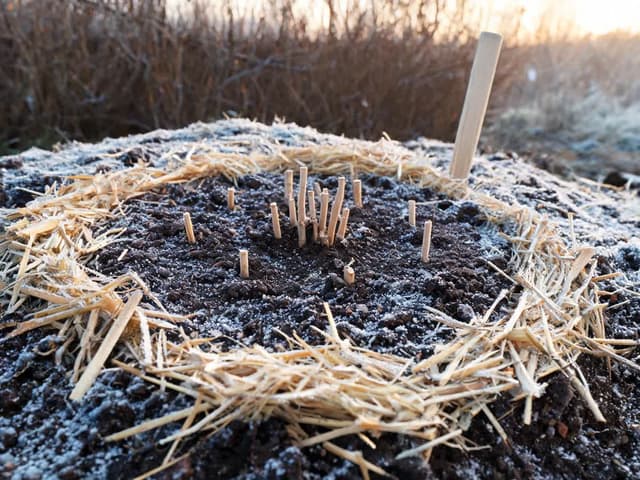
Peonies in Winter: Can They Handle Frost? Care by Type and in Pots
Peonies in winter: the herbaceous type tolerates lows of −15 to −20 °C, dies back above ground in winter and returns in spring, and tree peonies keep their branches. Cut dead foliage down to the ground, mulch the soil only in the first winter, protect the roots in pots, and cover the buds on frosty nights.
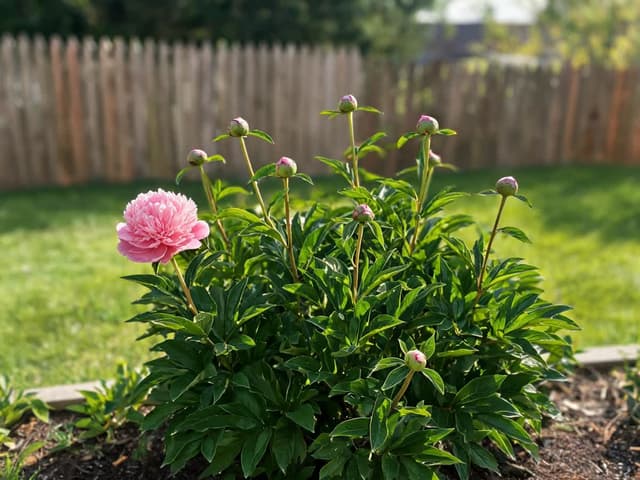
Peonies: How to Make Them Bloom and Why Buds Don't Open
Peonies: how to make them bloom. A peony that fails to bloom usually has buds buried too deep, too little sun, a warm winter, or is too young. Learn when it flowers, how long it takes to produce its first bloom, and how to identify the cause from the plant's symptoms.
How to Take Care of Peonies: Cold, Shallow Planting, Sun and Blooms
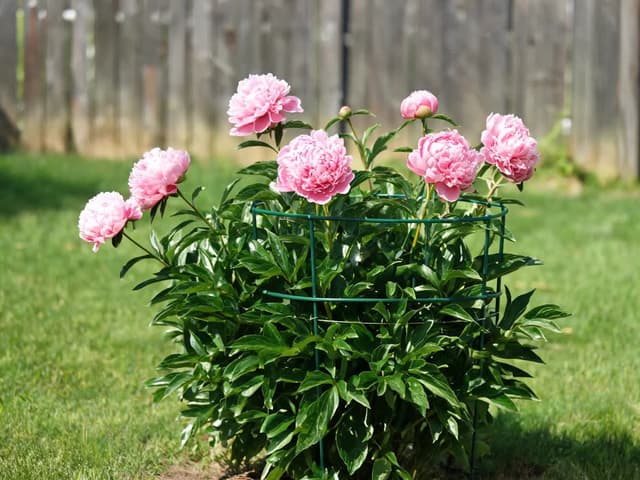
How to take care of peonies, from planting to bloom. They need full sun, buds (eyes) 1 to 2 inches below the surface, well-draining soil, and a cold winter to flower. See what changes for tree peonies, how to water, fertilize, stake, divide, and deal with powdery mildew and ants.