Azalea Yellow Leaves: What the Veins and Leaf Age Reveal
A yellow new leaf with green veins signals iron deficiency because the azalea's soil or water is no longer acidic enough. Old leaves yellowing after blooming is normal turnover. Yellow and wilted leaves with moist soil point to roots. Here is how to tell the causes apart and save the azalea.
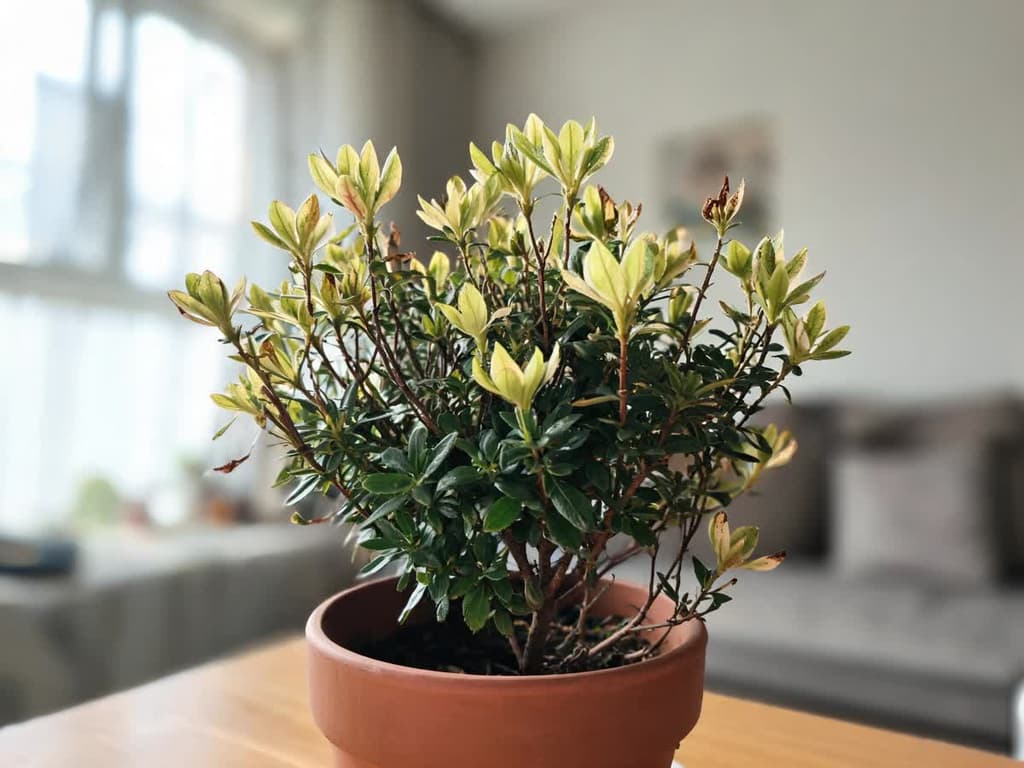
Azalea yellow leaves at the branch tips, with the veins still green, mean iron deficiency. Almost always, the iron is present in the soil, but the roots cannot absorb it because the soil or the irrigation water has become insufficiently acidic. This is the classic problem of the azalea (Rhododendron simsii), a plant that only thrives in acidic soil.
Two other situations also turn an azalea yellow and require different care. Older leaves deep inside the plant that gradually yellow after blooming are simply going through normal leaf turnover. In that case, the plant does not need anything. Yellow and wilted leaves paired with moist soil point to root problems. Both iron deficiency and diseased roots have solutions as long as the roots and branches remain alive.
Where and how it turned yellow: what each sign indicates on an azalea
Two observations distinguish the causes: the age of the leaf that turned yellow and the pattern of the yellowing (between the veins or across the whole leaf). A new leaf sits in the cluster at the tip of the branch. An old leaf is located lower down and further inside the plant. Check the underside of the leaf and the potting mix as well.
What you see | Probable cause | What to do first |
|---|---|---|
Yellow new leaf, green veins | Iron deficiency caused by high pH (insufficiently acidic soil) | Test soil pH with a kit and water only with rainwater |
Old leaf yellowing between the veins, with reddish-purple blotches | Magnesium deficiency | Epsom salt, at the label rate |
Old leaf entirely yellow | Nitrogen deficiency | Fertilizer for acid-loving plants, at half the label rate |
Old leaves inside the plant, green and firm branch tips, after blooming | Normal leaf turnover | Nothing |
Yellow and wilted leaf in the morning, moist soil | Diseased or waterlogged roots | Inspect the roots and the base of the stem |
Leaf stippled white on top, black dots on the underside | Azalea lace bug | Wash the undersides of the leaves with a stream of water |
Bronzed leaf, fine webbing on the underside, no black dots | Spider mites | Tap a branch over white paper to confirm |
Chlorosis is the technical term for leaf yellowing caused by a lack of chlorophyll, the green pigment. On an azalea, chlorosis on new leaves with green veins has a specific name: iron chlorosis, a shortage of iron.
Yellow new leaf with green veins: iron deficiency
The sign of iron deficiency is yellowing between the veins, with the veins remaining green, appearing first on the new leaves. The description comes from Purdue Extension, at Purdue University (USA). The University of Missouri adds that mature leaves, lower down, remain dark green. The same university states that gardeners often confuse this yellowing with nitrogen deficiency.
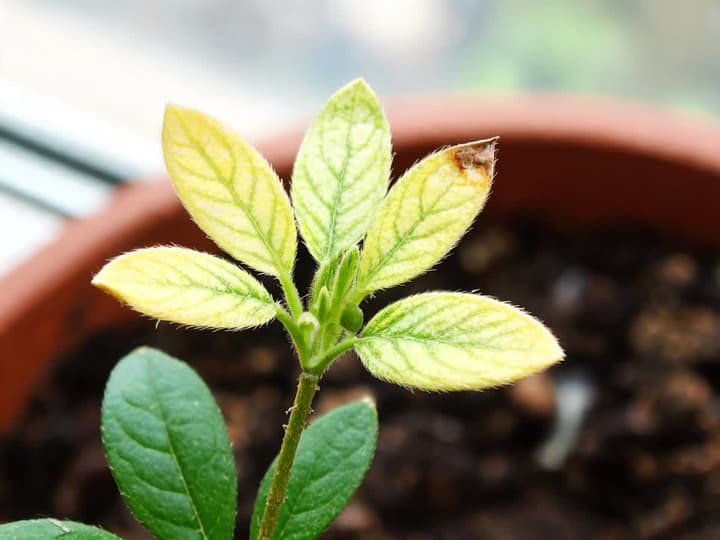
The University of Maryland explains that, with a pH above 6.5, iron remains in a form that the plant cannot use. It can be present in the soil in sufficient quantities and still be missing from the leaf. pH measures acidity: the lower the number, the more acidic the soil. UF/IFAS, the extension service of the University of Florida, indicates a pH between 5.0 and 5.5 as best for azaleas.
The sources do not provide the exact same range. The RHS, the British horticultural society, accepts 5.0 to 6.0, and Clemson University accepts 4.5 to 6.0. The UF/IFAS range fits within both, which is why this guide uses the narrower range.
When a yellow leaf begins to scorch along the margins
A nearly white leaf with a dry, brown tip or margin signals iron deficiency in an advanced stage. UF/IFAS describes this symptom in severe azalea cases. The plant can still recover if the roots are alive, though no source has measured this specifically in azaleas. The dry, brown portion of the leaf is dead and will not recover.
A brown margin on its own does not prove iron deficiency. The University of Maryland also links scorched margins to magnesium deficiency. Washington State University links them to excess fertilizer, too little or too much water, and dry winds. The indicator of iron deficiency remains green veins on a new leaf.
Why pH rises in a potted azalea
In pots, iron deficiency stems from three causes. These are tap water with high lime content, alkaline soil (the opposite of acidic), and excess fertilizer. The RHS points to all three as causes of yellow leaves in indoor azaleas. According to the RHS, hard water (water with high levels of dissolved lime) contains sodium bicarbonate, which is alkaline and toxic to the plant.
Alkaline irrigation water drives up the pH gradually. The University of Missouri notes that soil pH tends to rise over time when irrigation water is alkaline. Because of this, an azalea that stayed green for months can turn yellow without any visible shift in care.
In the garden, the University of Maryland and Rutgers University point out another common cause: azaleas planted near concrete walls, walkways, or foundations. Lime leaching from the concrete increases the surrounding soil's pH.
To find the pH, use a soil pH test kit sold at garden centers. The RHS recommends this simple test. Follow the kit's instructions: it indicates how much soil to mix and with how much water. Compare the color of the mixture with the chart on the packaging.
How to lower the pH and restore iron to the azalea
The long-lasting fix is lowering the pH. Applying iron without adjusting the pH provides only short-lived relief because the soil continues to lock up the iron. The correct steps depend on whether the azalea grows in a pot or in the garden.
In a pot:
Always water with rainwater, which is the option recommended by the RHS. Set a clean bucket outdoors to collect it.
If the kit reads a pH above 6.0, repot into a mix made for acid-loving plants. That is the upper limit accepted by both the RHS and Clemson. The packaging usually lists azaleas, camellias, and gardenias. The guide on how to care for azaleas details the soil mix and the right time to repot.
The University of Missouri recommends a mixture for potted azaleas with yellow leaves. Dissolve half a teaspoon of iron sulfate and half a teaspoon of ammonium sulfate in about 1 liter of rainwater. Water with this mixture every 2 to 3 weeks.
The University of Missouri does not state how long to continue this treatment. The RHS warns that excessive fertilizer also yellows an azalea, so stop once new leaves emerge green.
Chelated iron. This is iron in a form that roots absorb more easily. It is sold as a powder or liquid to apply to the soil at the label rate. Read the chemical name on the label. North Dakota State University (NDSU) focuses on trees and provides the limits for each type. EDTA chelate keeps iron available only at a pH up to 6.3, and EDDHA up to 9.0. With hard tap water, look for EDDHA on the label.
Foliar iron. Spraying iron directly onto foliage yields rapid and temporary results, according to Clemson University. Colorado State University cautions that the dose that greens up leaves is very close to the dose that burns them. Follow the label rate exactly and rely on the spray solely as a temporary aid while soil pH drops.
In the garden. The University of Missouri provides the timelines. Elemental sulfur takes 3 to 6 months to lower soil pH. Iron sulfate acts in 3 to 4 weeks. Ohio State University explains that sulfur depends on soil microorganisms and barely works in cold temperatures. Apply it in spring or summer.
Do not use aluminum sulfate, the compound used to turn hydrangeas blue. The University of Maryland cautions that azaleas are sensitive to aluminum accumulation in the soil.
Will yellow leaves turn green again?
No extension source has measured whether yellow leaves turn green again on azaleas. On trees, NDSU documented that foliar iron sprays restore green color to treated leaves within roughly 2 weeks. Leaves that develop later tend to emerge yellow again if the pH remains elevated. The true sign that the treatment worked is when new growth emerges fully green.
Old leaves turning yellow after flowering: normal shed
It is normal for azaleas to turn yellow and gradually drop older leaves, even though they keep foliage year-round. Clemson University notes that older azalea leaves turn yellow or purplish in early fall. In Brazil, the beginning of fall falls in March and April.
For potted azaleas, the timing is different. The RHS notes that it sheds a portion of its older leaves every year in spring and summer. In Brazil, this runs from September to March, the local spring and summer.
Normal turnover involves three symptoms occurring simultaneously:
the yellow leaves sit lower on the branches and toward the interior of the plant;
the leaves at branch tips stay green and firm;
the yellow leaves drop on their own, without clinging to the branch.
If dead leaves cling to the branch without falling, the cause is different. Washington State University includes dead leaves that fail to drop among the symptoms of root rot.
Entirely yellow older leaf: nitrogen or magnesium
An older leaf yellowing uniformly points to nitrogen deficiency. UF/IFAS describes this yellowing as uniform, most pronounced on the oldest leaves. In the same publication, UF/IFAS notes that nitrogen deficiency is rare in garden shrubs.
An older leaf yellowing between the veins indicates magnesium deficiency. The University of Missouri notes that magnesium deficiency begins on older foliage and then moves upward toward new growth. The University of Maryland adds reddish-purple blotches and brown margins to the symptoms.
For nitrogen deficiency, apply an acid-plant fertilizer during spring and summer. The RHS recommends half the label rate for potted azaleas. For magnesium deficiency, the University of Maryland recommends Epsom salt (magnesium sulfate) at the label rate. The fertilization calendar appears in the guide on how to care for azaleas. To compare this symptom across other species, the guide on yellow leaves on plants outlines nutrient deficiencies based on leaf position.
Yellow, wilting leaves with moist soil: root rot
Yellow, wilted, and curled leaves, with the potting soil still moist, are the sign of a diseased root. The most serious cause is root rot from Phytophthora, a soil microorganism that attacks waterlogged roots. Iowa State University describes drooping, curled, dull, and wilted leaves, and states that the disease is favored by continuously wet soil.
The time of day when the leaf wilts shows whether the cause is a diseased root or a lack of water. Rutgers University explains that a leaf wilted from a diseased root remains wilted early in the morning. A leaf wilted from heat or dry soil recovers overnight.
To confirm the diagnosis, run two tests:
Base of the stem. Scrape away a tiny section of bark at the soil line. Iowa State University describes a sharp boundary in diseased plants between healthy, light-colored tissue and brown, diseased tissue.
Roots. Slide the plant out of its pot and pull a fine root gently between two fingers. According to UF/IFAS, the outer cortex slips right off rotted roots, exposing only the white central core.
If the majority of the roots are firm and pale, repot into fresh mix formulated for acid-loving plants. Iowa State University suggests a mix rich in bark (such as pine bark) or lime-free sand. This medium drains much better than straight peat moss. Peat is the dark organic component found in standard bagged potting mixes that retains high amounts of moisture. Water when the soil surface feels dry to the touch, without letting the root ball dry out completely. Empty the drip tray immediately after watering.
If most of the roots are mushy and dark, the azalea is unlikely to recover. UF/IFAS considers an approved fungicide an option only if the disease is caught early and overwatering is resolved. Iowa State University and the University of Maryland maintain that fungicides will not cure a plant that already shows symptoms. Because an azalea displaying yellow, wilted leaves is already symptomatic, this guide follows those two sources and does not recommend fungicides. Iowa State University advises discarding severely infected plants along with their soil.
Gift azaleas that arrive in full bloom and drop foliage during the first few weeks suffer from different causes. These are a dry root ball (the mass of soil bound by the roots) and hot, dry indoor air. The guide on how to care for azaleas explains how to rehydrate a dry root ball using a bucket of water.
Scratch test: is the azalea still alive?
Before pruning the entire azalea, test the branches. The University of New Hampshire extension recommends lightly scratching the outer bark of the branch. Green under the bark indicates a living branch with a good chance of recovery. Brown underneath indicates a dead branch.
Perform the test on three or four branches, working from the tip toward the base. A branch with a brown tip might still be green further down. The same extension service advises pruning out only the branches that show zero signs of life once the plant resumes new growth.
Stippled foliage, not yellow: lace bugs and spider mites
Leaves covered in tiny white or yellowish specks, giving them a bleached look, indicate feeding damage from a pest sucking sap from the underside. The most frequent pest of this type on azaleas is the azalea lace bug (Stephanitis pyrioides). UF/IFAS describes it as an insect measuring 3 to 6 mm (1/8 to 1/4 inch) with clear, lace-like wings.
The lace bug occurs in Brazil. The first record in the country was published in 1997 in the journal Arquivos do Instituto Biológico. The pest appeared on azaleas in parks and gardens in the city of São Paulo.
To tell the lace bug apart from the spider mite (a tiny, eight-legged creature that also sucks leaf sap), turn the leaf over. NC State Extension, part of North Carolina State University, explains that the lace bug leaves black specks of excrement on the underside. Spider mites do not leave these specks. According to UF/IFAS, spider mites leave the upper leaf surface bronzed and produce a fine webbing on the underside. To confirm spider mites, UF/IFAS advises tapping a branch over a sheet of white paper and looking for specks that move.
Lace bug feeding starts on older leaves, according to the University of Maryland. According to UF/IFAS, infestations are more severe on azaleas grown in full sun. For lace bugs, UF/IFAS recommends knocking the insects off using a strong spray of water aimed at the leaf undersides. Any survivors will continue feeding, so repeat the spraying and inspect the undersides weekly.
Frequently asked questions
Can I add vinegar to an azalea's watering can?
Missouri Botanical Garden suggests 1 tablespoon of vinegar per gallon of water (3.8 liters) specifically for tap water in the St. Louis area. No other university extension source consulted recommends vinegar. Rainwater, as advised by the RHS, remains the safest option for potted azaleas.
Does standard plant food help an azalea with yellow leaves?
Standard plant food will not correct yellowing on new leaves with green veins because the problem is soil pH, not an overall nutrient shortage. According to the RHS, excess fertilizer can also turn an azalea yellow. Use a fertilizer formulated specifically for acid-loving plants at a low application rate. To combat high pH, use rainwater and an acidic potting mix.
Should I cut off the yellow leaves on my azalea?
There is no need. During normal leaf shedding, the yellow leaves fall off naturally. In cases of iron deficiency, stripping yellow foliage does not resolve the root cause: lowering the soil pH is what allows new foliage to grow green. Only prune away branches that test brown during the scratch test, and wait until the plant begins pushing new growth.
How long does an azalea take to turn green again?
No university extension source has documented this timeline specifically for azaleas. The true indicator that the treatment worked is when new foliage emerges green. For potted plants, after switching your water source and repotting, watch the next flush of leaves at the branch tips. When iron is applied, yellow leaves that have not completely dried out may also re-green, according to NDSU trials on trees. In garden beds, sulfur requires 3 to 6 months to lower soil pH, according to the University of Missouri.
The first step with your azalea
Begin by examining the foliage. New leaves yellow with green veins: check the soil pH and switch exclusively to rainwater. Older leaves inside the canopy yellowing while branch tips stay green after flowering: be patient. Foliage wilted in the morning while soil is damp: unpot the plant and inspect its root system today.
The azalea with yellow leaves page on Bloom gathers other potential causes, from scale insects to leaf spots, along with treatments for each. When your symptoms go beyond yellowing, the guide on what's wrong with my plant categorizes common plant problems for any container. If you are still unsure, the photo diagnosis feature in Bloom (Premium subscription, iPhone app) compares your leaf against symptom profiles for each specific cause.
Related articles
How to Care for a Goldfish Plant: Light, Watering, and Blooms
How to care for a goldfish plant: bright light without strong sun, water when the soil surface dries, and humid air. Learn how to tell a Nematanthus from a Columnea, why it drops leaves, and how to get it to bloom again.
Lavender Leaves Turning Yellow: Where the Yellowing Starts Shows the Cause
Lower leaves turning yellow with moist soil means overwatered roots, the most common cause. Old leaves drying one by one on woody stems is normal. Take the stem and root test, see if your plant can still be saved, and find out what to do today.
How to Propagate Lavender: Where to Cut and Why Cuttings Rot
A lavender cutting comes from a non-flowering branch tip, about 4 inches long, planted in sandy soil that never stays soggy. Learn where to cut, rooting times, seasonality in Brazil, and what to do if the base turns black.