Agapanthus Care: Sun, Watering, Winter Protection, and Spent Stems
How to care for agapanthus: 6 or more hours of direct sun, well-draining soil, watering based on the soil and season, fertilizer only in pots, and winter care by plant type. Learn what to do with spent stems and yellowing or soft leaves.
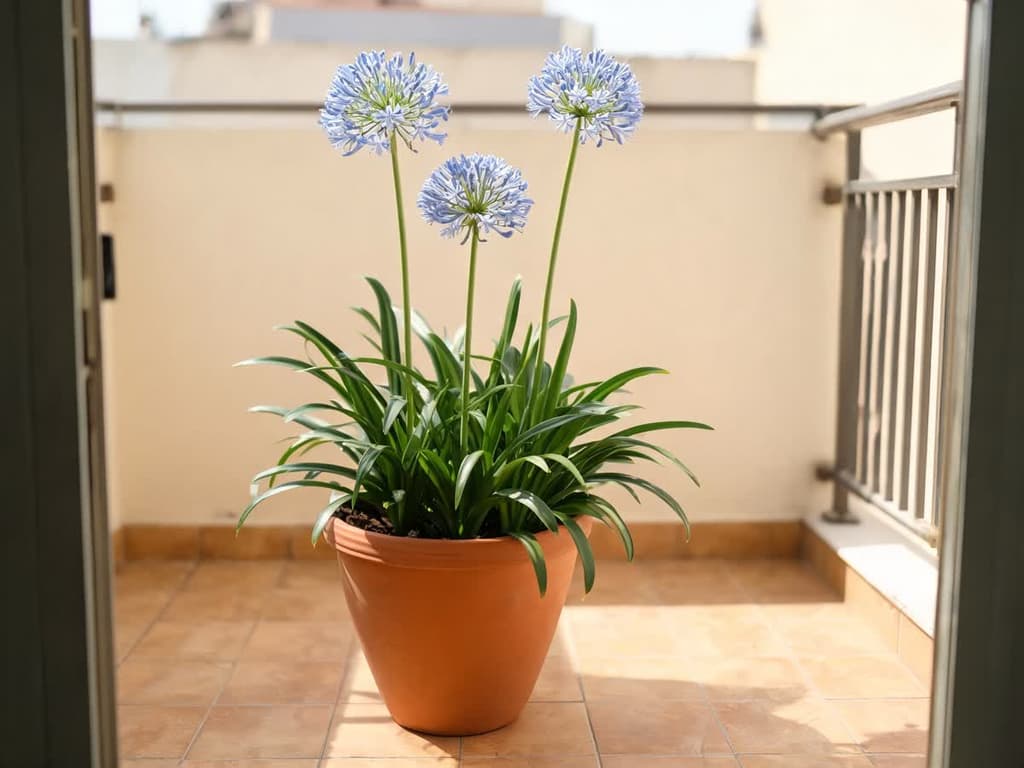
To care for agapanthus, plant it where it gets 6 hours or more of direct sunlight, in soil that drains well. Water according to the soil and the season, not by a calendar. In pots, fertilize from spring to fall. In winter, care depends on the type of agapanthus: evergreen types suffer from frost, while deciduous types tolerate more cold.
Agapanthus (genus Agapanthus) comes from southern Africa and forms clumps of long, strap-shaped leaves. The blue, purple, or white flowers emerge together in a spherical cluster atop a leafless stem. The plant grows from rhizomes, which are thick, fleshy underground stems.
How to care for agapanthus: quick guide
Care | What to do |
|---|---|
Light | Direct sun for 6 hours or more; in shade, it blooms poorly |
Soil | Well-draining; pot at least 20 cm (8 inches) in diameter, with a drainage hole |
Watering | In pots, water when the top 2 cm (about 1 inch) of soil dries out; in garden beds, mature plants need little water; during winter dormancy, almost none |
Fertilizer | In pots, liquid fertilizer from spring to fall at the label rate; in garden beds, generally not needed |
Cold | Evergreen types suffer from frost; deciduous types tolerate more cold |
Spent stems | Cut back to the base after flowering, or keep seed heads for winter interest |
Pot | Repot into a container 2.5 to 5 cm (1 to 2 inches) larger on each side every 2 to 3 years |
Pets | NC State rates it as having low toxicity to humans and does not evaluate cats and dogs; the sap irritates skin and eyes |
The care summary below covers Agapanthus praecox, the evergreen agapanthus. The watering frequency shown is an average: in a pot, dry soil determines when to water.
Evergreen or deciduous: which type of agapanthus do you have
There are two types of agapanthus, and cold care differs between them. The evergreen type keeps its leaves year-round, like Agapanthus praecox, according to NC State. The deciduous type loses its leaves in the fall. According to the RHS, the British horticultural society, the deciduous type is the most cold-hardy, and many evergreen varieties need protection.
To find out which type you have, watch the plant during its first winter. If the leaves remain green, the agapanthus is evergreen. If the foliage turns yellow, dries out, and disappears in the fall, it is deciduous, and that yellowing is not a disease.
Agapanthus is sometimes confused with hydrangea because both plants produce spherical clusters of blue flowers. Hydrangeas are woody shrubs with broad, oval leaves along the branches. In agapanthus, the leaves are narrow and emerge directly from the ground, with each flower head sitting atop a single leafless stalk. If you still have doubts, Bloom (available for iOS) identifies the plant from a photo.
Where to plant agapanthus: light and soil
Agapanthus needs full sun, which means 6 hours or more of direct sun per day, according to the NC State Extension. The RHS warns that it flowers less in the shade. NC State notes that the plant leans toward the sun, so choose the sunniest side. In Brazil, that is the north-facing side.
Severe heat also marks the leaves. According to the LSU AgCenter, an extension of Louisiana State University, agapanthus does not like temperatures above 32 °C (90 °F). On those days, the tips of the leaves turn yellow and then brown. The plant recovers on its own, and damaged leaves can be trimmed off.
The soil must drain freely. NC State recommends fertile, well-drained soil and lists root rot as a consequence of waterlogged conditions. When growing in containers, use high-quality potting mix and a pot at least 20 to 23 cm (8 to 9 inches) across, as recommended by the RHS. The container must have a drainage hole at the bottom.
A drainage layer of gravel at the bottom of the pot does not replace the drainage hole. Regarding the layer itself, published evidence is mixed. A paper from Washington State University states that it impedes water movement. A 2025 experiment in PLOS ONE measured the opposite, but without a plant growing in the pot. The 2025 study did not include a plant in the pot. Therefore, the safest option is to avoid using a gravel layer, keep the drainage hole clear, and never let the pot sit in standing water in a saucer.
To plant a bare-root rhizome, cover the crown with soil. NC State recommends 2.5 cm (1 inch) of soil over the rhizome, while the RHS recommends 5 cm (2 inches). In regions that get frost, go with the 5 cm (2-inch) depth. Potted nursery starts should be planted at the same depth they were growing in their container.
How to water agapanthus
In pots, water agapanthus when the top 2 cm (about 1 inch) of soil feels dry to the touch. Water thoroughly until moisture runs out the drainage hole, and empty the drip saucer afterward. According to the RHS, potted agapanthus must never dry out completely from summer to early fall. That is when the plant develops its flower buds for the following year, and water stress interferes with bud formation.
In garden beds, mature agapanthus needs little water, according to the RHS. An established bed only requires extra watering at the end of a very dry summer. Agapanthus planted less than a year ago is still developing roots: water whenever the soil dries out on the surface.
In winter, agapanthus enters dormancy, the phase when the plant stops growing, and watering drops to almost zero. UF/IFAS, the extension service of the University of Florida, where winters are mild as in much of Brazil, recommends light watering from spring to fall. During dormancy, UF/IFAS instructs not to water. For pots, none of the sources in this guide state how much to water during this phase. The safest option is to water sparingly, only when the soil is completely dry.
Fertilizer for agapanthus
Potted agapanthus benefits from regular feeding because the root system has a limited volume of soil to draw nutrients from. The RHS recommends feeding with liquid fertilizer throughout the growing season, which it defines as spanning from spring to autumn. Follow the label for application rates and intervals. Do not fertilize in winter.
In garden beds, agapanthus generally requires no fertilizer. The RHS only recommends fertilizing potted plants. UF/IFAS points to soil rich in organic matter as a key factor that encourages flowering. To improve garden beds, incorporate organic compost into the soil at planting time.
Too much fertilizer causes mineral salts to accumulate in the potting soil, forming a white crust. The guide on fertilizing houseplants explains how to read labels, dilute correctly, and flush out accumulated salts.
Spent agapanthus stems: cut back or keep
You can prune off spent stems or leave them on the plant: both choices are safe. The RHS recommends cutting each stem back to the base when the flowers fade, as this prolongs the blooming period. At the same time, the RHS notes that you can leave the seed pods intact to provide visual interest in the garden through early winter.
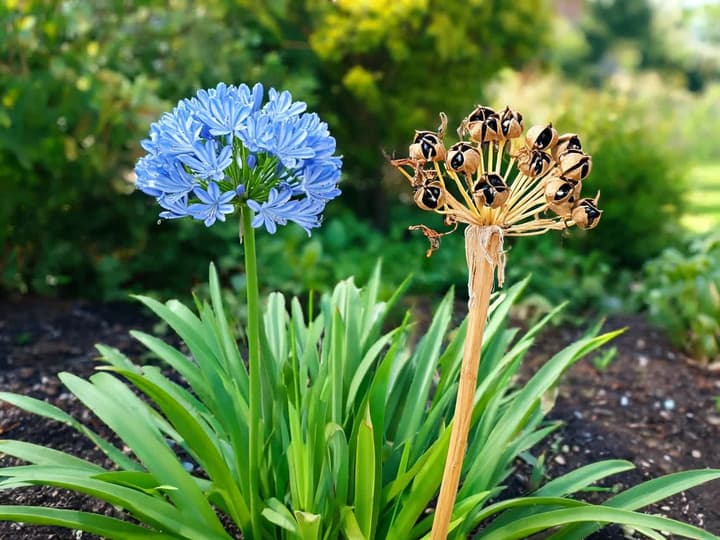
Leaving seed heads simply to collect seed rarely yields the results you expect. According to the RHS, plants grown from seed differ from the parent plant. According to NC State, a seedling can take up to 5 years to produce its first bloom. To grow more plants identical to yours, divide the clump instead.
Do not cut green leaves. For evergreen agapanthus, the RHS states that only damaged or unsightly leaves should be removed, which can be done at any time. For deciduous varieties, clear away the foliage in autumn once it has completely turned yellow and dried out.
Agapanthus in winter: caring for plants in the cold
Where there is no frost, agapanthus spends the winter outdoors, and watering is what changes the most. In Brazil, winter runs from June to August, and frost is concentrated in the South and in mountain regions. It is in these places that agapanthus needs protection.
In frost-prone garden beds, the RHS recommends mulching the clump with a layer of straw, bark, or compost over the soil. Aim for a thickness of 15 to 23 cm (6 to 9 inches). Apply the mulch in late autumn and remove it in early spring before fresh shoots emerge.
In pots, the roots suffer the most. According to UC ANR, the University of California Extension, a potted plant is surrounded by cold air on all sides. On frosty nights, move the pot to a sheltered, bright, unheated spot, such as a covered porch. If no sheltered place is available, wrap the pot in bubble wrap or burlap. Leafless deciduous agapanthus can spend the winter in a cool, dark place above 32 °F (0 °C), according to NC State.
The RHS does not prescribe a specific wintering temperature for sheltered plants. It calls for a bright, frost-free location protected from winter rain. The RHS also notes that an overly warm winter can cause flowers to open prematurely and bloom weakly.
Yellow or soft agapanthus leaves
Yellow or mushy agapanthus leaves usually stem from five common causes, each showing distinctive symptoms. Before repotting or altering your watering routine, check where the leaf discoloration begins and feel the base of the plant.
Soft base and waterlogged soil: indicates root rot caused by excessively wet growing medium (NC State). Stop watering immediately and verify that the pot's drainage holes are clear.
Yellow tips turning brown after days above 32 °C (90 °F): indicates heat stress, from which the plant recovers naturally (LSU AgCenter).
All leaves turning yellow in autumn on a deciduous agapanthus: indicates normal seasonal dormancy and requires no corrective action (RHS).
Soft, translucent, black, or brown leaves immediately following a frost: indicate cold damage. UC ANR advises waiting until spring to cut them, because the damaged foliage protects new growth.
Brown spots with gray mold in cool and damp weather: can indicate botrytis, a fungus on NC State's agapanthus disease list.
If leaves turn soft after freezing temperatures while the base of the crown remains firm, the plant can push out new growth in spring. Wait until the weather warms before taking action. If the crown feels mushy and gives off a foul odor, the rhizome is actively rotting. In that scenario, unpot the plant, cut away all rotting tissue from the rhizome, and replant the healthy portion in fresh, well-draining potting soil. Resume watering only when the top inch of soil feels dry.
Yellow leaves on other houseplants stem from similar underlying causes. The guide on yellow leaves helps diagnose whether the cause is overwatering, low light, or nutrient deficiencies based on where the yellowing appears on the leaf.
Repotting, dividing, and sizing containers for agapanthus
Agapanthus flowers poorly in containers that are excessively large as well as those that are overly tight, according to the RHS. NC State notes that potted agapanthus blooms best when its roots are slightly crowded. UF/IFAS reports that the plant flowers most profusely when grown in dense, undisturbed clumps. The RHS partially qualifies this, noting that severely pot-bound roots can also restrict blooming. A general rule from the RHS reconciles these perspectives: move up to a pot 2.5 to 5 cm (1 to 2 inches) larger on each side every 2 to 3 years. This keeps the root system snug without letting it become completely rootbound.
Repot your plant when roots begin creeping out through the drainage holes or start distorting the container. Once sizing up to a larger pot becomes unmanageable, divide the clump. Always wear gloves during the process, as the sap causes skin irritation.
To divide, remove the plant from the pot and cut the rhizome with a sharp knife or spade, leaving leaves and roots on each section. Plant each section promptly, at the same depth as before. The RHS recommends early spring, which in Brazil runs from late September to October. UF/IFAS, writing for Florida's mild climate, divides in the fall, which in Brazil runs from March to May. Where there is no frost, follow UF/IFAS, which is a university extension service. Where there is frost, follow the RHS and divide in spring.
Divided plants may skip blooming during their first year, according to NC State. UF/IFAS highlights that agapanthus blooms most abundantly in thick, undisturbed clumps. Avoid dividing your plants frequently purely for propagation purposes.
Why agapanthus fails to bloom
According to the RHS, agapanthus fails to produce flowers due to deep shade, unshielded cold, or overly warm winter conditions. Flowering also suffers in oversized containers, severely cramped pots, or clumps divided too frequently. For potted plants, dry soil during late summer directly impairs flower bud development for the upcoming year. UF/IFAS notes that agapanthus typically requires 2 to 3 years after planting to achieve peak flowering performance.
Agapanthus pests and diseases
NC State lists aphids, scale insects, spider mites, mealybugs, and slugs among common agapanthus pests. Among diseases, it identifies botrytis blight, root rot, and powdery mildew, which coats foliage in a white powder. Slugs and snails feed on tender new foliage at night, leaving telltale silvery trails behind. The guide on slugs on plants details how to remove them without synthetic poisons. Scale insects look like tiny raised shells clinging to leaves, and our guide on scale insects outlines how to treat them.
Botrytis blight presents as brown blotches that develop fuzzy gray mold in cold, damp weather. Trim away affected leaves and increase air circulation around the clump.
Is agapanthus toxic to pets?
NC State classifies agapanthus as a low-toxicity plant for humans and provides no data on dogs and cats. The sap irritates the skin and eyes, and chewing the plant irritates the mouth and can cause sores. The ASPCA, the American animal poison control center, has no listing for agapanthus. Without an ASPCA listing, it is not possible to state that the plant is safe for dogs and cats.
As a precaution, keep potted agapanthus away from dogs and cats that tend to chew on greenery. If your pet consumes foliage or rhizomes and shows signs of distress, contact a veterinarian immediately. The guide on toxic plants for pets outlines other common houseplants and their respective risks.
Frequently asked questions
When does agapanthus bloom in Brazil?
In Brazil, agapanthus blooms in late spring and summer. In Curitiba, a PUCPR study monitored the flowers from October 2004 to January 2005. According to the same study, each flower opens around 8 a.m. and lasts 5 to 7 days.
How long does agapanthus take to bloom?
Newly planted agapanthus takes 2 to 3 years to reach peak bloom, according to UF/IFAS. Divided clumps may not flower during their first year, according to NC State. Plants started from seed can take up to 5 years to produce their first flowers.
Can agapanthus be grown indoors?
Only during winter in regions subject to hard freezes. Agapanthus requires 6 hours or more of direct sunlight, and indoor light levels are insufficient to stimulate blooming. For this reason, NC State recommends bringing evergreen agapanthus indoors or into a greenhouse exclusively for the cold season.
What conditions harm agapanthus?
Agapanthus does not tolerate heavy shade, waterlogged soil, or excessively large pots. When grown in containers, it also suffers if allowed to dry out from summer to early autumn, when next season's flower buds form. Evergreen types are easily damaged by frost, while deciduous varieties tolerate significantly more cold.
Summary of agapanthus care
Agapanthus requires 6 hours or more of direct sun, well-draining soil, and containers equipped with drainage holes. In pots, water whenever the top 2 cm (about 1 inch) of soil dries out, and feed from spring through autumn. In garden beds, established plants need minimal watering and generally no supplemental fertilizer. Cut back spent flower stalks at the base or leave seed heads in place, and never trim away healthy green leaves. Where frost occurs, provide winter shelter for evergreen varieties and potted plants.
Related articles
How to Care for a Prayer Plant: Light, Water, Humidity, and Closing Leaves
To care for a prayer plant, provide bright indirect light, keep the soil moist without waterlogging, and maintain air humidity above 50%. Water with fluoride-free water. Leaves that rise and fold at night are the plant's normal movement.
Peonies in Winter: Can They Handle Frost? Care by Type and in Pots
Peonies in winter: the herbaceous type tolerates lows of −15 to −20 °C, dies back above ground in winter and returns in spring, and tree peonies keep their branches. Cut dead foliage down to the ground, mulch the soil only in the first winter, protect the roots in pots, and cover the buds on frosty nights.
Peonies: How to Make Them Bloom and Why Buds Don't Open
Peonies: how to make them bloom. A peony that fails to bloom usually has buds buried too deep, too little sun, a warm winter, or is too young. Learn when it flowers, how long it takes to produce its first bloom, and how to identify the cause from the plant's symptoms.