Complete Plant Guide
Explore plants by difficulty, season and more. Find the perfect plant for you.
Difficulty
Categories
Plants by City
🗺️ Plants by City3798 plants found
Showing 2233-2268 of 3798
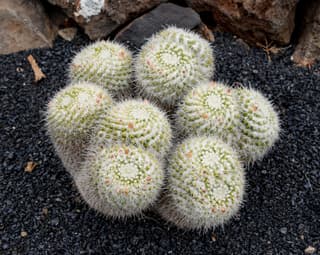
Royal Cross
Mammillaria karwinskiana
Mammillaria karwinskiana is a globular cactus native to south-central Mexico (Oaxaca, Puebla, Chiapas, Morelos, Guerrero, Michoacán and Colima) and Guatemala, growing wild in tropical deciduous forest and xerophilous scrub between 150 and 2,100 m elevation. It forms a solitary or basally branching stem, globose to short-cylindrical, up to 20 cm tall and 12 cm in diameter, with areoles bearing six pale radial spines with brown tips and no central spines. In spring it produces funnel-shaped, cream-to-yellow flowers with purplish midveins that open in a ring near the growing tip, giving rise to the common name "Royal Cross". The species is rated Least Concern by the IUCN and includes four recognized subspecies.
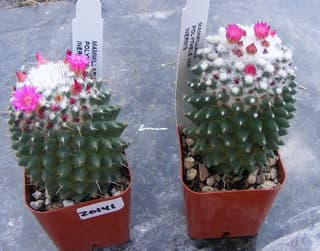
Mammillaria polythele
Mammillaria polythele
Mammillaria polythele is a solitary, cylindrical cactus native to the highlands of central Mexico, from Jalisco to Veracruz, where it grows among rocky desert and dry shrubland at 1,700-2,400 m elevation. Its dark green to bluish-green stem can reach up to 60 cm tall and 10 cm in diameter, densely covered in pyramidal tubercles tipped with spine clusters and woolly axils. In spring and summer it produces a ring of small deep pink to magenta flowers near the crown.

Rat-tail Nipple Cactus
Mammillaria pottsii
Mammillaria pottsii is a small, clustering cactus native to the Chihuahuan Desert of northern Mexico and the Big Bend region of West Texas. It forms clumps of slender cylindrical stems up to about 30 cm tall, covered in tubercles and fine white spines. Small pink to red flowers appear from late winter to spring, followed by red berries.
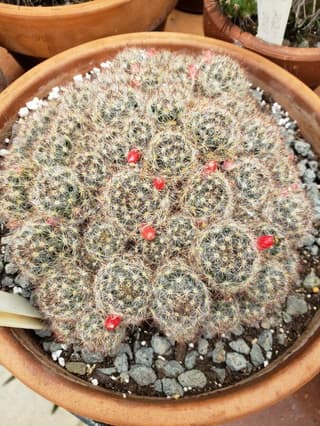
Little Candles
Mammillaria prolifera
Mammillaria prolifera is a small, clustering globular cactus native to Mexico, Texas, Cuba, the Dominican Republic, and Haiti. It readily produces offsets around the mother plant, forming dense cushion-like colonies covered in fine, hair-like spines. In spring and summer it produces small yellowish-white, cream, or pinkish-yellow flowers around the crown. It is a slow-growing, drought-tolerant, and easy-care cactus, well suited for beginners.
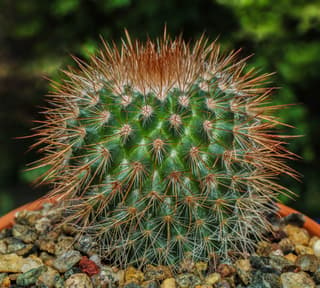
Spiny Pincushion Cactus
Mammillaria spinosissima
Mammillaria spinosissima, the Spiny Pincushion Cactus, is a cylindrical cactus endemic to the states of Guerrero and Morelos in central Mexico. It thrives at elevations between 1,600 and 1,900 meters in dry tropical forests and xerophilous scrub. It is celebrated for its dense bristly red-brown spines and rings of carmine-pink flowers that appear in spring.
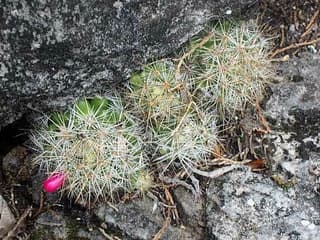
Golden Stars Cactus
Mammillaria vetula
Mammillaria vetula is a small, clustering cactus native to central Mexico (Hidalgo, Guanajuato and Queretaro), prized in cultivation as the popular subspecies gracilis. It forms dense mounds of cylindrical, bluish-green stems covered in fine white radial spines, topped in spring and summer with tiny pale-yellow, funnel-shaped flowers. It readily produces offsets that detach easily, making it one of the easiest cacti to propagate and share.
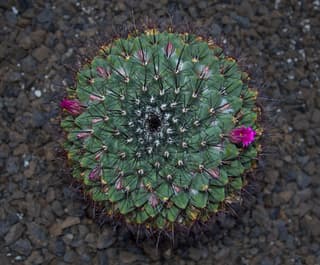
Saltillo Pincushion Cactus
Mammillaria winterae
The Saltillo pincushion cactus (Mammillaria winterae) is a slow-growing, globular cactus native to the mountains of Nuevo León and Coahuila, Mexico, where it grows among limestone rocks at high elevation. It typically has a solitary, flattened stem covered in radial spines and produces yellowish-white or greenish-yellow flowers in spring.
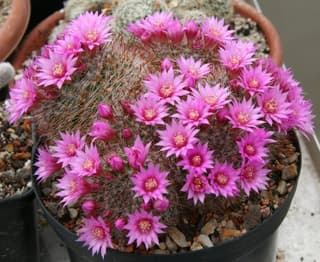
Rose Pincushion Cactus
Mammillaria zeilmanniana
Mammillaria zeilmanniana, commonly known as the Rose Pincushion Cactus, is a small, clustering cactus native to central Mexico. It forms compact, globular stems covered in dense, hooked white-to-yellow spines and produces abundant rosy-purple flowers in spring and summer. Popular as a compact houseplant, it is prized for its easy care and prolific blooming even in small pots.
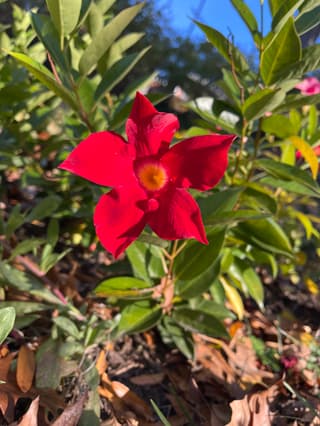
Mandevilla
Mandevilla
Mandevilla is a genus of tropical flowering vines in the Apocynaceae family, native to Central and South America. Species such as Mandevilla sanderi are widely grown for their glossy evergreen foliage and abundant trumpet-shaped flowers that bloom from late spring through fall on trellises, fences, and in hanging baskets.

White Rock Trumpet
Mandevilla boliviensis
The White Rock Trumpet (Mandevilla boliviensis) is an evergreen woody vine in the Apocynaceae family, native to Bolivia and Ecuador. It produces white, funnel-shaped flowers with a bright yellow throat that appear nearly year-round in warm climates. It is widely grown to cover trellises, pergolas, and fences in tropical and subtropical gardens.
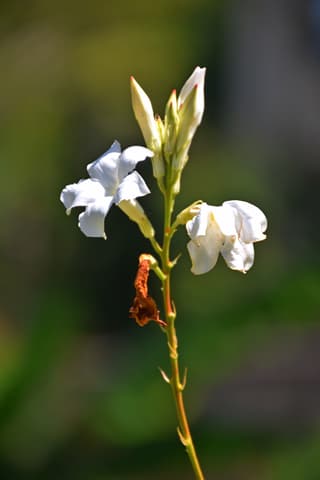
Chilean Jasmine
Mandevilla laxa
Chilean Jasmine (Mandevilla laxa) is a vigorous deciduous twining vine native to Bolivia, northwestern Argentina, and Peru. It produces clusters of funnel-shaped, creamy-white flowers with an intense vanilla fragrance — especially noticeable in the evenings — throughout summer and into fall. The milky white sap can irritate skin on contact.
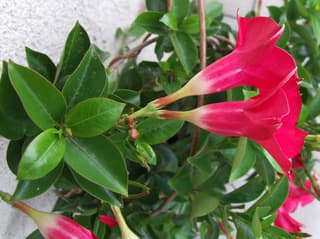
Mandevilla
Mandevilla sanderi
Mandevilla is a genus of tropical flowering vines in the Apocynaceae family, native to Central and South America. Species such as Mandevilla sanderi are widely grown for their glossy evergreen foliage and abundant trumpet-shaped flowers that bloom from late spring through fall on trellises, fences, and in hanging baskets.
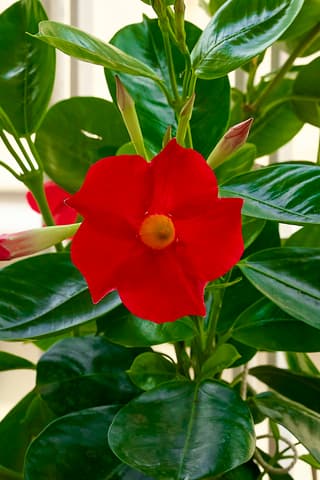
Mandevilla
Mandevilla splendens
Mandevilla splendens, widely sold in nurseries as Dipladenia, is a tropical evergreen twining vine in the Apocynaceae family, native to southeastern Brazil. Its trumpet-shaped, pale pink flowers deepen to rose as they age and bloom from spring through fall, attracting hummingbirds. The milky sap is mildly toxic and can irritate skin and eyes, so wear gloves when pruning.
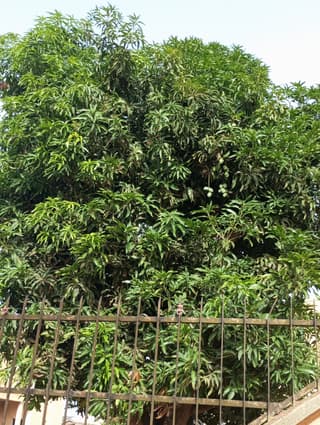
Mango Tree
Mangifera indica
The mango tree (Mangifera indica) is a tropical fruit tree native to South Asia, particularly India, where it has been cultivated for over 4,000 years. It belongs to the family Anacardiaceae and can reach up to 30 meters in height under ideal conditions. Widely regarded as the "King of Fruits," it holds immense cultural, economic, and culinary importance across the tropical world.

Cassava
Manihot esculenta
Cassava (Manihot esculenta) is a perennial shrub in the Euphorbiaceae family, native to South America and cultivated for millennia by indigenous peoples as an essential source of carbohydrates. It features deeply lobed palmate leaves, woody stems, and starchy tuberous roots that constitute the edible part of the plant. It is one of the most important food crops in the tropics, adapting well to poor soils and drought periods. Warning: all raw parts of the plant, especially the roots and leaves, contain cyanogenic glycosides and are toxic—they must only be consumed after being peeled and thoroughly cooked.

Hardy Manihot
Manihot grahamii
Hardy Manihot is a fast-growing shrub to small tree from the spurge family (Euphorbiaceae), native to southern Brazil, Uruguay, Paraguay, and Argentina. It is closely related to the edible cassava (Manihot esculenta), from which it differs primarily by its significantly higher cold tolerance. It features striking palmately lobed, deeply divided leaves and produces corymbs of waxy, reddish-streaked light green bell-shaped flowers in summer. In milder climates, it may die back to the ground in winter but quickly resprouts from its hardy root system in spring.
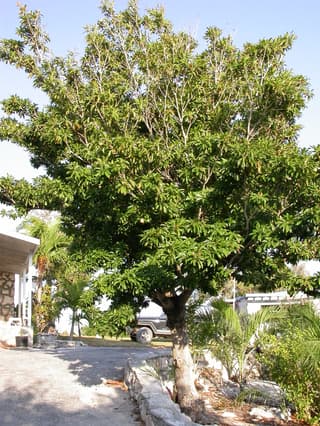
Sapodilla
Manilkara zapota
The sapodilla (Manilkara zapota) is an evergreen fruit tree in the Sapotaceae family, native to southern Mexico, the Yucatan, and Central America. In the wild, it can exceed 30 m in height, though cultivated specimens are usually kept between 9 and 15 m. Its foliage is dense and glossy dark green, its bell-shaped whitish flowers are inconspicuous, and its fruit—with sweet pulp and a grainy texture—is highly prized in tropical cuisine. Historically, the latex from its bark (chicle) was the basis for Mayan chewing gum.

Prayer Plant (genus)
Maranta
Maranta is a genus of tropical plants in the family Marantaceae, native to tropical Central and South America. Best known for M. leuconeura (the prayer plant), the genus is celebrated for its striking patterned foliage and the fascinating nyctinastic movement of folding leaves upward at night.

Arrowroot
Maranta arundinacea
Maranta arundinacea, commonly known as arrowroot, is a tropical rhizomatous perennial herb native to the West Indies, Central America, and northern South America. Grown both as an ornamental foliage plant and as a food crop, its starchy underground rhizomes are processed into a fine, easily digestible, gluten-free starch used in cooking and baking. The plant forms clumps of broad, glossy, mid-green oval leaves and produces small white flowers in spring and summer.

Prayer Plant
Maranta leuconeura
Maranta leuconeura is a tropical plant native to Brazilian rainforests, prized for its decorative leaves with unique colorful vein patterns. Its common name "Prayer Plant" comes from the nyctinastic movement of its leaves, which fold upward at night like hands in prayer and open during the day to absorb light.
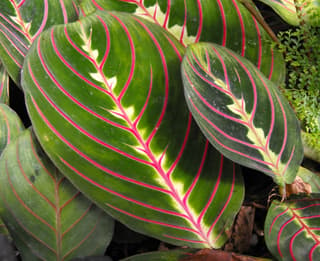
Red Prayer Plant
Maranta leuconeura var. erythroneura
The Red Prayer Plant (Maranta leuconeura var. erythroneura) is one of the most striking members of the Marantaceae family, native to the tropical rainforests of Brazil. Its deep green, herringbone-patterned leaves are laced with vivid red veins, making it a true living work of art. The nickname "prayer plant" comes from its daily leaf movement: the leaves open flat during the day to capture light and fold upward at night like praying hands, a phenomenon called nyctinasty.

Rabbit's Foot Prayer Plant
Maranta leuconeura var. kerchoveana
A tropical evergreen perennial from the Brazilian rainforest floor, prized for its velvety, oval leaves patterned with dark blotches resembling rabbit tracks along the midrib. Like all prayer plants, its leaves rise and fold together at night and lie flat again during the day, an unusual light-driven behavior called nyctinasty.
Marasmius oreades
Marasmius oreades
Marasmius oreades, commonly known as the fairy ring mushroom, is a basidiomycete fungus that grows in lawns, forming characteristic circular rings. It has a small cap, 2 to 5 cm in diameter, with a color ranging from cream to pale tan. It is famous for its ability to completely desiccate during dry periods and 'revive' after rain, maintaining its structure and ability to release spores. It is an edible mushroom of excellent quality, with a sweet taste and an aroma reminiscent of almonds.

Common Liverwort
Marchantia polymorpha
Common Liverwort (Marchantia polymorpha) is a widespread bryophyte characterized by a flat, ribbon-like thallus that forms dense, green mats on moist, nutrient-rich soil. It is often the first plant to establish itself after fire or soil disturbance and is also used as an indicator of high soil moisture and poor drainage in nurseries and greenhouses. The species reproduces both sexually, via spores from umbrella-shaped reproductive organs (gametophores), and asexually, via gemmae formed in cup-like structures on the upper surface of the thallus.
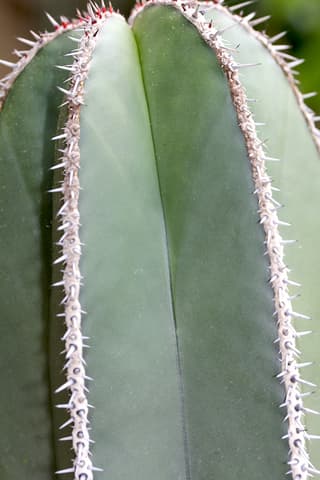
Mexican Fence Post Cactus
Marginatocereus marginatus
Marginatocereus marginatus, also known as Pachycereus marginatus, is a columnar cactus native to central Mexico. It forms erect, ribbed green stems about 7-10 cm thick that grow densely and parallel to each other, reaching over 6 meters in the wild with a slow growth rate. The spines are short and relatively harmless. In spring, reddish funnel-shaped flowers appear at the top of the stems—though these are rare on young potted specimens—followed by spherical fruits about 4 cm wide covered in spines and fuzz. In Mexico, cuttings are used to create living fences.

Condurango
Marsdenia
Marsdenia is a tropical genus of vines and shrubs in the family Apocynaceae, comprising around 69 species distributed across Asia, Africa, Australia, and the Americas. Best known is M. cundurango (condurango), a woody Andean vine used for centuries in traditional medicine. The genus produces fragrant tubular flowers and heart-shaped velvety leaves, making several species popular ornamentals.

Nardoo
Marsilea mutica
Marsilea mutica is an aquatic or semi-aquatic fern native to Australia and New Caledonia, naturally found in swamps and shallow freshwater. Its leaves resemble a four-leaf clover, featuring a yellowish-green variegated pattern with a reddish-brown arched band, and can either float on the water's surface or grow emergent above waterlogged substrate. It is a vigorous, fast-growing plant widely used in ponds, aquariums, and water gardens as a groundcover.

German Chamomile
Matricaria chamomilla
Matricaria chamomilla, known as German chamomile or common chamomile, is an annual herbaceous plant famous for its delicate daisy-like flowers and sweet, herbaceous aroma. It is one of the oldest and most widely used medicinal herbs by humanity, valued for its calming and digestive properties.
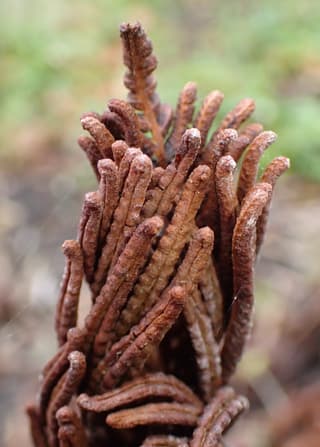
Ostrich fern
Matteuccia struthiopteris
Matteuccia struthiopteris (Ostrich fern) is a perennial, rhizomatous, and deciduous fern from the Onocleaceae family, native to temperate regions of the Northern Hemisphere (North America, Europe, Asia). It forms erect clumps of leek-green fronds arranged in a crown shape, resembling ostrich feathers, which can reach 3-5 feet (90-150 cm) in height in cultivation. It is frost-hardy (USDA zones 2-8) but requires partial to full shade and constantly moist soil rich in organic matter—it does not tolerate drought or strong sun exposure, which scorches its fronds. According to the ASPCA, the plant is non-toxic to cats, dogs, or humans. In spring, the young shoots ("fiddleheads") are harvested and consumed as a seasonal vegetable, but only after being thoroughly boiled.
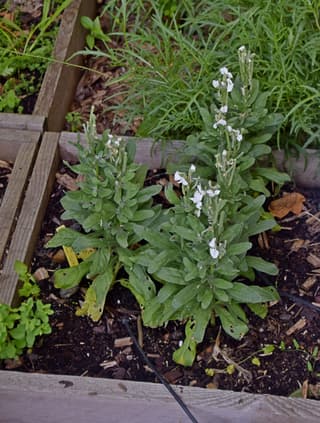
Stock
Matthiola
Matthiola, commonly known as stock or gillyflower, is a genus of flowering herbaceous plants in the Brassicaceae family, native to the Mediterranean region. Prized for their dense, fragrant flower spikes in shades of white, pink, purple, lavender and cream, they are widely grown as garden ornamentals and cut flowers, blooming from spring through summer.
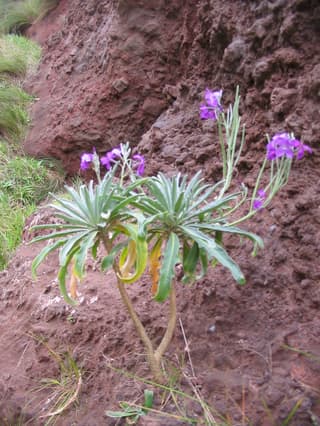
Stock Flower
Matthiola incana
Matthiola incana, commonly known as stock flower or hoary stock, is an ornamental plant from the Brassicaceae family, native to the Mediterranean region. Prized for its intensely fragrant flowers in shades of white, pink, lavender, purple, and red, it is widely grown in cottage gardens, borders, and as a cut flower. This biennial or short-lived perennial is typically treated as an annual, blooming in spring and early summer in cool, temperate climates.
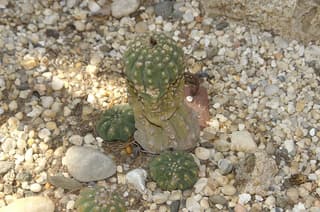
Madison Cactus
Matucana madisoniorum
Matucana madisoniorum is a small, solitary-growing, globular or slightly cylindrical cactus native to a very narrow range in the Amazon region of Peru, specifically the Marañón River valley, at elevations of only 400-1000 meters. Its grayish-green stem consists of 7-12 flat, wavy ribs, and its spination is highly variable: some individuals possess long, curved, dark brown spines, while others are completely spineless, making them easily confused with the peyote cactus (Lophophora williamsii). The funnel-shaped flowers blooming from the apical areoles are bright orange-red, or more rarely white, reaching 8-10 cm in length, and bloom in several waves during the summer. The species is listed as Critically Endangered by the International Union for Conservation of Nature (IUCN) due to habitat loss and over-collection.

Mini Marguerite
Mauranthemum paludosum
Mauranthemum paludosum, commonly known as Mini Marguerite or Creeping Daisy, is a compact, fast-growing annual native to the western Mediterranean region, including Spain, Morocco, Algeria, Tunisia, and the Balearic Islands. Belonging to the Asteraceae family, this charming dwarf plant reaches only 20–25 cm in height and produces an abundance of small, classic daisy flowers — white ray petals radiating around a bright yellow disc centre — that open and close in response to sunlight. It thrives in cool weather, making it a popular choice for fall and winter gardens in mild climates, and spring displays in cooler regions. Its low-spreading habit and prolific blooming make it ideal for borders, rock gardens, containers, and mass plantings.
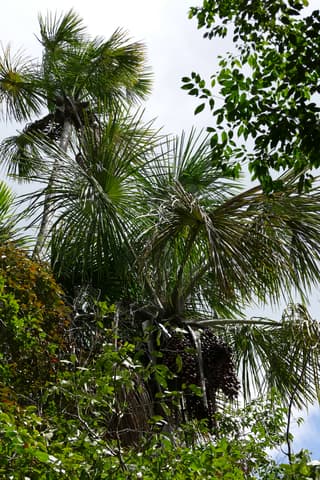
Moriche Palm
Mauritia flexuosa
The Moriche Palm (Mauritia flexuosa) is a majestic palm native to South America, particularly abundant in the wetland gallery forests (veredas) of the Brazilian Cerrado and throughout the Amazon basin. Known as the "Tree of Life" for its extraordinary utility, it can reach up to 25 meters in height and produces large, reddish-brown scaly fruits rich in beta-carotene. It is one of the most ecologically and culturally important palms of South America.
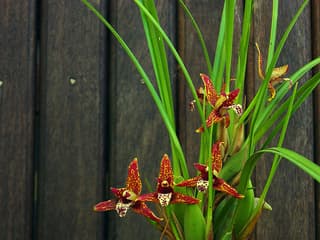
Maxillaria (genus)
Maxillaria
Maxillaria is a large genus of epiphytic Neotropical orchids in the family Orchidaceae, comprising hundreds of species from Mexico to South America. Prized for their solitary, often fragrant flowers, they grow naturally on tree trunks and branches in humid tropical forests.
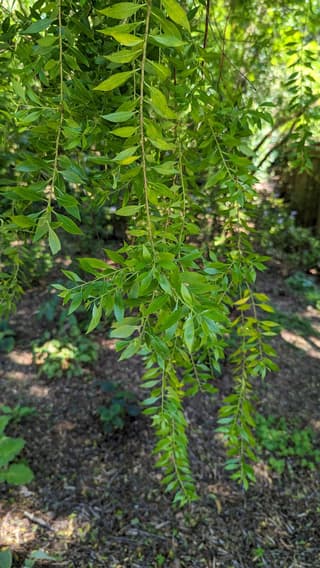
Maitén
Maytenus boaria
The Maitén (Maytenus boaria) is a tree native to Chile and Argentina, belonging to the Celastraceae family. It is an evergreen species with a dense, rounded canopy and somewhat drooping branches, reaching between 10 and 20 m in height in the wild. Its leaves are alternate, elliptical, 2 to 6 cm long, with finely serrated edges. It flowers between August and September with small yellowish-green flowers and produces capsules with seeds enclosed in a red aril. It grows wild in semi-arid transition zones and along riverbanks and streams, from sea level up to about 1600 m in altitude, and is considered a sacred tree by the Mapuche people.
Find the Perfect Plant
Our plant guide helps you find ideal species for your experience level and time of year.
Browse by Difficulty, Season & More
Use the filters below to narrow this catalog by care difficulty, season, environment, or search directly by name. Each filter leads to a focused list tailored to your specific growing conditions.