Complete Plant Guide
Explore plants by difficulty, season and more. Find the perfect plant for you.
Difficulty
Categories
Plants by City
🗺️ Plants by City4349 plants found
Showing 3925-3960 of 4349
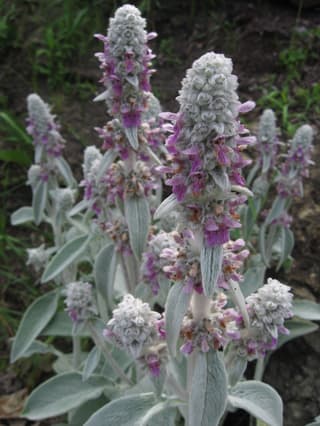
Lamb's Ear
Stachys
Lamb's Ear (Stachys byzantina) is a low-growing, mat-forming perennial in the mint family (Lamiaceae), celebrated for its striking silvery-white, densely woolly leaves that feel as soft as velvet. Native to Turkey, Armenia, and Iran, this hardy plant thrives in sunny, dry garden borders and is beloved in cottage gardens, sensory gardens, and water-wise landscapes. It produces upright spikes of small pink-purple flowers in late spring and summer, though it is primarily grown for its distinctive textured foliage.
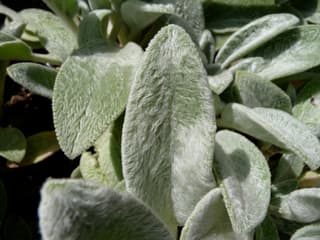
Lamb's Ear
Stachys byzantina
Stachys byzantina is a herbaceous perennial famous for its leaves densely covered in silky white hairs, which give it a velvety texture and a unique silvery color. Native to the Middle East, it forms dense, low mats, making it an excellent groundcover. In summer, it produces upright stems with small purple flowers, although it is primarily grown for its exotic foliage that resembles lamb's ears.
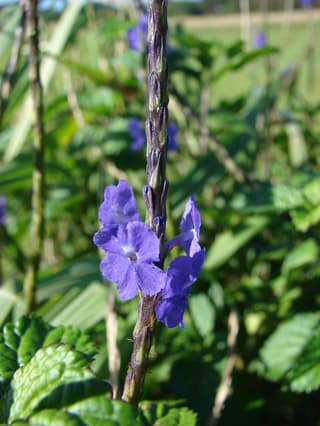
Blue Snakeweed
Stachytarpheta cayennensis
Blue Snakeweed (Stachytarpheta cayennensis) is a fast-growing tropical subshrub native to tropical America, belonging to the Verbenaceae family. It produces long, slender flower spikes adorned with vivid blue-purple tubular flowers that bloom successively over many months. A magnet for pollinators, it attracts over 98 butterfly species, bees, and hummingbirds. It is widely used as an ornamental garden plant and holds significant importance in traditional medicine throughout the tropics.
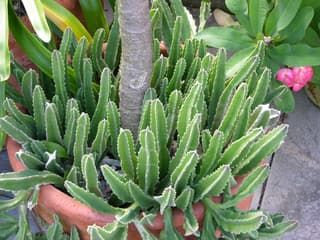
Zulu Giant
Stapelia gigantea
Stapelia gigantea, commonly known as the Zulu Giant or Carrion Flower, is a striking succulent native to South Africa. It produces enormous star-shaped flowers up to 30 cm across with a distinctive reddish-maroon and cream pattern. The flowers emit a carrion-like odor to attract flies for pollination. Its leafless, ribbed succulent stems grow in dense clumps and turn reddish-purple in bright sunlight.
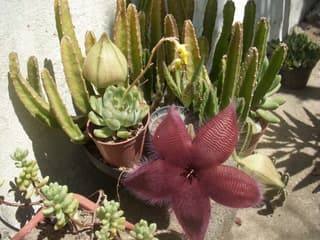
Starfish Flower
Stapelia grandiflora
Stapelia grandiflora, commonly known as the Starfish Flower or Carrion Plant, is a fascinating succulent native to South Africa. It produces striking star-shaped flowers up to 10 inches across, covered in fine hairs. The flowers emit a carrion scent to attract flies as pollinators, making it a remarkable botanical curiosity and a prized plant among succulent collectors.
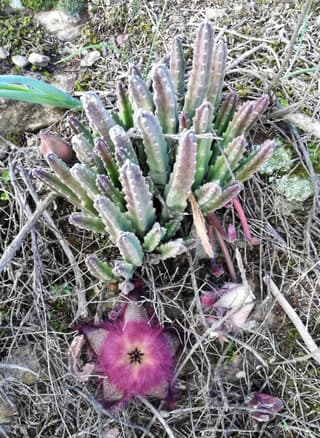
Starfish Flower
Stapelia hirsuta
Stapelia hirsuta is a striking South African succulent known for its velvety, four-angled stems and extraordinary star-shaped flowers that can reach up to 15 cm across. The flowers range from dark red to purple-brown and are covered in fine hairs, producing a foul odor to attract fly pollinators — a fascinating evolutionary adaptation. Native to the Cape Province of South Africa, it thrives in rocky, arid conditions and makes a rewarding houseplant for succulent enthusiasts.
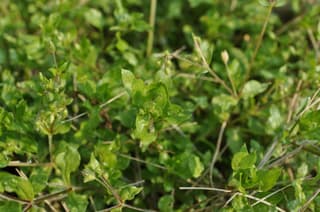
Common Chickweed
Stellaria
Stellaria is a genus of roughly 120 low-growing herbaceous plants in the carnation family (Caryophyllaceae), best known through its most common and widespread member, Stellaria media, or common chickweed. This sprawling, mat-forming annual produces tender oval leaves and tiny star-shaped white flowers (its genus name comes from the Latin "stella," meaning star). Chickweed thrives in cool, moist conditions and is one of the fastest-growing plants in temperate gardens, often flowering and setting seed within weeks of germination. It is naturalized nearly worldwide and is valued both as a nutritious wild edible and as a traditional skin-soothing herb, even though gardeners often treat it as a weed.
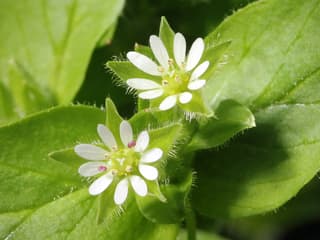
Chickweed
Stellaria media
Stellaria media, commonly called chickweed, is a low-growing, sprawling annual (or winter annual) native to Europe and now naturalized worldwide. It forms soft mats of small oval leaves and tiny white star-shaped flowers, thriving in cool, moist, disturbed soil such as garden beds, lawns, and greenhouses. Prized both as a cottage-garden ground cover and as one of the most popular wild edible and medicinal weeds, chickweed grows and flowers almost year-round in temperate climates.

Brain Cactus
Stenocactus phyllacanthus
Stenocactus phyllacanthus is a small, solitary, globose to short-cylindrical cactus native to the high-desert scrublands of central and northern Mexico (Aguascalientes, Guanajuato, Hidalgo, Jalisco, Nuevo León, Querétaro, San Luis Potosí and Zacatecas), typically found between 1,700 and 2,800 m elevation. Rarely exceeding 15 cm in height and 10 cm in diameter, it is prized by collectors for its dramatically wavy, paper-thin ribs crowned with dense tufts of fine spines. In spring and summer it bears funnel-shaped, yellowish-white flowers with brownish-red throats near the crown. Slow-growing and undemanding, it is one of the easiest Stenocactus species to bring into flower in cultivation.
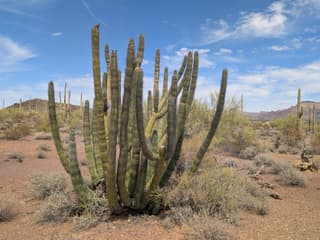
Organ Pipe Cactus
Stenocereus
Stenocereus is a genus of large, tree-like columnar cacti native to the deserts of Mexico and the southwestern United States. The best-known species, Stenocereus thurberi (organ pipe cactus), forms clusters of slender, upright stems rising from a short trunk, resembling the pipes of a musical organ. Ribbed, spiny stems can reach up to 8 m tall and 3.5 m wide, producing white, night-blooming flowers followed by spiny, sweet edible fruit.
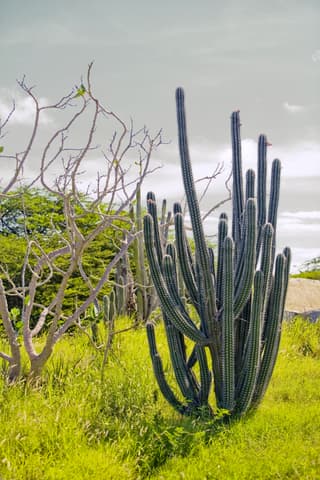
Mexican Organ Pipe Cactus
Stenocereus griseus
Stenocereus griseus, commonly known as the Mexican Organ Pipe Cactus or Dagger Cactus, is a tall columnar cactus native to Mexico and the Caribbean. It can grow up to 9 meters tall, producing white nocturnal flowers pollinated by bats and edible red fruits prized across the Caribbean. Extremely drought-tolerant, it thrives in arid landscapes and desert gardens.

Gray Ghost Organ Pipe Cactus
Stenocereus pruinosus
A slow-to-moderate growing Mexican columnar cactus with pale, gray-green branching stems dusted with a fine bloom (pruina) and covered in yellow spines, giving it a ghostly appearance. Native to arid regions of Mexico, it produces large, funnel-shaped white flowers that open at night in summer, followed by sweet, edible pitaya fruit prized locally.
St. Augustine Grass
Stenotaphrum secundatum
St. Augustine Grass (Stenotaphrum secundatum) is a fast-growing warm-season turfgrass native to the Gulf of Mexico region, widely used for residential and commercial lawns in tropical and subtropical climates. It forms a dense, vigorous carpet with good tolerance to partial shade and coastal salt exposure.
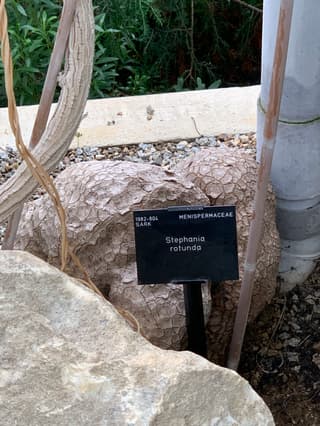
Elephant Foot Plant
Stephania
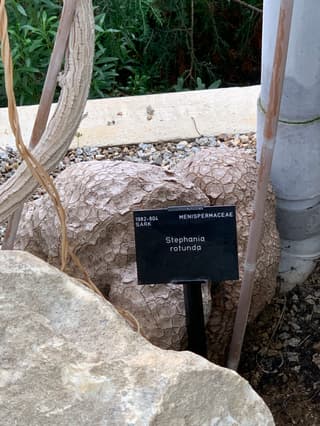
Stephania is a genus of caudiciform vines in the Menispermaceae family, native to the tropical forests of Southeast and East Asia. It is prized by collectors for its swollen, potato-like caudex, a woody, water-storing tuber that can grow to nearly a foot across over many decades. Each growing season, slender, twining vines emerge from the caudex, unfurling round, peltate leaves before dying back into dormancy when temperatures drop. Left largely untouched during its winter rest, the plant channels its energy into slowly thickening the caudex, making it as much a sculptural centerpiece as a houseplant.
Stephania Erecta
Stephania erecta
Stephania erecta is a fascinating tropical plant native to Thailand and Southeast Asia, prized for its unique potato-shaped woody caudex (bulb) from which elegant, slender stems and peltate (shield-shaped) leaves emerge. The plant goes through a natural dormancy cycle, dropping its leaves in winter and re-sprouting vigorously in spring, making it a captivating conversation piece for any plant collector.
Stephania Erecta
Stephania pierrei
Stephania pierrei is a Southeast Asian climbing plant that grows from a swollen, potato-like caudex used to store water and energy. Slender vines carry rounded, shield-shaped leaves up to about 6 cm across. It is prized by collectors and sold commercially as Stephania erecta. It is deciduous and goes dormant in the cooler months.
Madagascar Jasmine
Stephanotis floribunda
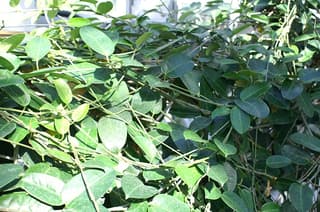
Stephanotis floribunda (Madagascar jasmine) is an evergreen climbing plant in the Apocynaceae family, native to the tropical rainforests of Madagascar. It is characterized by star-shaped, snow-white, waxy flowers with an intense, sweet fragrance that appear in spring and summer. The plant's strong vines can climb 4–6 meters with the help of a support structure. It gained worldwide fame as a bridal flower—Grace Kelly even decorated her wedding bouquet with it. Indoor cultivation is challenging: it is sensitive to temperature fluctuations, direct sunlight, and watering errors.
Tropical Chestnut
Sterculia
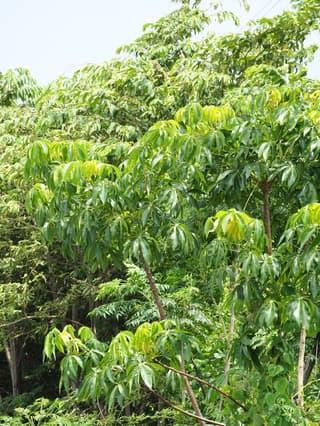
Sterculia is a genus of tropical and subtropical trees in the family Malvaceae, comprising over 150 species found across Africa, Asia, and Australia. Notable species include Sterculia foetida (Java Olive) and S. quadrifida, prized for their timber, medicinal properties, and ornamental value. Some species bear edible seeds and have been used in traditional medicine for centuries.
Crust fungi
Stereum
Stereum, commonly known as crust fungi, is a genus of wood-decay fungi that form flat or shelf-like fruiting bodies on deadwood. They are characterized by their smooth underside, lacking pores or gills. These fungi play a crucial role in forest ecosystems by breaking down lignin and returning nutrients to the soil. Visually, they often feature striking concentric zones in shades of brown, orange, or gray.
Sternbergia
Sternbergia
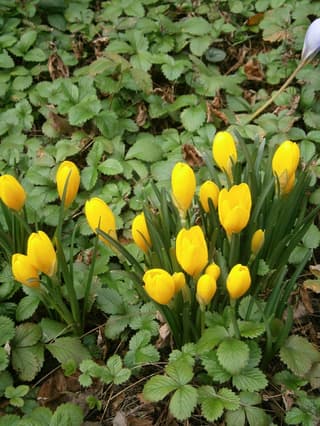
Sternbergia is a genus of eight bulbous plants in the amaryllis family, from the Mediterranean to central and southwestern Asia, often in rocky places. The flowers look like crocuses, but the plants are relatives of daffodils. Most bear golden-yellow, goblet-shaped flowers in autumn, often right after the first rains; S. vernalis and S. candida bloom in spring, and S. candida is the only white one. The narrow leaves appear with or soon after the flowers, last through winter and die down in spring; in summer the bulb rests dry. The most widely grown is S. lutea. All trade in the genus is regulated by CITES.

Winter Daffodil
Sternbergia lutea
Sternbergia lutea is a small Mediterranean bulbous plant in the Amaryllidaceae family, cultivated for its bright yellow cup-shaped flowers that bloom in autumn, surrounded by dark green strap-like leaves. Hardy and low-maintenance, it naturalizes over time in rock gardens and sunny, well-drained borders.
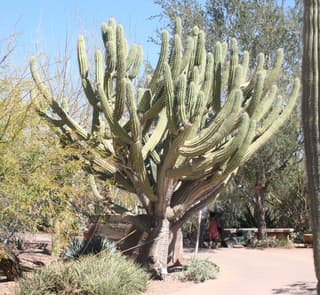
Argentine Toothpick Cactus
Stetsonia coryne
Stetsonia coryne is a large, tree-like columnar cactus native to the high-altitude arid regions of northwestern Argentina, Bolivia, Paraguay, and Brazil. In habitat it develops a thick trunk topped by many blue-green, eight- to nine-ribbed branches armed with stiff black or yellowish-brown spines that fade to white with age -- the source of its common name. Large, funnel-shaped white flowers open at night on mature plants, followed by fleshy, edible fruit.

Stevia
Stevia rebaudiana
Stevia (Stevia rebaudiana) is a perennial subtropical herb from the Asteraceae family, native to Paraguay and Brazil. It grows to a height of approximately 60 cm, has small ovate to elliptical leaves with a finely serrated edge, and in summer produces small white tubular flowers in racemose inflorescences. The leaves contain steviol glycosides – a natural sweetener up to 300 times sweeter than sugar, which is why the plant is cultivated worldwide as a sugar alternative.

European feather grass
Stipa pennata
European feather grass (Stipa pennata) is a characteristic clump-forming perennial grass of the Eurasian steppes, native from Mongolia to the Hungarian Great Plain and the sandy, loess steppes of the Carpathian Basin. Growing 60-90 cm tall, it produces narrow, slender leaves and, between May and August, releases the long, silvery-silky, feathery awns that made the species famous, waving characteristically in the wind. It is an increasingly rare species in Hungary, tied to protected habitats, and has been a symbol of the Hungarian puszta since the national romantic era of poets Sándor Petőfi and Mihály Tompa.

Mexican feather grass
Stipa tenuissima
Stipa tenuissima, commonly known as Mexican feather grass, is a perennial ornamental grass forming dense, rounded tufts of fine, bright green thread-like leaves. In summer, it produces long, feathery panicles that transition from silvery-green to cream and then to golden blond, swaying with the slightest breeze. Hardy in USDA zones 7 to 10, this grass reaches 12 to 24 inches in height and width, and is particularly valued for xeriscaping, rock gardens, and naturalist-style borders.
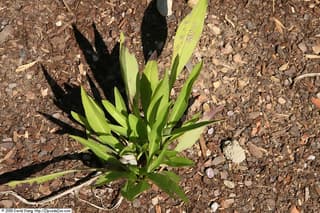
Stokes' Aster
Stokesia laevis
Stokesia laevis, commonly known as Stokes' Aster, is a herbaceous perennial native to the wetlands, bottomlands, and pine savannas of the southeastern United States. It produces showy, cornflower-like blooms in shades of lavender-blue, purple, white, and pink, making it a beloved addition to native and cottage gardens. Despite its origins in moist habitats, it adapts remarkably well to average garden conditions and is notably drought-tolerant once established.
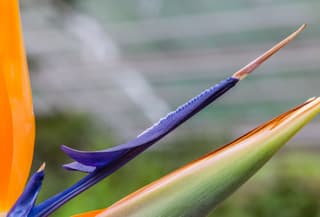
Bird of Paradise
Strelitzia
Strelitzia is a genus of striking tropical plants native to South Africa, celebrated for their dramatic paddle-shaped leaves and exotic flowers. The genus includes the popular Strelitzia reginae (orange Bird of Paradise) and Strelitzia nicolai (white Bird of Paradise), both widely grown as bold indoor statement plants.
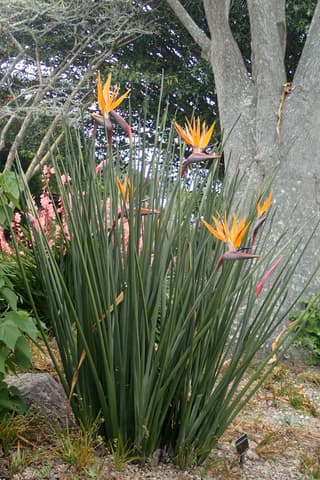
Narrow-Leaved Bird of Paradise
Strelitzia juncea
Strelitzia juncea is a striking South African native prized for its dramatic, rush-like cylindrical stems that replace traditional broad leaves. Unlike its famous relative Strelitzia reginae, this species produces upright, reed-like foliage giving it an architectural, minimalist appearance. It produces the iconic orange and yellow bird-of-paradise flowers, attracting sunbirds in its natural habitat in the Eastern Cape.
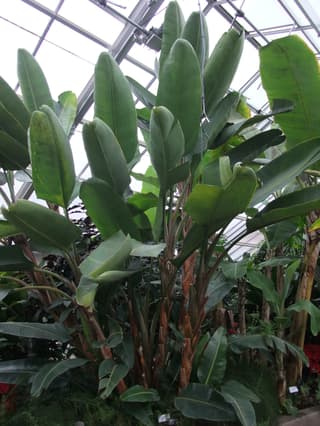
Giant White Bird of Paradise
Strelitzia nicolai
Strelitzia nicolai is a striking evergreen plant native to South Africa, known for its large banana-like leaves and dramatic white and blue flowers. It can grow up to 9 meters tall outdoors but remains more manageable indoors, making it a popular choice for creating tropical ambiance in homes and offices.
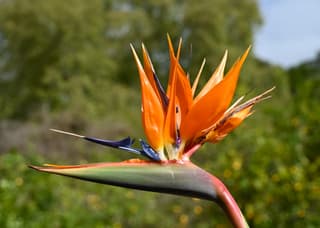
Bird of Paradise
Strelitzia reginae
Strelitzia reginae, commonly known as Bird of Paradise or Crane Flower, is a striking tropical plant native to South Africa. Famous for its spectacular orange and blue flowers that resemble an exotic bird in flight, it has become the official flower of the City of Los Angeles. This evergreen perennial forms clumps of banana-like grey-green leaves and produces long-lasting cut flowers that can survive up to 2 weeks in a vase.

Cape Primrose
Streptocarpus
Streptocarpus, also known as Cape Primrose, is a genus of ornamental plants native to South Africa, belonging to the Gesneriaceae family. Highly valued as an indoor plant, it produces vibrant tubular flowers in shades of purple, lilac, white, pink, red, and blue for much of the year. Its long, velvety, and slightly wrinkled leaves form an elegant rosette. It is an easy-to-grow and very rewarding plant for those seeking prolonged flowering in indoor environments.
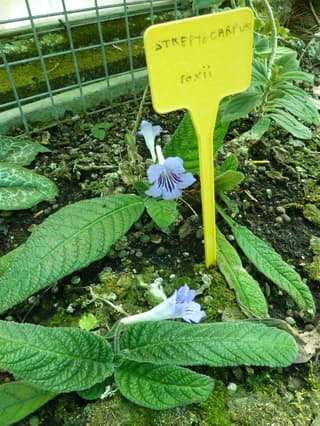
Cape Primrose
Streptocarpus rexii
Streptocarpus rexii, commonly known as Cape Primrose, is a stunning stemless herb native to the rocky coastal forests and stream banks of South Africa. It produces rosettes of long, strap-shaped leaves and bears delicate trumpet-shaped flowers in shades of white, blue, lilac, and violet from spring through autumn. It thrives as a houseplant in bright indirect light.
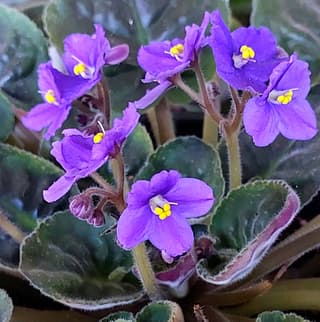
African violet
Streptocarpus sect. Saintpaulia
African violet (Streptocarpus sect. Saintpaulia, formerly genus Saintpaulia) is a compact, rosette-forming perennial from the Gesneriaceae family, native to the Eastern Arc Mountains and coastal forests of Tanzania and Kenya. Prized for its fuzzy, deep-green leaves and near-continuous clusters of purple, pink, blue, or white flowers, it is one of the most popular flowering houseplants worldwide.
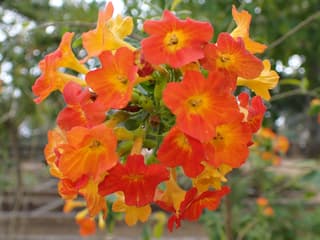
Marmalade bush
Streptosolen jamesonii
The marmalade bush (Streptosolen jamesonii) is an ornamental perennial, semi-woody, and scrambling shrub native to the Andean regions of Colombia, Ecuador, Peru, and Bolivia in South America. Belonging to the Solanaceae family, it can reach 1.5 to 2 meters in height, featuring long, flexible, and arching branches. Its leaves are ovate to elliptical, dark green, glossy, and deeply veined. The trumpet-shaped flowers bloom in clusters and change color as they mature—starting yellow and evolving into shades of orange and red—an effect reminiscent of orange marmalade, which gives the plant its popular name. It flowers intensely during spring and summer, attracting hummingbirds, bees, and butterflies to the garden.
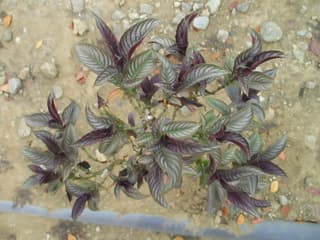
Persian shield
Strobilanthes dyeriana
Strobilanthes dyeriana, commonly known as Persian Shield, is a stunning tropical evergreen subshrub native to Myanmar. It is highly prized for its lance-shaped leaves that feature a brilliant iridescent purple sheen with silver highlights and dark green veins. The underside of the foliage is a deep maroon. While it can produce small violet flowers in winter, it is primarily grown for its spectacular foliage which adds a dramatic touch to any plant collection.
Old-man-of-the-woods
Strobilomyces strobilaceus
Strobilomyces strobilaceus, commonly known as Old-man-of-the-woods, is a distinctive mycorrhizal fungus found in deciduous forests. It is easily recognized by its cap, which is covered in large, dark, woolly scales resembling a pine cone. The flesh stains pinkish then black when cut, and the underside features a greyish pore surface rather than gills.
Find the Perfect Plant
Our plant guide helps you find ideal species for your experience level and time of year.
Browse by Difficulty, Season & More
Use the filters below to narrow this catalog by care difficulty, season, environment, or search directly by name. Each filter leads to a focused list tailored to your specific growing conditions.