Complete Plant Guide
Explore plants by difficulty, season and more. Find the perfect plant for you.
Difficulty
Categories
Plants by City
🗺️ Plants by City3733 plants found
Showing 361-396 of 3733
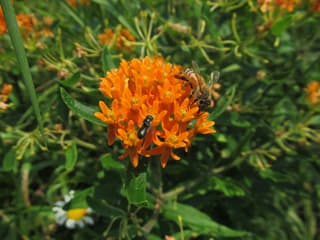
Butterfly Weed
Asclepias tuberosa
Asclepias tuberosa, commonly known as Butterfly Weed, is a stunning native North American perennial celebrated for its vivid clusters of bright orange flowers that bloom from late spring through summer. A critical host plant for monarch butterflies, it provides food for their caterpillars and nectar for countless pollinators. This drought-tolerant, deep-rooted wildflower thrives in poor, well-drained soils and requires very little maintenance once established.
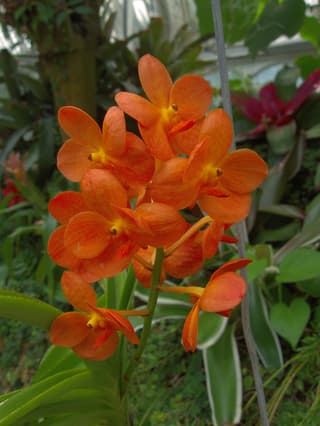
Ascocenda Orchid
Ascocenda
Ascocenda is an orchid nothogenus, a hybrid between Ascocentrum and Vanda within the family Orchidaceae. It combines the compact growth habit of Ascocentrum with the vibrant, large blooms of Vanda, producing jewel-like flowers in shades of purple, pink, orange, and yellow on upright spikes.
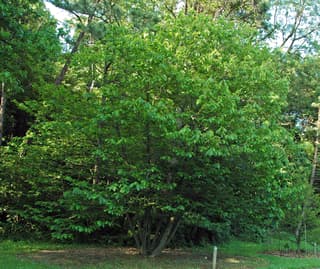
Pawpaw
Asimina triloba
The pawpaw (Asimina triloba) is a deciduous tree in the Annonaceae family, native to the eastern United States and Canada. It is the largest edible fruit tree native to North America. The species naturally grows as an understory tree in forests and produces striking, cup-shaped purple-brown flowers in the spring before the leaves emerge. The large, greenish-yellow fruits have a creamy texture with a flavor reminiscent of a blend of banana, mango, and vanilla.
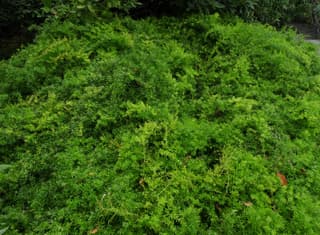
Asparagus
Asparagus
The Asparagus genus encompasses over 200 species native to Africa, Europe, and Asia, ranging from the edible garden asparagus (A. officinalis) to delicate ornamentals like the asparagus fern (A. setaceus) and Sprengeri fern (A. densiflorus). Known for their feathery, needle-like foliage (cladodes), asparagus plants are prized in floral arrangements, hanging baskets, and as graceful houseplants.
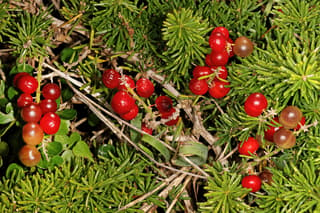
Sprenger's Asparagus
Asparagus aethiopicus
Sprenger's Asparagus (Asparagus aethiopicus) is an evergreen perennial native to South Africa, prized for its feathery, bright-green plumose foliage. Widely used in floral arrangements, hanging baskets, and as a ground cover, this resilient plant thrives in a variety of conditions and is easy to grow both indoors and outdoors.
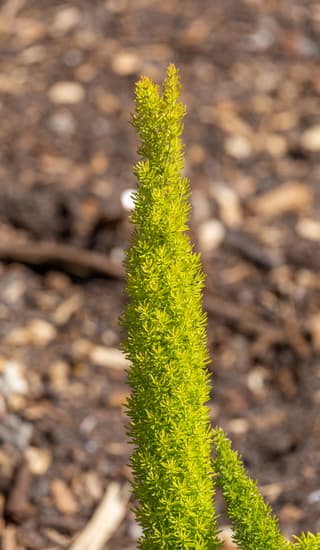
Asparagus Fern
Asparagus densiflorus
Asparagus densiflorus is a graceful, feathery houseplant native to South Africa. Despite its common name, it is not a true fern but belongs to the asparagus family (Asparagaceae). Known for its arching, needle-like cladodes on wiry stems, it creates a lush, cascading display perfect for hanging baskets and shelves. It produces small white or pink flowers in spring and summer, followed by decorative red berries.
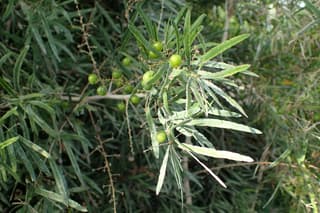
Sicklethorn
Asparagus falcatus
Asparagus falcatus, commonly known as Sicklethorn, is a vigorous climbing perennial native to South Africa, Sri Lanka, and the Himalayas. Its sickle-shaped cladodes and arching thorny stems make it a striking ornamental plant for both indoor and outdoor settings. It can reach up to 8 feet (240 cm) tall when grown indoors with support.
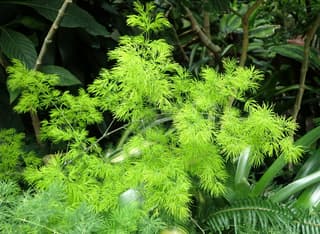
Ming Fern
Asparagus macowanii
Asparagus macowanii, commonly known as Ming Fern or Pony-tail Fern, is a perennial ornamental plant native to South Africa. Its feathery, needle-like bright green foliage creates an airy, elegant appearance suited for both indoor and outdoor settings. It is widely used in floral arrangements and as a decorative houseplant.
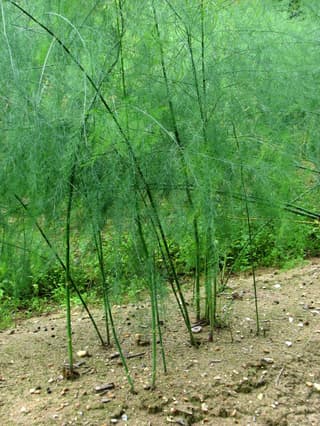
Garden Asparagus
Asparagus officinalis
Garden Asparagus (Asparagus officinalis) is a perennial herbaceous plant native to the Mediterranean region and Asia Minor, cultivated for over 2,000 years as a prized food crop. It produces edible spears in spring and develops ornamental feathery ferns in summer. WARNING: The mature red berries are toxic to humans, cats, and dogs.
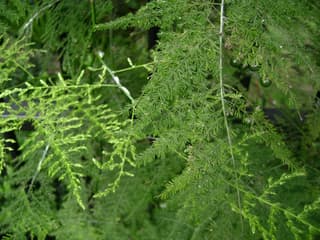
Lace Fern
Asparagus setaceus
Asparagus setaceus is an elegant, feathery climbing plant native to South Africa. Despite its common name, it is not a true fern but a member of the Asparagaceae family. Its delicate, needle-like cladodes create a soft, cloud-like appearance, making it one of the most popular ornamental houseplants worldwide. It is widely used in floral arrangements for its graceful trailing foliage.
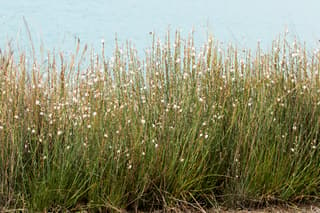
Onionweed
Asphodelus fistulosus
Asphodelus fistulosus is a slender Mediterranean perennial native to the Mediterranean basin and Southwest Asia. It produces hollow, rush-like stems with star-shaped white to pale pink flowers with pink veins in spring and summer. Extremely drought-tolerant, it thrives in poor, sandy, well-drained soils and full sun. Note: it is a Federal Noxious Weed in the USA and invasive in several countries including Australia and New Zealand.
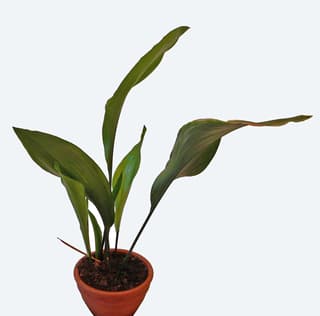
Cast Iron Plant
Aspidistra elatior
The Cast Iron Plant is a classic, low-maintenance houseplant native to the shady forest floors of Japan. Known for its dark green, glossy leaves that can grow up to 60cm long, this remarkably resilient plant earns its name from its ability to tolerate neglect, low light, and varying temperatures. It has been a popular Victorian parlor plant and remains an excellent choice for beginners or challenging growing conditions.
Cast Iron Plant
Aspidistra lurida
Aspidistra lurida, commonly known as the Cast Iron Plant, is a slow-growing, evergreen perennial native to the forest floors of East Asia. It features upright, leathery, lance-shaped dark green leaves that can reach up to 1 metre in height. Renowned for its extraordinary toughness, it thrives in deep shade, tolerates temperature fluctuations, irregular watering, and low humidity — conditions that would kill most houseplants. It is one of the most forgiving and long-lived indoor plants available, capable of surviving for decades with minimal care.
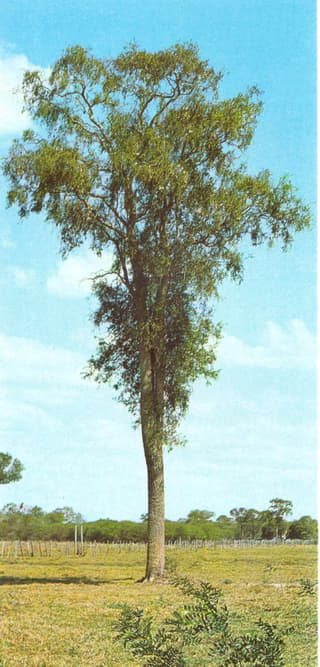
Aspidosperma (genus)
Aspidosperma
Aspidosperma is a genus of tropical and subtropical trees in the family Apocynaceae, native to South America, Central America, and the Caribbean. It includes notable species such as peroba-rosa (A. polyneuron), white quebracho (A. quebracho-blanco), and A. macrocarpon. These slow-growing, large-canopy trees produce extremely hard and durable timber. The bark contains valuable medicinal alkaloids used in traditional medicine across the Neotropics.
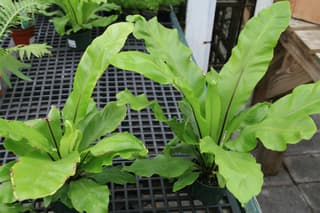
Spleenwort
Asplenium
Asplenium is a genus of approximately 700 fern species found across tropical and subtropical regions worldwide. The most popular indoor species is Asplenium nidus, the Bird's Nest Fern, recognised by its long, glossy, bright-green fronds radiating from a central rosette. Naturally adapted to low-light forest floors and tree trunks, Asplenium makes an excellent houseplant for rooms with limited natural light.
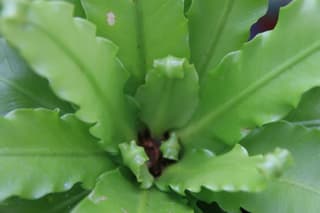
Japanese Bird's Nest Fern
Asplenium antiquum
Asplenium antiquum, the Japanese bird's nest fern, is an evergreen epiphytic fern native to subtropical East Asia — Japan, Taiwan, southeastern China, and South Korea — where it grows on tree trunks, rocks, and cliffs in humid forests. Its glossy, undivided, arching fronds radiate from a single central rosette resembling a bird's nest, reaching roughly 60-90 cm across at maturity. It is a popular tropical houseplant valued for its bold architectural foliage and is non-toxic to pets.
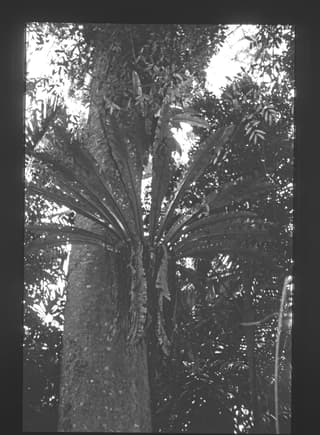
Birds Nest Fern
Asplenium australasicum
Asplenium australasicum, commonly known as the birds nest fern, is an epiphytic fern native to the rainforests of eastern Australia. Its broad, wavy fronds grow in a rosette, forming a bowl shape that collects fallen leaves and rainwater in the wild.
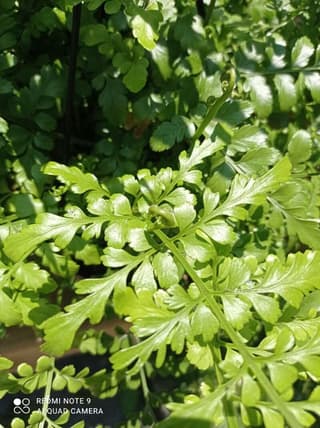
Balearic Spleenwort
Asplenium balearicum
Asplenium balearicum, commonly known as the Balearic Spleenwort, is a small and elegant fern endemic to the Balearic Islands and the Western Mediterranean. It grows naturally in limestone rock crevices and shaded slopes, forming dense clumps of dark green fronds. Well-suited to indoor environments with good humidity, it is an adaptable plant that brings a Mediterranean touch to any space.
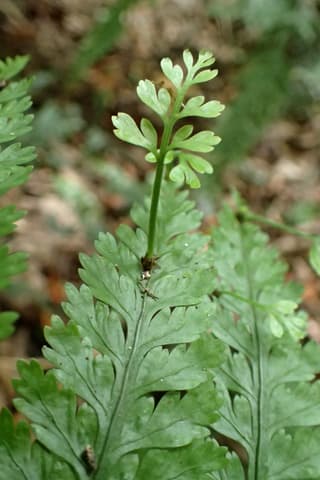
Hen and Chickens Fern
Asplenium bulbiferum
The Hen and Chickens Fern (Asplenium bulbiferum) is an elegant fern native to New Zealand and nearby islands, celebrated for its finely divided, bright-green fronds and its remarkable ability to produce tiny plantlets (bulbils) directly on mature fronds. This unique characteristic inspired its whimsical common name, as the plantlets resemble chicks clustering around a mother hen. It is widely grown as an indoor houseplant and in shaded garden settings.
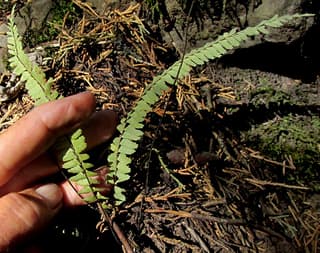
Single-sorus Spleenwort
Asplenium monanthes
Asplenium monanthes is a small evergreen fern with erect, once-divided fronds on shiny, dark reddish-brown to blackish stalks. Each fertile leaflet carries a single sorus, which gives the species its name. It grows in tropical and subtropical regions of the Americas, Africa and Atlantic islands, usually on shaded, humid forest floors and moist rock faces. Fronds are typically around 15 to 30 cm long.
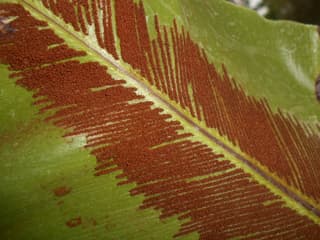
Bird's Nest Fern
Asplenium nidus
The Bird's Nest Fern (Asplenium nidus) is an elegant tropical epiphytic fern known for its rosette of bright green, lance-shaped fronds that unfurl from a central nest-like crown. Native to Southeast Asia, Australia, and the Pacific Islands, this slow-growing beauty thrives in humid environments and makes an excellent houseplant for bathrooms and shaded spaces.
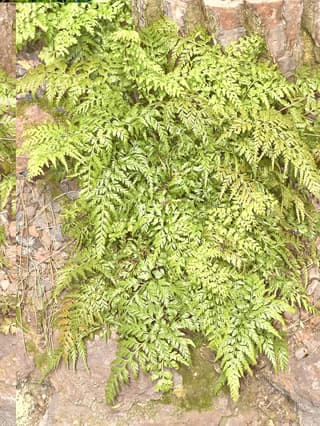
Irish spleenwort
Asplenium onopteris
Irish spleenwort (Asplenium onopteris) is an evergreen perennial fern in the family Aspleniaceae, native to the Mediterranean Basin, Macaronesia, and the Atlantic coasts of western and central Europe, with isolated populations reaching as far north as Ireland and Poland. It grows on shaded, humid rock faces, banks, and woodland floors, usually on acidic substrates, up to about 1900 m elevation. The leathery, glossy dark-green fronds are triangular-ovate in outline, 2-4 times pinnate, with a reddish-brown to black petiole (stipe). Plants reach 10-50 cm in height.
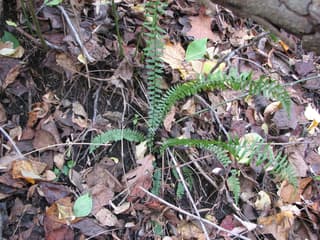
Ebony Spleenwort
Asplenium platyneuron
Ebony Spleenwort is a small dimorphic fern native to eastern North America, characterized by its glossy ebony-black rachis contrasting beautifully with dark green fronds. It produces two distinct frond types: shorter sterile fronds that spread horizontally and taller fertile fronds that stand upright. A low-maintenance native fern ideal for shade gardens and rocky landscapes.
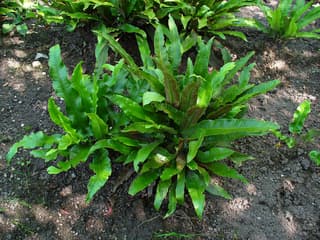
Hart's-tongue Fern
Asplenium scolopendrium
Asplenium scolopendrium, commonly known as the hart's-tongue fern, is an elegant evergreen fern native to moist, shady woodlands and rocky limestone habitats across Europe, Asia, and parts of North America. It produces distinctive undivided, strap-shaped, glossy bright-green fronds unlike most other ferns, giving it a unique tropical appearance in temperate gardens.

Maidenhair Spleenwort
Asplenium trichomanes
Asplenium trichomanes, commonly known as maidenhair spleenwort, is a small evergreen fern in the Aspleniaceae family. It forms neat rosettes of slender fronds lined with tiny, rounded, bright green leaflets attached to glossy black stems. Native to rocky, shaded habitats across the Northern Hemisphere and tropical mountains, it naturally colonizes crevices in limestone walls, rock outcrops, and stone masonry, making it a charming, low-maintenance choice for shaded gardens, terrariums, and rockeries.
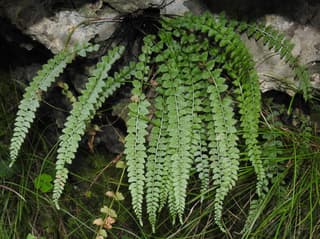
Green Spleenwort
Asplenium viride
Green Spleenwort (Asplenium viride) is a small rock-crevice fern native to calcareous mountain rocks across northern temperate Eurasia and North America. It is distinguished from the similar Maidenhair Spleenwort (Asplenium trichomanes) by its green stipes and rachises. A slow-growing, cold-hardy evergreen fern, it is well suited for rock gardens, troughs, and cool, humid indoor settings.
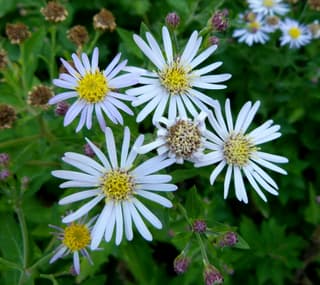
Wild Aster
Aster ageratoides
Aster ageratoides, the Asian aster, is a robust and hardy perennial from East Asia known for its late and abundant flowering. From late summer well into autumn, the plant is covered in a wealth of small, star-shaped flowers in shades of purple, blue, pink, or white with yellow centers. It has an upright growth habit with dark green, lance-shaped leaves that form a dense ground cover, and it thrives best in full sun to light shade. The plant is valued in horticulture for its low maintenance, but it is sensitive to wet, poorly drained soil, which can lead to root rot.
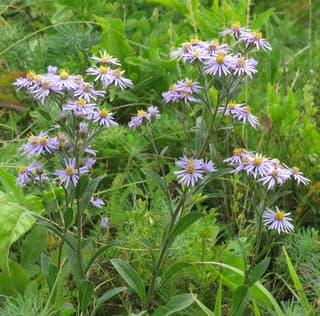
European Michaelmas Daisy
Aster amellus
Aster amellus is a compact, clump-forming herbaceous perennial of the daisy family (Asteraceae), native to central and southern Europe and parts of western Asia. It grows 30 to 60 cm tall and produces masses of lilac-purple, daisy-like flowers with golden-yellow centres from late summer well into autumn. In the wild it favours sunny, rocky, limestone-rich slopes and dry meadows. In gardens it is prized for late colour, a tidy self-supporting habit, and good resistance to the powdery mildew that affects many other asters.
Powdery Piggyback Mushroom
Asterophora lycoperdoides
Asterophora lycoperdoides is a fascinating mycoparasitic fungus that grows specifically on the decaying fruiting bodies of mushrooms from the Russula and Lactarius genera. It is characterized by a small cap, initially hemispherical and whitish, which soon becomes covered by a brown powdery mass of chlamydospores (asexual spores). It is a species with a very specific ecological niche, essential for the study of mycology and forest biodiversity.
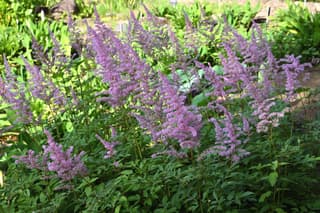
Rose Astilbe
Astilbe × rosea
Astilbe × rosea is a perennial hybrid in the Saxifragaceae family, prized for its feathery plumes of rose-pink flowers rising above finely cut, fern-like foliage. Native to shade gardens, it forms compact clumps and blooms from late spring through summer, adding color and texture to shaded borders and pond edges.
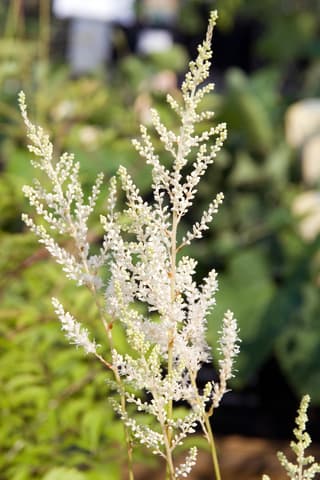
Japanese Astilbe
Astilbe japonica
Astilbe japonica, commonly known as Japanese Astilbe or False Goatsbeard, is a graceful rhizomatous herbaceous perennial native to Japan. It produces feathery, plume-like flower spikes in shades of white and pink above deeply divided, glossy dark green foliage. A beloved shade garden staple, it thrives in moist, organically rich soil and brings elegant texture and soft colour to woodland gardens, borders, and shaded landscapes from late spring into early summer.
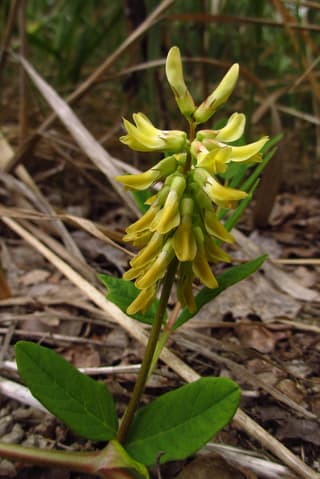
Astragalus
Astragalus
Astragalus is the largest genus in the Fabaceae (legume) family, with nearly 2900 species found in the Northern Hemisphere, Central Asia, China, and North America. Most species are perennial herbaceous plants or shrubs, characterized by compound, odd-pinnate leaves and distinctive pea-like flowers. The most medicinally important species is Astragalus membranaceus (Huang Qi), which has been used in traditional Chinese medicine for over 2000 years as an immune booster and adaptogen. However, some species within the genus (known as 'locoweed' species) contain swainsonine or organic nitro compounds, which can be toxic to animals and humans. The plant produces yellow, purple, or white pea-like flowers in spring and summer and requires moderate care.
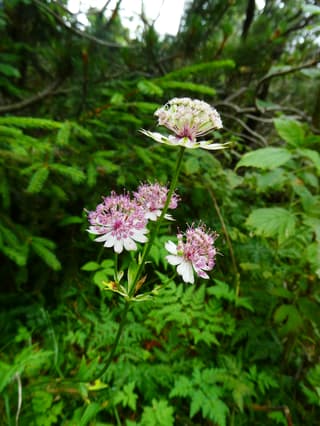
Great Masterwort
Astrantia major
Great Masterwort (Astrantia major) is a hardy perennial from the carrot family (Apiaceae), native to moist deciduous forests and stream banks of Central and Eastern Europe. The tiny, greenish-white flowers are surrounded by striking, star-shaped bracts in white, pink, green, or red, making the inflorescence resemble a small star-shaped umbrella. The plant forms compact clumps with 3- to 5-lobed leaves and blooms from June through September, making it a beloved addition to borders and cottage gardens.
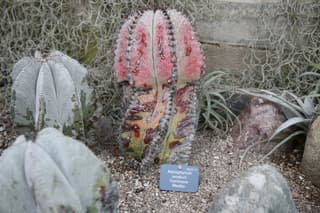
Monk's Hood Cactus
Astrophytum ornatum
The Monk's Hood Cactus (Astrophytum ornatum) is a slow-growing, typically solitary, columnar cactus native to Mexico, where it thrives on rocky terrain in full sun. The body reaches approximately 12 cm in diameter and can grow over one meter tall in its natural habitat; it features 7-8 spiraling ribs adorned with whitish to brownish spines and fine white scales. Starting at around five years of age, it produces large, vibrant yellow flowers over 7 cm in diameter, each lasting only a few days.
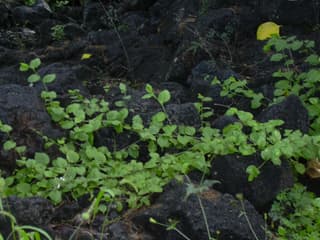
Chinese Violet
Asystasia gangetica
Asystasia gangetica, commonly known as Chinese violet or coromandel, is a fast-growing perennial herb in the family Acanthaceae, native to India and tropical Africa. This spreading groundcover reaches up to 1 meter tall when supported, producing delicate bell-shaped flowers in white, lilac, and purple throughout the year. It is widely cultivated in tropical and subtropical gardens for its ornamental value, vigorous growth, and ability to cover large areas quickly.
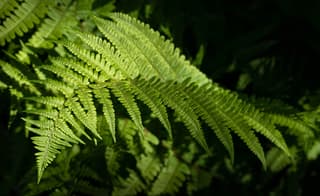
Lady Fern
Athyrium
Athyrium is a genus of around 180 deciduous ferns, best known through the widespread lady fern (A. filix-femina) and ornamental cultivars like the Japanese painted fern. Plants form graceful clumps of finely divided, lace-like fronds from a creeping or erect rhizome, thriving in shaded woodland conditions with consistently moist, humus-rich soil. They are generally trouble-free, cold-hardy, and popular for shade gardens, borders and pond margins.
Find the Perfect Plant
Our plant guide helps you find ideal species for your experience level and time of year.
Browse by Difficulty, Season & More
Use the filters below to narrow this catalog by care difficulty, season, environment, or search directly by name. Each filter leads to a focused list tailored to your specific growing conditions.