1162 Medium Easy Care | 2026 Guide - Page 13
Find 1162 medium easy care. Complete guide for your garden.
1162 Easy Care with medium level
Showing 433-468 of 1162
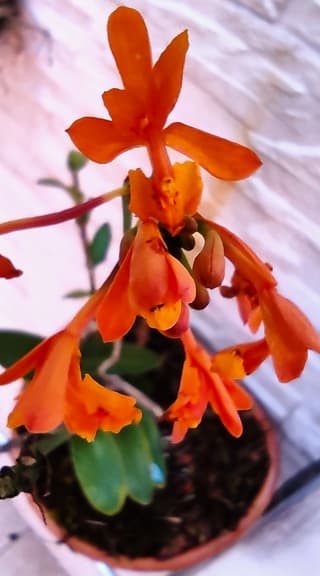
Beach Crucifix Orchid
Epidendrum fulgens
Epidendrum fulgens is a terrestrial crucifix orchid native to the restinga (coastal scrubland) of southern and southeastern Brazil, from Rio de Janeiro to Rio Grande do Sul. It forms robust clumps of cane-like pseudobulbs and produces upright flower spikes bearing dozens of brilliant orange-yellow, non-resupinate flowers with red spots on the lip. The species is remarkably tolerant of full sun, strong coastal winds, and salt spray.
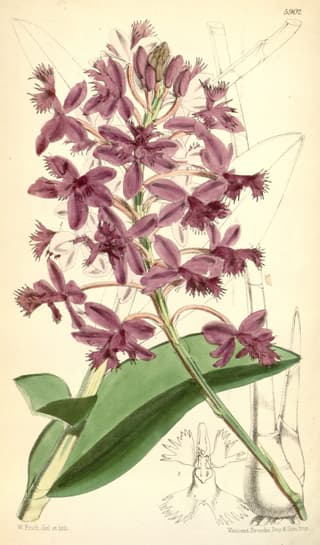
Jamieson's Epidendrum
Epidendrum jamiesonis
Epidendrum jamiesonis is a large, reed-stemmed terrestrial-to-epiphytic orchid native to the cool cloud forests of Colombia and Ecuador, found on trees and slopes between 1,700 and 3,500 meters elevation. Its sturdy cane-like stems carry evergreen leaves and terminate in showy inflorescences packed with numerous small, star-shaped flowers roughly 2.5 cm across. Unlike many orchids tied to a single bloom season, it can flower at almost any time of year given consistent moisture and bright light. First described by Reichenbach in 1856 and named for the Scottish botanist William Jamieson, who collected extensively in Ecuador, the species is now considered vulnerable in the wild due to habitat loss, making cultivated specimens valuable for ex-situ conservation.
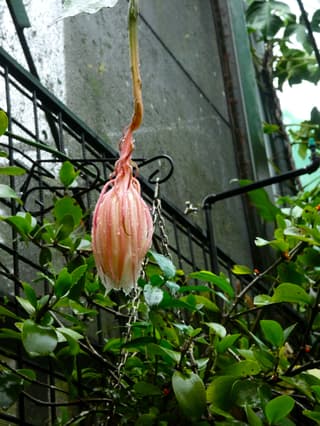
Orchid Cactus
Epiphyllum
Epiphyllum is a genus of epiphytic cacti native to the tropical forests of Central and South America. Unlike desert cacti, they grow perched on tree branches in dappled light, producing long, flat, trailing stems. They are celebrated for their spectacular flowers — enormous, often fragrant, and sometimes night-blooming — that last only one or two days, making each bloom a fleeting but unforgettable event.
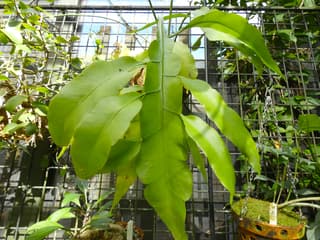
Queen of the Night
Epiphyllum oxypetalum
Epiphyllum oxypetalum is a spectacular epiphytic cactus native to Central America, famous for its stunning white nocturnal flowers that can reach up to 30 cm in diameter. The flowers open only for one night, releasing a sweet and intense fragrance, and wilt by dawn. It is a fast-growing plant that can reach up to 3 meters in height, with flattened stems that function as leaves (phylloclades) with wavy edges. Unlike other cacti, it has no spines.
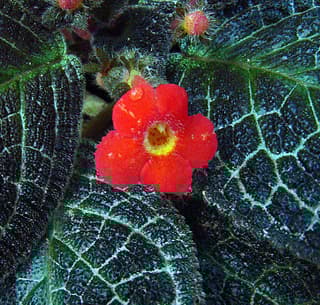
Flame Violet
Episcia cupreata
Episcia cupreata is a tropical creeping plant native to Colombia, belonging to the Gesneriaceae family. It features velvety leaves with stunning metallic patterns in shades of copper, silver, and green, along with tubular red or orange flowers that bloom throughout the year. Highly valued as a houseplant for its decorative foliage and trailing stoloniferous growth habit.
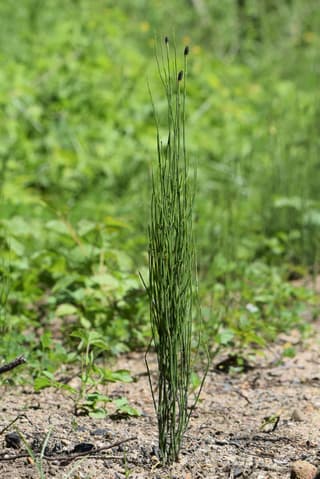
Marsh Horsetail
Equisetum palustre
Equisetum palustre, commonly known as Marsh Horsetail, is a primitive vascular plant from the ancient Equisetaceae family — a lineage dating back over 300 million years. Native to cool, wet regions of Eurasia and North America, it thrives in marshes, bogs, stream banks, and other waterlogged habitats. Its jointed, reed-like stems rise 10–60 cm and bear whorls of slender branches. WARNING: All parts are toxic to livestock, particularly horses and cattle, due to thiaminase and the alkaloid palustrine which destroy vitamin B1.
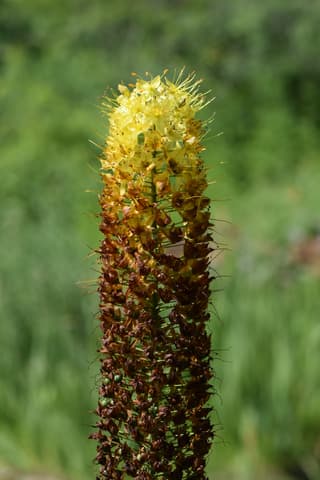
Foxtail Lily
Eremurus stenophyllus
Eremurus stenophyllus, commonly known as the Foxtail Lily or Desert Candle, is a tuberous-rooted perennial native to the steppes and semi-desert regions of Central Asia. It forms a rosette of narrow, strap-like leaves from which a tall, erect flower spike emerges in summer, reaching heights of 4 to 5 feet. This spike is densely packed with small, star-shaped yellow flowers that turn brownish at the base as they age. A recipient of the RHS Award of Garden Merit, it is highly prized for its spectacular architectural presence in the garden.
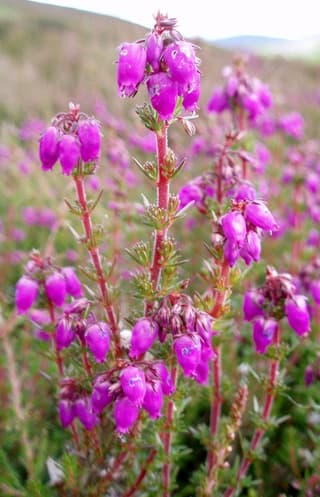
Bell heather
Erica cinerea
Bell heather (Erica cinerea) is a low, evergreen shrub in the Ericaceae family, native to the heathlands and coastal moors of Western Europe, including Britain, Ireland, France, and northern Spain. It forms compact mounds of fine, needle-like foliage and produces bell-shaped flowers in shades of purple, pink, or white from early summer to early autumn. Hardy and drought-tolerant once established, it thrives in acidic, well-drained soil and is a favorite for naturalistic gardens, borders, and ground cover.

Cape Heath
Erica gracilis
Erica gracilis, commonly known as Cape heath, is a small evergreen shrub native to the Cape region of South Africa, belonging to the Ericaceae family. It reaches a maximum height of 40-45 cm with a compact canopy of about 35 cm, formed by dark, needle-like leaves. From October to January (with possible reblooming until March), it produces dense clusters of small bell-shaped flowers at the tips of the branches in shades of pink, white, or magenta, featuring a light honey scent. It is a calcifuge plant: it rejects lime-rich soils and requires an acidic substrate.
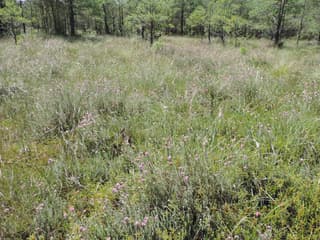
Cross-leaved Heath
Erica tetralix
Low evergreen shrub of the Ericaceae family, native to bogs, wet heaths and damp coniferous woodland across western Europe. It has erect or creeping stems, grey-green glandular leaves arranged in whorls of four, and drooping clusters of small pink bell-shaped flowers from summer to autumn.
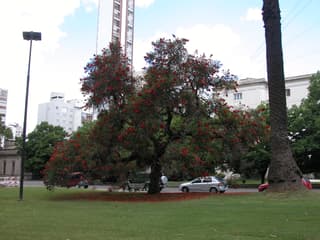
Cockspur Coral Tree
Erythrina crista-galli
The Cockspur Coral Tree (Erythrina crista-galli) is a deciduous flowering tree native to South America — Brazil, Argentina, and Uruguay. Belonging to the Fabaceae family, it produces spectacular crimson-red, velvety flowers in drooping clusters up to 60 cm long during spring and summer. It is the national tree of Argentina and its flower is the national flower of both Argentina and Uruguay.
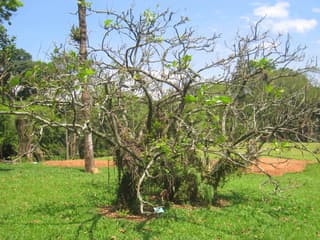
Brazilian Coral Tree
Erythrina speciosa
The Brazilian Coral Tree (Erythrina speciosa) is a native tree from Brazil's Atlantic Forest, renowned for its spectacular scarlet flowering that occurs during winter while the tree is leafless. A highly ornamental species widely used in urban landscaping and gardens, it attracts hummingbirds with its brilliant tubular flowers.
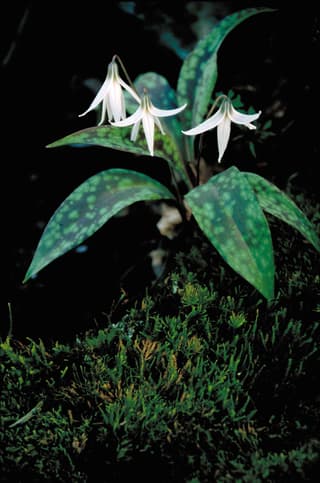
Trout Lily
Erythronium
Erythronium, commonly known as trout lily, fawn lily, or dog's-tooth violet, is a genus of roughly 30 spring-blooming bulbous perennials native to woodlands across North America, Europe, and Asia. Named for the mottled, trout-skin-like pattern on its paired leaves, this diminutive woodland ephemeral produces nodding, lily-shaped flowers in shades of yellow, white, pink, or lavender-purple that emerge before deciduous tree canopies leaf out in spring. After a brief flowering period of about two weeks, the foliage yellows and dies back, and the plant spends the rest of the year dormant underground as a small, tooth-shaped corm, the origin of the common name dog's-tooth violet. Slow to establish from seed (often taking 4-7 years to first flower) but long-lived and naturalizing readily by offsets once settled, Erythronium is prized by woodland and native-plant gardeners for its fleeting but exquisite early-spring display.
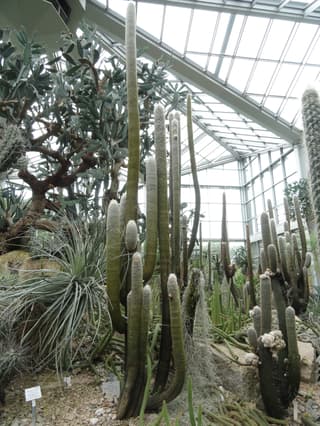
Old Man Cactus
Espostoa lanata
Espostoa lanata, commonly known as the Old Man Cactus, is a columnar cactus native to the Andean slopes from southern Ecuador to northern Peru. Its stem is densely covered in woolly white hairs that hide sharp spines, giving it a fuzzy and ornamental appearance. In its natural habitat, it can exceed 7 meters in height, but when grown in pots, it grows much more compactly and slowly.

White Head Cactus
Espostoopsis dybowskii
Espostoopsis dybowskii is a rare, columnar cactus species native exclusively to the eastern and northern parts of Bahia state in Brazil, within the caatinga habitat at altitudes of 300–750 meters. The plant grows on granite and gneiss rocks, as well as quartzitic outcrops, where it occasionally forms dense, single-species stands. Its erect, unbranched, cylindrical stems can reach heights of 2–4 meters with a diameter of approximately 8 cm and 20–28 low ribs. The stems are covered in dense, white hair that almost completely hides the surface, giving rise to the Portuguese folk names "cabeça-branca" (white head) and "homem-velho" (old man). The spines consist of 2–3 yellowish or brownish, needle-like central spines 2–3 cm long, while the radial spines are fine and short, hidden within the wool. Its nocturnal, approximately 4 cm long, white, bell-shaped flowers emerge from a lateral cephalium (a white woolly flowering area), typically in summer. The species is endemic to Brazil and is the only known species in the monotypic genus Espostoopsis within the Cactaceae family.
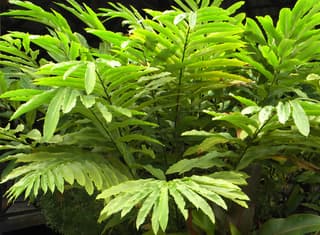
Torch Ginger
Etlingera elatior
Torch Ginger (Etlingera elatior) is a majestic tropical plant in the Zingiberaceae family, native to Southeast Asia, particularly Indonesia and Malaysia. Renowned for its spectacular torch-shaped inflorescences in shades of red, pink, and white, it can reach up to 20 feet (6 m) in height. It is highly valued as an ornamental plant, in traditional Southeast Asian cuisines, and in folk medicine.

Eucalyptus
Eucalyptus
Eucalyptus is a large genus of fast-growing flowering trees and shrubs native primarily to Australia, comprising over 700 recognized species. Iconic for their aromatic silvery-blue foliage, peeling decorative bark, and clusters of distinctive brush-like flowers, eucalyptus trees are among the most widely planted trees in the world. While they grow into large trees outdoors, certain dwarf and compact varieties can be grown as potted ornamental plants.
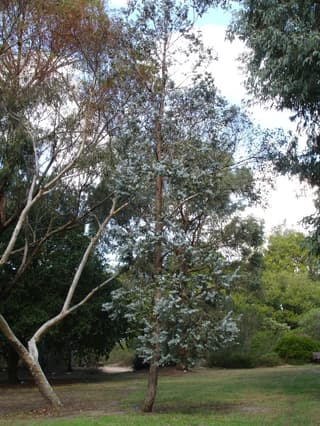
Argyle Apple
Eucalyptus cinerea
Eucalyptus cinerea, commonly called Argyle apple or silver dollar gum, is a fast-growing evergreen tree native to southeastern Australia (New South Wales, Victoria, ACT), in the Myrtaceae family. Its rounded, silvery-blue juvenile foliage is prized in floristry. In the ground it can reach over 15 m, though it is often coppiced and grown as an ornamental shrub for its foliage.
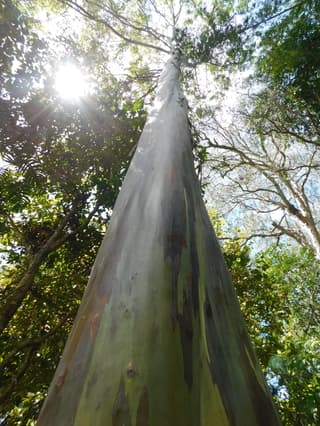
Rainbow Eucalyptus
Eucalyptus deglupta
Eucalyptus deglupta, commonly known as the Rainbow Eucalyptus, is a magnificent fast-growing tree native to the Philippines, Indonesia, and Papua New Guinea. It is the only eucalyptus species indigenous to the Northern Hemisphere. Famous for its stunning multicolored bark that peels away to reveal bright green, blue, purple, orange, and maroon layers underneath, it is one of the most visually spectacular trees in the world.
Tasmanian Blue Gum
Eucalyptus globulus
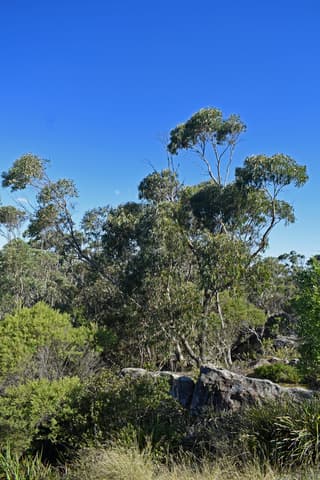
Eucalyptus globulus, commonly known as the Tasmanian Blue Gum, is a fast-growing evergreen tree native to Tasmania and southeastern Australia. Belonging to the Myrtaceae family, it can reach up to 70 metres in height under optimal conditions. Juvenile leaves are rounded with a distinctive blue-grey waxy coating, while mature leaves become long, lance-shaped, and pendulous. Widely cultivated worldwide for its medicinal, aromatic, and timber value, it is renowned for its essential oil with potent antiseptic and expectorant properties. The foliage is toxic if ingested by humans, cats, or dogs.
Silver-leaved Mountain Gum
Eucalyptus pulverulenta
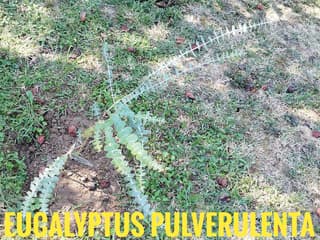
Eucalyptus pulverulenta, the silver-leaved mountain gum, is an evergreen tree or mallee native to the tablelands of southeastern New South Wales, Australia. It is prized for its rounded, powdery silver-blue juvenile leaves, which remain in that form even at maturity, making it a favorite in floral arranging.
Amazon Lily
Eucharis amazonica
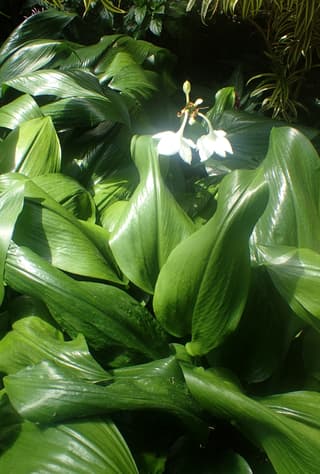
The Amazon Lily is a perennial bulb from the Amaryllidaceae family, native to Peru and the Amazon basin. Its fragrant white flowers resemble daffodils and bloom on upright stems above glossy, broad green leaves. It is highly valued as an indoor plant for its exotic beauty and relatively easy care.
Amazon Lily
Eucharis grandiflora
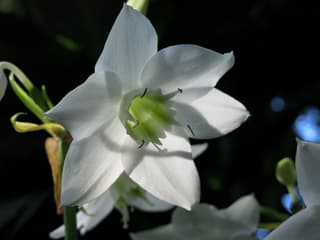
The Amazon Lily (Eucharis grandiflora) is a tropical bulbous perennial native to the rainforests of Colombia and Peru, belonging to the Amaryllidaceae family. It is celebrated for its stunning pure-white, fragrant flowers resembling daffodils, which appear in elegant clusters on tall sturdy stems. Widely cultivated as a houseplant and in tropical gardens, it blooms 2-3 times a year under ideal conditions.
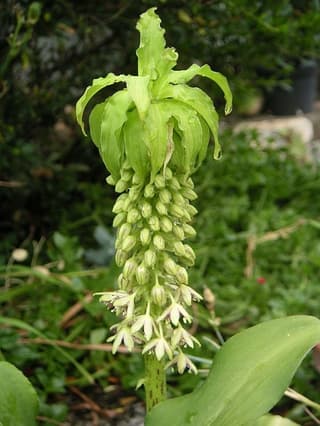
Pineapple lily
Eucomis bicolor
The Pineapple lily (Eucomis bicolor) is a bulbous plant in the asparagus family (Asparagaceae) native to South Africa. It forms a rosette of broad, strap-shaped leaves, and in summer, it sends up a dense inflorescence of star-shaped, pale green flowers edged in purple, crowned by a tuft of green bracts resembling a pineapple. The species grows 12–24 inches (30–60 cm) tall and blooms from July to September. It is not winter-hardy in colder climates, and the bulbs must be overwintered in a dry, frost-free environment.
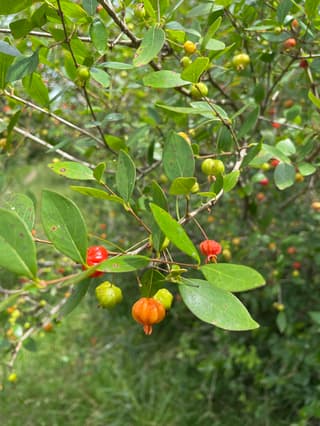
Eugenia
Eugenia
Eugenia is one of the largest genera in the Myrtaceae family, comprising hundreds of tropical and subtropical trees and shrubs native to the Americas. It features glossy evergreen foliage, small white flowers with showy stamens, and prized edible fruit, such as pitanga (Eugenia uniflora) and grumixama (Eugenia brasiliensis). Species in this genus are grown both as backyard fruit trees and as ornamentals, and are especially popular for hedging and topiary thanks to their tolerance of frequent pruning.
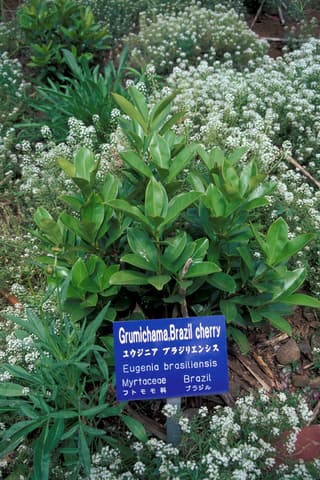
Grumichama
Eugenia brasiliensis
Grumichama (Eugenia brasiliensis) is a native fruit tree of Brazil's Atlantic Forest, belonging to the Myrtaceae family. It produces small, round berries with juicy pulp and a sweet-tart flavor, available in black, red, and yellow varieties. Highly valued both for its edible fruit and ornamental beauty, it is an important species for Atlantic Forest restoration.
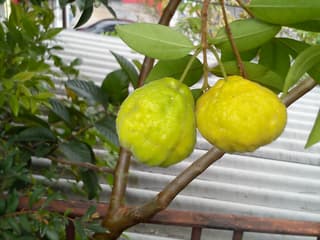
Uvaia
Eugenia pyriformis
Uvaia (Eugenia pyriformis) is a fruit-bearing tree native to the Brazilian Atlantic Forest, belonging to the Myrtaceae family. It produces aromatic yellow-orange fruits rich in vitamin C and bioactive compounds. This species holds great ecological and gastronomic value, widely used in forest restoration projects and sustainable landscaping.
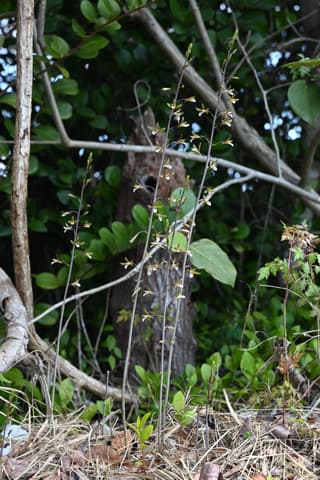
Chinese Crown Orchid
Eulophia graminea
Eulophia graminea, commonly known as Chinese Crown Orchid or Grass-leaf Eulophia, is a terrestrial orchid native to South and Southeast Asia. It produces grass-like leaves from pseudobulbs and sends up tall flower spikes bearing small green and brownish-purple blooms in spring. Though elegant in its native habitat, this species has become invasive in Florida, spreading rapidly through diverse ecosystems via dust-like seeds and wood chip mulch.
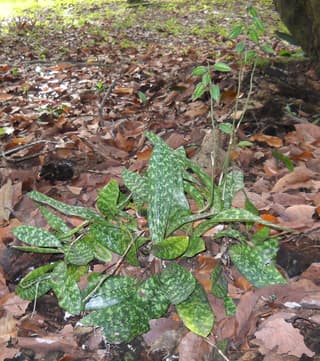
Spotted Eulophia
Eulophia maculata
Eulophia maculata, widely known by its synonym Oeceoclades maculata, is a terrestrial orchid native to tropical Africa, including Madagascar and Mauritius. Commonly called the Spotted Eulophia or Monk Orchid, it is one of the most successfully naturalized orchids in the world, now found throughout the Neotropics, Caribbean, and Florida. It grows in leaf litter and rocky scrub slopes up to 1200m elevation, producing mottled evergreen leaves and delicate white to pink flowers in late summer and fall.
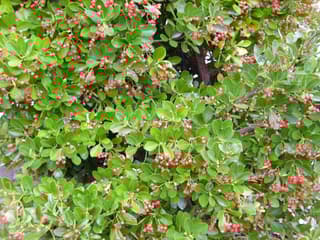
Japanese Spindle Tree
Euonymus japonicus
Euonymus japonicus, commonly known as the Japanese Spindle Tree, is an evergreen shrub native to Japan, Korea, and China. It is widely cultivated as an ornamental plant and hedging shrub throughout temperate regions worldwide. Growing at a medium rate, it can reach over 4.5 meters tall and is prized for its glossy, dark-green foliage that remains attractive year-round. It adapts well to various soil types and tolerates drought, wind, salt spray, and urban pollution, making it a popular choice for formal gardens, coastal landscapes, and topiary.
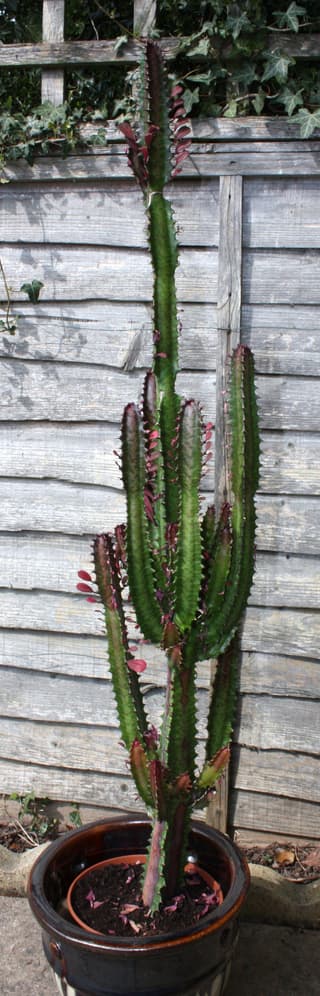
Spurge
Euphorbia
Euphorbia is one of the largest and most diverse plant genera on Earth, comprising over 2,000 species distributed across every continent except Antarctica. The genus spans an extraordinary range of forms — from spiny, cactus-like succulents such as Euphorbia trigona (African milk tree) and Euphorbia milii (crown of thorns), to the iconic holiday plant Euphorbia pulcherrima (poinsettia), and even large shrubs and trees. Despite their wildly different appearances, all Euphorbias share one defining trait: a milky white latex sap that is toxic to humans, cats, and dogs, causing skin and mucous membrane irritation on contact. Native to Africa, the Americas, and Eurasia, Euphorbias have adapted to deserts, tropical forests, and temperate meadows alike, making them among the most ecologically versatile plants known.
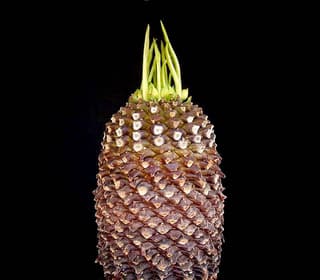
Pine Cone Plant
Euphorbia bupleurifolia
Euphorbia bupleurifolia, commonly known as the Pine Cone Plant, is a rare caudiciform succulent native to the Eastern Cape of South Africa. Its swollen, tuberous stem covered in spiral leaf-scar patterns resembles a pine cone, making it a prized collector's specimen. It grows slowly and produces small yellow-green flowers in spring.
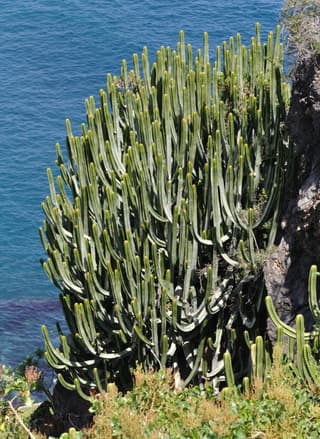
Canary Island Spurge
Euphorbia canariensis
Euphorbia canariensis, commonly known as Canary Island Spurge or Cardón, is a columnar succulent endemic to the Canary Islands (Spain). It is one of the most iconic plants of the Macaronesian region, forming dense stands called cardonal in arid lowlands. The plant grows up to 4 meters tall with a distinctive candelabra-like branching structure. Its thick green stems have four prominent ribs lined with pairs of reddish spines. In spring, it produces small reddish-green cyathia (flower-like structures). All parts of the plant contain a highly toxic milky white latex that causes severe skin irritation and can cause blindness on eye contact.
Dogwood Poinsettia
Euphorbia cornastra
Euphorbia cornastra is a shrubby member of the spurge family (Euphorbiaceae), native to the seasonally dry tropical forests of Guerrero, Mexico. Discovered in 1973, it resembles its famous relative Euphorbia pulcherrima (the Christmas poinsettia) but carries gray-green foliage and blooms in summer with pure-white, dogwood-like bracts. It is widely used by breeders to create compact, brightly bracted poinsettia hybrids such as the Princettia series. Like all euphorbias, it exudes a milky latex sap that is toxic and irritating to skin and eyes.
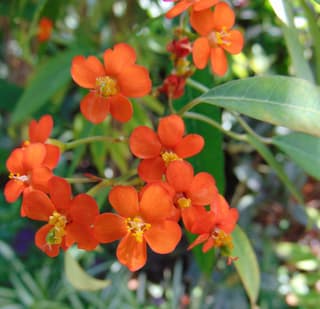
Scarlet Plume
Euphorbia fulgens
Scarlet Plume (Euphorbia fulgens) is a deciduous shrub native to Mexico, renowned for its gracefully arching branches adorned with small scarlet to orange flowers during winter. Belonging to the Euphorbiaceae family, it produces a milky white latex sap that is irritating to skin and eyes. It is widely cultivated as an ornamental plant and used as a cut flower.

Thornless Crown of Thorns
Euphorbia geroldii
Euphorbia geroldii, commonly known as the Thornless Crown of Thorns or Gerold's Spurge, is a succulent shrub in the spurge family (Euphorbiaceae), endemic to the dry coastal forests of northeastern Madagascar. Unlike its thorny relative Euphorbia milii, E. geroldii produces smooth, unarmed woody stems clothed in glossy, dark green, lance-shaped leaves edged in red. Clusters of small, saucer-shaped bracts in vivid red with yellow centers appear almost continuously throughout the year, making this a popular, low-maintenance flowering succulent for bright indoor spaces and warm-climate gardens. In the wild it is classified as Critically Endangered due to habitat loss, so cultivated specimens play a small role in ex-situ conservation.
Medium Care Easy Care
Our selection of 1162 medium easy care combines the characteristics of this category with moderate care needs. Ideal for those with basic experience.
Why Choose Medium Easy Care?
Combining the beauty of easy care with medium difficulty level lets you enjoy this category with a balanced care commitment. Each plant was selected to offer the best characteristics of the category at the care level you are looking for.