2343 Easy Plants | 2026 Guide - Page 37
Discover 2343 easy plants for your garden. Complete care guide.
2343 Easy Plants
Showing 1297-1332 of 2343
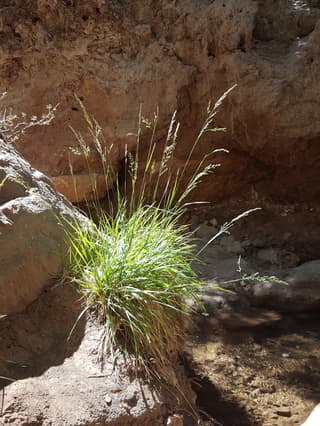
Tall Fescue
Lolium arundinaceum
Tall Fescue (Lolium arundinaceum) is a robust cool-season perennial grass native to Europe and widely naturalized worldwide. Renowned for its deep root system — extending up to 3 feet — it is one of the most heat- and drought-tolerant cool-season grasses available. It forms dense clumps and grows vigorously in spring and fall, thriving in a wide range of soils and light conditions from full sun to partial shade. It is widely used for lawns, pastures, erosion control, and sports fields.
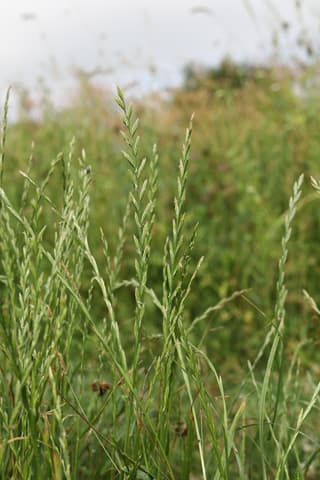
Perennial ryegrass
Lolium perenne
Perennial ryegrass (Lolium perenne) is one of the most widespread and important perennial turfgrasses in the world. A member of the Poaceae (grass) family, it is a bunch-forming perennial with dense, shiny, dark green leaves, growing to a height of 10–80 cm. Due to its outstanding wear tolerance and exceptional recovery capacity, it is extensively used on sports fields, airports, parks, and home lawns. With rapid germination (5–10 days) and a vigorous growth rate, it is one of the most reliable turf-forming grasses, while also serving as an important forage crop in agriculture.
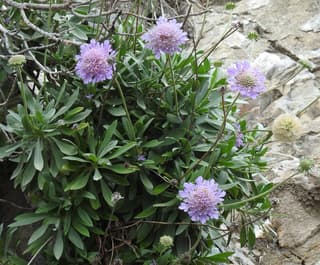
Cretan Scabious
Lomelosia cretica
The Cretan Scabious (Lomelosia cretica, formerly known as Scabiosa cretica) is a low-growing, semi-evergreen perennial shrub in the honeysuckle family (Caprifoliaceae), native to the eastern Mediterranean basin, primarily the island of Crete. Its characteristic pincushion-shaped, lavender-pink flowers bloom from late spring to mid-summer above silvery gray-green, ovate-lanceolate leaves, held by white-tomentose stems. It is a drought-tolerant, sun-loving species best suited for rock gardens and Mediterranean-style plantings with well-ventilated, calcareous soil.
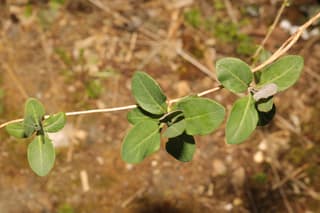
Honeysuckle
Lonicera
Lonicera, commonly known as honeysuckle, is a large genus of around 200 species in the family Caprifoliaceae, native to the Northern Hemisphere. The genus includes both climbing vines and shrubs, deciduous and semi-evergreen, prized for their tubular, often fragrant flowers, long bloom season, and ornamental berries. Species such as Lonicera periclymenum (European honeysuckle) and L. japonica (Japanese honeysuckle) are garden classics that attract pollinators, hummingbirds, and birds.
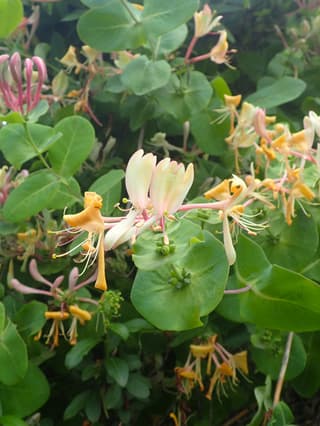
Italian Honeysuckle
Lonicera caprifolium
Lonicera caprifolium, commonly known as Italian honeysuckle or goat-leaf honeysuckle, is a vigorous deciduous climbing vine native to Europe, from Norway south to Spain and east into the Caucasus. It is celebrated for its exceptionally fragrant tubular flowers in shades of cream, white, and pink, which are especially intoxicating at dusk and dawn. A classic cottage garden plant, it twines readily over pergolas, fences, and trellises, attracting bees, butterflies, and hummingbirds.
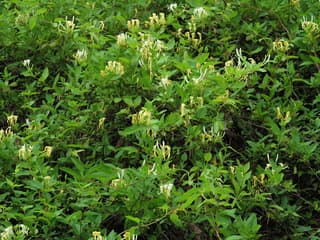
Japanese Honeysuckle
Lonicera japonica
Lonicera japonica, commonly known as Japanese Honeysuckle, is a vigorous, twining, woody vine native to eastern Asia. It produces intensely fragrant tubular flowers that open white and fade to golden yellow, attracting hummingbirds and butterflies. While beloved for its sweet scent and ornamental value, it is classified as an invasive species in many regions outside its native range due to its rapid, aggressive growth.
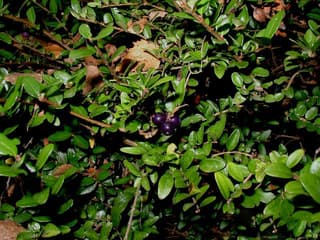
Boxleaf Honeysuckle
Lonicera nitida
Lonicera nitida, commonly known as Boxleaf Honeysuckle, is a fast-growing evergreen shrub native to China. It is widely valued in horticulture for its dense, small-leaved foliage that responds exceptionally well to clipping and shaping. Frequently used for hedging, topiary, ground cover, and border planting, it produces small, fragrant white flowers in spring followed by blue-purple berries.
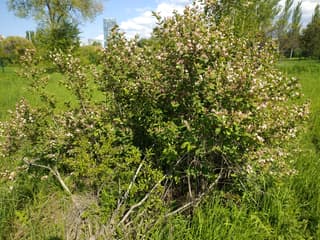
Tatarian Honeysuckle
Lonicera tatarica
Tatarian honeysuckle (Lonicera tatarica) is a fast-growing deciduous shrub in the Caprifoliaceae family, native to Central Asia and southern Siberia. It typically reaches 2-3 m tall and wide, with oval blue-green leaves and fragrant, tubular pink-to-white flowers that bloom in late spring, followed by round red-to-orange berries in summer. Long valued as an ornamental hedge and screening plant for its dense growth and early flowering, it has since escaped cultivation across much of the northeastern and midwestern United States and eastern Canada, where it is classified as invasive: it leafs out earlier and drops leaves later than native shrubs, shading out spring wildflowers and outcompeting native understory vegetation. Its berries, while attractive to birds that spread the seeds widely, are mildly toxic to humans and pets if eaten in quantity.
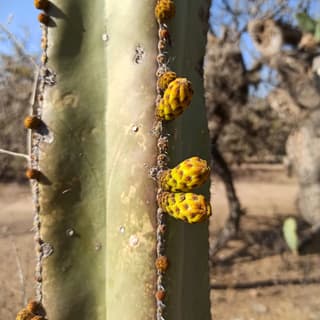
Mexican Fencepost Cactus
Lophocereus marginatus
The Mexican Fencepost Cactus (Lophocereus marginatus) is a tall columnar cactus native to Mexico, traditionally used as a living fence in rural areas. Its upright, spine-laden stems form effective natural barriers. It grows rapidly, potentially exceeding 20 feet, and produces small pinkish-red flowers in spring and summer.
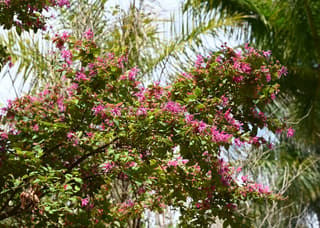
Chinese Fringe Flower
Loropetalum chinense
The Chinese fringe flower (Loropetalum chinense) is an evergreen shrub in the Hamamelidaceae family, native to China, Japan, and northern India. It is highly valued in ornamental gardening for its striking ribbon-like or fringed flowers, which bloom in clusters toward the end of winter and early spring, and for its foliage, which in popular varieties (such as var. rubrum) takes on deep purple or burgundy tones under direct sunlight. With a medium growth rate and compact habit, it is commonly used as a hedge, specimen shrub, or border plant in temperate to warm climate gardens.
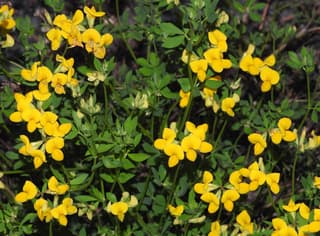
Bird's-Foot Trefoil
Lotus
Bird's-Foot Trefoil (Lotus) is a low-growing perennial wildflower in the pea family (Fabaceae), native to temperate Eurasia and North Africa. It forms spreading mats of bright yellow-orange flowers from late spring through summer, attracting bumblebees and butterflies. Exceptionally drought-tolerant, it thrives in poor soils and can fix atmospheric nitrogen through root symbionts, making it valuable for meadow restoration and erosion control.
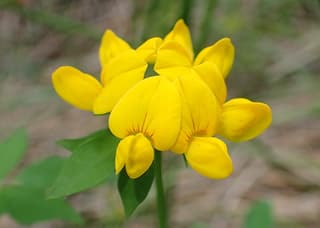
Greater Bird's-foot Trefoil
Lotus pedunculatus
Greater bird's-foot trefoil (Lotus pedunculatus) is a herbaceous perennial legume native to Europe, found in damp meadows, wet ditches, marshes and riverbanks. It differs from related trefoils by its always-hollow stem and reflexed sepals. It bears clusters of golden-yellow flowers and, as a nitrogen-fixing legume, is valued both as a forage crop and as a wildlife-friendly ornamental for wet gardens and pond margins.
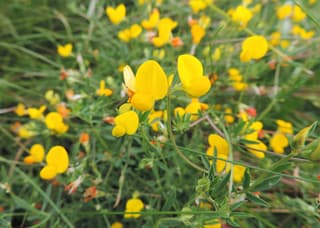
Narrow-leaved bird's-foot trefoil
Lotus tenuis
Lotus tenuis, commonly called narrow-leaved bird's-foot trefoil, is a low-growing perennial legume in the pea family (Fabaceae), closely related to Lotus corniculatus. Native to Europe and southwestern Asia and now naturalized worldwide, it forms compact, bushy clumps 30-45 cm tall with slender, hairless leaflets and clusters of bright yellow flowers that fade to orange-red with age. As a nitrogen-fixing legume it improves soil fertility naturally and is prized for pollinator-friendly meadows, erosion control, and low-input forage plantings.
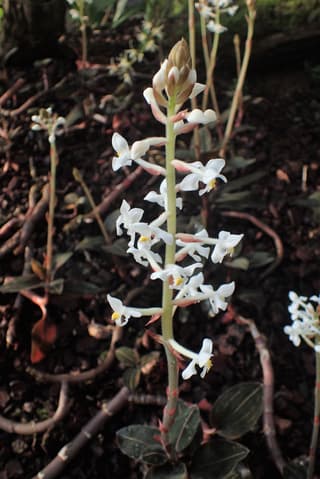
Jewel Orchid
Ludisia discolor
Ludisia discolor, commonly known as the Jewel Orchid, is a terrestrial orchid prized for its stunning velvety foliage rather than its flowers. Native to the tropical forests of Southeast Asia, this orchid features deep green to nearly black leaves adorned with shimmering gold, red, or pink veins and burgundy undersides. Unlike most orchids, it grows in soil rather than on trees, spreading via creeping rhizomes to form dense, elegant clumps.
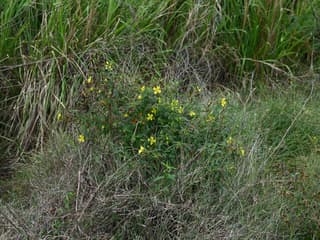
Mexican Primrose-Willow
Ludwigia octovalvis
Ludwigia octovalvis, commonly known as the Mexican primrose-willow, is a perennial plant in the Onagraceae family, native to tropical and subtropical regions worldwide. It grows naturally along riverbanks, marshes, rice paddies, ditches, and wetlands, reaching up to 3 meters in height. Its erect, branched stems become woody at the base, while the lanceolate, glossy leaves add elegance to the plant's stature. The four-petaled yellow flowers are numerous and appear along the branches during spring and summer, attracting pollinators such as bees and insects. It is widely used in ethnomedicine by Asian, African, and American communities to treat gastrointestinal conditions, rheumatism, diabetes, and skin problems.
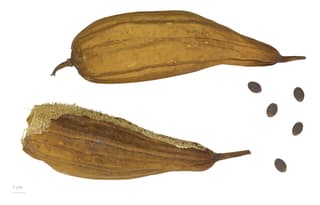
Sponge Gourd
Luffa aegyptiaca
Luffa aegyptiaca, commonly known as Sponge Gourd or Smooth Loofah, is a vigorous annual climbing vine in the Cucurbitaceae family, native to South and Southeast Asia. Widely cultivated throughout the tropics, it is prized for its fibrous mature fruits that dry into natural sponges used for bathing and cleaning. The plant produces showy bright yellow flowers and can reach up to 9 meters in length with proper support.
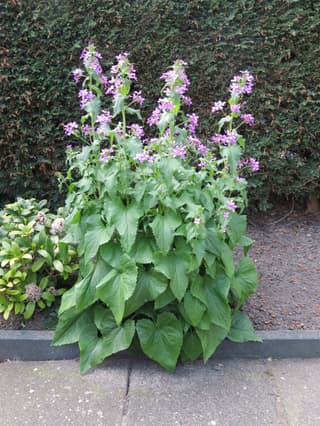
Honesty
Lunaria
Honesty (Lunaria annua) is a biennial member of the Brassicaceae (cabbage) family, grown in gardens worldwide for its fragrant pink, purple, and white spring flowers and, above all, for its translucent, silvery seed pods that resemble coins or full moons. Native to southeastern Europe and western Asia, the plant spends its first year as a low rosette of leaves and only flowers in its second year, reaching 60-90 cm tall. After flowering, the flat green seed pods mature and shed their outer layers, revealing a papery, shimmering inner septum prized in dried floral arrangements.
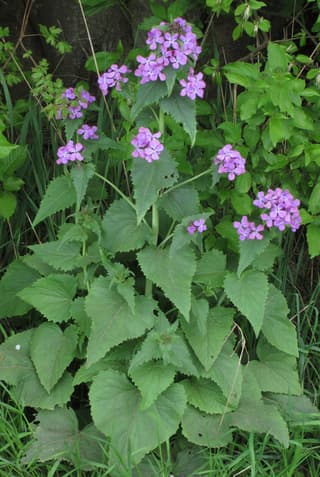
Honesty
Lunaria annua
Honesty (Lunaria annua) is a cottage-garden biennial in the mustard family, grown for its purple-to-white spring flowers and, later, its papery, translucent, coin-shaped seed pods that are prized in dried arrangements.
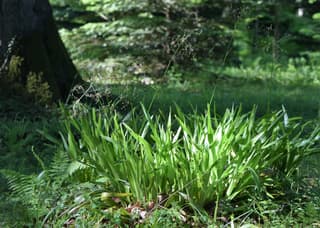
Woodrush
Luzula
Luzula is a genus of grass-like evergreen perennials in the rush family (Juncaceae), commonly called woodrushes. They form dense clumps of glossy green leaves fringed with fine silky hairs, topped in spring by airy panicles of small brown and cream flowers on arching stems. Shade-tolerant and low-maintenance, they are grown chiefly as ground cover in woodland gardens and shaded borders.
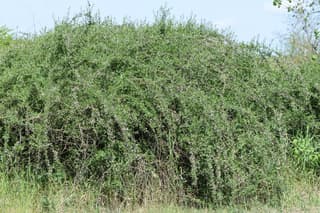
Goji Berry
Lycium barbarum
Lycium barbarum, commonly known as goji berry or wolfberry, is a deciduous woody shrub native to China, prized for its bright orange-red, nutrient-rich berries and long history of use in Traditional Chinese Medicine. It grows as an arching, spreading bush up to 3 m tall and is valued both as an edible fruiting shrub and as an ornamental hedge.
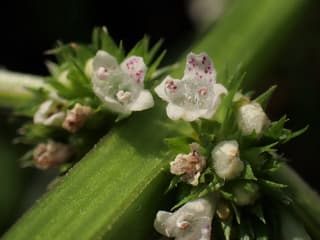
Gypsywort
Lycopus europaeus
Gypsywort (Lycopus europaeus) is a perennial herbaceous plant from the mint family (Lamiaceae), widely distributed throughout Europe, the Caucasus, and West Asia. It prefers to grow on banks, in reeds, and sedge stands on wet to flooded, nutrient-rich soils. The plant, 30 to 120 cm tall, forms opposite, deeply lobed leaves whose shape resembles a wolf's paw – hence the German and Latin names (Greek "lykos" = wolf, "pous" = foot). From July to September, small white, violet-dotted labiate flowers appear in the leaf axils, attracting numerous wild bees, hoverflies, and butterflies. The vigorous plant spreads rapidly via underground runners.
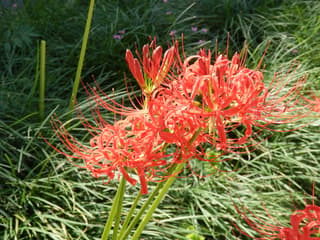
Red Spider Lily
Lycoris radiata
Lycoris radiata is a bulbous perennial from East Asia that sends up leafless stalks topped with fiery red, spidery flowers in early autumn. The strap-like leaves appear only after the blooms fade, persist through winter and spring, then vanish in early summer as the bulb goes dormant. All parts of the plant are highly toxic because of lycorine alkaloids.
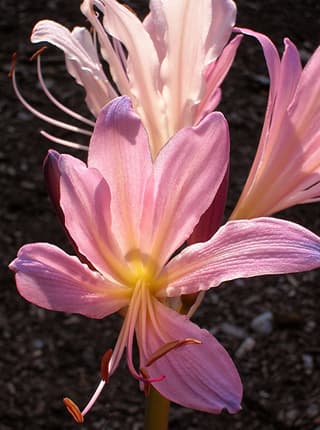
Resurrection lily
Lycoris squamigera
Lycoris squamigera is a hardy bulb in the Amaryllidaceae family, prized for its surprising bloom cycle: strap-shaped, silvery-green leaves emerge in early spring, photosynthesize, and die back completely by early summer, leaving bare ground. Then, seemingly out of nowhere in late summer, leafless flower stalks shoot up and open into clusters of fragrant, rose-pink, trumpet-shaped blooms. All parts of the plant contain lycorine alkaloids and should be kept away from children and pets.
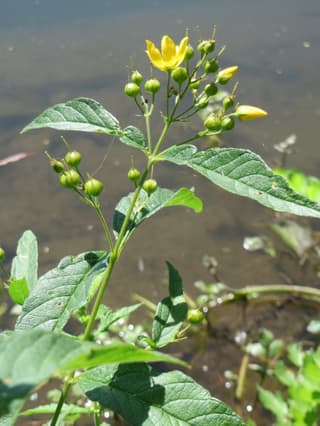
Loosestrife
Lysimachia
Lysimachia is a large and diverse genus of flowering plants in the family Primulaceae, commonly known as loosestrifes. The genus encompasses around 180 species of annuals and perennials native to temperate regions across the Northern Hemisphere, with the greatest diversity found in China. Species range from upright border perennials like Lysimachia punctata (dotted loosestrife) and Lysimachia vulgaris (yellow loosestrife) to ground-hugging creepers like Lysimachia nummularia (creeping Jenny). Flowers are typically five-petaled and appear in yellow, white, pink, or purple. Many species thrive in moist to wet environments, making them excellent choices for pond margins, rain gardens, and boggy areas.
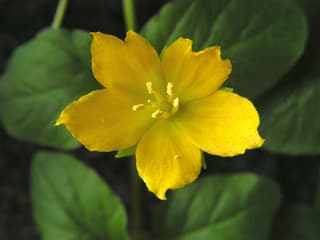
Creeping Jenny
Lysimachia nummularia
Lysimachia nummularia, commonly known as Creeping Jenny, is a vigorous, low-growing perennial ground cover. It features small, rounded, lime-green to golden leaves that resemble coins, and produces bright yellow, cup-shaped flowers in the summer. It is highly valued for its ability to quickly cover ground in damp areas and its beautiful trailing habit in containers. It can also be grown submerged in aquariums.
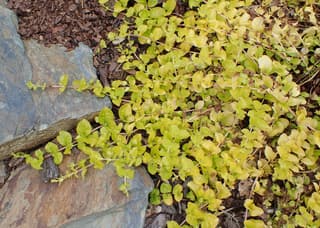
Golden Creeping Jenny
Lysimachia nummularia 'Aurea'
Lysimachia nummularia 'Aurea' is a golden-foliaged cultivar of the European Creeping Jenny, forming dense, low-growing mats of bright yellow-green to golden foliage. It is widely used as a ground cover, in bog gardens, along water features, and in hanging baskets.
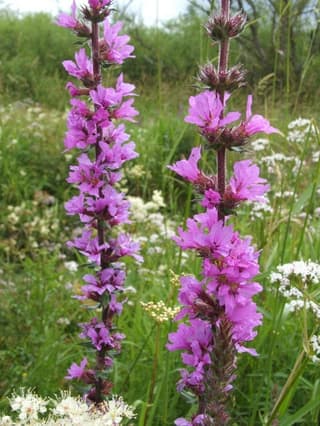
Loosestrife (genus)
Lythrum
Lythrum is a genus of herbaceous perennial plants in the family Lythraceae, found across wetlands, riverbanks, and marshy areas worldwide. The most well-known species, L. salicaria (purple loosestrife), produces dense spikes of rose-purple flowers in summer and is considered invasive in North America.
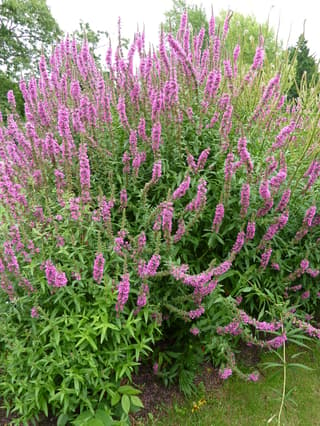
Purple Loosestrife
Lythrum salicaria
Purple loosestrife is a wetland perennial native to Europe and Asia, prized for its tall, showy spikes of magenta-purple flowers that bloom through summer. It grows vigorously in moist meadows, marshes, and pond margins. WARNING: it is a highly invasive species in North American wetlands, where it forms dense monocultures that crowd out native vegetation — planting and sale are banned or restricted in many US states and Canadian provinces.
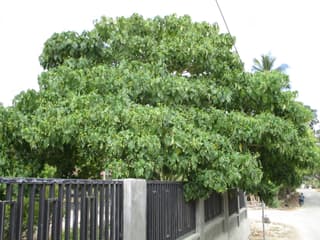
Parasol leaf tree
Macaranga tanarius
Macaranga tanarius is a fast-growing pioneer tree belonging to the Euphorbiaceae family, native to Southeast Asia, southern China, Australia, and the Pacific Islands. It reaches between 4 and 15 meters in height in its natural habitat and is distinguished by its large, peltate, rounded leaves with a velvety texture, where the petiole is inserted near the center of the underside rather than the edge. It is a typical colonizing species of secondary forests, clearings, and disturbed land, hence its common name 'parasol tree'. It produces greenish-yellow flowers clustered in racemes that give way to three-celled prickly capsules containing black seeds.
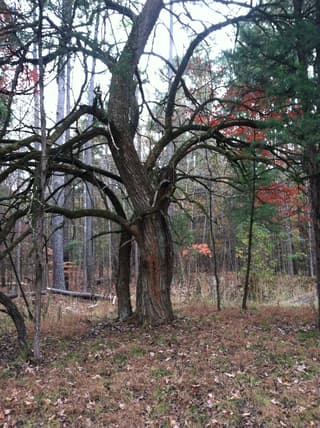
Osage Orange
Maclura pomifera
Osage orange (Maclura pomifera) is a medium to large deciduous tree native to the river valleys of Oklahoma, Texas, and Arkansas. It is best known for its large, wrinkled, yellow-green fruit that resembles an orange but is inedible to humans. Historically planted as a thorny living fence before the invention of barbed wire, its extremely dense, durable wood was prized by Native American tribes for making bows -- earning it the name bois d'arc (wood of the bow).
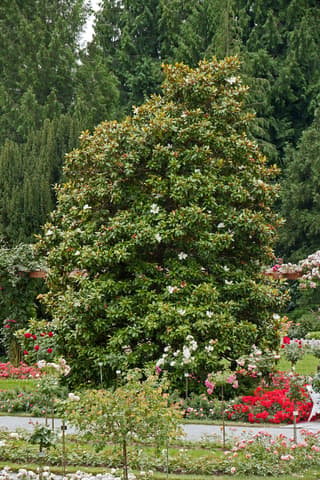
Southern Magnolia
Magnolia grandiflora
Magnolia grandiflora, the Southern Magnolia or Bull Bay, is a majestic evergreen tree native to the southeastern United States. It is celebrated for its enormous creamy-white fragrant flowers up to 30 cm across, glossy dark green leaves with distinctive rust-colored undersides, and impressive stature reaching up to 24 meters tall.
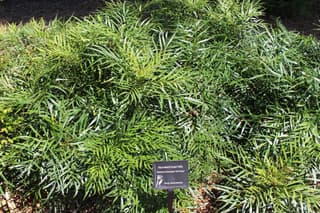
Soft Caress Mahonia
Mahonia eurybracteata
Mahonia eurybracteata 'Soft Caress' is an evergreen ornamental shrub native to China, known for its soft, thornless, narrow leaves that grow in rosettes and resemble ferns. From late summer to early spring, it blooms with lemon-yellow, sweetly scented flower spikes, which are later followed by blue berries that birds enjoy. The shrub has a compact, upright growth habit and rarely exceeds one meter in height, making it suitable as a groundcover or a specimen plant in shade gardens.
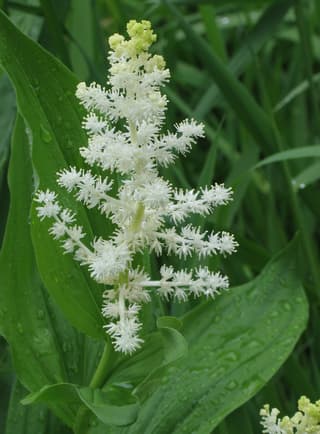
False Lily of the Valley
Maianthemum
Maianthemum is a genus of 35+ rhizomatous woodland perennials in the asparagus family (Asparagaceae, subfamily Nolinoideae), native across North America, Europe, and East Asia. This is a GENUS-level profile covering multiple species -- including M. racemosum (False Solomon's Seal, North America) and M. bifolium (May Lily, Europe/Asia) -- rather than a single species. Plants spread slowly into colonies via thick creeping rhizomes, bearing heart-shaped to lance-shaped leaves and clusters of small white star-shaped flowers followed by red berries in fall.

Copper Ice Plant
Malephora crocea
Malephora crocea is a low-growing, evergreen succulent groundcover from the Aizoaceae family, native to South Africa. Its fleshy, triangular leaves range in color from grayish-green to reddish, turning a distinct copper-red during periods of drought. From spring to fall, it produces multi-petaled flowers in shades of yellow, orange, or red that only fully open in bright sunlight. Its woody, trailing stems root wherever they touch the ground, forming a dense, spreading carpet.
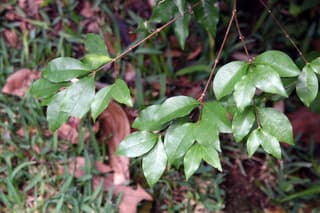
Barbados Cherry
Malpighia glabra
Malpighia glabra, commonly known as Barbados Cherry or Acerola, is a tropical fruit shrub native to the Caribbean and Central and South America. It is celebrated worldwide for producing one of the richest natural sources of vitamin C — small red cherries with a sweet-tart flavor that ripen multiple times per year. Equally valued as an ornamental and edible plant.
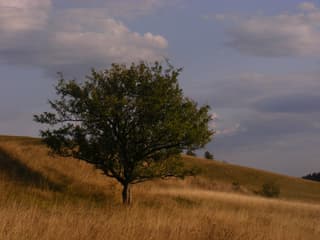
European Crab Apple
Malus sylvestris
Malus sylvestris, the European Crab Apple, is a small to medium deciduous tree native to Europe and parts of western Asia. It belongs to the Rosaceae family and grows up to 10 metres tall, producing clusters of delicate white to pale pink blossoms in spring, followed by small, hard, greenish-yellow fruits (2–4 cm) with a characteristically sour and astringent flavour. One of the ancestors of the cultivated apple, this species is of great ecological importance, supporting over 90 associated insect species and providing food for birds and mammals. Its bark becomes rough and fissured with age, and the dense, thorny branching offers excellent wildlife habitat.
What are Easy Plants?
Easy Plants are ideal for beginners or people with little time for care. These species are tolerant of watering mistakes, light variations, and don't require constant attention. Perfect for those just starting out with plants.
Tips for Growing Easy Plants
To succeed with easy plants, remember: less is more. Avoid overwatering, choose a spot with adequate light, and let the soil dry between waterings. Most of these plants prefer to be 'forgotten' occasionally.