Asteraceae
Helichrysum: how to grow everlasting flowers
Helichrysum
A sun-loving, Mediterranean-style plant that thrives on little care: full sun, sharply draining poor-to-average soil and only occasional watering once established. Avoid wet, heavy soil and humid, stagnant air, which cause rot and mildew. Trim lightly after flowering and cut back in spring to keep it compact; hardiness depends on the species, so protect tender types such as the licorice plant from frost.
Every 10 days
Direct sun
-5° - 35°C
30% - 60%
Categories
What is Helichrysum?
Helichrysum (Helichrysum) is a easy-care plant from the Asteraceae family. Helichrysum is a large genus of about 600 species in the daisy family (Asteraceae), native mainly to Africa and Madagascar, with others around the Mediterranean, in Eurasia and Australasia. Most are low, bushy subshrubs or perennials with narrow, often silvery or woolly grey leaves and clusters of s...
Helichrysum grows up to 60cm, spread of 60cm, watering every 10 days, -5°C – 35°C, 30–60% humidity. It is not suitable for indoor environments and safe for pets.
Unlike many tropical plants, Helichrysum tolerates watering mistakes. Best for beginners. Unlike many popular species, Helichrysum is safe to keep around pets.
How to Care for Helichrysum?
TLDR: Helichrysum needs Direct sun, watering every 10 days, and temperatures between -5-35°C with 30-60% humidity.
How Often Should You Water Helichrysum?
Water deeply but infrequently. In pots, let the top few centimetres of compost dry out before soaking again, roughly every 7-10 days in summer and much less in winter. Plants in the ground need watering only until established and then during long droughts or heatwaves. Never leave the roots sitting in wet soil and water at the base, keeping the foliage dry.
How Much Light Does Helichrysum Need?
Give it full sun, at least six hours of direct light a day, in a spot sheltered from cold, drying winds. In shade the stems become leggy, the silver colour fades and flowering is poor. It is an outdoor plant; indoors it rarely gets enough light.
What Is the Best Soil for Helichrysum?
Use a well-drained, poor to moderately fertile soil, ideally neutral to alkaline. Sandy, gravelly or loamy soils are fine; heavy clay must be improved with grit. In containers, mix about 30% horticultural grit or perlite into a loam-based compost and make sure the pot drains freely.
What Pot Should You Use for Helichrysum?
A terracotta or other porous pot with large drainage holes, filled with gritty, loam-based compost. Wide, shallow containers and rock-garden troughs suit the compact species; the trailing licorice plant looks best spilling from hanging baskets and window boxes.
Care Schedule
Repot
Every 730 days
What Is Helichrysum and Where Does It Come From?
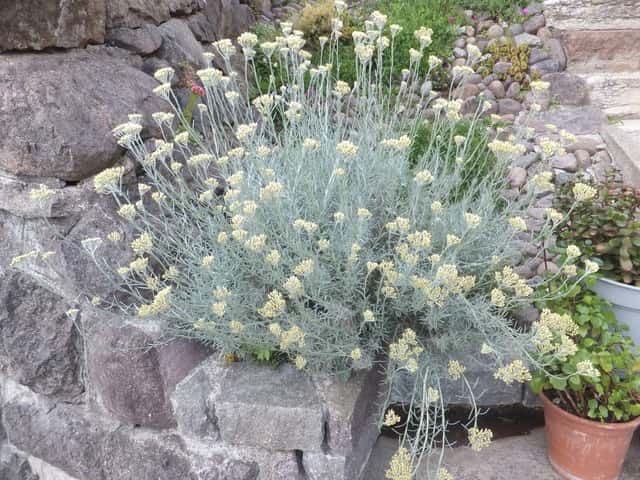
Helichrysum is a large genus of about 600 species in the daisy family (Asteraceae), native mainly to Africa and Madagascar, with others around the Mediterranean, in Eurasia and Australasia. Most are low, bushy subshrubs or perennials with narrow, often silvery or woolly grey leaves and clusters of small button-like flower heads surrounded by dry, papery bracts that keep their shape and colour when dried, hence the names everlasting, immortelle and strawflower. In gardens the most common are Helichrysum italicum (curry plant), with curry-scented silver foliage and mustard-yellow flowers, Helichrysum petiolare (licorice plant), grown for its trailing felted leaves, and compact rock-garden species such as H. amorginum and H. stoechas. Grown plants usually stay 20-60 cm tall. The big, colourful annual sold as strawflower (formerly H. bracteatum) is now classified as Xerochrysum bracteatum.
How to Propagate Helichrysum?
Semi-ripe stem cuttings
Grey, woolly-leaved cuttings rot easily: keep the mix barely moist and give them good air circulation instead of a closed propagator.
- 1 In summer, cut non-flowering shoot tips 7-10 cm long just below a leaf node.
- 2 Strip the lower leaves and, if you like, dip the base in rooting hormone.
- 3 Insert the cuttings into a very free-draining mix of compost and perlite or grit.
- 4 Keep them in bright, indirect light and water sparingly, without covering them tightly.
- 5 Pot them on once roots appear and grow them on before planting out.
Materials needed:
Sowing seed
Many named varieties do not come true from seed; use cuttings to keep a particular form.
- 1 Sow seed in spring on the surface of a seed-raising mix, pressing it in lightly.
- 2 Keep at about 18-21 C in good light and lightly moist.
- 3 Transplant seedlings when they have 2-4 true leaves.
- 4 Plant out in full sun after the last frost.
Materials needed:
Division
Works for clump-forming perennials; woody shrubby types are better propagated by cuttings.
- 1 In spring, lift clump-forming perennial species.
- 2 Split the clump into sections, each with healthy roots and shoots.
- 3 Replant at once in well-drained soil and water in lightly.
Materials needed:
How Big Does Helichrysum Grow?
TLDR: Helichrysum can reach up to 60cm tall with Medium growth rate.
Max height
60cm
Spread
60cm
Growth rate
Medium
Foliage
Evergreen
Plant Uses
Ornamental
Great for decoration
Aromatic
Pleasant fragrance
Medicinal
Medicinal properties
Medicinal Uses
- Essential oil of Helichrysum italicum (immortelle) is used in aromatherapy and skin-care products
- Flowers of Helichrysum arenarium are used in traditional European herbal medicine as an infusion for digestion and the bile ducts
Is your plant showing symptoms?
Click on the symptom to discover possible causes:
What Diseases Commonly Affect Helichrysum?
TLDR: Helichrysum is susceptible to 10 known diseases. Monitor regularly for early detection.
Root Rot
Root rot is a serious fungal disease that affects the root system of plants, causing them to decay and die. It is primarily caused by overwatering, poor drainage, or soil-borne fungi such as Pythium, Phytophthora, Rhizoctonia, and Fusarium. The disease thrives in waterlogged conditions where roots are deprived of oxygen, making them susceptible to fungal infection.
Powdery Mildew
Powdery mildew is a common fungal disease caused by various fungi species including Erysiphe, Podosphaera, Oïdium, and Leveillula. It affects over 10,000 plant species worldwide. The disease thrives in warm, dry climates with high humidity and appears as a distinctive white powdery coating on plant surfaces.
Grey Mould
Crown Rot
Crown rot is a serious fungal disease that attacks the crown (base) of the plant where the stem meets the soil. It is caused by various fungal pathogens including Phytophthora, Fusarium, and Rhizoctonia. The disease thrives in waterlogged conditions and can quickly spread to kill the entire plant if not addressed promptly.
Meaning & Symbolism
Immortality and lasting remembrance: the name comes from the Greek helios (sun) and chrysos (gold), and the papery flower heads keep their colour long after picking, which earned the genus the names everlasting and immortelle.
Fun Facts
The name Helichrysum comes from the Greek helios (sun) and chrysos (gold), after the golden flower heads of many species.
South Africa alone is home to about 244 Helichrysum species.
The leaves of Helichrysum italicum smell strongly of curry, but the plant is not the source of curry powder or curry leaves.
The papery bracts hold their shape and colour for months after drying, which made the genus a classic of dried-flower arrangements.
Frequently asked questions
Is Helichrysum the same as strawflower?
How often should I water Helichrysum?
Is Helichrysum frost hardy?
Why is my Helichrysum turning brown or rotting?
When should I prune Helichrysum?
Compare with similar plants
| Attribute | Difficulty | Light | Watering | Pet Safe |
|---|---|---|---|---|
| Field Maple | Easy | Bright indirect | 14d | ✓ |
| Iberian Houseleek | Easy | Direct sun | 14d | ✓ |
| Silver Birch | Easy | Direct sun | 14d | ✓ |
| Common Blanketflower | Easy | Direct sun | 10d | ✓ |