Arecaceae
Cabbage Palm (Sabal palmetto): Care Guide
Sabal palmetto
An easy, low-maintenance palm for full sun outdoors in USDA zones 8a-11. It is not fussy about soil, tolerates drought and occasional flooding once established, and handles salt spray. Water regularly while it establishes, feed with a controlled-release palm fertilizer about three times a year, and only cut off leaves that are completely brown.
Every 10 days
Direct sun
-12° - °C
% - %
Categories
What is Cabbage palm?
Cabbage palm (Sabal palmetto) is a easy-care plant from the Arecaceae family. Sabal palmetto, the cabbage palm, is a solitary fan palm native to the coastal plain of the southeastern United States (Florida to North Carolina), the Bahamas, northern Cuba and the Yucatan Peninsula. It carries a round crown of large costapalmate, fan-shaped leaves on a single trunk 25-40 cm thick...
Cabbage palm grows up to 24.0m, spread of 450cm, watering every 10 days. It is not suitable for indoor environments and safe for pets.
Unlike many tropical plants, Cabbage palm tolerates watering mistakes. Best for beginners. Unlike many popular species, Cabbage palm is safe to keep around pets.
How to Care for Cabbage palm?
TLDR: Cabbage palm needs Direct sun, watering every 10 days, and temperatures between -12-30°C with 40-70% humidity.
How Often Should You Water Cabbage palm?
Keep the root zone evenly moist for the first months after planting or transplanting, when the palm lives mostly on water stored in its trunk. Once established it is drought tolerant, but it grows best with deep watering every week or two during hot, dry spells.
How Much Light Does Cabbage palm Need?
Plant in full sun with at least 6 hours of direct light a day. Young palms tolerate some shade, but they will not form a trunk until they get open sky above them.
What Is the Best Soil for Cabbage palm?
Grows in sandy, loamy or clay soils across a wide pH range, as long as the roots are not in salty water. A fertile, well-drained soil with some organic matter gives the fullest canopy.
What Pot Should You Use for Cabbage palm?
Best planted in the ground. Young palms can spend a few years in a deep, heavy terracotta or plastic nursery pot with drainage holes, since the roots grow straight down.
Care Schedule
Fertilize
Every 120 days
What Is Cabbage palm and Where Does It Come From?
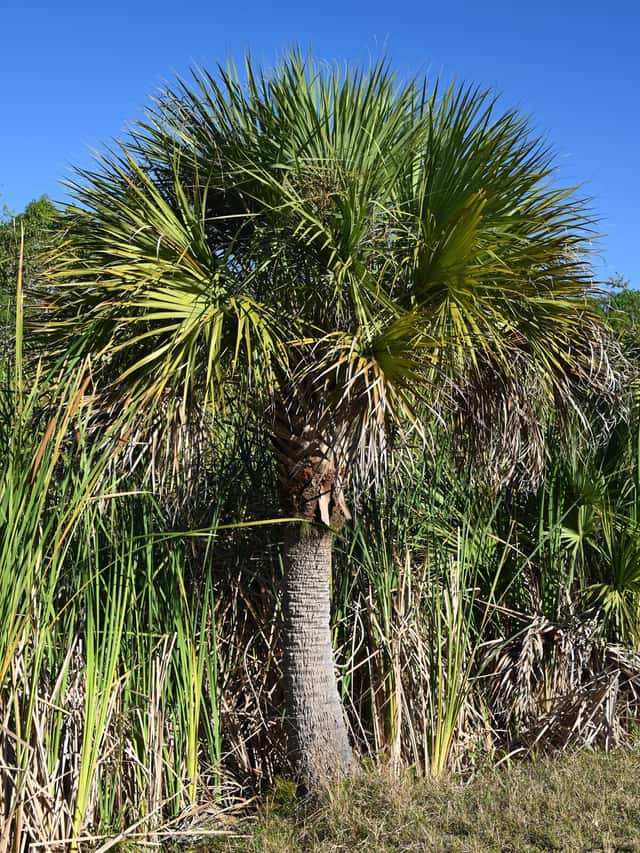
Sabal palmetto, the cabbage palm, is a solitary fan palm native to the coastal plain of the southeastern United States (Florida to North Carolina), the Bahamas, northern Cuba and the Yucatan Peninsula. It carries a round crown of large costapalmate, fan-shaped leaves on a single trunk 25-40 cm thick that can reach 24 m in the wild, though garden specimens usually stay at 4-10 m. Old leaf bases ("boots") often remain on the trunk in a crisscross pattern. In late spring and early summer long branched flower stalks carry thousands of tiny, fragrant creamy-white flowers that draw bees, followed by small black fruits eaten by birds and raccoons. It is the state tree of both Florida and South Carolina, and is famous for shrugging off salt spray, hurricanes, drought, floods and fire.
How to Propagate Cabbage palm?
Seed
Fresh seed germinates best; under warm, humid conditions germination can start in about 18 days. Seedlings grow slowly and can take many years to form a trunk, so be patient and never cut the roots of trunkless palms.
- 1 Collect ripe black fruits in late summer or fall and remove the thin pulp
- 2 Sow the fresh seeds about 1 cm deep in a deep pot of moist, well-drained mix
- 3 Keep the pot warm (30-35 C) and evenly moist
- 4 Seedlings appear grass-like; let each new leaf widen before transplanting
- 5 Move the young palm to its final spot while it is still small and trunkless, keeping the root ball intact
Materials needed:
How Big Does Cabbage palm Grow?
TLDR: Cabbage palm can reach up to 24.0m tall with Slow growth rate.
Max height
24.0m
Spread
4.5m
Growth rate
Slow
Foliage
Evergreen
Plant Uses
Ornamental
Great for decoration
Edible
Can be consumed
Culinary Uses
- The heart (terminal bud) is eaten raw or cooked as "swamp cabbage" or heart of palm, but harvesting it kills the palm
- The flowers are a major nectar source for palmetto honey
Is your plant showing symptoms?
Click on the symptom to discover possible causes:
What Diseases Commonly Affect Cabbage palm?
TLDR: Cabbage palm is susceptible to 5 known diseases. Monitor regularly for early detection.
Phytoplasma
Potassium Deficiency
Potassium deficiency is a nutritional disorder that affects a plant's ability to regulate stomatal opening and closing, resulting in characteristic leaf edge burn. Potassium is a mobile nutrient, so symptoms first appear on older, lower leaves.
Magnesium Deficiency
Magnesium deficiency is a nutrient disorder characterized by interveinal chlorosis, where leaf tissue between veins turns yellow while the veins remain green. This deficiency affects older leaves first as magnesium is a mobile nutrient that plants relocate to support new growth. Magnesium is essential for chlorophyll production and photosynthesis, making this deficiency critical for plant health.
Scale Insects
Scale insects are small sap-sucking pests that appear as brown, shell-like bumps on plant stems and leaves. There are over 25 species, divided into armored (hard) and unarmored (soft) scales. They feed by piercing plant tissue and extracting sap, which weakens the plant and can lead to yellowing, stunted growth, and even death if left untreated. They also excrete honeydew, which attracts ants and promotes sooty mold growth.
Meaning & Symbolism
The palmetto is the emblem of South Carolina: its spongy trunks built Fort Moultrie, whose walls absorbed British cannonballs in 1776, so the palm stands on the state flag as a symbol of resilience and defense. It is also the state tree of Florida.
Fun Facts
The name "cabbage palm" comes from its edible heart, which tastes like cabbage.
After a cut root dies it is not repaired: the palm grows a whole new set of roots from the base of its trunk.
A seedling in a natural forest can take 15-30 years to form a visible trunk.
Native peoples such as the Seminole built their homes (chickees) from its trunks and leaves.
Frequently asked questions
How cold-hardy is the cabbage palm?
Should I trim the leaves of my cabbage palm?
Why are the old leaves of my Sabal palmetto turning yellow-orange?
Why do transplanted cabbage palms struggle?
Can I grow a cabbage palm indoors?
Compare with similar plants
| Attribute | Difficulty | Light | Watering | Pet Safe |
|---|---|---|---|---|
| Field Maple | Easy | Bright indirect | 14d | ✓ |
| Iberian Houseleek | Easy | Direct sun | 14d | ✓ |
| Silver Birch | Easy | Direct sun | 14d | ✓ |
| Common Blanketflower | Easy | Direct sun | 10d | ✓ |





