Yellow Leaves on Sunflowers: Causes and What to Do
Yellow leaves on sunflowers: use the plant's stage and where the yellow sits to tell end of life cycle, watering, low fertilizer, fungus or mites apart, plus the test that confirms each cause.
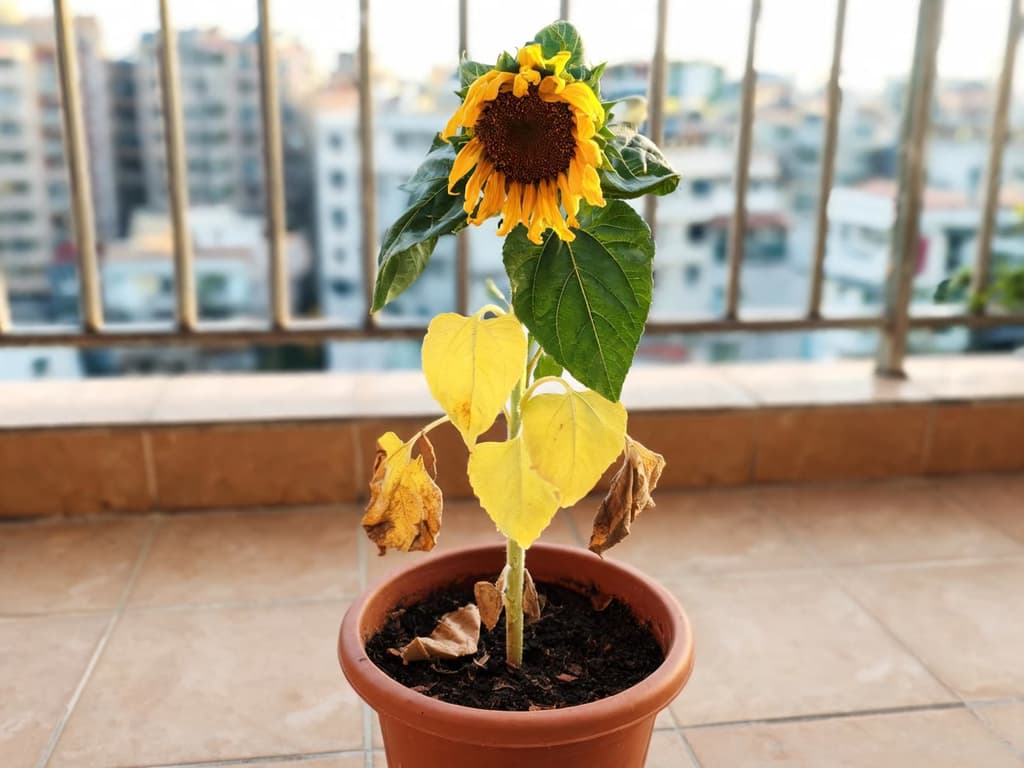
A sunflower with yellow leaves has different causes depending on the plant's stage and the location of the yellowing. If the sunflower has already bloomed and only the bottom leaves turn yellow, it is the end of the cycle: there is no fix, and it is not a disease. Before flowering, yellow bottom leaves point to incorrect watering, a lack of nitrogen, or a pot that is too small.
Yellow leaves at the top of the plant have other causes: cold combined with waterlogged soil, a lack of boron, or a lack of sulfur. Tiny spots and pustules (raised bumps) with a yellow border are rust, fungal leaf spot, or mites. Each cause has a simple test, done with a finger, a knife, or a sheet of paper.
Quick summary:
The sunflower (Helianthus annuus) is an annual. After flowering, the death of the leaves becomes what changes the plant's foliage the most (INMET and Embrapa).
In a study using 3-liter pots, the sunflower without nitrogen grew smaller and had yellow leaves. The older leaves dried out (Pesquisa Agropecuária Brasileira, 1983).
In the same study, a lack of boron and a lack of sulfur turned the top leaves yellow. A lack of potassium turned the edges of the old leaves yellow.
Yellowing between the veins of the bottom leaves around flowering time can be Verticillium wilt, a soil fungus. The sign is a brown ring inside the stem (NDSU).
Rust forms cinnamon-colored pustules with a yellow border, and the powder rubs off on your finger (NDSU).
Bottom leaves yellowing after flowering: the end of the sunflower's cycle
The sunflower sprouts, flowers, sets seed, and dies in the same cycle. Seeds mature 70 to 100 days after planting, according to Iowa State University. The oldest leaves, located at the bottom, are the first to die. The chapter on sunflowers by INMET and Embrapa describes this leaf death starting before flowering. After flowering, the death of the leaves becomes what changes the plant's foliage the most.
This yellowing at the end of the cycle has four signs together:
the flower has already opened, or is already wilting;
the yellowing starts on the lowest leaf and slowly moves up, one leaf at a time;
each leaf turns yellow evenly, with no tiny spots, powder, or blotches;
The top leaves and the leaves surrounding the flower stay green.
In this case, do not fertilize and do not change how you water: keep watering based on dry soil. Remove the dry leaves by hand or with clean scissors if their appearance bothers you. Fertilizer does not make an annual plant start growing again, and a leaf that has turned completely yellow does not turn green again.
You also do not need to cut the plant. The tall sunflower in the yard, with yellow and dried bottom leaves, is forming seeds in the head. Let the head mature to harvest the seeds or for the birds, and pull up the plant when it dries out completely.
A lack of water speeds up this yellowing. Embrapa Meio-Norte records that a lack of water after flowering makes the leaves age prematurely. In a small pot in the sun, check the soil every day until the seed ripens. The guide on how to care for a sunflower shows how long each phase lasts and what to do when the flower dies.
The yellowing is not just the cycle in three cases: before any bud appears, moving up several leaves in a single week, or on the top leaves while the flower is still young. In these cases, the table below points to the cause.
Where the yellow is on the sunflower: the table of causes
Look at the whole plant before changing the watering or fertilizer. The position of the yellowing and its pattern on the leaf separate the causes.
What you see | When it usually appears | Likely cause | Test that confirms |
|---|---|---|---|
Bottom leaves turning uniformly yellow, one at a time, with the top leaves green | After flowering | End of the cycle | Open or wilting flower, with no spots or powder |
Bottom leaves that are yellow and soft, with wet soil | Any stage | Overwatering | Moist soil 3 cm deep, saucer with water |
Bottom leaves yellow and dry, with dry soil | Any stage, more often in the heat | Lack of water | Dry soil at 3 cm, plant perks up after watering |
Small plant, smaller yellowish-green leaves, bottom leaves drying out | Before flowering | A lack of nitrogen | The entire plant is smaller and paler, with completely yellow leaves and no spots |
Edges of the old leaves yellow, then brown and dry | Near the flower | Potassium deficiency | Yellow only on the edge, the middle of the leaf green |
Yellowing between the veins of the bottom leaves, moving upward, with wilting | During flowering | Verticillium wilt | Brown ring or spot on the stem cut |
Bright yellow, almost white leaves at the top | Seedling, with cold and waterlogged soil | Apical chlorosis (yellow top leaves, caused by bacteria) | New leaves emerge green when the weather warms up |
Light-green, deformed, thick top leaves | Near the flower | Lack of boron | Deformed new leaves, small or crooked flower head |
Cinnamon-colored pustules with a yellow border | More common from flowering onward | Rust | The powder rubs off on your finger |
Fine, light stippling, sometimes with webbing | Heat and dry weather | Mites | Tiny specks that move on white paper |
Yellow bottom leaves before flowering: water, nitrogen, or a small pot
Before flowering, the sunflower is still growing leaves. Bottom leaves turning yellow at this stage generally have a cause that can be fixed, and the plant can still produce new green leaves.
Waterlogged or overly dry soil
Stick your finger about 3 cm into the soil before anything else. Wet soil with yellow, soft leaves indicates excess water: the roots run out of air. Dry soil with yellow, dry, and drooping leaves indicates thirst.
In both cases, the rule is the same: water the sunflower based on dry soil, when your finger comes out dry at 3 cm. Water until water drains through the hole and empty the saucer. Waterlogged soil also promotes two diseases that turn young sunflowers yellow: downy mildew and apical chlorosis (yellowing on the top leaves). NDSU, a North Dakota university, links both to waterlogged soil.
Lack of nitrogen
A lack of nitrogen leaves the entire plant smaller and lighter, and the older leaves dry out first. That is what a study from Pesquisa Agropecuária Brasileira measured in 1983, with sunflowers in 3-liter pots. The plants without nitrogen had slow growth from the start. They were smaller, with smaller and yellowish leaves, and bloomed late.
The same study notes that the sunflower absorbs the most nitrogen from the beginning of head formation (the flower head) until flowering.
The test is the pattern of the yellowing. With a lack of nitrogen, the leaf turns yellow completely, without tiny spots or blemishes. The entire plant stays smaller and has a paler green than normal.
To fix this, use flower fertilizer at the label dose, with the soil already moist. Illinois Extension suggests liquid fertilizer every 2 weeks for potted plants. Do not overdo nitrogen: Iowa State University warns that excess nitrogen makes the sunflower grow leaves and disrupts flowering. A sunflower bought already in bloom does not need fertilizer, because the flower is already formed.
A pot that is too small for the roots
The florist sunflower grows in a small pot. In a study published in the journal HortTechnology in 1998, commercial potted plants grew in 0.65- and 1.2-liter pots. The sunflower has a thick taproot that grows straight down, and in a pot that size it has nowhere to go down.
A small pot combines two causes of yellow leaves: the soil dries out in a few hours of sun, and the fertilizer runs out quickly. Iowa State University explains that nutrients in potting soil deplete quickly. The plant absorbs part of them, and watering washes away the rest. The slow-release fertilizer that comes in store-bought soil rarely lasts the entire season.
Signs that the pot has become too small: roots coming out through the drainage hole at the bottom and soil that dries out every day. If the sunflower is still in bud, move it to a larger pot. Keep the root ball intact, the block of soil attached to the roots, without breaking it apart. If it is already in bloom, leave it in the pot and water it more often.
A potted dwarf sunflower bought in bloom combines both factors: a small pot and a plant at the end of its cycle. Pale yellow bottom leaves falling off, with green top leaves and an open flower, are not your mistake. Watering more and then less does not change this yellowing. Keep the soil moist and enjoy the bloom: each flower head stays open for 10 to 15 days, according to Embrapa Meio-Norte.
Yellow border on the old leaves: potassium
When the yellowing begins at the edges of the bottom leaves and the middle of the leaf stays green, the suspect is a lack of potassium. In the 1983 study, the symptom appeared around 50 days after germination. The edge turned yellow on the older leaves, moved to the newer ones, and then dried out, turning brown.
Potassium comes in complete fertilizers, the ones that show the three numbers N, P, and K (nitrogen, phosphorus, and potassium) on the label. Check whether the flower fertilizer has all three and use the dose on the label.
Yellow between the veins of the bottom leaves at flowering time
Yellowing between the veins of the bottom leaves, with the veins still green, has two similar causes in sunflowers. One is a lack of magnesium, which in most plants causes this yellowing between the veins, according to the review of the 1983 study. The other is Verticillium wilt, a disease caused by a fungus that lives in the soil.
NDSU describes Verticillium in sunflowers as follows:
the yellow color and dead spots appear between the veins, starting on the lowest leaves and moving up;
the plant wilts during flowering;
inside the stem, a brown ring appears in the tissue that carries water;
the plant in flower and setting seed is more sensitive than the young plant;
A lack of water, heat, and sandy soil favor the disease.
The test is to cut the stem. Choose a plant that is already heavily affected and cut the base of the stem with a clean knife, from side to side. A brown ring or spot on the cut indicates Verticillium. A clean stem on the inside makes Verticillium less likely and points more toward a nutrient issue.
A beige spot at the base of the stem, right against the soil, with white mold and black grains, is another disease: Sclerotinia rot. NDSU describes the entire plant wilting and the stem fraying at the base. The black grains survive for many years in the soil.
Verticillium and sclerotinia have no cure in the consulted sources. NDSU notes that the Verticillium fungus survives in plant debris. When the sunflower finishes, pull the entire plant up with the roots and do not put it in the compost bin. Embrapa Meio-Norte recommends planting sunflowers in the same area only every 4 years, because of diseases.
In the pot, replace all the soil before planting again. Epsom salt (magnesium sulfate) does not help when the cut shows the brown ring, because the problem is the fungus and not magnesium.
Yellow leaves at the top of the sunflower
A yellow new leaf at the top of the plant is neither the natural cycle nor a lack of nitrogen. In the 1983 study, the deficiencies that turned the top leaves yellow were boron and sulfur. Before thinking about fertilizer, check the weather over the last few days.
Apical chlorosis (cold with waterlogged soil). Chlorosis is the yellowing of the leaf, and apical chlorosis affects the leaves at the top. In sunflowers, NDSU attributes it to a bacterium (Pseudomonas syringae pv. tagetis). The newest leaves turn bright yellow, almost white. It appears with cold, wet weather and waterlogged soil, and the damage is minor, except in very young plants. The test is to wait: with warm weather, new leaves come out green again.
Lack of boron. Embrapa Meio-Norte calls boron the most limiting micronutrient for sunflowers. The deficiency starts in the youngest leaves, which become deformed, light green, and then brown, thick, and brittle. The flower head emerges small or deformed. The same circular explains that very acidic or very alkaline soil locks up boron, even when it is present.
Lack of sulfur. In the 1983 study, a lack of sulfur appeared around 55 days and turned the top leaves yellow. It is easily confused with a lack of nitrogen, and what separates the two is the location: nitrogen yellows the bottom, sulfur the top.
Boron and sulfur come in fertilizers that list these two nutrients on the label. Use the dose on the label, with moist soil.
Small, yellow seedling with a white layer under the leaf. On a young sunflower, this combination is downy mildew, a disease caused by a fungus-like organism. NDSU describes small, yellow plants with a white layer on the underside of the leaves, which can die. Downy mildew appears when it rains right after planting and the soil turns cold and waterlogged. A seedling affected entirely does not recover: pull it out and sow again in soil that does not become waterlogged.
Tiny dots or spots with a yellow border: rust, Alternaria leaf spot, or mites
When the yellow appears around tiny spots, pustules, or patches, the cause is fungus or pests. Watering less or fertilizing does not solve these cases.
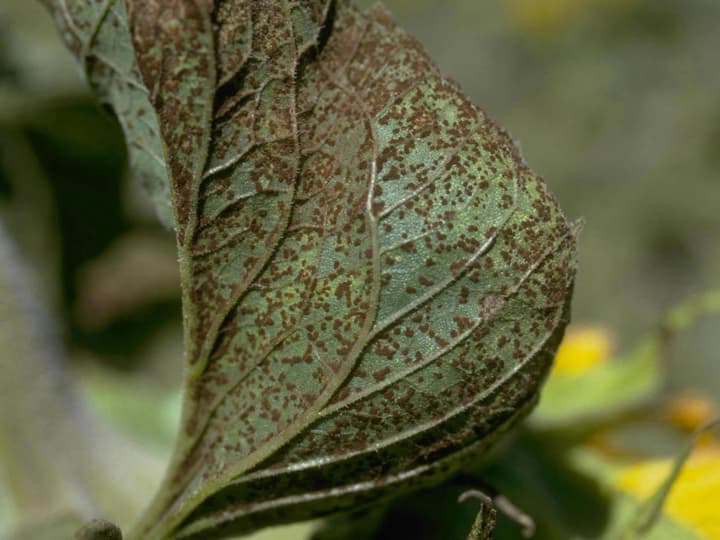
Rust. NDSU describes cinnamon-colored pustules that release a powder that is easy to remove with a finger, often with a yellow border. Embrapa Meio-Norte measures the pustules at 1 to 2 mm, from orange to black. They start on the bottom leaves and move up. Embrapa cites 18 °C to 22 °C with high humidity, and NDSU cites 13 °C to 29 °C.
The test is rubbing a finger over the pustule. NDSU warns that soil splashed onto the bottom leaves is easily confused with rust. Cinnamon-colored powder that stains your finger is rust. Soil washes off with water and does not have a yellow border around it.
Rust spreads where the leaf stays wet frequently from dew, fog, or light rain. Water at the soil level without wetting the leaves, and remove the most affected leaves. According to NDSU, sunflower rust attacks only sunflowers, cultivated or wild, and does not spread to other plants in the garden:
Alternaria leaf spot and Septoria leaf spot. These are spots caused by two fungi. Embrapa Meio-Norte describes Alternaria with 3 to 5 mm spots, brown to black, round or angular. They appear first on the lowest leaves and can merge into large dead areas. Septoria, according to NDSU, causes round spots up to 1.9 cm (¾ inch). They have a tan to gray center and a dark border, often with a yellow ring around them. Neither leaves powder on your finger, unlike rust.
For both types of spots, remove the affected leaves and water without wetting the foliage. A plant that has dark spots and is wilting at the same time calls for the stem test from the previous section.
Mites. The mite is a tiny pest that feeds on the leaf. NC State Extension explains that each bite leaves a light speck. With many specks together, the entire leaf turns yellow or bronze. Fine webbing under the leaves is another sign.
For the mite test, hold a white sheet of paper under the branch and tap the branch lightly, as Iowa State University recommends. Tiny dots that walk slowly on the paper are mites. NC State records that, in hot, dry weather, mites spread carried by the wind. If the paper shows mites, remove the most affected leaves and move the pot away from other plants.
Light stippling without webbing, with black insects that have lace-like wings on the underside of the leaf, is lace bugs. NC State Extension lists the sunflower among the plants this pest attacks.
If you have a dog or cat in the yard, you can treat spots, rust, and mites without any products. Removing diseased leaves, watering at the soil level, changing the potting soil, and pulling up lost plants leave no residue. For a spot or pest you do not recognize, a photo in the Bloom app (available for iOS) identifies the disease. Photo diagnosis is part of the Premium plan.
Should you cut off the yellow leaves of the sunflower?
Before flowering, cut off leaves that are already dry or completely yellow: they will not turn green again. Leaves with rust pustules or dark spots can be removed right away to reduce the fungus near healthy leaves. Leaves that turned yellow from a lack of water or nitrogen, but are still partly green, can stay until they dry out.
Use clean shears and cut flush with the stem. At the end of the cycle, there is no need to remove anything: the whole plant will dry out after forming seeds. Diseased leaves go into the trash, not the compost bin.
Frequently asked questions
Does a sunflower's yellow leaf turn green again?
No. A leaf that has turned completely yellow does not turn green again, even after you correct the watering or fertilizer. The sign that the fix worked is that new leaves come in green. After flowering, the yellowing moves from the bottom up until the plant dries out.
Is a sunflower with yellow, wilting leaves getting too much water?
It can be too much or too little water, and the soil separates the two. Wet soil with soft, yellow leaves indicates roots without air. Dry soil indicates thirst. If the soil is moist and the plant still wilts, look at the base of the stem. A beige spot close to the soil, with white mold and black grains, is Sclerotinia rot.
Does Epsom salt fix yellow leaves on sunflowers?
Only if the cause is magnesium deficiency, which in most plants produces yellowing between the leaf veins. In sunflowers, Verticillium wilt causes the same pattern. Cut the stem first: a brown ring means the fungus, and the salt does not help. The guide on yellow leaves on potted plants explains when Epsom salt causes harm.
Why is the sunflower seedling yellow?
A sunflower seedling that turns yellow after cold and rainy days, with waterlogged soil, usually has apical chlorosis or downy mildew. In apical chlorosis, only the top leaves turn yellow, and the new leaves emerge green when it warms up. In downy mildew, the seedling stays small and develops a white coating on the underside of the leaf. Wait for the soil to dry to a depth of 3 cm before the next watering.
What to do today with the yellow sunflower
First check if the sunflower has already bloomed: bottom leaves turning yellow after the flower is the end of the cycle and needs no fix. Before the flower, stick your finger in the soil and look whether the yellow is at the bottom, at the top, or around tiny spots. Test for the cause, correct only that cause, and monitor the new leaves the following week.
Sources
North Dakota State University (NDSU) Extension, Sunflower Disease Diagnostic Series (Markell, Harveson, Block, and Gulya): ndsu.edu. Accessed on October 8, 2026.
Ribeiro, J. L. Manejo da cultura do girassol no Meio-Norte do Brasil. Embrapa Meio-Norte, Circular Técnica 48, 2008: ainfo.cnptia.embrapa.br. Accessed on October 8, 2026.
Ungaro, M. R. G., Castro, C., Farias, J. R. B. and colleagues. Girassol. In: Agrometeorologia dos cultivos, INMET, 2009: alice.cnptia.embrapa.br. Accessed on October 8, 2026.
Cruz, M. C. P., Ferreira, M. E., and Fernandes, N. G. Diagnose por subtração em girassol. Pesquisa Agropecuária Brasileira, v. 18, n. 12, p. 1311–1315, 1983: seer.sct.embrapa.br. Accessed on October 8, 2026.
Whipker, B. E. and Dasoju, S. Potted sunflower growth and flowering responses to foliar applications of daminozide, paclobutrazol, and uniconazole. HortTechnology, v. 8, 1998: doi.org. Accessed on October 8, 2026.
Iowa State University Extension, Yard and Garden, Is it necessary to fertilize annuals growing in containers? and Growing Sunflowers and Their Varieties: yardandgarden.extension.iastate.edu and yardandgarden.extension.iastate.edu. Accessed on October 8, 2026.
University of Illinois Extension, Container Gardens: Fertilizing: extension.illinois.edu. Accessed on October 8, 2026.
NC State Extension, Twospotted Spider Mites on Landscape Plants and Chrysanthemum Lace Bug: content.ces.ncsu.edu and content.ces.ncsu.edu. Accessed on October 8, 2026.
Iowa State University Extension, Yard and Garden, Spider mites: yardandgarden.extension.iastate.edu. Accessed on October 8, 2026.
Related articles
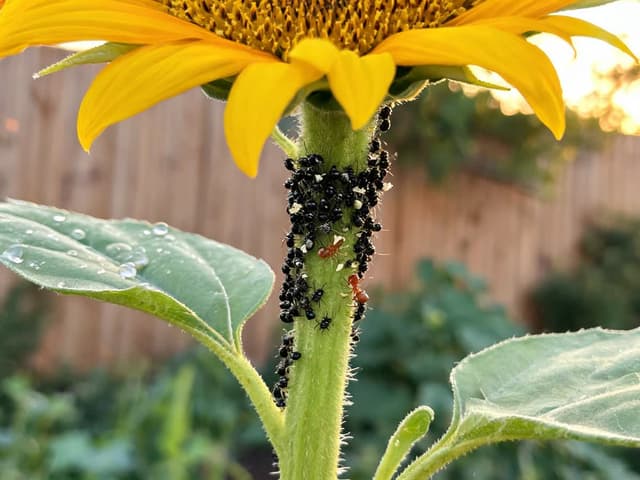
Bugs on Sunflowers: What They Are and What to Do
The bordered patch caterpillar is the main pest among the bugs on sunflowers in Brazil. Learn how to recognize this caterpillar, aphids, leaf beetles, stink bugs, and birds by the damage, when to treat, and when to let the plant finish its cycle.
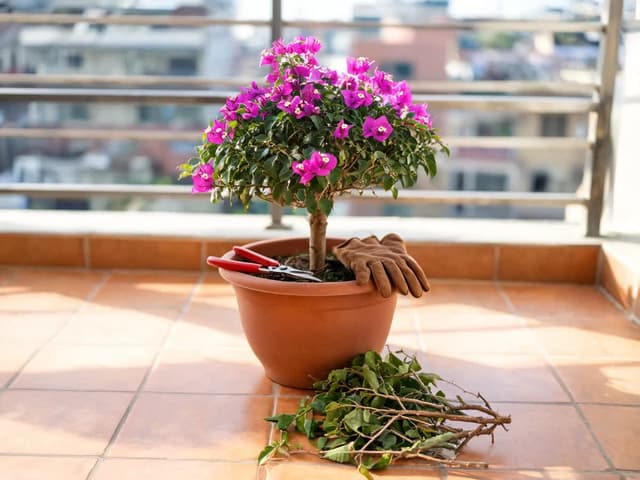
How to Prune Bougainvillea: When, How Much, and Where to Cut
How to prune bougainvillea: cut after flowering, right above a node, and save hard pruning for when the plant starts growing again. See how much to remove, the three types of pruning, and how to train potted bougainvillea.
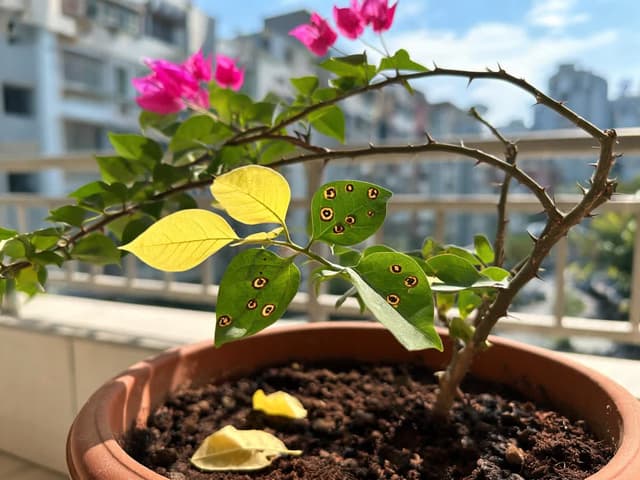
Bougainvillea with Yellow Leaves or Spots: Causes and Fixes
Bougainvillea with yellow leaves or yellow spots: tell apart leaf spot, pests, watering, cold, and iron deficiency by the pattern, and see what to do in each case.