Bougainvillea with Yellow Leaves or Spots: Causes and Fixes
Bougainvillea with yellow leaves or yellow spots: tell apart leaf spot, pests, watering, cold, and iron deficiency by the pattern, and see what to do in each case.
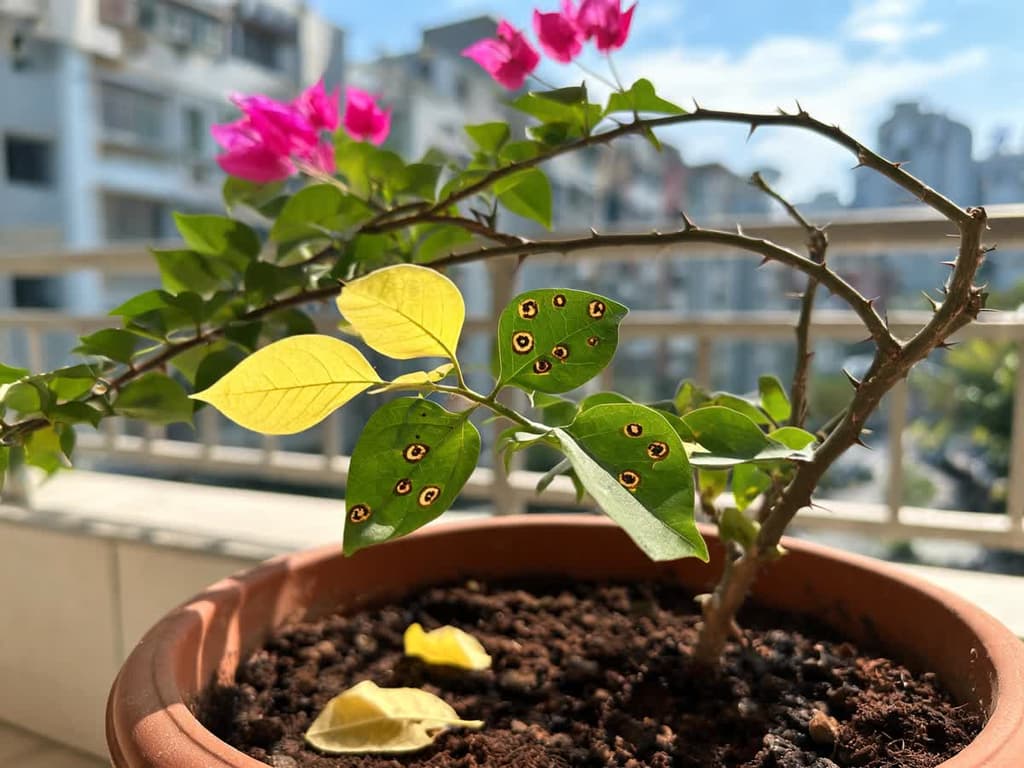
Bougainvillea with yellow leaves has different causes depending on the pattern of the yellowing. Round yellow spots around a brown or white center indicate leaf spot, a disease caused by fungi or bacteria. Tiny yellow dots scattered across the leaf indicate sap-sucking pests, such as spider mites, whiteflies, or scale insects. An entirely yellow leaf points to the roots, watering, cold temperatures, lack of sunlight, or nutrient deficiency.
Bougainvillea can recover from these causes once you correct the underlying problem. A leaf that has already turned yellow generally does not turn green again. What shows that the problem has been solved is the new growth, which emerges green and spot-free during the next flush.
Spots with a dead center and pest punctures do not disappear with a change in watering. If you have already watered more, then less, and the spots remained, stop altering your watering routine. Check the center of the spots and the underside of the leaf, and compare them with the table below.
Yellow spots or entirely yellow leaves: the first test
Before treating, check three things on an affected leaf: the pattern of the yellowing, the age of the leaf, and the underside. A spot with a brown or white center is different from fine stippling without a center. Yellow new leaves have different causes than yellow old leaves. The underside reveals pests hiding beneath the leaf.
White specks along with yellow spots have two origins. If the white material is cottony fluff, a scale, or a tiny fly that detaches from the leaf, it is a pest. If the white area is a dry circle inside the leaf tissue with a dark border, it is the center of a leaf spot.
What you see | Likely cause | How to confirm | What to do |
|---|---|---|---|
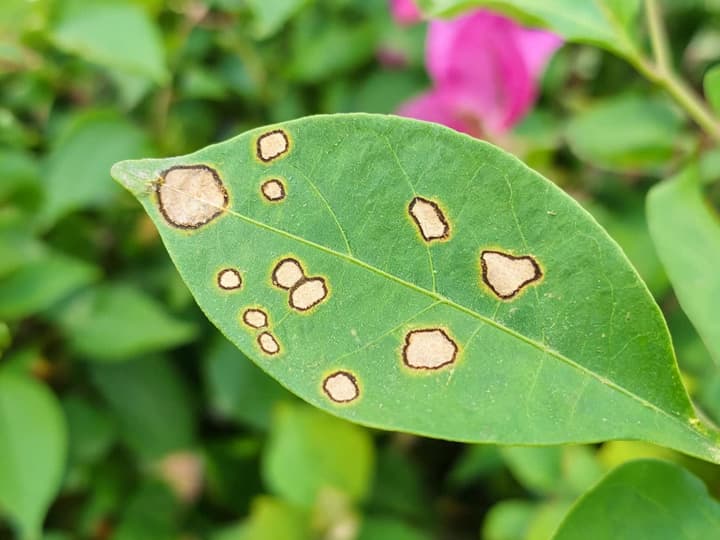
Round spots from 1 to 7 mm with a brown or white center and a yellow halo around them | Leaf spot (fungus or bacterium) | The spot appears on both sides of the leaf and has a dark border | Remove spotted and fallen leaves, water at the soil line near the stem, and keep foliage dry |
Fine yellow stippling, like dust, giving the leaf a bronzed look | Spider mites | Tap the branch over a sheet of white paper and look for moving specks | Spray the undersides of leaves with a cold water jet and apply insecticidal soap (ready-to-use commercial product) |
Yellow speckling and a black coating on lower leaves | Whiteflies | Flip the leaf over and look for tiny white flies on the underside | Apply insecticidal soap or horticultural oil to the undersides of leaves |
Yellow streak extending from a brown shell on the stem or leaf | Scale insect | The shell stays firmly in place and does not crawl | Dab with a cotton swab dipped in alcohol and apply horticultural oil |
Yellow new leaves with green veins | Iron or magnesium deficiency | The yellowing starts at the tips of the branches | Check the soil and cold exposure before fertilizing |
Old leaves yellowing from the bottom upward | Nitrogen deficiency, magnesium deficiency, or root issues | Soil that stays wet days after watering points to the roots; well-draining soil points to nutrient deficiency | Check the soil before fertilizing |
Entire leaves turning yellow and dropping from multiple branches at once | Improper watering, low light, or cold | Feel the soil and recall the temperatures over recent nights | Adjust watering, increase light, or protect from cold |
Yellow spots with a brown or white center: leaf spot
Bougainvillea leaf spot is a disease in which fungi or bacteria kill small circles of the leaf. The dead tissue sits at the center, and the yellow is the ring around it. One of the agents is the fungus Passalora bougainvilleae, formerly called Cercospora bougainvilleae. According to a commercial production guide hosted by North Carolina State University (NC State), this spot is the most important disease of bougainvillea.
The first report of this fungus in Mexico appeared in the journal Plant Disease in 2011 (Ayala-Escobar and colleagues). In 2009, the authors examined bougainvillea of the species Bougainvillea spectabilis in 28 gardens. All plants had the disease, but the spots covered only 3% to 7% of the leaf area. Bougainvilleas with white bracts (the colored leaves that resemble petals) were the most heavily affected.
In the Mexican study, the spots were circular, 2 to 7 mm across, light brown in the center with dark brown margins. Many had a yellowish halo around them and were delimited by major leaf veins. They appeared on both leaf surfaces. In deliberately inoculated plants, symptoms took 45 to 60 days to develop.
In Brazil, the same fungus has already been recorded in Pernambuco, the Federal District (on Bougainvillea glabra), and Roraima. In Roraima, Embrapa researchers found the spots during the region's rainiest season, according to Acta Amazonica. There, the lesions were white, 1 to 3 mm across, with a dark brown ring. Under a magnifying glass, the undersides of old spots show dark tufts, which are the fungal structures.
The color of the center varies between the Mexican and Roraima records: light brown in the former and white in the latter. In both records, the spots are small and circular, with a pale center and a distinct border. Look closely at the center of each yellow spot. If there is a dead patch in the middle, the yellow area is a halo around tissue killed by the disease, not a nutrient deficiency.
The University of Florida (UF/IFAS) also describes a leaf spot caused by bacteria. It starts as tiny reddish-brown dots on new leaves, some with a yellow ring, and expands into dark spots. The bacteria spread through water splashing and hands. The leaf spot from the fungus Colletotrichum, also described by UF/IFAS, is light brown, with darker borders, and sometimes V-shaped. With this fungus, the leaf turns yellow and drops prematurely.
Treatment is the same for all three spots, according to UF/IFAS and the University of Hawaii (CTAHR):
remove spotted leaves and pick up any that have fallen onto the soil or pot;
space containers and neighboring plants apart so air can circulate through the canopy;
water the soil near the stem and keep the foliage dry, especially late in the day;
discard heavily infected plants, as the disease spreads to neighboring plants through water splashes.
CTAHR recommends discarding infected plants. However, the Mexican study found the disease on every plant across 28 gardens, yet spots covered only 3% to 7% of the foliage. Neither source specifies how many spotted leaves warrant discarding a garden bougainvillea. When only a few leaves are affected, start by removing those leaves and monitor the new growth.
CTAHR states that leaf spot occurs more frequently during extended rainy periods. According to the same source, various broad-spectrum fungicides (which target multiple fungal species) are effective. If you use a fungicide, follow the dosage and application interval on the product label. Spotted leaves remain marked, so the sign of recovery is new growth emerging clean.
Yellow specks on bougainvillea leaves: sap-sucking pests
Tiny yellow dots without a dead center are usually feeding marks from sap-sucking pests. Each pest leaves a different pattern and lives on a different part of the plant, according to the pest table from CTAHR. The Royal Horticultural Society (RHS) lists whiteflies, mealybugs, aphids, and red spider mites as bougainvillea pests.
Spider mites: fine stippling that leaves foliage bronzed
The spider mite is an eight-legged animal, related to spiders, that pierces the leaf to suck sap. It is very small and hard to see, even with a magnifying glass. Each puncture becomes a tiny yellow dot, and many dots together form stippling, according to the NC State Extension. With heavy mite infestations, the entire leaf turns yellow or bronze and can drop. CTAHR also describes wrinkled, distorted new growth on bougainvillea.
To confirm their presence, tap a branch over a sheet of white paper and wait a few seconds. On the white sheet, moving specks are spider mites, while loose debris remains stationary. Spider mites thrive in hot, dry conditions, and fertilizers high in nitrogen encourage pest populations, according to NC State.
To treat, wash the undersides of the leaves with a strong spray of cold water. Then, apply insecticidal soap or horticultural oil to the undersides of the foliage. Repeat the application 7 to 10 days later, as the initial treatment does not kill unhatched eggs, according to NC State.
Whiteflies: yellow specks where they feed
Whiteflies are small insects that feed on the undersides of leaves, with adults resembling tiny white moths. Infested foliage displays yellow specks at feeding sites used by adults and nymphs, according to CTAHR. Under heavy populations, the entire leaf turns yellow. Lower leaves become coated in sooty mold, a black fungal film that grows on the sugary honeydew excreted by the insects.
To treat, apply insecticidal soap or horticultural oil to the undersides of all leaves, following label instructions. CTAHR recommends repeating the application; check the product label for the proper interval. Whitefly nymphs look like tiny scales fixed to the leaf undersides, according to the same source.
Scale insects: yellow streaks spreading from protective shells
Armored scale insects are immobile pests covered by a brown protective shell attached to stems or leaves. As they draw sap, they leave a yellow streak radiating from the attachment point, according to CTAHR. Mealybugs appear as white, cottony masses in leaf axils and on leaf undersides.
To treat, remove shells and cottony clusters using a cotton swab dipped in rubbing alcohol. Next, wash the plant with soapy water and a soft brush, or apply horticultural oil according to label instructions. Also control ants, which transport scale insects between branches.
If you have already applied neem oil and soap yet the pest persists, check three factors. First, ensure the product covers the undersides of all leaves. Second, repeat the treatment as CTAHR recommends. Third, against mealybugs, the same source prefers systemic insecticides (absorbed by plant tissues). It also warns that overly concentrated oil, or oil applied during midday heat, burns leaves and bracts.
Aphids: speckling and distorted shoots
Aphids are soft-bodied insects that feed in clusters on branch tips, flower buds, and tender new leaves. As aphids suck sap, they cause leaf speckling, color loss, and stunted shoots, according to CTAHR. The safest control measure, according to the same source, is insecticidal soap.
Leaves with holes or chewed edges indicate caterpillars. CTAHR notes that a caterpillar feeds on bougainvillea leaves at night, leaving scalloped margins behind. Chewing pests on bougainvillea produce holes or ragged margins rather than yellow specks.
Yellow new leaves with green veins: iron or magnesium
Yellow new leaves with green veins are a sign of chlorosis. Chlorosis is the yellowing of the leaf when a nutrient needed to produce green color is lacking. In bougainvillea, yellowing on new leaves is usually a lack of magnesium or iron, according to UF/IFAS (ENH 874).
The plant can show iron deficiency even when the soil has enough iron. CTAHR explains that soil pH above 6.0 makes it difficult for roots to absorb iron. Soil pH measures acidity: above 6.0, soil is slightly acidic or alkaline. NC State notes that Bougainvillea glabra can develop chlorosis in alkaline soil. Iowa State adds that high pH, overwatering, cold, and nematodes (microscopic worms that attack the roots) produce the same yellow leaves with green veins.
Follow this order of checks before buying fertilizer:
Feel the soil. If it remains soggy days after watering, correct your watering routine first.
Consider recent nighttime temperatures. If temperatures dropped below 50°F (10°C), wait for new growth to emerge in warmer weather before applying fertilizer.
If the soil drains well and temperatures remained mild, apply a micronutrient fertilizer containing chelated iron according to the label. Micronutrients are elements plants consume in small amounts. Chelated iron is iron bound to an organic molecule that keeps it soluble for root uptake.
UF/IFAS cautions against excessive applications of either iron or manganese. An overabundance of one inhibits uptake of the other, triggering an induced deficiency. CTAHR also notes that sulfur, aluminum sulfate, or ferrous sulfate can acidify the soil to resolve chlorosis. However, it provides no container rates. This guide follows UF/IFAS, which specifies chelated iron for bougainvillea and warns of excess.
Old leaves yellowing from the bottom upward
Yellowing that begins on older leaves from the bottom up points to nitrogen deficiency, magnesium deficiency, or root problems. Nitrogen deficiency turns lower leaves light green and then yellow. Over time, the yellowing moves up the plant, according to Iowa State.
CTAHR warns that fungal root rot produces yellowing similar to nutrient deficiencies. Check the potting mix before fertilizing. If the soil is waterlogged or smells sour, fertilizer will not help, because damaged roots cannot take up added nutrients.
For yellowing older leaves in well-draining soil, UF/IFAS recommends Epsom salt (magnesium sulfate). The rate is 1 to 2 teaspoons per gallon (3.8 liters) of water. Use this solution as a soil drench or foliar spray. The source does not specify application frequency: apply once and wait for the next growth cycle before repeating. Epsom salt addresses only magnesium deficiency. For nitrogen deficiency, the cited sources do not specify rates for bougainvillea: follow package directions. Avoid overapplication, as surplus nitrogen promotes spider mite outbreaks, according to NC State.
Bougainvillea dropping yellow leaves: soil, light, and cold
Bougainvillea drops yellow leaves due to overwatering, underwatering, insufficient light, or cold temperatures, according to UF/IFAS. In these situations, the entire leaf turns yellow without distinct spot patterns, and multiple leaves fall simultaneously across branches. Check these factors in order: soil moisture (overwatering or underwatering), light levels, and cold exposure.
Soil. Check moisture with your finger. Soil that stays wet days after watering indicates overwatering: let the root zone dry out before watering again. CTAHR describes root rot manifesting with wilting, branch dieback, and yellow foliage. Soil dry all the way through indicates underwatering: water until moisture drains freely from bottom holes. Our guide on how to water bougainvillea covers the soil test, pot weight, and water volume.
Light. Bougainvillea requires direct sunlight to retain foliage. CTAHR notes that in low-light environments, such as indoor rooms, the plant drops its leaves. If the container sits indoors or in shade, move the plant to a spot with direct sunlight.
Cold. According to the RHS, bougainvillea tolerates short periods at 5 °C (41 °F). Below 10 °C (50 °F), it tends to drop its leaves and go dormant, without growing. In Brazil, nights below 10 °C happen mainly from June to August.
After a cold night, lightly scratch the bark of a branch with your fingernail. Green tissue underneath indicates a live branch, and brown or black tissue indicates a dead branch at that point, according to UF/IFAS (MG025). Bougainvillea winter care explains how to protect the plant from frost and when to prune the dead branch.
When yellow leaves on bougainvillea are normal
UF/IFAS states that leaf shed following a flowering flush is often normal and precedes a new growth flush. Leaves yellow and drop cleanly without spotting, followed quickly by emerging shoots.
Bougainvillea also drops foliage where dry spells last several months, according to CTAHR. During extended drought, the plant reduces its canopy and flushes fresh leaves once rains return. In cold weather below 50°F (10°C), leaf shed is part of natural plant dormancy, according to the RHS.
Some bougainvilleas naturally display yellow foliage. UF/IFAS highlights three cultivars: 'Vicky' features leaves with yellow centers, 'Raspberry Ice' has variegated foliage, and 'Sweet Dream' carries golden leaves. On variegated plants, yellow coloration is genetic and present on emerging shoots as well. It does not form dark-centered spots.
Did you inherit or receive a flowering vine with purple or pink blooms and need to identify it? Bloom (available for iOS) identifies plants from a photo. With a Premium subscription, the app also diagnoses sick leaves to identify probable causes and treatments. Our guide on how to care for bougainvillea covers sunlight, watering, fertilizer, and pruning.
Frequently asked questions about bougainvillea yellow leaves
Will a yellow bougainvillea leaf turn green again?
Generally, no. A leaf that turned yellow from leaf spots, pests, or nutrient deficiencies remains yellow and eventually drops. The true sign of recovery is new growth. Once you fix the cause, new shoots emerge green and spotless. Remove leaves with leaf spot disease from the plant, as they harbor pathogens.
Does bougainvillea leaf spot spread to other plants?
It can spread to other bougainvilleas. UF/IFAS reports that bacterial leaf spot spreads through splashing water, hands, and cuttings taken from diseased stock. For this reason, collect fallen leaves, keep foliage dry when watering, and never propagate from infected stems. Wash hands and pruners after handling infected plants.
Can I use home remedies for bougainvillea with yellow leaves?
It depends on the cause. For spider mites, CTAHR recommends spraying the undersides of leaves with cold water. For scale insects, it recommends washing the plant with soapy water and a soft brush. For spider mites, whiteflies, and aphids, it recommends insecticidal soap, an off-the-shelf commercial product. For leaf spot, the solution is removing diseased leaves and keeping the canopy dry. For iron deficiency, none of the consulted sources recommends home remedies: apply chelated iron fertilizer according to the label.
How long does bougainvillea take to recover?
None of the consulted sources provides an exact recovery timeline for bougainvillea. Watch the new growth: wait for the next flush after correcting the cause. In cold weather, the plant will not push new growth until nights warm up. If emerging leaves also show spots or yellowing, the issue remains unresolved.
Related articles
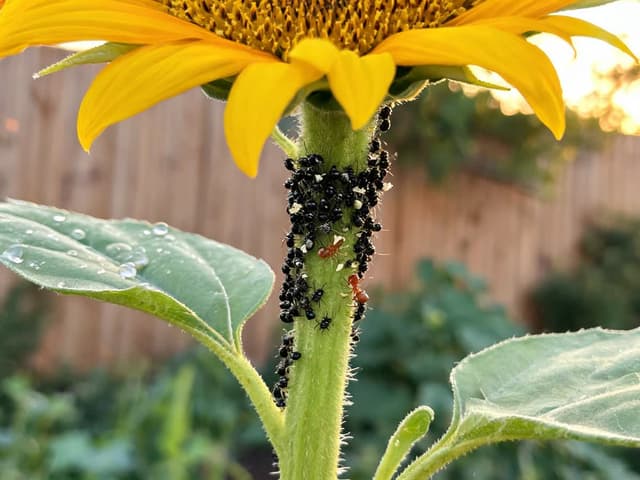
Bugs on Sunflowers: What They Are and What to Do
The bordered patch caterpillar is the main pest among the bugs on sunflowers in Brazil. Learn how to recognize this caterpillar, aphids, leaf beetles, stink bugs, and birds by the damage, when to treat, and when to let the plant finish its cycle.
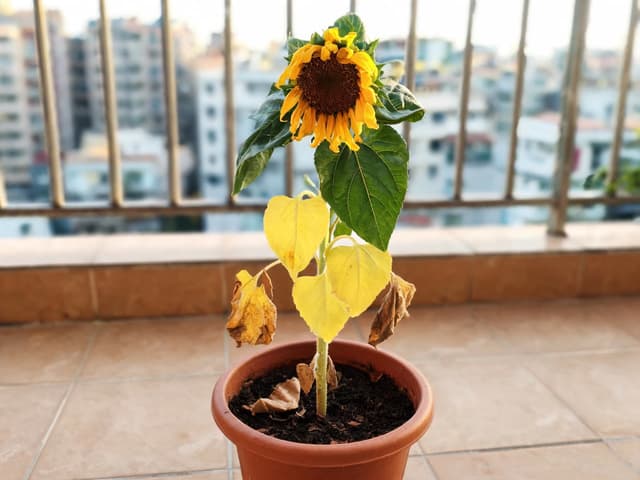
Yellow Leaves on Sunflowers: Causes and What to Do
Yellow leaves on sunflowers: use the plant's stage and where the yellow sits to tell end of life cycle, watering, low fertilizer, fungus or mites apart, plus the test that confirms each cause.
How to Prune Bougainvillea: When, How Much, and Where to Cut
How to prune bougainvillea: cut after flowering, right above a node, and save hard pruning for when the plant starts growing again. See how much to remove, the three types of pruning, and how to train potted bougainvillea.