Bugs on Sunflowers: What They Are and What to Do
The bordered patch caterpillar is the main pest among the bugs on sunflowers in Brazil. Learn how to recognize this caterpillar, aphids, leaf beetles, stink bugs, and birds by the damage, when to treat, and when to let the plant finish its cycle.
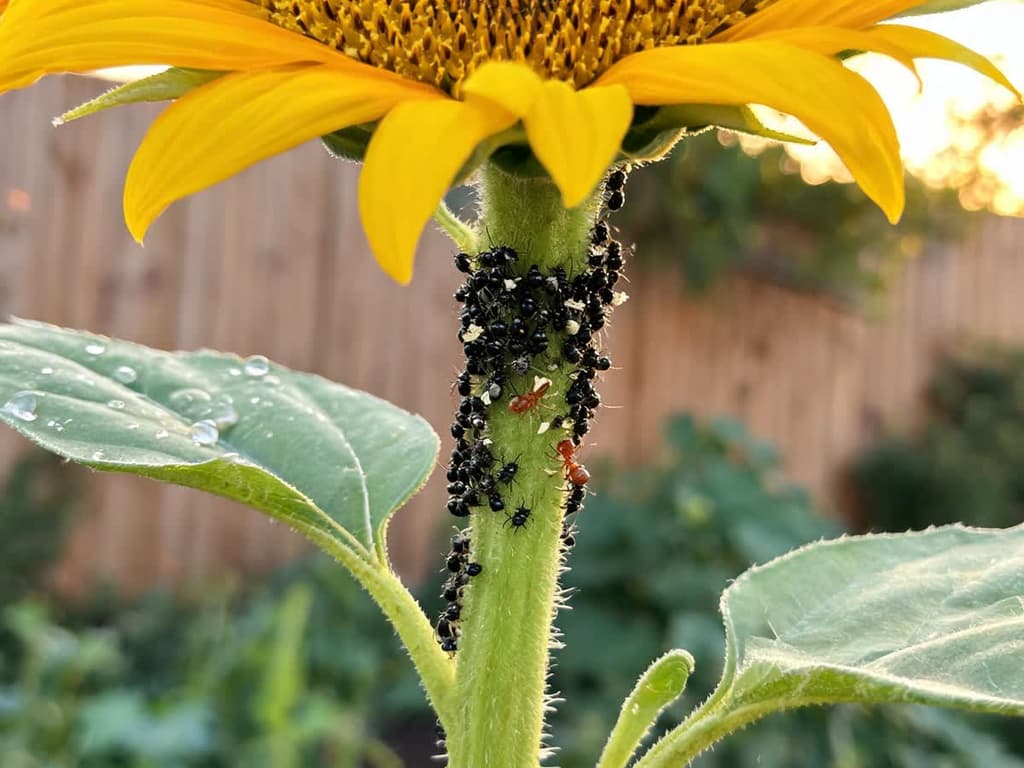
Bugs on sunflowers recorded by Embrapa in Brazil include the bordered patch caterpillar, the leaf beetle, and aphids. The bordered patch caterpillar eats leaves in groups, the leaf beetle chews holes in leaves, and aphids form colonies on the stem. Stink bugs suck sap from the stem just below the flower, and birds eat the mature seed. An adult sunflower handles the attack well: losing up to a quarter of its leaves causes no change at all, according to Embrapa Soja.
Treating makes sense in two cases. The first is a seedling under 40 days old with a pest threatening to eat all its leaves. The second is when pests destroy more than a quarter of the leaves between the bud stage and the open flower. Pick caterpillars off by hand and knock aphids down with a stream of water. A sunflower that has already bloomed and is drying out needs no leaf pest treatment. It is finishing its annual plant life cycle, as explained in the sunflower care guide.
Quick summary:
With up to 25% of leaves eaten, the sunflower does not change at all, at any stage (Embrapa Soja).
A sunflower that loses all its leaves before 40 days of age produces no seeds (Embrapa Soja).
The bordered patch caterpillar eats about 85% of all the foliage it will consume during its final two growth stages. Finding the caterpillars while they are small is what saves the plant (Embrapa Soja).
Insecticidal soap kills aphids and mites, but does not kill caterpillars or adult beetles (Colorado State University).
In a study conducted in the Brazilian semiarid region, birds took 25% to 70% of the seeds, depending on the variety (Revista Ciência Agronômica, 2019).
What bug is on your sunflower
To find out what bug is on your sunflower, look first at where the damage is and then at the pest itself. The table below follows the plant from bottom to top, from seedling to seed head.
What you see | Where | What it is | What to do |
|---|---|---|---|
Seedling cut at ground level, in the morning | Base of the seedling | Cutworm | Check neighboring seedlings every morning |
Cut leaves and an ant trail | Seedling and new leaves | Leafcutter ant (saúva or quenquém) | Find the nest and use ant bait |
Irregular holes and a shiny trail | Lower leaves, after a humid night | Slug or snail | Handpick at night with a flashlight |
Small round holes and a small green beetle with yellow spots | Leaves | Cucurbit beetle (vaquinha) | Handpick; on a large plant, ignore |
Group of small orange or black caterpillars with spines | Middle leaves (yellow eggs underneath) | Bordered patch caterpillar (sunflower caterpillar) | Cut off the leaf with the cluster |
Colony of tiny 1.5 to 3 mm black or green bugs, with ants | Stem, buds, and leaf undersides | Aphid | Strong jet of water |
Cloud of white insects when disturbed | Underside of the leaf | Whitefly | Jet of water on leaf undersides |
Light stippling on leaves and fine webbing | Underside of the leaf, in hot and dry weather | Spider mite | Wash leaf undersides every week |
Green or brown shield-shaped bug | Stem just below the flower | Stink bug | Handpick |
Seeds vanishing from the mature head | Flower head | Birds | Cover the head with a fine mesh or cloth bag |
The sunflower pest directory lists symptoms for each pest and what to do. Wilted leaves, spots, or white powder with no bugs in sight could indicate disease or watering problems rather than pests.
Seed weevil, sunflower head moth, and sunflower beetle are crop pests in the United States. None of them appear in Embrapa Soja's chapter on sunflower insects in Brazil.
If your sunflower pest is not listed in the table, take a close-up photo of the leaf, front and back. In Bloom (available for iOS), photo diagnosis in the Premium plan identifies the problem from your picture and tells you what to do.
Black caterpillar: the main sunflower pest in Brazil
The black caterpillar (Chlosyne lacinia saundersii), also called the sunflower caterpillar, is the main caterpillar that eats sunflower leaves in Brazil, according to Embrapa Soja. It comes from a black and orange butterfly with a wingspan of about 4 cm. The butterfly lays clusters of yellow eggs on the underside of the leaf.
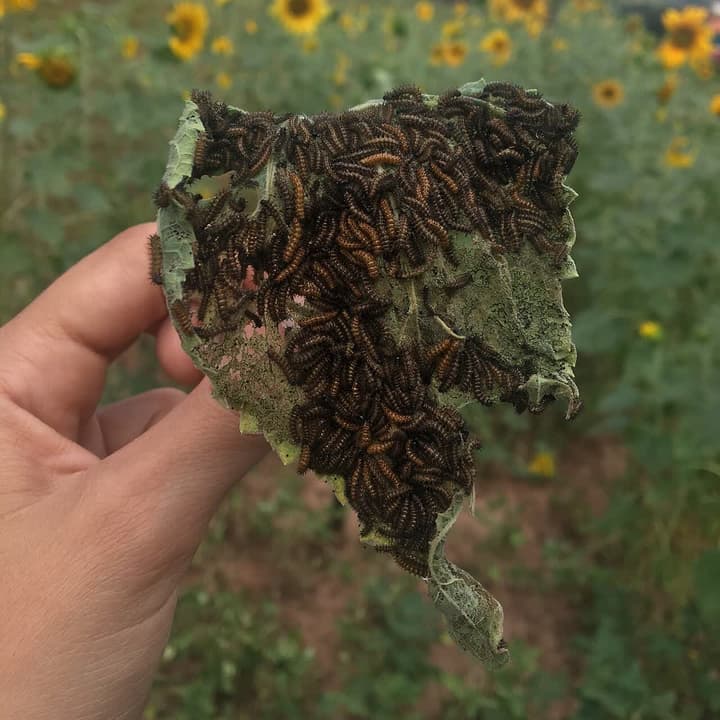
The caterpillars hatch from the eggs in about 7 days and live for 17 to 18 days until they pupate. During the first half of this phase, they stay clustered on the same leaf and have an orange color. Then they spread across the plant and darken: most turn completely black, with spines across their bodies. Embrapa Soja described this cycle in the book Girassol no Brasil.
The time to act is during this orange, clustered stage. Caterpillars go through six growth instars, and the last two consume roughly 85% of all the foliage they will ever eat. A single egg cluster can strip a plant completely bare. The caterpillars may then leave the plant and attack neighboring sunflowers.
What to do in your garden or container:
Check the undersides of the middle leaves once a week and look for yellow clusters or groups of small orange caterpillars.
Snip off the leaf with the entire group and discard it in a sealed bag.
Handpick large caterpillars that have already scattered, wearing gloves.
If there are many small caterpillars, apply a biological insecticide based on Bacillus thuringiensis (Bt), using the label rate. Embrapa Soja recommends Bt for the bordered patch caterpillar.
Bt is a bacterium that only kills caterpillars that eat sprayed foliage. It works best on small caterpillars, according to Iowa State University. Insecticidal soap will not work: Colorado State University notes that caterpillars are "generally immune" to it.
The bordered patch caterpillar has many natural enemies in Brazil. Embrapa Soja records wasps, ladybugs, spiders, and birds eating the caterpillar, with birds killing up to 66% of the cocoons. A tiny wasp parasitized up to 48.5% of the eggs.
Embrapa Soja noted higher caterpillar numbers on sunflowers planted late, in January and February, in Paraná. A 1976 study recorded the highest population between October and May, so watch your sunflowers closely during those months.
Aphids on sunflowers: colonies on stems and ants nearby
Aphids are soft-bodied insects measuring 1.5 to 3 mm that live in colonies and suck plant sap. Embrapa Soja records aphids on Brazilian sunflowers. They gather on the stem just below the bloom, on new shoots, and on leaf undersides. The Royal Horticultural Society (RHS) notes green and black aphids, as well as yellow, pink, and white varieties.
Ants running up and down the stem are the easiest telltale sign. The RHS explains that ants farm the colony to feed on honeydew, the sugary fluid excreted by aphids. They also fend off natural predators that would otherwise eat the aphids.
To remove aphids from your sunflower, follow these steps in order:
Small colony: crush them with your fingers, as the RHS recommends.
Large colony: spray a strong stream of water from the hose onto the stem and the undersides of the leaves. Colorado State University explains that few aphids knocked off manage to return to the plant.
Back within a few days: spray ready-to-use insecticidal soap, which has 1% to 2% soap, according to the University of Florida (UF/IFAS). Thoroughly wet the undersides of the leaves.
Repeat the soap application every 4 to 7 days, because it only kills pests it directly contacts, as Colorado State points out.
Do not apply soap on days above 90 °F (32 °C) or on water-stressed sunflowers, warns UF/IFAS. The University of Maryland sets the threshold at 85 °F (29 °C) for soaps and oils. When in doubt, follow the lower limit. Under these conditions, foliage can burn.
Ladybug larvae consume large numbers of aphids, according to Colorado State. The RHS notes that aphid populations often surge before natural predators arrive in sufficient force. If the colony is small and you prefer not to intervene, waiting a few days often resolves the issue.
The reason aphids return after the first treatment and other methods are detailed in the aphids on plants guide.
Whiteflies and spider mites on potted sunflowers
Whiteflies are winged, white insects measuring about 1.5 mm that live on leaf undersides. When you disturb the plant, a cloud of them flutters up, notes the RHS. Embrapa Soja reports whiteflies (Bemisia) on Brazilian sunflowers, with severe outbreaks documented in 1973. The consulted sources list no specific sunflower-tailored treatment for whiteflies. The water blast and insecticidal soap used for aphids remain the safest choices.
A white bug that does not fly and stays stuck to the stem is a different pest. Mealybugs require a different treatment, described in their own guide.
Spider mites are nearly microscopic pests that leave pale speckling on foliage and spin fine webbing on leaf undersides. NC State Extension notes that two-spotted spider mites are most active in hot, dry weather. They are absent from the Embrapa Soja sunflower pest list, which focuses on field production.
To verify, hold a sheet of white paper beneath a sunflower branch and tap it lightly, as recommended by Iowa State University. If the specks that fall begin crawling around, you have spider mites.
A sunflower with spider mites does not belong in the trash. Move the pot away from other plants. Thoroughly rinse the undersides of the leaves with lukewarm water weekly, as directed by Washington State University. If mite populations are heavy, apply ready-to-use insecticidal soap on a day below 85 °F (29 °C), and repeat 7 to 10 days later, according to NC State. The second application catches mites that were still in eggs during the first round.
If you have a cat or dog, start with water, which leaves nothing on the leaf. The complete step-by-step process, including the paper test, is in the guide to spider mites on plants.
Leaf beetles, stink bugs, and other beetles: chewed leaves and wilted heads
The cucurbit beetle (Diabrotica speciosa), known locally as vaquinha, patriota, or brasileirinho, is a small green beetle with yellow spots that chews holes in leaves. Embrapa Soja states that its damage matters during the early seedling stage. If beetles appear only after the first two weeks of plant growth, control is unnecessary, according to Embrapa Meio-Norte. Sunflowers produce abundant leaves.
In the garden, handpick beetles from young seedlings and drop them into a container of soapy water. Spraying soap rarely affects adult beetles, whose hard exoskeletons protect them, according to Colorado State University.
Stink bugs are shield-shaped, green or brown insects that suck sap. Embrapa Soja outlines where they target sunflowers: on the stem right below the bloom and on developing seeds. Developing flower heads can wilt and fail to form properly. In farm fields, Embrapa advises treatment only at densities of 3 or more stink bugs per plant. In home gardens, handpick any found on the stem directly below the flower.
The lace bug is a tiny, flattened bug with transparent wings resembling lace, which leaves foliage stippled with white. NC State Extension records it on sunflowers in the United States, and a 2001 release from Embrapa Cerrados addresses it on sunflowers in the Central-West region of Brazil. Soap and oil kill nymphs and adults, but not the eggs, which remain inside the leaf (NC State). Because of this, repeat the treatment every 4 to 7 days, the interval Colorado State gives for soap.
The scarab beetle (Cyclocephala melanocephala) bores tunnels inside the flower head, according to Embrapa Meio-Norte. Under severe attack, the flower head grows distorted. The consulted sources offer no garden-specific controls.
Cut or missing seedlings: cutworms, ants, and slugs
A sunflower seedling clipped at ground level overnight signals cutworms. Embrapa Meio-Norte describes this caterpillar feeding on leaves and stems, severing young plants right at the soil line. Embrapa recommends regular scouting, as damage tends to occur in localized patches. Inspect neighboring seedlings every morning.
Leafcutter ants, particularly saúvas, can strip all top growth from sunflower seedlings in days, warns Embrapa Soja. Embrapa Meio-Norte recommends ant bait along active foraging trails or around the mound, using granular bait during rainy stretches. Ants that simply run up and down stems without stripping foliage are tending aphids.
Slugs and snails feed on seedlings during wet spells, and Embrapa Soja notes that managing them proves difficult. They feed by night and take shelter during daylight hours. The University of Connecticut recommends handpicking them at night with a flashlight, or early in the morning, for a week, dropping them into a bucket of soapy water.
Birds feeding on sunflower seeds
Birds and powdery mildew (a fungal disease blanketing leaves in white powder) are the two biggest garden challenges for sunflowers, according to Iowa State University. In a study in the Brazilian semiarid region published in Revista Ciência Agronômica in 2019, birds took 25% to 70% of the seeds, depending on cultivar. The most frequent visitor was the red-cowled cardinal, a bird native to northeastern Brazil.
The protective method that succeeded in the study was covering flower heads with non-woven fabric (TNT) covers, made from the same material used in disposable hairnets. Covered flower heads produced more seeds, and these seeds were heavier than those on uncovered plants.
In home gardens, cover the head once petals wilt and turn brown. Use cheesecloth, fine mesh, or a paper bag tied around the stem right below the head, as recommended by a Kansas State University Extension specialist. Leave the head covered on the plant until seeds finish maturing. If birds begin pecking before petals fade, Colorado State University suggests using a ventilated plastic bag over the head.
If you have no interest in saving seeds, let the birds feast. NC State Extension suggests leaving dried seed heads in the garden for local wildlife.
Bugs found on sunflowers that are not pests
Sunflowers draw many insects that cause no plant harm, and several feed on garden pests. Before applying any sprays, check whether the insect is one of these beneficial visitors:
Soldier beetle: an elongated, yellow beetle with black spots that moves in groups on flowers. University of Wisconsin Extension says that it does not damage flowers, does not sting, and does not bite, and that the adult can eat aphids. In Brazil, there are several species of the same genus (Chauliognathus), recorded in the Revista Brasileira de Zoologia.
Astylus beetle: a yellowish beetle with black spots on its back that gathers in large numbers on the sunflower head. Embrapa Soja records that it eats pollen and appears to act more as a pollinator than as a pest. Its larva, however, can eat seed.
Ladybugs and ladybug larvae: adult ladybugs and larvae devour aphids. Embrapa Soja highlights the ladybug Cycloneda sanguinea among the natural enemies of the bordered patch caterpillar.
Bees: these are the primary pollinators of sunflowers, and Embrapa Soja advises avoiding insecticides while flowers are blooming.
Dark-spotted beetles clustered on sunflower blooms without neighboring foliage damage may be soldier beetles or Astylus beetles. Consulted sources provide no visual method to distinguish the two by eye, but adults of both appear harmless to flowers. There is no need to destroy volunteers growing on their own in your yard.
When treating your sunflower is not worth it
Sunflowers handle foliage loss well. Embrapa Soja consolidated the research: with up to 25% leaf loss, plant performance remains unchanged across all growth stages. Losing up to 50% of foliage during the vegetative stage, prior to bud set, likewise resulted in no yield penalty. Embrapa uses this 25% threshold as a safe guide when deciding whether pest control is warranted.
The vulnerabilities lie at the seedling and flowering stages. In a study cited by Embrapa Soja, plants stripped of all leaves before 40 days of age produced no seed. Embrapa Meio-Norte notes that defoliation during bud development and flowering severely impairs seed yield.
At the opposite end of the life cycle, do not intervene. Embrapa Meio-Norte explains that once sunflowers begin drying down after blooming, foliage loss has zero impact on the plant. Sunflowers are annuals that die after setting seed, and the sunflower care guide explains the duration of each phase.
At the conclusion of the life cycle, lower foliage naturally yellows and dries out, which does not indicate pest activity.
Home remedies for sunflower pests: dish soap, vinegar, and neem
"The DIY recipe calls for water, vinegar, and dish soap. Does it work?" It does not. Iowa State University explains that vinegar, alcohol, and dish detergent are marketed as safe options, but they can scorch foliage. None are intended for plant applications. Colorado State University notes that dish detergent can injure plant tissue and contaminate water sources.
The soap recommended by authoritative sources is commercial insecticidal soap diluted to 1% to 2%, the same product recommended for aphids. Test on a single leaf and wait 1 to 2 days before treating the entire plant, as advised by Colorado State.
Neem oil marketed for gardens is typically formulated as horticultural oil (oil refined specifically for spraying plants), explains the University of Maryland. It advises against applying oils when temperatures exceed 85 °F (29 °C), as the risk of leaf burn increases substantially. Avoid oils on water-stressed or recently transplanted plants as well.
Water-stressed sunflowers are far more vulnerable to damage from soaps and oils. Water thoroughly the previous day, following the sunflower watering guide, and apply early in the morning or late in the evening.
Foliage that has already suffered scorch will not turn green again. Iowa State University notes that injured leaves remain spotted while new growth emerges clean. On mature sunflowers, trim away only badly scorched leaves and wait for fresh foliage.
Protect bees when sunflowers are in flower. Embrapa Soja advises withholding insecticides throughout the blooming period. If caterpillars strike during this window, choose Bt, which does not harm bees, and apply it in late evening when foraging declines.
Frequently asked questions
Can a sunflower infested with aphids be saved?
Yes. Spray the stem and leaf undersides with a strong jet of water and repeat whenever colonies reappear. If they return within days, apply commercial insecticidal soap mixed at 1% to 2% every 4 to 7 days, avoiding temperatures above 85 °F (29 °C).
Do ants on sunflowers harm the plant?
Ants running up and down the stem do not feed on sunflowers. They tend aphids that excrete sugary honeydew and chase off predators that would otherwise consume them. Knock aphids off with a hose: without honeydew, ants lose interest. Ants that strip leaves are leafcutter ants, which require toxic bait.
Can I apply insecticide to a flowering sunflower?
Avoid it. Embrapa Soja urges growers not to spray insecticides during flowering, as bees pollinate sunflowers. If bordered patch caterpillars appear while flowers are open, apply a biological insecticide using Bacillus thuringiensis (Bt), which is safe for bees, in late afternoon. Remove aphids and stink bugs from flowers with water sprays or by hand.
Do sunflower pests spread to other plants?
Some do. Aphids, whiteflies, and spider mites infest diverse plant species and can migrate to adjacent containers. For this reason, isolate infested sunflowers until the problem clears. Bordered patch caterpillars may leave one sunflower to feed on neighboring ones. Before placing a new plant alongside your containers, inspect the undersides of its leaves.
The next time you check your sunflower
Turn over three or four leaves along the middle of the plant and inspect the stem right beneath the bloom. A cluster of small orange caterpillars: trim off the leaf. An aphid colony attended by ants: hit it with a strong blast of water. If the plant has finished blooming and is drying down, let it conclude its cycle and protect the seed head to save your harvest.
Sources
Moscardi, F., Sosa-Gómez, D. R. and Corso, I. C. Invertebrados associados ao girassol e seu manejo. In: Girassol no Brasil, Embrapa Soja, 2005, ch. 16: alice.cnptia.embrapa.br. Accessed on October 8, 2026.
Ribeiro, J. L. Manejo da cultura do girassol no Meio-Norte do Brasil. Embrapa Meio-Norte, Circular Técnica 48, 2008: ainfo.cnptia.embrapa.br. Accessed on October 8, 2026.
Embrapa Cerrados. Identification of the main sunflower pests in the Central-West region. Technical Communication 50, 2001: infoteca.cnptia.embrapa.br. Accessed October 8, 2026.
Yield loss in sunflower cultivars due to bird attack. Revista Ciência Agronômica, 2019: doi.org. Accessed on October 8, 2026.
Polymorphism in Brazilian species of Chauliognathus. Revista Brasileira de Zoologia, 2006: doi.org. Accessed on October 8, 2026.
Iowa State University Extension: Growing Sunflowers and Their Varieties, Spider Mites, Chemical Injury to Garden Plants, and Yellownecked caterpillar: yardandgarden.extension.iastate.edu. Accessed on October 8, 2026.
Colorado State University Extension: Insect Control: Insecticidal Soap and Aphids on Shade Trees and Ornamentals: extension.colostate.edu. Accessed on October 8, 2026.
Colorado State University Extension, PlantTalk, Harvesting and Roasting Sunflower Seeds: planttalk.colostate.edu. Accessed October 8, 2026.
University of Florida IFAS, Soaps, Detergents, and Pest Management: gardeningsolutions.ifas.ufl.edu. Accessed October 8, 2026.
NC State Extension: Helianthus annuus factsheet, Twospotted Spider Mites on Landscape Plants, and Chrysanthemum Lace Bug: plants.ces.ncsu.edu and content.ces.ncsu.edu. Accessed October 8, 2026.
University of Maryland Extension, Pesticide Profile: Horticultural Oil: extension.umd.edu. Accessed October 8, 2026.
University of Connecticut, Slugs and Snails: homegarden.cahnr.uconn.edu. Accessed on October 8, 2026.
University of Wisconsin Extension, Soldier beetles in the garden: chippewa.extension.wisc.edu. Accessed October 8, 2026.
Washington State University, Spider mites: pestsense.cahnrs.wsu.edu. Accessed October 8, 2026.
Kansas State University Research and Extension, Garden Variety column, 2020: ljworld.com. Accessed on October 8, 2026.
Royal Horticultural Society, Aphids and Glasshouse whitefly: rhs.org.uk and rhs.org.uk. Accessed October 8, 2026.
Related articles
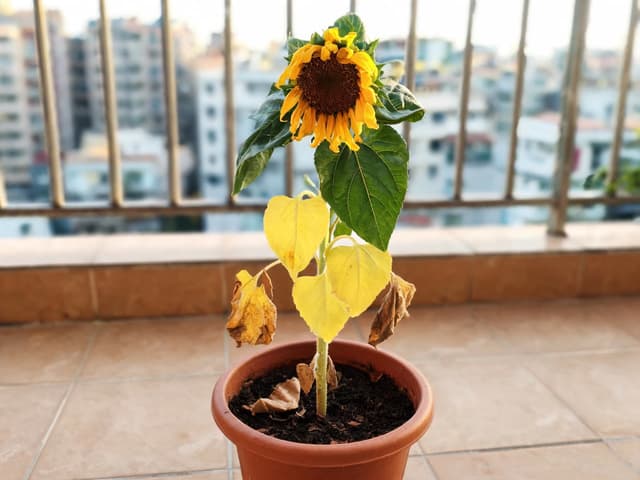
Yellow Leaves on Sunflowers: Causes and What to Do
Yellow leaves on sunflowers: use the plant's stage and where the yellow sits to tell end of life cycle, watering, low fertilizer, fungus or mites apart, plus the test that confirms each cause.
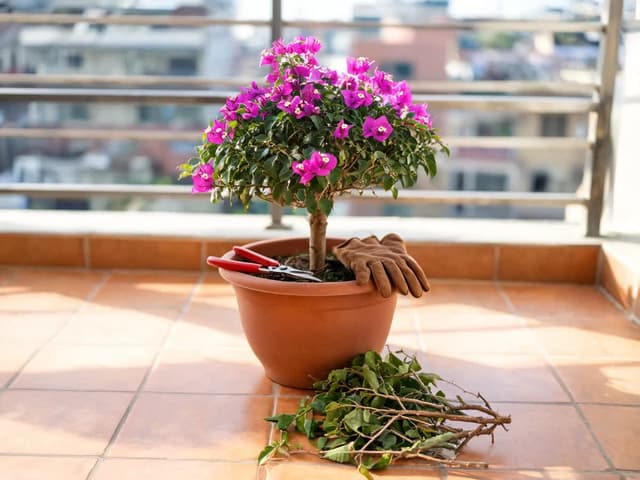
How to Prune Bougainvillea: When, How Much, and Where to Cut
How to prune bougainvillea: cut after flowering, right above a node, and save hard pruning for when the plant starts growing again. See how much to remove, the three types of pruning, and how to train potted bougainvillea.
Bougainvillea with Yellow Leaves or Spots: Causes and Fixes
Bougainvillea with yellow leaves or yellow spots: tell apart leaf spot, pests, watering, cold, and iron deficiency by the pattern, and see what to do in each case.