Does the Rubber Plant Flower? Where the Flower Is and What the Red Sheath Is
In a pot, the rubber plant almost never flowers. The flower stays hidden inside a small fig, and only one wasp known to live only in Asia pollinates it. Find out what the red sheath at the top of the plant is and why you shouldn't cut it.
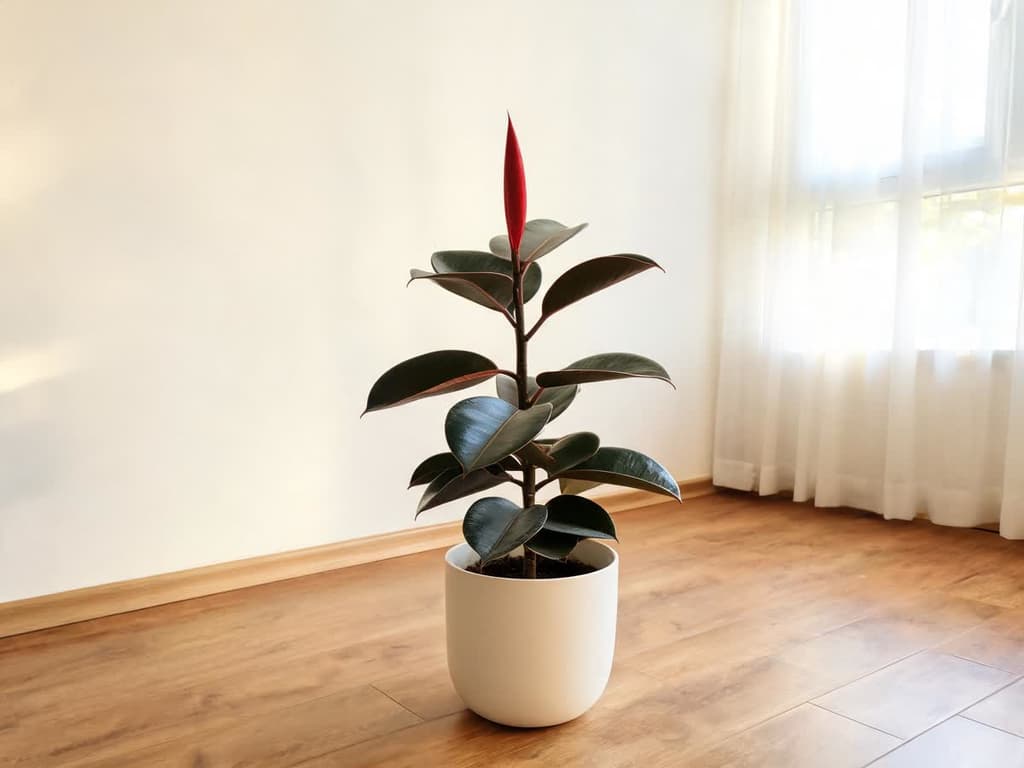
In a pot indoors, the rubber plant practically never flowers. The flower of the rubber plant (Ficus elastica) is hidden inside a small fig. Only a tiny wasp, from a single species, pollinates this flower and allows the fig to produce seeds. As far as records show, this wasp lives only in Asia (Harrison et al., Scientific Reports, 2017).
The red tip that appears at the top of the stem is not a flower: it is the sheath protecting the new leaf (the botanical term is stipule). Do not cut this sheath. It dries up and drops off on its own when the leaf unfolds, and it is a sign that your rubber plant is growing.
Quick summary:
The rubber plant flower is tiny and inconspicuous, growing inside a fig up to 1.3 cm in size. The source is NC State Extension, an extension service of North Carolina State University in the United States.
Indoors, the rubber plant rarely produces figs. An adult tree planted in the ground in a warm climate produces yellowish figs (RHS, the UK's Royal Horticultural Society).
Without the right wasp, the fig will still develop, but it won't contain viable seeds.
The red sheath at the tip is the new leaf's stipule: let the sheath fall off on its own.
What you see | What it is | What to do |
|---|---|---|
A thin, pointed red, pink, or purplish tip at the top of the stem | The stipule, the sheath wrapping the new leaf | Nothing: the leaf opens and the sheath falls off on its own |
A dry, brown sheath clinging to the stem beside an already opened new leaf | The stipule at the end of its cycle | Let the sheath fall off on its own |
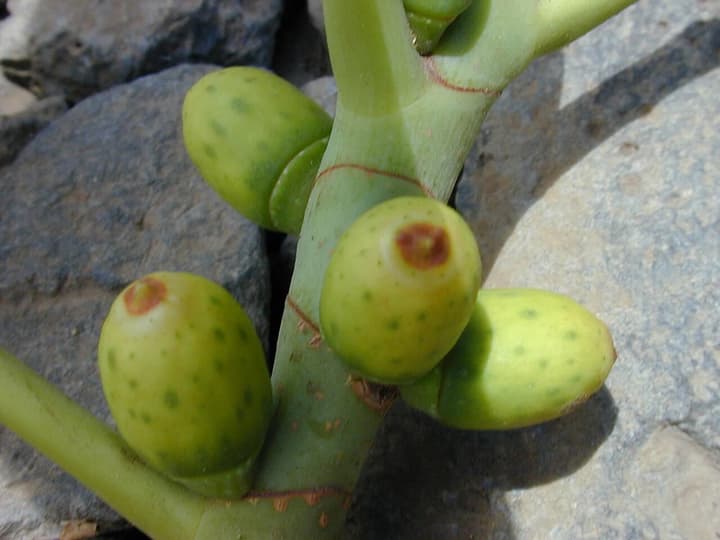
Small green balls about 1 cm wide, in pairs, right at the base of the leaves | New figs, which already carry the flowers inside | Nothing for the plant: they are rare in pots. If you have dogs or cats at home, pick up any that fall |
A red sheath at the top and yellowing leaves dropping below | Two separate signs: the sheath means new growth, while the yellow leaf has another cause | Stick your finger 2 inches into the soil and water only if it is dry |
A red sheath at the top and a drooping leaf | The wilting leaf has its own cause, unrelated to the sheath | Stick your finger 2 inches into the soil and water only if it is dry |
The red tip on a rubber plant is not a flower
The red tip of the rubber plant is the stipule, a thin sheath that wraps around the new leaf as it forms. The stipule of Ficus elastica is dark red, long, and pointed. When it falls off, it leaves a ring scar around the stem (Hong Kong Baptist University).
The color of the sheath ranges from dark red to pink or purple. Every new rubber plant leaf emerges inside this sheath. Because of this, a fresh red tip means the plant is actively growing a leaf.
Do not cut or pull off the stipule. It dries up and drops naturally once the leaf opens, as described in the rubber plant care guide. The brown rings you see along the stem are the scars left by sheaths that have already fallen off.
A yellow leaf dropping at the bottom and a new sheath at the top are two different matters: the sheath is growth, and the yellow leaf has another cause. A bottom leaf that yellows and drops from time to time is the oldest leaf being replaced (NC State Extension). If several leaves turn yellow in the same week, stick your finger 2 inches into the soil before watering. The complete rule: the rubber plant should only be watered when the top 2 inches of soil are dry. Yellow leaves have other causes beyond watering, and the page on yellow leaves on rubber plants brings together the most common ones.
If you inherited the plant and aren't sure whether it's truly a rubber plant, Bloom (available for iOS) identifies the species from a photo of the leaf.
What the rubber plant flower looks like
The rubber plant's flower is tiny, inconspicuous, and has little scent, developing inside a fleshy pouch called a syconium, which is the fig. The flowers are separated into male and female and line the inside wall of the fig. A wasp enters through a small hole at the tip to pollinate (NC State Extension).
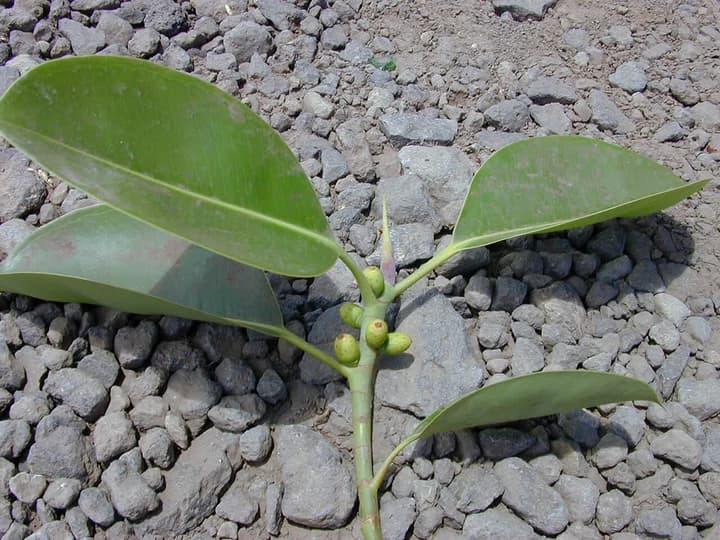
The rubber plant fig is oval and grows up to 1.3 cm (0.5 in) long and 0.6 cm (0.2 in) wide. It starts green with darker specks and turns yellow as it matures. The figs grow in pairs or clusters, attached directly to the branch without a stem (NC State Extension).
NC State Extension explains that the bloom requires a single species of wasp for pollination. For this reason, the flower lacks bright colors or strong scents to lure other insects. The flower of the edible fig sits in the exact same place, inside the fig: all Ficus species produce a syconium.
Why rubber plants don't bloom indoors
Rubber plant flowers stay inside the fig, so without a fig, no flower appears. NC State Extension notes that, indoors, the plant rarely flowers and rarely fruits. The RHS, the horticultural society of the United Kingdom, only describes figs on mature trees in warm climates (RHS). No source we read explains in detail why the potted plant hardly ever forms figs.
Even when the fig forms, it only produces seeds if the rubber plant wasp is nearby. This wasp is Platyscapa clavigera, a tiny insect that only pollinates Ficus elastica (Harrison et al., 2017). NC State notes that the fig only has fertile seeds where the pollinating insect is present.
The rubber plant was planted in Singapore in the 19th century and spent at least 70 years without a seed. Singapore had more than 50 native fig species, but none of the wasps from these fig trees pollinated the rubber plant (Harrison et al., 2017).
The first seed-grown saplings appeared in Singapore around 2005. Genetic analysis showed that these seedlings were not clones: they inherited genes from a nearby tree as well as from other trees. The pollinator discovered was Platyscapa clavigera, a wasp first described in 1885 in Bogor, on the island of Java.
Rubber plants have been propagated by cuttings (branch segments that take root) for more than a century. Every plant created this way is a clone, an identical copy of the mother plant, and sterile clones make up the vast majority of rubber plants cultivated today. The authors also examined dozens of rubber plants with figs across cities in Malaysia, Thailand, and China's Yunnan province. Not a single fig had been pollinated.
When a rubber plant produces figs
The rubber plant produces figs as a mature tree planted in the ground in warm climates. The RHS describes yellow figs in clusters on these trees. ICRAF, the World Agroforestry Centre's tree database, records that rubber plants planted outdoors flower year-round in most places. Indoors, they rarely flower (ICRAF).
The fig forms even without the wasp: the wasp only determines whether there are fertile seeds (NC State Extension). In Florida, the rubber plant is planted in yards as a shade tree. The University of Florida lists the figs and leaves that drop from this tree as ground litter (UF/IFAS).
In the tropics, the rubber plant is a common street and plaza tree (Harrison et al., 2017). A large outdoor tree can develop yellowish figs just over 1 cm in size. We found no record of the rubber plant wasp outside Asia, so these figs likely contain no seeds.
An article from the magazine Ciência Hoje, by a researcher from USP Ribeirão Preto, cites three fig trees from other countries. The edible fig and creeping fig (Ficus pumila), a climbing vine used to cover walls, do not reproduce by seed in Brazil. The wasps for these two fig trees do not exist here. The Asian fig tree found in public squares only propagated by cuttings until the 1980s. During that decade, this fig tree's wasp was introduced into the country (Pereira, Ciência Hoje, 2005).
Can you make a rubber plant bloom?
We found no studies or technical guides showing how to force a potted rubber plant to bloom using fertilizer, light, or pruning. The sources associate figs strictly with mature trees growing in warm climates, and the wasp only determines whether the fig produces viable seeds. The best approach for the plant is focusing on leaf care. A healthy rubber plant produces new leaves, one red sheath after another.
We found no published record stating the exact age at which a rubber plant flowers for the first time. The RHS estimates 10 to 20 years for the plant to reach its mature size, and that timeline reflects physical size, not blooming.
For a potted rubber plant, focus on leaf health: keep the plant in a bright spot with direct sun only in the morning. Water when the top 2 inches of soil feel dry, and keep the temperature above 55 °F (13 °C). You can find step-by-step guidance on light, watering, pruning, and temperature in our rubber plant care guide.
Frequently asked questions
Are rubber plant figs edible?
The rubber plant's fig is not an edible fruit. NC State Extension notes that the fig is barely edible. The ASPCA, an American animal poison control center, classifies plants in the genus Ficus as toxic to dogs and cats (ASPCA). Because of this, keep the plant and any fallen figs out of reach of pets.
Can I remove the dried sheath still clinging to my rubber plant?
Do not pull off the dry sheath: leave it alone until it falls off by itself. We found no technical source advising the removal of attached sheaths, and the safest option for the plant is leaving it undisturbed. The stipule drops off naturally once the leaf opens.
Does the rubber plant bloom during a specific season?
In a pot, the rubber plant has no blooming season because it almost never flowers. ICRAF notes that mature outdoor trees bloom year-round in most areas. In Florida, UF/IFAS reports figs appearing in early summer, meaning timing depends on location. The red sheath appears whenever the plant grows a new leaf.
Which rubber tree produces actual rubber?
Today, natural rubber comes from a different tree, the Amazonian rubber tree (Hevea brasiliensis), from another family. The potted rubber plant is Ficus elastica, an Asian fig tree that served as a source of latex in the 19th century (Harrison et al., 2017). Both have white sap, but only Ficus elastica forms the fig with the hidden flower described in this guide.
Potted rubber plants rarely flower: what to do with yours
Do not cut the red sheath at the tip: it wraps the new leaf and drops on its own. If a small green ball develops near the leaf bases, it is a rare fig and the plant requires no special care. If you have dogs or cats, pick up any fallen figs. If yellow or wilted leaves appear at the same time, stick your finger 2 inches into the soil and water only if it is dry.
Sources
Related articles
Prayer Plant Brown Tips: Causes, Water, and How to Trim
A prayer plant develops brown tips from tap water fluoride and chlorine, dry air, soil that dries out too much, or fertilizer salts. Brown tips will not turn green again: trim the dry part following the leaf's shape and check new leaves to confirm the fix.
How to Care for a Prayer Plant: Light, Water, Humidity, and Closing Leaves
To care for a prayer plant, provide bright indirect light, keep the soil moist without waterlogging, and maintain air humidity above 50%. Water with fluoride-free water. Leaves that rise and fold at night are the plant's normal movement.
Peonies in Winter: Can They Handle Frost? Care by Type and in Pots
Peonies in winter: the herbaceous type tolerates lows of −15 to −20 °C, dies back above ground in winter and returns in spring, and tree peonies keep their branches. Cut dead foliage down to the ground, mulch the soil only in the first winter, protect the roots in pots, and cover the buds on frosty nights.