Prayer Plant Brown Tips: Causes, Water, and How to Trim
A prayer plant develops brown tips from tap water fluoride and chlorine, dry air, soil that dries out too much, or fertilizer salts. Brown tips will not turn green again: trim the dry part following the leaf's shape and check new leaves to confirm the fix.
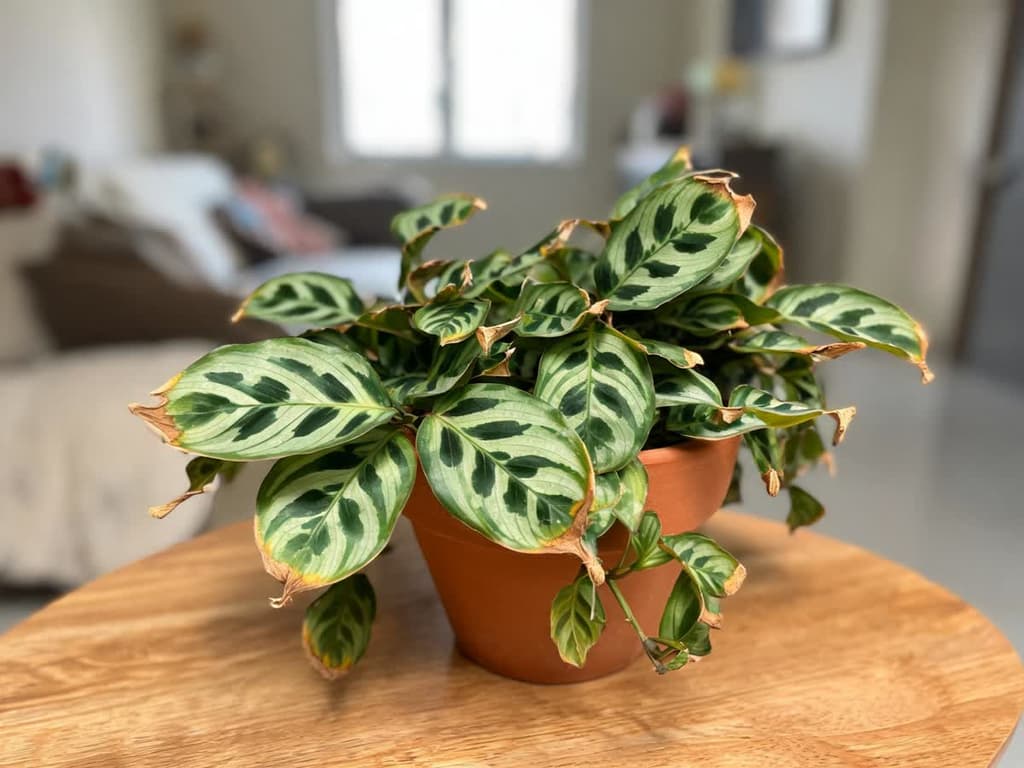
A prayer plant gets brown tips from four main causes: fluoride and chlorine in tap water, dry air, soil that dries out too much between waterings, and fertilizer salts accumulating in the pot. A tip that has already turned brown is dead tissue and will not turn green again. Trim the dry part and judge whether the issue is fixed by watching new leaves after they unfurl completely.
If you are debating between trimming the tips and switching your water, do both. Trimming improves the look right away, while changing the water tackles fluoride, the cause most cited across consulted sources for prayer plants. First, gently squeeze the base of the stems near the soil: a firm base means the rhizome (the short stem right at the soil line) is alive, and the plant will still push out new growth. The guide on how to care for a prayer plant explains this test and how to repot only the firm sections if the base feels soft and dark.
Quick summary:
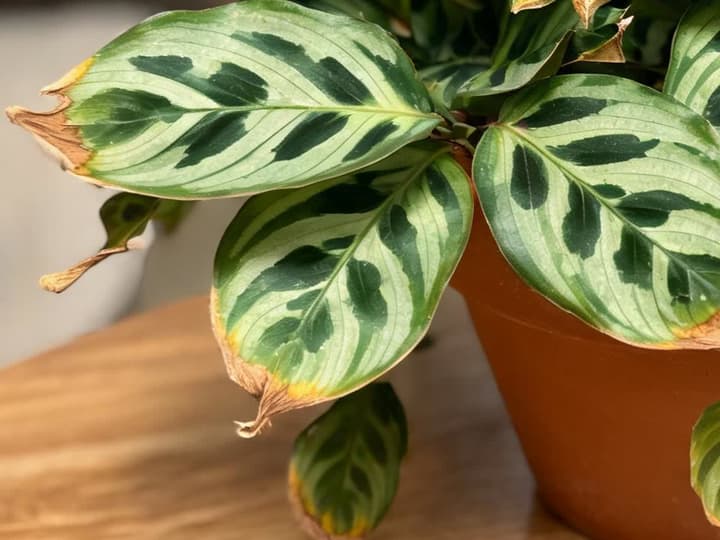
Brown tips and edges separated from green tissue by a yellow halo, beginning on the oldest leaves, point to fluoride or salt buildup.
Letting tap water sit for 24 hours removes chlorine, but it does not remove fluoride. Boiling and carbon filters do not remove it either.
Distilled water, reverse osmosis water (which uses a membrane filter that traps minerals), and rainwater avoid the fluoride found in municipal tap water.
Trim brown tips using sharp scissors, matching the leaf's natural curve without cutting into green tissue.
Why prayer plants develop brown tips
A brown tip on a prayer plant (Maranta leuconeura) is tip necrosis, also called tip burn. The tissue at the edge of the leaf dies, dries out, and turns brown and brittle. NC State Extension is the extension service of North Carolina State University. According to them, prayer plant leaves burn from excess fluoride and excess fertilizer (NC State).
Fluoride sensitivity is documented in the species itself. A 1996 NC State bulletin lists Maranta leuconeura among commercially produced plants sensitive to fluoride. Calatheas and ctenanthes, from the same family, appear on the same list (Everett and Nelson, NC State). For this reason, what applies to water here also applies to calathea, which many call by the same common name in English, prayer plant.
The Iowa State Extension lists the prayer plant among plants sensitive to chlorine and fluoride in tap water (Iowa State). Ask Extension is the question-and-answer service of American extension offices. In an answer published there, the University of Maryland Extension states that the prayer plant is sensitive to water quality. The issues cited include fluoride in treated tap water, hard water (high in calcium and magnesium), and sodium from water softener systems (Ask Extension).
The New York Botanical Garden (NYBG) points to causes unrelated to water quality. According to the NYBG, brown tips and margins, curling leaves, and dropping leaves usually indicate a lack of moisture in the soil or the air (NYBG).
How to diagnose the cause by leaf and pot symptoms
Where the browning appears, the age of the affected leaves, and the condition of the soil separate each cause. Before changing your routine, inspect the foliage closely, check the soil surface, and look at the pot's rim. Note where the plant sits in relation to the nearest window as well.
What you see on the leaf and pot | Most likely cause | First step |
|---|---|---|
Brown tips and margins with a yellow halo between brown and green tissue, most pronounced on older leaves | Fluoride from water or fertilizer, or salt buildup in the soil | Switch your water source and flush the potting mix |
Brown tip accompanied by a white crust on the soil surface or pot rim | Salts from fertilizer or mineral-heavy tap water | Scrape off the crust and flush the potting mix |
Brown tips and edges, curled foliage, and soil dried out all the way through | Soil allowed to dry out excessively between waterings | Drench until water flows freely from the drainage hole; for subsequent waterings, insert your finger 1 inch (2.5 cm) into the soil and water only when the fingertip emerges dry |
Brown tips and margins while soil remains moist in a room with dry air | Low humidity | Check room humidity with a hygrometer; if below 70%, run a humidifier |
Faded color and scorch marks on foliage facing a window | Direct sunlight | Move the pot away from a direct-sun window (in Brazil, one facing north or west) |
Small scattered tan specks merging into larger spots edged with yellow borders | Fungal leaf spot | Stop getting water on the leaves |
Dark band of dead tissue running parallel to the leaf margin without starting at the tip | Mites | Isolate the plant and inspect closely with a magnifying lens |
The yellow band between the brown and green points to fluoride, salt, or excessive light. Penn State Extension describes prayer plant tip burn this way: the tip and margin die, with a yellow halo between the dead and living tissue (Penn State). The causes it lists are phosphate fertilizer, fluoride, and excessive light. The University of Florida (UF/IFAS) prayer plant production guide describes the same symptom and adds salt buildup in the soil (UF/IFAS).
In the NC State bulletin, fluoride damage starts at the tips and margins of older leaves, first yellowing and then drying out. NC State also warns that prayer plants do not tolerate direct sun and that intense sun fades leaf colors. In Brazil, windows that receive direct sun face north or west.
The last two rows of the table have a different cause than the others. UF/IFAS describes Helminthosporium leaf spot, a fungus. The tiny spots start water-soaked, dry out, and merge into brown patches up to 1.3 cm (0.5 in) across, with a yellow halo. The spot appears when the leaf stays wet for 6 hours or longer. The same guide describes the mite Steneotarsonemus furcatus, which leaves a line of dead tissue parallel to the leaf margin and can kill the plant. The page on prayer plant pests shows how to confirm the mite and how to treat the plant.
The full overview of causes of dry tips on prayer plants also covers cold and heat stress. If your symptoms do not match any row in the table, cross-reference a photo of the affected leaf with similar cases before overhauling everything at once. Photo diagnosis in Bloom (available for iOS) handles this comparison and is included with the Premium plan.
Distilled, rain, or filtered water: what truly removes fluoride and chlorine
To remove fluoride from watering water for a prayer plant with brown tips, use distilled water, reverse osmosis water, or rainwater. In Brazil, tap water is fluoridated by law: Law 6,050 of 1974 mandates the addition of fluoride in public systems with a treatment plant (Law 6,050).
What removes and what fails to remove fluoride and chlorine from water:
Leaving water to sit for 24 hours removes chlorine, which evaporates. It does not remove fluoride or minerals, according to Ask Extension (Ask Extension).
Boiling does not remove fluoride, and standard household carbon filters do not either. This information comes from the EPA, the United States environmental agency (EPA).
Water pitcher filters can let fluoride, calcium, and magnesium slip right through. The Ask Extension answer regarding prayer plants advises checking packaging claims to see what contaminants a filter actually eliminates.
Distilled water and reverse osmosis water reduce fluoride, and the EPA cites both treatments as effective. Reverse osmosis forces water through a membrane that traps minerals.
Rainwater does not contain added municipal fluoride. Collect it in a clean, covered container.
Water from a softener (a unit that swaps calcium in water for sodium) deposits sodium into the soil. The Ask Extension guidance lists this sodium among the specific water components prayer plants dislike.
Pick a filter only if its packaging explicitly claims fluoride reduction (fluoride being the dissolved form in tap water). Without that clear claim, assume fluoride stays in the filtered water.
NYBG also warns against hard water, which leaves chalky mineral deposits on leaves. If water leaves white scale inside your teakettle, it is hard: switch to rainwater or distilled water for that reason too.
Fertilizers and perlite can introduce fluoride as well
Superphosphate, a phosphorus fertilizer, carries between 1% and 2% fluoride as a manufacturing contaminant and scorches prayer plant foliage, according to UF/IFAS. Read fertilizer labels carefully and avoid products listing superphosphate. NC State notes that excess fertilizer burns prayer plant foliage on its own, even without fluoride. Adhere strictly to the product label rate without exceeding it.
Perlite, the white mineral granules mixed through potting soil, divides gardening resources. Penn State recommends avoiding perlite with prayer plants because it contains fluoride. NC State's 1996 bulletin tested fluoride levels in perlite: 17 mg per kg, compared to 2,600 mg per kg in ordinary superphosphate. Researchers also found that two or three generous flushes wash out most of that fluoride.
This guide follows NC State, which measured perlite's fluoride content directly, over Penn State's blanket exclusion. If your fresh potting mix contains perlite, give it two or three thorough flushings using distilled, reverse osmosis, or rain water before applying fertilizer.
How to flush salts and fluoride from prayer plant soil
Switching your water source only manages what enters the pot going forward. Fluoride and fertilizer salts already sitting in the mix remain behind, which is why leaf tips can keep browning even after you change water. Leaching the soil with fluoride-free water washes these accumulated salts out through the drainage holes.
The University of Maryland Extension describes the procedure like this (UMD Extension):
Scrape away any white crust sitting on the soil surface using a spoon.
Pour through distilled, reverse osmosis, or rain water equal to at least twice the pot's volume: for a 1-quart pot, use 2 quarts. Let all the runoff drain out completely through the bottom holes.
Repeat this process every 4 to 6 months, always doing so right before you fertilize so you do not wash away fresh nutrients.
Always use distilled, reverse osmosis, or rain water to leach prayer plant soil showing brown tips, never standard tap water. Empty the saucer 15 minutes after watering, as NYBG instructs. Ask Extension's answer on prayer plants also recommends repotting into fresh mix, perhaps once a year, to clear out accumulated buildup. Between yearly repottings, continue flushing the soil every 4 to 6 months.
Dry air and soil allowed to dry out completely
According to NYBG, prayer plants require relative humidity well over 50% and soil that never dries out entirely. In NYBG's guidance on prayer plants with brown margins, that recommendation climbs to 70% or higher. If your prayer plant already shows brown tips, aim for 70% humidity and monitor conditions using a hygrometer placed right by the pot.
To raise humidity levels, run a room humidifier near the plant until your hygrometer reads 70% or higher. NYBG mentions misting with distilled water. This guide follows Ask Extension, which advises against misting because wet leaves encourage plant pathogens. Do not mist the foliage. The Helminthosporium leaf spot cited in the table needs just 6 hours of continuous leaf wetness to take hold. In addition, place the pot well away from air conditioning and heating vents, which sap humidity.
When watering, insert your finger 1 inch (2.5 cm) into the potting soil: if your fingertip comes out dry, water thoroughly until it drains freely from the base. NC State warns that poorly draining soil leads to root rot. Brown tips paired with constantly soggy soil and soft stem bases point to root rot, not tap water chemistry. In that scenario, wait until your finger, inserted 1 inch (2.5 cm) down, emerges dry before watering again. The guide on how to care for a prayer plant details watering and humidity requirements across each season.
How long until fresh foliage opens without brown tips
No consulted source specifies the exact time a prayer plant needs to produce pristine foliage. The true sign that you solved the underlying cause is when a new leaf unfurls and matures with no brown tips. A tip that has already turned brown will never turn green again.
A new leaf can be deceiving. Missouri IPM is the pest management program at the University of Missouri. It explains that a new leaf can emerge normal and turn dark at the tip as it matures (Missouri IPM). Therefore, judge whether the issue is fixed by leaves that have already unfurled completely, not by the newly emerged shoot.
Use your trim as a progress marker:
Trim every brown tip on the same day and record the date.
From that date onward, evaluate only leaves that unfurl after your trim.
If these leaves stay free of brown tips after expanding fully, you fixed the underlying issue.
If these leaves also turn brown at the ends, the trigger remains active: refer back to the table and test the next cause fitting what you observe.
Brown tips do not mean your plant is dying. According to Missouri IPM, leaf tipburn harms the plant's aesthetic value rather than its survival. As long as the base of the stems stays firm, a prayer plant will keep producing new leaves.
How to trim brown tips on a prayer plant
Trimming brown tips does not harm your prayer plant and improves the leaf's appearance. Iowa State Extension notes the limit: the tip will turn dark again if the underlying cause persists (Iowa State).
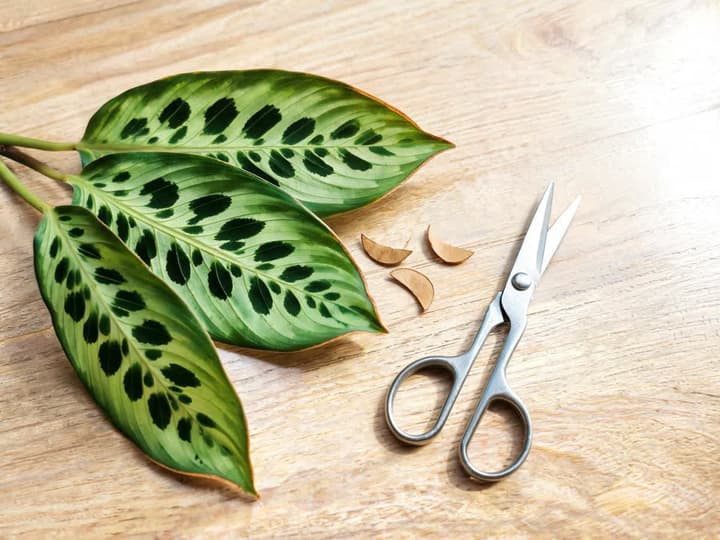
To trim your plant:
Use clean, sharp scissors. University of Maryland Extension advises using sharp shears to take off dry tips with a clean cut.
Follow the shape of the leaf. University of Arkansas Extension recommends following the natural contour of the leaf. A straight cut draws attention to the leaf (UA Extension). On a prayer plant, the leaf is almost oval: cut in a curve, following the edge to reshape the tip.
Leave a thin brown margin. Do not slice into live green tissue. The RHS (Royal Horticultural Society) offers this guidance for indoor palms. While no sources specifically state this for prayer plants, maintaining that sliver prevents opening a fresh wound in healthy tissue.
Prune away leaves that are mostly brown. The RHS advises cutting off entirely brown leaves, which cannot recover. For foliage that remains predominantly green, trim only the dry tip and leave the leaf on the plant until new growth takes over. Snip the leaf petiole close to where it joins the stem.
Frequently asked questions
Should I trim brown tips off my prayer plant?
Yes, you can trim them. A brown tip is dead tissue that cannot recover green color, and trimming it away with sharp shears will not harm your prayer plant. Follow the leaf's natural outline and preserve a hairline brown margin so you do not cut into green tissue. Trimming only improves appearance: if the underlying cause persists, tips will turn brown again.
Can I water my prayer plant with distilled water?
Yes. Distilled water contains none of the fluoride found in municipal tap water, and reverse osmosis water and rainwater are similarly fluoride-free. Letting tap water sit overnight only rids it of chlorine, and boiling does not remove fluoride. After switching water, leach the potting mix to remove existing accumulated fluoride.
Will brown tips on a prayer plant turn green again?
No. Brown leaf tissue is dead, and Missouri IPM states there is no way to restore normal color to a desiccated leaf tip. Improvements from correcting plant care appear only on newly produced foliage. Check these leaves only after they open fully, as tips can still discolor as the leaf expands.
Are prayer plants toxic to cats and dogs?
The ASPCA's "Prayer Plant" entry classifies Calathea insignis, which belongs to the same family as the prayer plant, as nontoxic to dogs and cats (ASPCA). The ASPCA does not have a dedicated entry for Maranta leuconeura. To be safe, keep the pot out of reach of pets that chew on leaves.
Action checklist for prayer plants with brown tips
Squeeze stem bases gently: firm growth indicates your plant is healthy and alive.
Inspect the foliage and pot: yellow halos point toward fluoride or salt, white surface crusts signify salt, thoroughly dried soil indicates underwatering, and dark lines running parallel to leaf edges point to mites.
Flush the soil using twice the pot's volume in distilled, reverse osmosis, or rain water, and empty the drainage saucer after 15 minutes.
Switch future waterings to distilled, reverse osmosis, or rain water, and steer clear of superphosphate fertilizers.
Check humidity around the plant and run a humidifier if readings drop below 70%.
Trim every brown leaf tip on the same day, note the date, and check new leaves that unfurl afterward.
Sources
UF/IFAS: Maranta Production Guide (Henley, Chase, and Osborne, RH-91-22), archived copy
New York Botanical Garden: Prayer Plant (Maranta leuconeura)
Iowa State University Extension: Why does my houseplant have brown leaf tips and edges?
University of Arkansas Extension: Houseplants, general information
Related articles
How to Care for a Prayer Plant: Light, Water, Humidity, and Closing Leaves
To care for a prayer plant, provide bright indirect light, keep the soil moist without waterlogging, and maintain air humidity above 50%. Water with fluoride-free water. Leaves that rise and fold at night are the plant's normal movement.
Peonies in Winter: Can They Handle Frost? Care by Type and in Pots
Peonies in winter: the herbaceous type tolerates lows of −15 to −20 °C, dies back above ground in winter and returns in spring, and tree peonies keep their branches. Cut dead foliage down to the ground, mulch the soil only in the first winter, protect the roots in pots, and cover the buds on frosty nights.
Peonies: How to Make Them Bloom and Why Buds Don't Open
Peonies: how to make them bloom. A peony that fails to bloom usually has buds buried too deep, too little sun, a warm winter, or is too young. Learn when it flowers, how long it takes to produce its first bloom, and how to identify the cause from the plant's symptoms.