How to Take Care of Peonies: Cold, Shallow Planting, Sun and Blooms
How to take care of peonies, from planting to bloom. They need full sun, buds (eyes) 1 to 2 inches below the surface, well-draining soil, and a cold winter to flower. See what changes for tree peonies, how to water, fertilize, stake, divide, and deal with powdery mildew and ants.
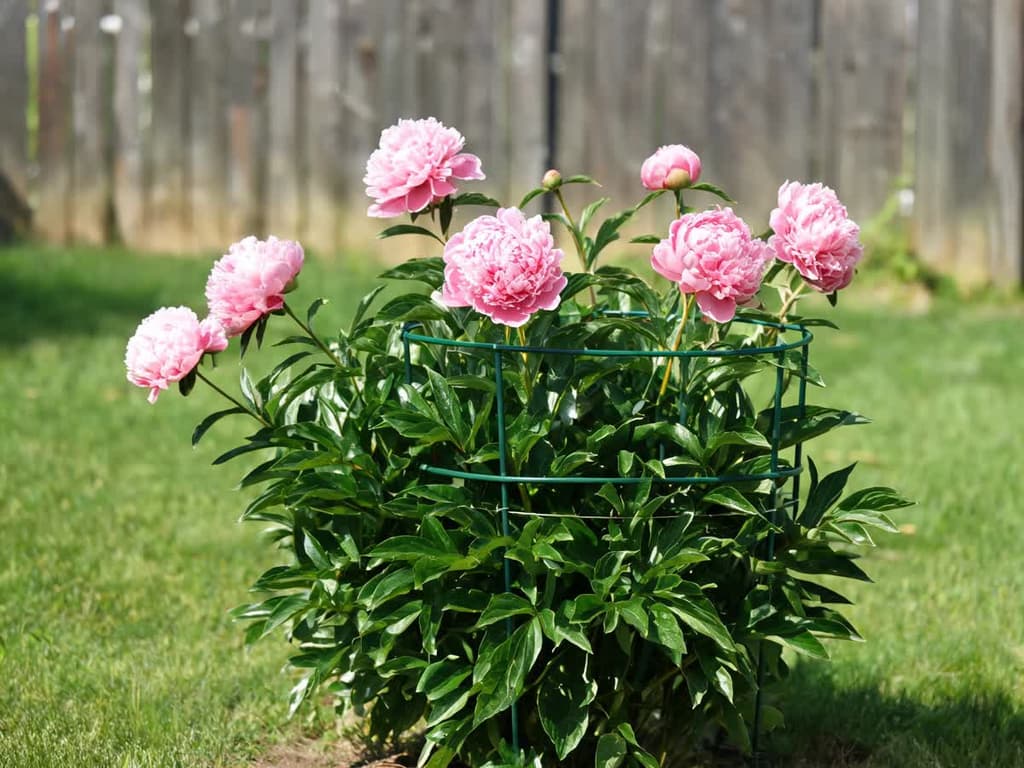
To take care of peonies, plant them in direct sun for 6 hours or more, in well-draining soil. Keep the eyes (the red buds on top of the root) no more than 2 inches (5 cm) below the surface, or 1 inch (2.5 cm) where winters are short. After the first year, they rarely need watering. To bloom, peonies need to go through a cold winter: in Brazil, they are most likely to bloom well only where winters are cold, such as in the South and in the mountains.
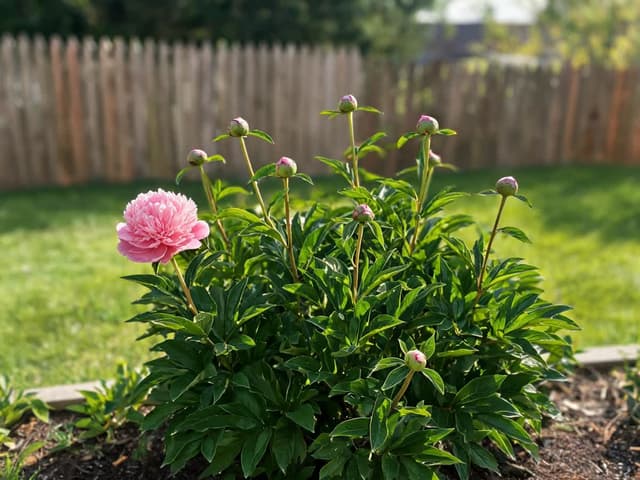
The peony (genus Paeonia) is a perennial: it lives for many years in the same spot and re-emerges every year from thick roots located underground. The buds, also called "eyes," are the reddish shoots located on top of these roots. It is from them that the next season's stems and flowers emerge.
The sources for this guide are mostly extension services: the growing guidance that public universities in the US maintain (Wisconsin, Cornell, Purdue, Iowa State, Clemson, NC State, WSU, Missouri, and Colorado State). The RHS (Royal Horticultural Society, the UK gardening society) and the ASPCA, an American animal protection organization, are also included.
How to take care of peonies: quick facts
Care | What to do |
|---|---|
Light | Direct sun for 6 to 8 hours; in hot areas, afternoon shade |
Planting | Eyes 1 to 2 inches deep, never deeper |
Soil | Well-draining; soggy soil rots the roots |
Watering | In the first year, water during dry spells; after that, only in extended droughts |
Fertilizer | Once a year when shoots emerge, with low nitrogen |
Cold | Needs a cold winter to set flower buds |
Support | Ring placed when shoots emerge from the soil |
Pets | Toxic to dogs, cats, and horses (ASPCA) |
Size | Tree peony from 3 to 5 feet (Purdue) |
The profile below shows the average across the entire genus. The temperature range covers different types of peonies, and watering "every 7 days" is an average: your soil and local rainfall determine watering needs.
Which type of peony you have: herbaceous, tree, or Itoh
There are three types of garden peony, and care varies from one to another. The University of Wisconsin breaks them down as follows:
Herbaceous (Paeonia lactiflora and hybrids): stems are soft and die back completely in winter, right down to the ground. In spring, red shoots emerge directly from the soil.
Tree (Paeonia suffruticosa): forms a shrub with woody branches that loses its leaves in winter but keeps its stems. According to Cornell, its flower is larger (20 to 30 cm) and opens about two weeks before the herbaceous peony.
Itoh (or intersectional): a cross between the two. It has short, woody stems. Wisconsin states that they die to the ground in winter; the NC State Lee County extension states that part of them remains standing. In fall, cut down to the ground only the stems that have dried out.
What changes in practice is cutting and planting. Herbaceous peonies are cut down to the ground in fall; tree peonies never are, because the following year's growth comes from the old branches. Tree peonies are usually grafted (attached to the root of another peony) and are planted deeper in the soil. You divide herbaceous peonies to propagate them; tree peonies, according to WSU, are not divided.
People who inherit a garden sometimes confuse herbaceous peonies with hydrangeas because both have large blooms in shades of pink. Peony foliage is divided into narrow, pointed leaflets, and each stem ends in a single flower packed with petals. Hydrangeas have entire leaves, and their "flower" is a cluster of small blossoms. If you are still unsure, Bloom (available for iOS) identifies the plant from a photo.
Peonies need cold to bloom
The peony needs a period of winter chill to set flower buds, according to WSU. NC State states that, in warm areas, the herbaceous peony does poorly because it does not receive the cold it needs.
None of the consulted extensions gives a number of chilling hours. The only measured number we found comes from a 2017 Chinese study on 'Hang Baishao', a low-chill variety. Even for it, the minimum requirement was 504 to 672 cumulative chilling hours in winter, the equivalent of 21 to 28 full days. Common garden varieties were not measured in this study.
In Brazil, we found no study on the cold requirements peonies have here. American sources state that they do well in cold regions and poorly in warm ones. By this logic, flowering should be better in the South and in the mountains, but that is our deduction, not a measurement.
Where winters are short, NC State and the NC State Lee County extension give four care tips:
on herbaceous and Itoh peonies, plant the eyes no more than 2.5 cm deep, or level with the surface;
do not cover the crown (the point where the buds emerge) with straw or bark in winter, because the mulch insulates the buds from the cold;
choose varieties with low chilling requirements. NC State highlights herbaceous cultivars like 'Festiva Maxima', 'Sarah Bernhardt', 'Felix Crousse', and 'Monsieur Jules Elie'. Clemson recommends early-blooming and single-flowered varieties (a single row of petals);
give them afternoon shade, which protects the bloom from heat.
Regarding mulch (straw or bark spread around the plant), sources diverge. The RHS instructs spreading 5 cm around the peony, without covering the center, and writes for cold winters. Where winters are short, NC State and the Lee County extension instruct leaving the crown uncovered. We follow these two, because mulch deprives the buds of the cold they need.
NC State also states that in North Carolina (a warm-climate southern US state), tree peonies usually perform better than herbaceous peonies. The RHS notes that tree peonies can take up to 4 years to establish and bloom.
How to plant peonies: location and depth
Plant peonies in a spot with direct sun for 6 to 8 hours, according to the University of Wisconsin. Clemson states that herbaceous peonies need at least 6 hours of direct sun to bloom well. In hot areas, afternoon shade protects the flowers. The 6-hour sun rule applies to herbaceous peonies. Tree peonies, according to Clemson, require dappled sunlight or afternoon shade, and Purdue notes they tolerate full sun to partial shade.
The soil needs to drain well. The RHS says that the herbaceous peony even grows in clay soil (muddy and heavy), provided the soil does not become waterlogged in winter. Leave 90 cm to 1.2 m between plants, as Purdue indicates.
Depth is the most frequently cited cause of missing blooms: Clemson states that most non-flowering peonies were planted too deep. On herbaceous and Itoh peonies, set the top of the eyes no more than 2 inches below the surface. The RHS, Clemson, and Colorado State call for 1 inch. Use 1 inch where winters are short, as NC State recommends for warm climates, and up to 2 inches where winters are cold.
The tree peony follows a different rule, because it usually comes grafted onto a herbaceous peony root. The RHS directs planting the graft union (the point where the two plants were joined) about 15 cm deep. WSU mentions 10 to 13 cm. Clemson calls for only 2.5 cm; we follow the RHS and WSU, which agree with each other. With the graft deep, the top part develops its own roots, according to the RHS.
The planting season in American sources is early fall, in September and October. In Brazil, the same stage for the plant falls in March and April. The RHS accepts moving container-grown peonies into the ground in late spring, but the Lee County Extension prefers waiting until fall. When in doubt, plant in fall, the season most sources recommend.
How to water peonies
In the first year after planting, water peonies whenever a week passes without rain, soaking the soil deeply all at once. After that, the RHS states that the plant develops deep roots and does not require routine watering. During long dry spells, Clemson advises watering deeply every 10 to 14 days.
Overwatering is the primary risk. WSU states that peonies rot if the soil stays constantly wet, and recommends letting the soil dry out slightly between waterings. Water the soil, not the foliage: Iowa State notes that wetting leaves during watering promotes fungal leaf spots.
Fertilizing peonies
Fertilize the peony once a year, when the shoots emerge from the soil. Clemson uses a low-nitrogen fertilizer, such as 5-10-10, when the stems are 2 to 3 inches tall. Nitrogen (N) is the first of the three numbers on the N-P-K label. Use the rate indicated on the package. In Brazil, sprouting happens between late winter and early spring, around August and September. Spread the fertilizer around the plant, without touching the shoots.
Sources disagree on the timing. The RHS, Clemson, and the Lee County extension fertilize at shoot emergence. Purdue fertilizes right after flowering. Cornell and the Missouri extension prefer late summer or fall. None of them compare the timings with measurements. We follow shoot emergence, which three of the sources indicate.
Too much nitrogen causes peonies to produce leaves instead of flowers. Missouri, Cornell, the University of Wisconsin, and Clemson all give this warning. The guide on how to choose fertilizer from the label and how much to use explains phosphorus (P) and potassium (K), the other two numbers on the label.
Support to keep peonies from flopping
The flower of the herbaceous peony is heavy and holds rainwater, so the stems flop over. Colorado State University recommends staking herbaceous and Itoh peonies early in the season. Place the ring or cage when the red shoots emerge from the soil, before the plant grows. Purdue explains the reason: putting up the support when the plant is large injures the stems.
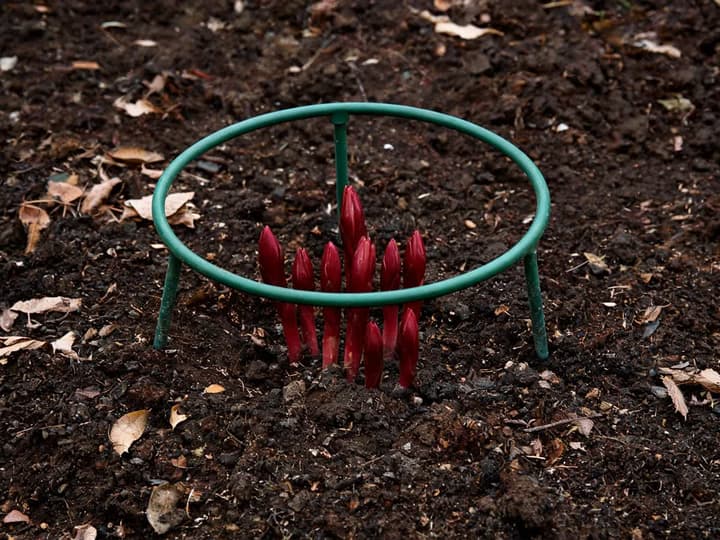
If your peonies have already flopped from rain, do not cut back the stems: herbaceous pruning happens in fall. Prop the plant up with stakes and twine wrapped around the clump (the group of stems emerging from the same root system). Purdue notes that mature tree peonies rarely need staking because their woody branches hold the weight of the blooms.
Ants on peony buds
Ants on the peony bud do not harm the plant and do not need to be removed. The RHS states that they cause no damage. According to Purdue, ants come for the nectar, a sweet liquid that the peony releases from glands at the base of the bud.
The idea that peonies need ants to open their flowers is a myth. Iowa State states that the bud opens without any ants at all. Purdue adds that ants also keep other insects away from the bud.
Powdery mildew and gray mold on peonies
The white powder covering peony leaves late in the season is powdery mildew, a fungal disease. According to Iowa State, powdery mildew rarely kills the plant, and once it appears, there is little you can do that year. Do not dig up the peony because of powdery mildew. None of the consulted sources recommends spraying detergent or homemade recipes on the leaves.
Powdery mildew occurs more frequently on plants with low light and poor air circulation, such as peonies crowded together. Purdue states that applying fungicide in a home garden after symptoms appear is not worth the effort. In fall, cut herbaceous peonies right down to the ground, throw the foliage in the trash, and keep it out of the compost pile. On tree peonies, remove only the diseased leaves. For the following season, provide more sun and more space around the plant.
Gray mold (botrytis) is more serious. The RHS calls it the only severe disease of peonies. Iowa State describes three signs. New shoots turn black at the base, wilt, and flop over. Buds turn brown and fail to open. A fuzzy gray mold appears, especially during cold, wet weather.
The gray mold fungus overwinters in plant debris. Because of this, remove dry buds and wilted flowers in spring, and cut stems right down to the ground in fall. Throw everything in the trash. Dark spots on the leaves can also come from other fungi, such as leaf spot, which Iowa State says usually does not kill the plant. The page on causes of spots on peony leaves lists three possible causes.
After blooming and in the fall: what to prune on peonies
After flowering finishes, cut off spent blossoms with clean shears. Clemson states that removing seed pods (the fruit that forms after the flower fades) allows the plant to conserve more energy. Do not cut away green leaves after flowering. Pruning herbaceous peonies is left for fall, once the foliage dies back.
In fall (in Brazil, from March to May), after the foliage dies, cut herbaceous peonies down to the ground without damaging the eyes. The RHS does this pruning to reduce the risk of gray mold.
Tree peonies are never cut down to the ground. Cornell explains that the following year's growth emerges from buds on the old branches. On tree peonies, remove only dead branches and spent blossoms.
How to divide peonies
Divide herbaceous peonies only when flowering drops off or the center of the clump becomes bare. WSU notes that the plant can grow for 15 to 20 years before it ever needs dividing. Do not divide plants that are less than 3 years old.
Cornell, Wisconsin, and Clemson divide in September and October, early fall in the Northern Hemisphere. The step-by-step process, according to the RHS and Cornell:
In early fall (in Brazil, March and April), cut the stems and remove the entire clump from the ground.
Using a clean, sharp knife, cut sections containing 3 to 5 eyes along with attached root tissue.
Replant each division with the top of the eyes 1 inch below the surface.
The RHS states that divided plants usually take about two years to flower. Clemson cautions that divisions with only 1 or 2 eyes may take several years to produce blooms. Tree peonies are not divided.
Why peonies fail to bloom
The most common causes, according to the sources cited in this guide:
Buds planted too deep: more than 5 cm of soil over them (more than 2.5 cm where winters are short). Replant in fall (in Brazil, March and April), with the top of the buds at 2.5 cm.
Not enough sun: less than 6 hours of direct sunlight.
Excess nitrogen: abundant leaves with no flower buds.
Young or recently divided plant: Clemson notes that garden peonies typically start blooming within three years.
Warm winter: without sufficient cold, the plant does not form buds.
Gray mold: flower buds turn black and fail to open.
Are peonies toxic to pets?
Yes. The ASPCA lists the peony (on the entry, Paeonia officinalis) as toxic to dogs, cats, and horses. The toxic principle is paeonol, and the signs are vomiting, diarrhea, and depression. If the animal ate the plant, consult a veterinarian.
Pet owners can check other species in the list of plants toxic to cats, dogs, and children, organized by severity.
Frequently asked questions
I bought a potted peony. What should I do with it?
Keep the peony in the pot during the summer, watered, and plant it in the ground in the fall (in Brazil, March and April). That is what the NC State Lee County extension recommends. The RHS accepts planting in late spring, but fall is the time that most sources indicate. Plant with the eyes at the same height they were in the pot, never deeper.
How long does it take for a peony to bloom?
Herbaceous peonies usually begin blooming within three years of planting, according to Clemson. A divided start flowers in about two years, according to the RHS. Tree peonies can take up to four years to establish and flower, even when bought already in bloom. A young plant that only produces foliage during its first few years is completely normal.
How long do peonies live?
Peonies live for decades in the exact same spot. Purdue states that they keep growing and flowering for over 50 years. Pick your planting site carefully: according to Purdue, a transplanted peony can take two to three years to resume normal flowering.
Can you grow peonies indoors?
It is not recommended. Herbaceous peonies need direct sun for 6 hours or more and a cold winter to set their flower buds. Indoors, they get neither. None of the consulted sources teach permanent pot culture. Potted peonies purchased at a nursery should go outside into the garden in a sunny spot.
Summary of peony care
Plant the peony in direct sun for 6 hours or more, in soil that drains well. Keep the eyes no more than 5 cm deep (2.5 cm where winters are short). Water in the first year and after that only during a long drought. Fertilize once, at shoot emergence, with low nitrogen, and stake early. In fall, cut the herbaceous peony down to the ground and throw the leaves in the trash; the tree peony keeps its branches. In Brazil, flowering depends on a cold winter.
Related articles
How to Care for a Prayer Plant: Light, Water, Humidity, and Closing Leaves
To care for a prayer plant, provide bright indirect light, keep the soil moist without waterlogging, and maintain air humidity above 50%. Water with fluoride-free water. Leaves that rise and fold at night are the plant's normal movement.
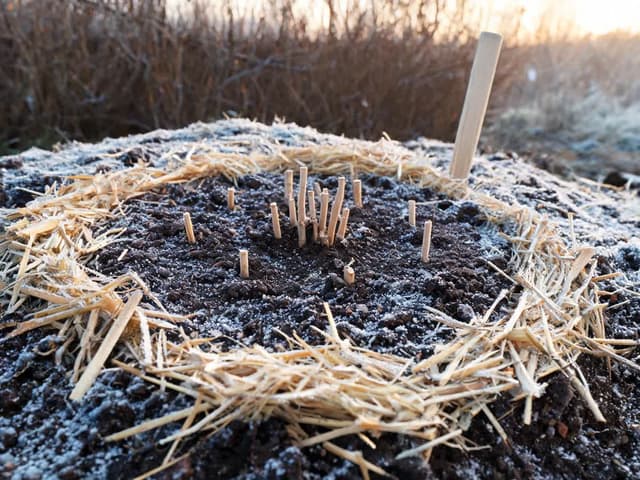
Peonies in Winter: Can They Handle Frost? Care by Type and in Pots
Peonies in winter: the herbaceous type tolerates lows of −15 to −20 °C, dies back above ground in winter and returns in spring, and tree peonies keep their branches. Cut dead foliage down to the ground, mulch the soil only in the first winter, protect the roots in pots, and cover the buds on frosty nights.
Peonies: How to Make Them Bloom and Why Buds Don't Open
Peonies: how to make them bloom. A peony that fails to bloom usually has buds buried too deep, too little sun, a warm winter, or is too young. Learn when it flowers, how long it takes to produce its first bloom, and how to identify the cause from the plant's symptoms.