Palm Fertilizer: The Right Ratio for Pots and Gardens
Garden palm fertilizer needs more potassium than nitrogen, with magnesium and slow release, spread under the entire canopy every 3 months. In a pot, the math changes. See the formula, dosage, leaf signs, and when not to fertilize.
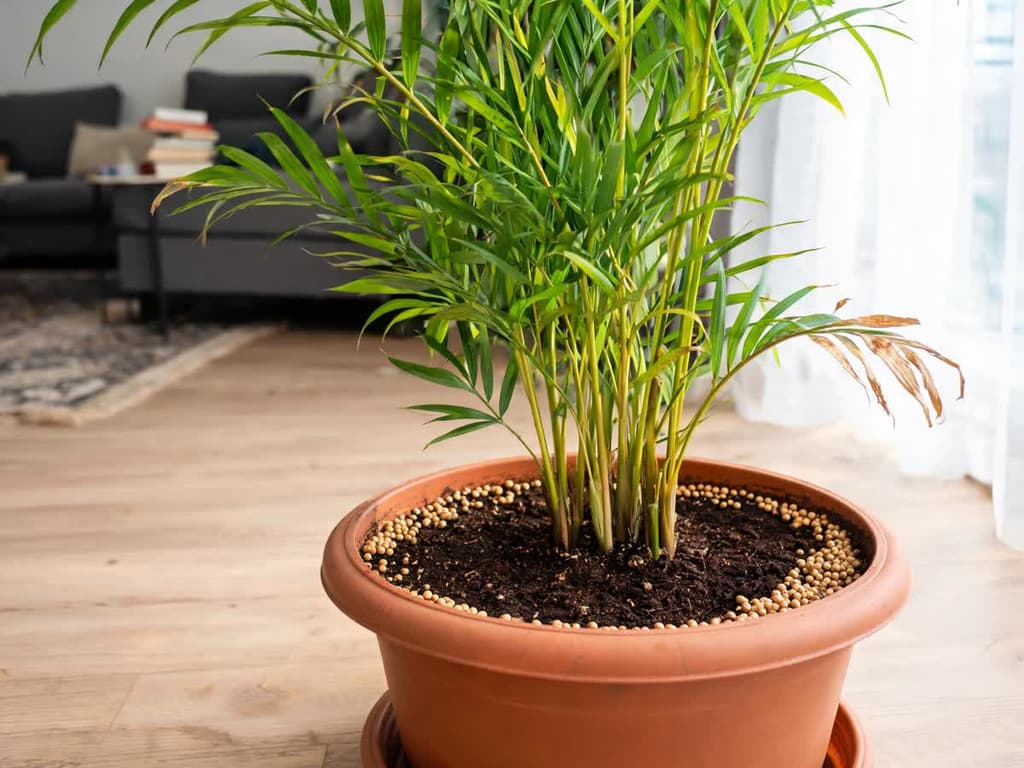
Fertilizer for garden palms contains more potassium than nitrogen, includes magnesium, and releases nutrients slowly. The formula tested by the University of Florida (UF/IFAS) is 8-2-12 plus 4% magnesium. Apply this fertilizer every 3 months, broadcast across the entire area under the canopy. Potted palms follow a different rule: nitrogen is the nutrient most often missing there, and too much fertilizer burns leaf tips.
This guide applies to the most widely sold potted palms in Brazil: areca, broadleaf lady palm, parlor palm, kentia, and pygmy date palm. It also applies to garden palms, such as the coconut palm and the royal palm. Each one appears with its scientific name the first time the text mentions it.
Quick summary:
In the garden, prioritize potassium over nitrogen. Nitrogen-heavy fertilizer forces the palm to grow without enough potassium and magnesium, causing deficiencies in both.
In pots, the most common deficiency is nitrogen. Potassium deficiency is rare in containers. Use slow-release fertilizer at the label dose, only during spring and summer.
Broadcast the fertilizer across the entire canopy footprint. Fertilizer spikes, deep holes, or a tight ring around the trunk reach fewer roots and burn more easily.
Brown tips on old leaves of potted palms are usually fertilizer salts. Flush the potting soil before even thinking about fertilizing again.
Do not cut off yellowing lower fronds. On a palm deficient in potassium, removing those fronds accelerates decline.
What NPK to use for palm trees
The three numbers on any fertilizer label are the NPK: the percentage of nitrogen (N), phosphorus (P), and potassium (K), always in that order. An 8-2-12 fertilizer contains 8% nitrogen, 2% phosphorus, and 12% potassium. For garden palms, UF/IFAS recommends 8-2-12 with 4% magnesium (Mg) and micronutrients. According to the university, this formula corrects mild to moderate deficiencies and keeps them from returning (Broschat, UF/IFAS ENH1009).
The nutrient source determines whether fertilizer helps or harms. According to the same publication, 100% of the nitrogen, potassium, and magnesium must be in slow-release form. Slow release means the granule releases nutrients gradually over weeks. Water-soluble versions wash out of the soil with the first heavy rain. Each soluble nutrient leaches at a different rate, skewing their balance in the ground. The palm requires this balance to remain stable.
High-nitrogen fertilizer causes potassium and magnesium deficiencies in garden palms. High nitrogen forces rapid palm growth without the potassium and magnesium needed to sustain it, causing the plant to display shortages of both. UF/IFAS documents palms killed by potassium deficiency after receiving high-nitrogen lawn fertilizer applied 30 feet (9 m) away on just one side of the plant. A mature palm's root system spreads 50 feet (15 m) or more from the trunk.
Because of this, balanced formulas like 10-10-10 are not recommended for garden palms. Fertilizers with more nitrogen than potassium are also unsuitable. On the package, check for four things:
What to look for on the label | What a garden palm needs |
|---|---|
The three numbers (N-P-K) | Potassium higher than nitrogen (such as 8-2-12) |
Magnesium (Mg) | Present, around 4% |
Nutrient form | "Slow-release" or "controlled-release" for N, K, and Mg |
Micronutrients | Manganese, iron, and boron listed |
Drugstore magnesium sulfate, or Epsom salt, is soluble magnesium. UF/IFAS prefers granular kieserite, a form of magnesium sulfate that dissolves slowly.
Potted palms: a different formula and dosage
In potted palms, the nutrient most often missing is nitrogen, and potassium deficiency is uncommon. Potting soil consists of tree bark and peat, a decomposed plant material common in commercially prepared potting mix. The microorganisms that break down this material consume nitrogen and compete with the roots for this nutrient (Broschat, UF/IFAS ENH1010). A slow-release foliage fertilizer with higher nitrogen works well in pots.
The areca palm (Dypsis lutescens) shows this shortage with its own unique symptom: the base of the leaves and the petioles turn golden, and older leaves turn uniformly light green. UF/IFAS attributes this golden color to nitrogen deficiency. In old pots, the shortage is magnesium. The same publication notes that the magnesium from limestone blended into potting soil is exhausted in about 6 months. A palm kept for years in the same pot begins showing yellow bands along the margins of older leaves.
Yellowing new leaves on a potted palm are almost never resolved with iron fertilizer. UF/IFAS explains that old soil breaks down, compacts, and loses aeration, and airless roots cannot absorb iron. The fix is removing the degraded potting mix and repotting in fresh substrate, without switching to an oversized pot.
The exact dosage for indoor environments has not been measured. UF/IFAS applies the maximum label rate in production nurseries where rapid growth is the goal. For palms indoors, North Carolina State University (NC State) recommends low fertilization rates for each species:
Parlor palm (Chamaedorea elegans): fertilize occasionally during the growing season and not at all in the winter (NC State).
Kentia (Howea forsteriana): houseplant fertilizer infrequently, and slow-release is ideal (NC State).
Lady palm (Rhapis excelsa): balanced slow-release fertilizer during the growing season (NC State).
The safest practice for an indoor palm follows NC State guidance. Use slow-release fertilizer at the lowest label dose during spring and summer. Reapply only when the package interval expires, skipping fertilizer entirely in winter. Other potted foliage houseplants also benefit from low doses and a winter rest: the peace lily fertilizer guide recommends four applications a year at quarter strength.
The potted palms in this guide, along with watering, light, and size requirements for each:
Palms in the garden or landscape: where and how much to apply
Broadcast fertilizer evenly across the entire area under the canopy, not in a narrow band against the trunk. UF/IFAS explains that nutrients move downward through the soil and barely travel sideways. Fertilizer concentrated in holes, spikes, or a ring around the trunk only reaches the small portion of roots directly underneath. It also burns those roots much more easily.
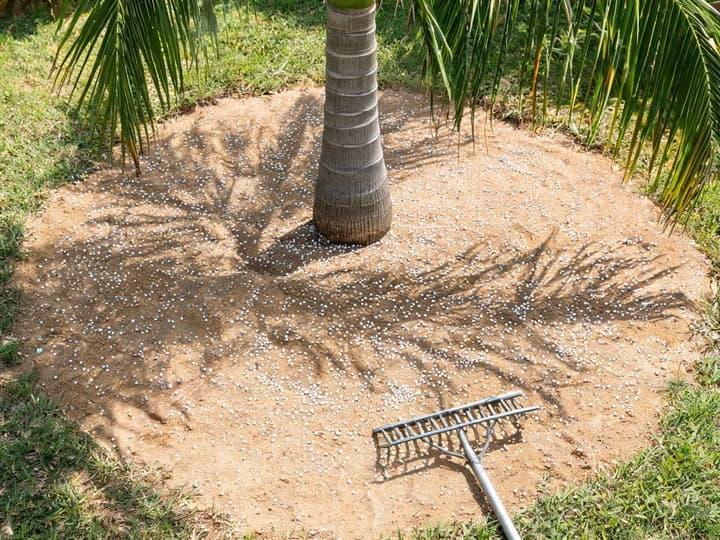
The UF/IFAS recommendation for South Florida is 1.5 pounds of 8-2-12 fertilizer per 100 square feet of canopy. That equals roughly 70 g per m², applied every 3 months. To calculate the area, measure the ground footprint directly beneath the fronds. In cooler regions of Florida, UF/IFAS notes that you can skip the winter application and use lower rates. This amount was calibrated on sandy soils, which leach nutrients quickly. No one has established the ideal rate for clay soil, which holds nutrients better: in clay, start with the lowest label rate.
In the yard, the first leaf to show potassium deficiency is always the lowest, oldest frond (Broschat, UF/IFAS ENH1017). In the coconut palm (Cocos nucifera), it starts with translucent yellow or orange spots on the leaflets, which are the strips of the leaf. Then the tip and margins dry out. The symptom is always more severe at the tip of the frond than near the trunk.
Potassium deficiency is the leading cause of death in royal palms (genus Roystonea) in South Florida landscapes, according to UF/IFAS. Veitchia and king palms (Archontophoenix) rank among the most resistant to this shortage.
Do not cut off yellowing lower fronds. UF/IFAS cites a study on pygmy date palms (Phoenix roebelenii): removing old potassium-deficient leaves accelerated plant decline. According to the university, cutting these fronds can cause premature palm death. UF/IFAS measures potassium deficiency severity by the number of living leaves in the canopy, not by the count of discolored fronds.
When and how much to fertilize: pots vs. garden side by side
Potted palm (indoor) | Garden palm | |
|---|---|---|
Formula | Foliage fertilizer, nitrogen can be the highest number | Potassium higher than nitrogen, with magnesium (8-2-12 + 4 Mg) |
Form | Slow-release | Slow-release for N, K, and Mg |
Dose | Lowest rate on the label | About 70 g per m² of canopy (measured in Florida) |
Frequency | When the label interval expires, spring and summer only | Every 3 months |
Winter | Do not fertilize | Can skip where winters turn cold |
Application area | Over the soil surface, away from the base | Spread across the entire area under the canopy |
What fronds reveal about palm nutrition
Older and younger fronds show different nutrient deficiencies. Potassium, magnesium, and nitrogen shortages appear first on lower leaves, because palms pull these mobile nutrients from older foliage to feed new growth. Iron and manganese shortages appear first on new fronds emerging from the center of the canopy.
Where it appears | What it looks like | Likely cause | What to do |
|---|---|---|---|
Old fronds | Translucent yellow or orange spots, necrotic curling tips, worse toward the frond tip | Potassium deficiency | High-potassium fertilizer with magnesium; do not remove the frond |
Old fronds | Broad lemon-yellow margin, leaf center remains deep green, no necrotic tissue | Magnesium deficiency | Slow-release magnesium fertilizer |
Old fronds, spreading to the whole canopy | Uniform light green; golden stems on areca palms | Nitrogen deficiency | Nitrogen fertilizer |
New frond | Uniform yellow, sometimes with greener veins | Suffocated roots, old or waterlogged soil | Fix soil structure and watering; iron supplements rarely solve this |
New frond | Yellow with necrotic streaks, worse toward the base of the frond | Manganese deficiency | Manganese sulfate applied to the soil |
Old fronds on potted palms | Dry tips, sometimes with a white crust on the soil surface | Accumulated fertilizer salts | Flush the potting soil |
The difference between magnesium and potassium lies in where the yellow appears. With magnesium, the yellow band is uniform from the base to the tip of the leaf and never comes with necrotic tissue (Broschat, UF/IFAS ENH1014). With potassium, the yellowing worsens toward the tip. Yellow fronds on palms have causes other than fertilizer, and the palm yellow leaves guide separates each pattern by species.
Correction takes time. With nitrogen deficiency, UF/IFAS expects foliage to green up within 1 to 2 months. With potassium deficiency, recovery takes 1 to 3 years because the entire canopy must replace itself with healthy, symptom-free fronds.
Brown tips on potted palms: fertilizer buildup
A palm with excess salt in the soil shows dry, brown leaflet tips on older leaves (Broschat, UF/IFAS ENH1011). The salt comes from excess fertilizer or irrigation water, and burned roots also cause new leaves to yellow or wilt. When dry tips come from salt, applying more fertilizer increases soil salt levels and worsens the burn.
To flush the substrate, place the pot in a utility sink or shower and pour water slowly until it drains freely from the base. Repeat this leaching process several times in sequence, as recommended by UF/IFAS once salts have built up. Afterwards, allow all excess water to drain out and never let the pot sit in standing runoff.
To keep salts from returning, UF/IFAS recommends low-salt fertilizers applied strictly at the label rate. With every watering, a little water should escape through the drainage holes. A white crust on the soil surface or the pot rim is the clear physical sign of buildup:
When to avoid fertilizing palms
Never fertilize a palm that is diseased, wilting, or sitting in perpetually wet soil. Fertilizer cannot revive roots: rotted or burnt roots absorb very little, and fertilizer salts worsen tissue burn. UF/IFAS reports that root rot and salt excess both manifest above ground as yellowing new leaves, which is easy to mistake for nutrient hunger.
The little black flies flying around the pot are fungus gnats. According to Colorado State University, they live in moist soil. The main control is to allow the top 1 to 2 inches of soil to dry out between waterings (CSU Extension). Correct the watering first and only resume fertilizing when the palm puts out a healthy new leaf.
Newly purchased palms also do not need fertilizer. In production nurseries, potted palms receive slow-release fertilizer at high label rates, according to UF/IFAS. The colored resin beads in the soil of many store-bought palms are that fertilizer: as long as they are present, hold off on feeding.
Homemade and organic palm fertilizers
No DIY recipe supplies the potassium-to-magnesium balance that outdoor palms require. Two popular inputs, manure and raw coffee grounds, actually create problems. Nutrient ratios and controlled release determine success, not whether a product is organic or synthetic. The sources tested on palms by UF/IFAS are slow-release minerals. None of their publications cited here evaluated organic fertilizers on palms.
Manure. UF/IFAS advises avoiding manure and composted sewage sludge near palms in its section on manganese deficiency. The university cites its own study on compost tying up this nutrient. Well-rotted manure often appears as an organic palm fertilizer, but this guide follows UF/IFAS on this point: it is the only consulted source that measured palm fertilization.
Coffee grounds. Grounds contain potassium: it is the mineral present in the largest amount, according to Washington State University (WSU). The problem is physical: grounds are fine, compact easily, and block the movement of water and air through soil. WSU recommends composting grounds before use, at a maximum of 20% of the compost pile by volume (WSU Extension FS207E).
Eggshells. The shell is almost entirely calcium, and in large pieces it takes at least a year to release that calcium. A study cited by the University of Illinois found hand-crushed shells "little better than nothing," and only fine powder worked (Illinois Extension). For palms, there is an added reason to skip them. UF/IFAS lists excess calcium relative to potassium among the causes of potassium deficiency.
Banana peels. Banana peels contain potassium, but no measurements exist showing how much ever reaches a palm tree. The safest choice is composting peels instead of burying them raw near the trunk.
Formulas, dosages, and deficiency symptoms vary across palm species. Many potted palms arrive home without an identifying label. Bloom identifies species from a simple leaf photo on your iPhone. Once you have the precise identity, you will know whether you are tending an areca palm, which reveals low nitrogen on its petiole, or a kentia palm, which requires very light feeding.
Frequently asked questions
Can I use 10-10-10 NPK fertilizer on palms?
For potted palms, a balanced slow-release fertilizer works because nitrogen is the nutrient most commonly lacking in containers. For landscape palms, UF/IFAS advises higher potassium than nitrogen (8-2-12) with 4% magnesium. Fertilizers with nitrogen equal to or higher than potassium can induce potassium and magnesium deficiencies in soils subject to rainfall leaching.
Will Epsom salt alone fix a yellow palm?
Only when the underlying issue is magnesium deficiency, shown by broad yellow margins on older fronds with a green center. Epsom salt is water-soluble magnesium sulfate and leaches out with rain, which is why UF/IFAS prefers slow-dissolving kieserite. Magnesium by itself does not correct potassium deficiency, which is the most widespread issue in garden palms.
How long does a palm take to respond to fertilizer?
That depends on the missing nutrient. With nitrogen deficiency, UF/IFAS expects foliage to turn green within 1 to 2 months. With potassium deficiency, recovery requires 1 to 3 years because discolored fronds never regain green color: the canopy must replace itself with new growth. Do not trim off old fronds during this recovery period.
Do fertilizer spikes work for palms?
They work poorly compared to broadcast applications. According to UF/IFAS, nutrients travel down through the soil and barely disperse horizontally. A spike only feeds the roots directly beneath it and burns those roots more easily. The same quantity distributed evenly under the entire canopy reaches vastly more roots.
The right calculation for every setting
For garden palms, the correct fertilizer contains more potassium than nitrogen, includes magnesium, releases slowly, and is broadcast beneath the canopy every 3 months. For potted palms, apply the lowest label rate only during spring and summer. Dry frond tips call for soil flushing before any additional feeding. Watering, lighting, and container sizing appear in the comprehensive palm care guide. Potted succulents also struggle with excessive fertilizer: the succulent fertilizer guide explains why high doses applied frequently harm plants.
Related articles
How to Care for Syngonium: Light, Watering, Cuttings, and Pests
How to care for syngonium indoors: bright indirect light, watering when the soil surface dries, 64 to 81°F (18 to 27°C), and 40 to 60% humidity. Also cover water cuttings, thrips, yellow leaves, and pet toxicity.
Rosemary Leaves Turning Yellow: Causes and Solutions
Rosemary with yellow leaves usually has overly wet roots. Check where the yellowing appears to see if it stems from wet roots, low light, spider mites, powdery mildew, or normal leaf shed, and learn how to save the plant.
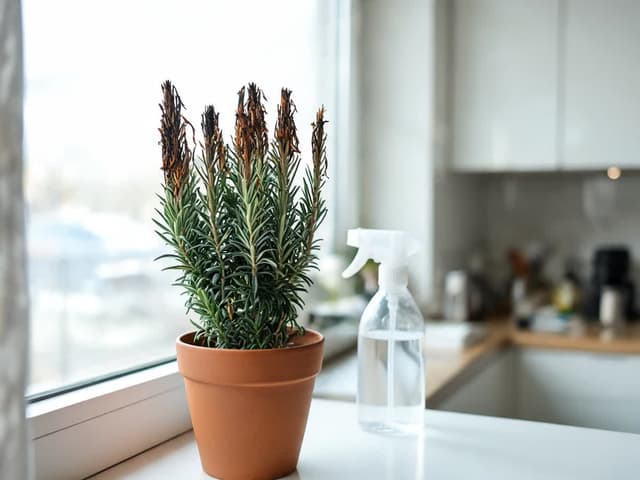
Is Your Rosemary Dying? How to Save Soap-Burned Rosemary
Rosemary with soap-burned leaves can usually be saved: the damage stays on the affected needles. Rinse the leaves, wait a week, scrape the stems, and prune only what is brown inside.