How to Care for Syngonium: Light, Watering, Cuttings, and Pests
How to care for syngonium indoors: bright indirect light, watering when the soil surface dries, 64 to 81°F (18 to 27°C), and 40 to 60% humidity. Also cover water cuttings, thrips, yellow leaves, and pet toxicity.
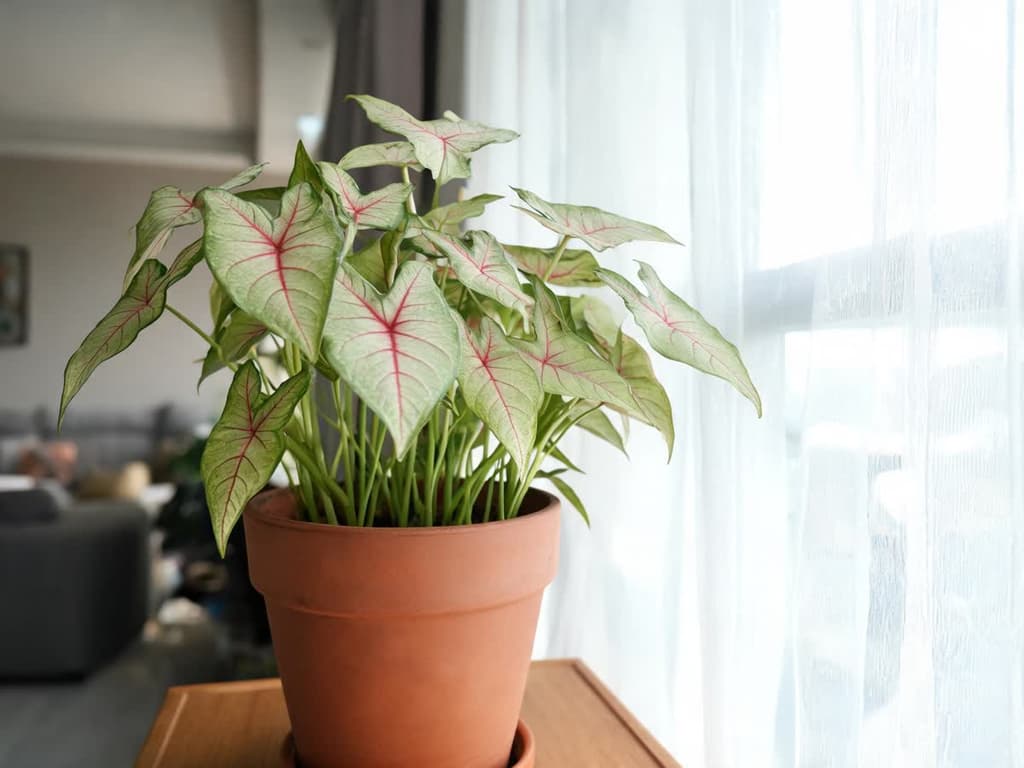
To care for syngonium, place the plant near a bright window, but out of direct sun. Water when the soil surface is slightly dry. Keep the environment between 18 and 27 °C. An air humidity of 40 to 60% is sufficient. These values come from the University of Florida Extension (UF/IFAS), the university service that guides plant growers and studies the commercial cultivation of syngonium (Syngonium podophyllum).
Syngonium is toxic to dogs, cats, and horses, and the sap irritates the skin.
How to care for syngonium: quick guide
Care | What to do |
|---|---|
Light | Bright, indirect light, with no direct sun on the leaves |
Watering | When the soil surface is slightly dry; in winter, water less without letting the soil dry out completely |
Temperature | 18 to 27 °C; below 13 °C the plant suffers cold damage |
Humidity | 40 to 60% |
Soil | Lightweight mix with pine bark and perlite, pH 5.5 to 6.5, pot with drainage hole |
Fertilizer | In spring and summer (from September to March in Brazil), diluted liquid fertilizer |
Size | Bushy when young; vine up to 1.8 m with age |
Pets | Toxic to dogs, cats, and horses |
Pink and green plant with no name: how to tell if it is a syngonium
Young syngonium has arrow- or heart-shaped leaves, 7.5 to 17.5 cm long. This shape is the origin of its common name in English, arrowhead plant. Many varieties have light veins, pink patches, or almost entirely pink leaves. The 'Neon' variety, for example, has solid hot pink leaves.
Two signs on the stem confirm syngonium: aerial roots and, if you cut the stem, milky sap. Each node (the point on the stem where the leaf emerges) usually has aerial roots, which are small brown roots that emerge from the stem above the soil. The milky sap is described by UF/IFAS.
A young plant without arrow-shaped leaves and without aerial roots on the stem is probably another species, and the care changes. Adult syngonium loses the arrow shape, as explained in the section on leaves that change with age. When in doubt, Bloom (available for iOS) identifies the plant from a photo of the leaf, and the free version allows 2 identifications per month.
How much light syngonium needs
Syngonium needs bright, indirect light. Indoors, UF/IFAS recommends about 2,700 to 10,800 lux (250 to 1,000 foot-candles, the unit used by the university). Lux is the measurement of brightness, and a light meter app on your phone shows the value. In practice, this is a spot near a bright window where the plant sees the sky, but the sun does not hit the leaves.
Direct sun burns or bleaches the foliage, according to the NC State Extension, the plant cultivation guidance service of North Carolina State University. East- or west-facing windows work well with a sheer curtain. In Brazil, the window that receives strong sun for the most hours is the north-facing one. At this window, keep the pot away from the glass or behind a curtain.
The sign of low light is a stretched stem. UF/IFAS describes plants with long spaces between the leaves and weak stems when light is low. If your syngonium develops long stems and few leaves, move the pot closer to the window.
Does pink or variegated syngonium need more light?
There is no measurement showing that pink or variegated syngonium needs more light. Some care guides say that pink and variegated varieties (with light patches on the leaf) require more light to avoid turning green, but none of them cite a measurement. The only test we found measured plant quality, not color.
In 1991, UF/IFAS researchers grew the pink variety 'Pink Allusion' under three light levels. Plant quality increased as light decreased, and the best plants were at the lowest level tested. Even the lowest level in the test, conducted in a nursery under shade cloth, was stronger than the light in a living room. For this reason, the test does not show how much light a pink plant needs indoors: it only shows that more light did not improve the plant.
The instruction in this guide follows the test, which is the only measurement: give pink syngonium the same bright, indirect light as other varieties, without direct sun. Some varieties change color on their own over time. 'Infra-Red', for example, puts out new pink leaves that turn green as they mature, according to UF/IFAS.
How to water syngonium
Water the syngonium when the soil surface is slightly dry. Stick your finger 1 cm into the soil: if it feels dry, water until water drains through the drainage hole of the pot. After 15 minutes, discard the water that collected in the saucer.
In winter (from June to August in Brazil), the plant grows less and uses less water. Continue with the finger test: the soil takes longer to dry, so watering becomes more spaced out. Do not let the soil dry out completely, recommends UF/IFAS. Soil that is too dry for too long causes the older leaves to turn yellow.
Use room temperature water. Cold water in winter causes water-soaked spots and a collapsed center, according to the UF/IFAS troubleshooting table.
Temperature and humidity for syngonium
Syngonium does well between 18 and 27 °C, the range that UF/IFAS indicates to maintain leaf color. Below 13 °C the plant suffers chilling injury. Keep the pot away from an open window on a cold night and from the air conditioning vent.
An air humidity of 40 to 60% is sufficient for syngonium to keep a good appearance indoors, according to UF/IFAS. On very dry days, mist the leaves with water and wipe off the dust with a soft cloth. UF/IFAS recommends misting and cleaning the leaves to reduce the chance of pests.
Soil, pot, and fertilizer for syngonium
Plant syngonium in a light potting mix that holds moisture without getting waterlogged. UF/IFAS uses mixes with peat (decomposed moss material), pine bark, vermiculite, and perlite (light, white grains that loosen the soil), with a pH between 5.5 and 6.5. At home, use ready-made foliage plant potting soil mixed with fine pine bark and perlite. Always use a pot with a drainage hole at the bottom.
To fertilize, use liquid fertilizer for foliage plants in spring and summer, when the plant is growing (from September to March in Brazil). Care guides do not agree on the frequency: some fertilize every 2 weeks, others every 4 to 6 weeks. No university extension has measured this frequency in indoor pots. When in doubt, fertilize lightly: half the label dose every 4 weeks in spring and summer, and no fertilizer in fall and winter (from April to August in Brazil).
Too little fertilizer also shows on the leaf. In the UF/IFAS table, yellowing old leaves can indicate a lack of nitrogen, as well as soil that is too dry.
Syngonium leaves change shape with age
Syngonium changes leaf shape as it matures. The young plant has simple, arrow- or heart-shaped leaves, and the habit of a small shrub. It is at this stage that syngonium is sold.
When the plant climbs a support, the leaves become longer and divide. The adult leaf is compound, with 3 to 11 leaflets (separate parts of the same leaf), according to UF/IFAS. Between the juvenile and adult leaf, the plant can have lobed leaves (with rounded cutouts along the edge), according to NC State.
Because of this change, an old syngonium on a support can look like another plant. If you want to keep the arrow-shaped leaves, you need to prune the stems that grow long.
Support pole or pruning: how to keep syngonium compact and full
To keep syngonium compact and with arrow-shaped leaves, cut the stems as soon as they begin to elongate. NC State Extension recommends this pruning to maintain the shrub shape. Cut the stem just above a node and leave at least 1 node with a leaf at the base of the stem.
To let syngonium climb, give it a stake, which is a support pole set in the pot. UF/IFAS mentions two types: the pole (a column) and the trellis (a grid). Secure the stems with soft ties and place the aerial roots against the stake. Without a stake, the stems grow outward and cascade over the edge of the pot, which works well in a hanging basket.
The stems cut during pruning become cuttings. Each piece with a node can root in water.
How to propagate syngonium in water
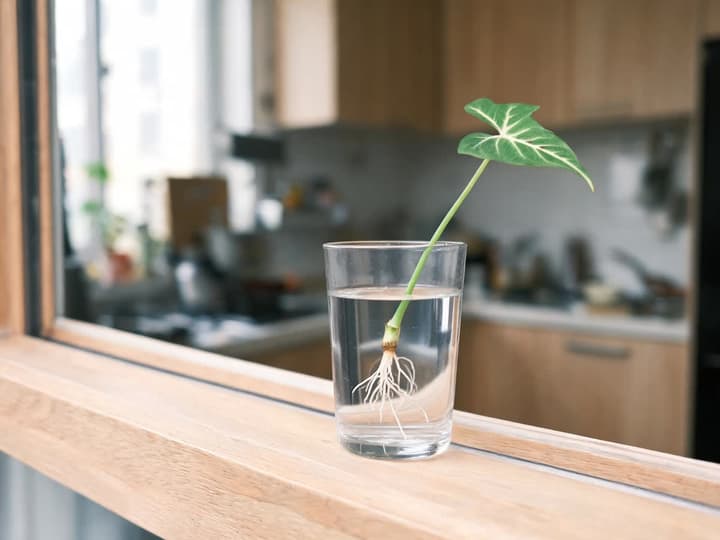
A syngonium cutting roots easily in water because each node usually already has the beginning of an aerial root. Do it like this:
Cut a piece of stem with 1 or 2 nodes and at least 1 leaf. Use clean scissors and gloves, because the sap can irritate the skin.
Remove the leaves from the lower node, which will be submerged in the water.
Place the cutting in a glass of room-temperature water, with the bottom node submerged and the leaf out.
Leave the cup in bright, indirect light. Warmth helps: UF/IFAS roots syngonium cuttings between 24 and 35 °C.
Change the water whenever it becomes cloudy, as recommended by the University of Vermont (UVM) Extension.
Transplant the cutting to soil when the new roots are longer than 5 to 7.5 cm, also according to UVM.
During the first few weeks in soil, keep the soil moist without waterlogging so the water roots can adapt.
How long do roots take in water? We found no measurement for syngonium. UVM says cuttings in water take days to weeks to root. Because heat helps, it's best to take cuttings in spring and summer (September to March in Brazil).
Thrips and spider mites on syngonium: how to recognize and prevent them
A syngonium with tiny insects and silvery patches can be saved as long as it still puts out new leaves without patches. Treatment takes at least 3 weeks, because a single application does not kill the eggs. Silvery patches or light stippling on syngonium leaves can be from thrips or spider mites. The table below shows how to tell the two apart.
The thrips Echinothrips americanus prefers the syngonium family, the arums, and UF/IFAS cites syngonium among the plants where this thrips appears most often. It sucks out the contents of the leaf cells and leaves silvery spots.
The two-spotted spider mite is even smaller and prefers warm, dry weather. It leaves the leaf with light speckles, which later turn yellow or bronze, and spins a fine web, according to UF/IFAS.
Sign | Thrips (Echinothrips) | Two-spotted spider mite |
|---|---|---|
Adult size | 1.6 mm, dark brown to black | 0.4 mm, nearly invisible |
Leaf damage | Silvery patches, more on the lower leaves | Light dots that turn yellow |
Extra sign | Tiny black specks of feces along the midrib | Fine webbing between leaf and stem |
Egg to adult cycle | 15 days at 25 °C | 5 to 20 days at 27 °C |
The thrips data comes from the pest management program at the University of Connecticut (UConn). The female thrips lays eggs inside the leaf tissue. That is why a single wash or spray does not solve the problem: the eggs remain protected and hatch days later. This thrips spends its entire life on the leaf, so changing the potting soil does not help.
To treat thrips or spider mites on syngonium:
Keep the syngonium away from other plants.
Cut off the most heavily spotted leaves.
Wash the plant in the shower with room-temperature water, paying attention to the underside of the leaves.
Apply insecticidal soap or horticultural oil (light mineral oil sold in gardening stores), at the label's dilution, to the entire plant, both front and back of the leaves. UF/IFAS recommends these two products for mites.
Repeat the application every 5 days in warm weather and every 7 days in winter, as UF/IFAS recommends for mites. Continue for at least 3 weeks. With the home at 20 °C, thrips take 34 days from egg to adult, according to UConn: in that case, continue for 5 weeks.
To prevent them, keep the air humidity between 40 and 60% and wipe the leaves with a damp cloth. UF/IFAS says that spider mites, aphids, and mealybugs are rare on syngonium when humidity is maintained. Against thrips, check the undersides of the leaves with every watering.
Syngonium with yellow leaves or dry tips
The cause of yellow leaves on syngonium appears in the soil test. Before watering or fertilizing, stick your finger deeper than in the watering test, about 3 cm, to find out if the soil is wet underneath. Then, observe which leaves turned yellow.
Yellow lower leaves and dry soil: the plant went without water for too long, or it is lacking nitrogen. Water until it drains and resume fertilizing in spring and summer.
Yellow, soft leaves, and soil that has been wet for days: overwatering. Wait for the soil surface to dry before the next watering and check that the drainage hole is not clogged.
Water-soaked spots in winter: cold water or the plant is in the cold. Use room-temperature water and move the pot away from cold drafts.
Silvery spots or tiny light dots: thrips or spider mites (previous section).
For dry, brown tips, check watering first: the surface can dry out between waterings, but the soil in the entire pot, down to the bottom, cannot. Then measure the air humidity with a hygrometer (a simple humidity meter). UF/IFAS links the good appearance of the leaves to a humidity of 40 to 60%: below 40%, move the pot away from air conditioning and mist the leaves. The page on dry tips on syngonium and the page on yellow leaves on syngonium list the other causes, with photos.
Is syngonium toxic to cats and dogs?
Yes. The ASPCA, an animal poison control center in the United States, classifies Syngonium podophyllum as toxic to dogs, cats, and horses. The toxic principle is insoluble calcium oxalate crystals, tiny crystals that irritate the mouth.
The signs, according to the ASPCA, are irritation, pain, and swelling of the mouth, tongue, and lips, excessive drooling, vomiting, and difficulty swallowing.
The sap also irritates the skin: NC State Extension notes that syngonium causes contact dermatitis (irritation of the skin that touches the sap). Wear gloves when pruning and wash your hands afterward. If your cat or dog chews on leaves, keep syngonium in a room where the animal cannot enter. If they chew the plant, call the vet. Other common plants with the same risk are on the list of plants toxic to pets.
Frequently asked questions about syngonium
Is syngonium easy to care for?
Yes, as long as the plant gets bright light without direct sun and the soil does not stay soggy. Syngonium tolerates air humidity of 40 to 60%. UF/IFAS notes that pests such as spider mites and mealybugs are rare when this humidity is maintained.
How big does syngonium grow?
When young, syngonium forms a bush with leaves 7.5 to 17.5 cm long, according to UF/IFAS. Over time, the stems become vines, and the NC State Extension records heights up to 1.8 m. With a support, the leaves grow longer and change shape. With regular pruning of the long stems, the plant stays compact and keeps its arrow-shaped leaves.
Are syngonium and pothos the same plant?
No. The golden pothos is Epipremnum aureum, a plant from another genus in the same family, the aroids. Both are vines with aerial roots at the node and root well in water. The leaf of the golden pothos is heart-shaped and glossy, without the arrowhead tip. Care instructions for golden pothos are in the guide on how to care for golden pothos.
Can I mist syngonium with water?
Yes. UF/IFAS recommends misting with water and wiping the leaves with a soft cloth to keep syngonium dust-free and with less risk of pests. Mist in the morning so the leaves dry during the day. Misting does not replace watering: the roots still need water when the soil surface dries out.
Summary of syngonium care
For basic care, syngonium needs bright light without direct sun, watering when the soil surface dries, and 18 to 27 °C. To keep the arrow-shaped leaves, cut long stems. To get adult leaves, which are longer and divided into parts, provide a support. Silvery spots require repeated treatment for at least 3 weeks. The complete species profile is on the syngonium page.
Related articles
Rosemary Leaves Turning Yellow: Causes and Solutions
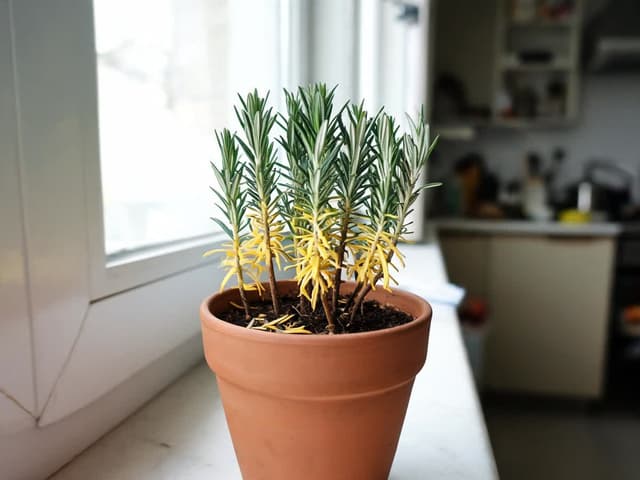
Rosemary with yellow leaves usually has overly wet roots. Check where the yellowing appears to see if it stems from wet roots, low light, spider mites, powdery mildew, or normal leaf shed, and learn how to save the plant.
Is Your Rosemary Dying? How to Save Soap-Burned Rosemary
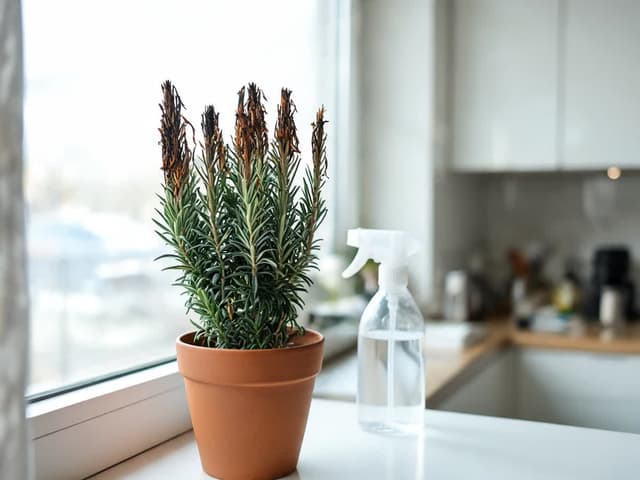
Rosemary with soap-burned leaves can usually be saved: the damage stays on the affected needles. Rinse the leaves, wait a week, scrape the stems, and prune only what is brown inside.
How to Fertilize Rosemary: When, How Much, and Which Fertilizer
How to fertilize rosemary in pots and in the ground: rosemary needs very little fertilizer. Learn the right timing in Brazil, doses, coffee grounds, lime, and signs of overfertilizing.