How to Propagate Dracaena Marginata Tricolor: One Cut, Two Plants
Cutting the top off a leggy Dracaena marginata Tricolor gives you two plants: the crown roots in a new pot and the remaining cane regrows. Learn where to cut, how to plant cane segments right side up, how to air layer, and why tap water interferes.
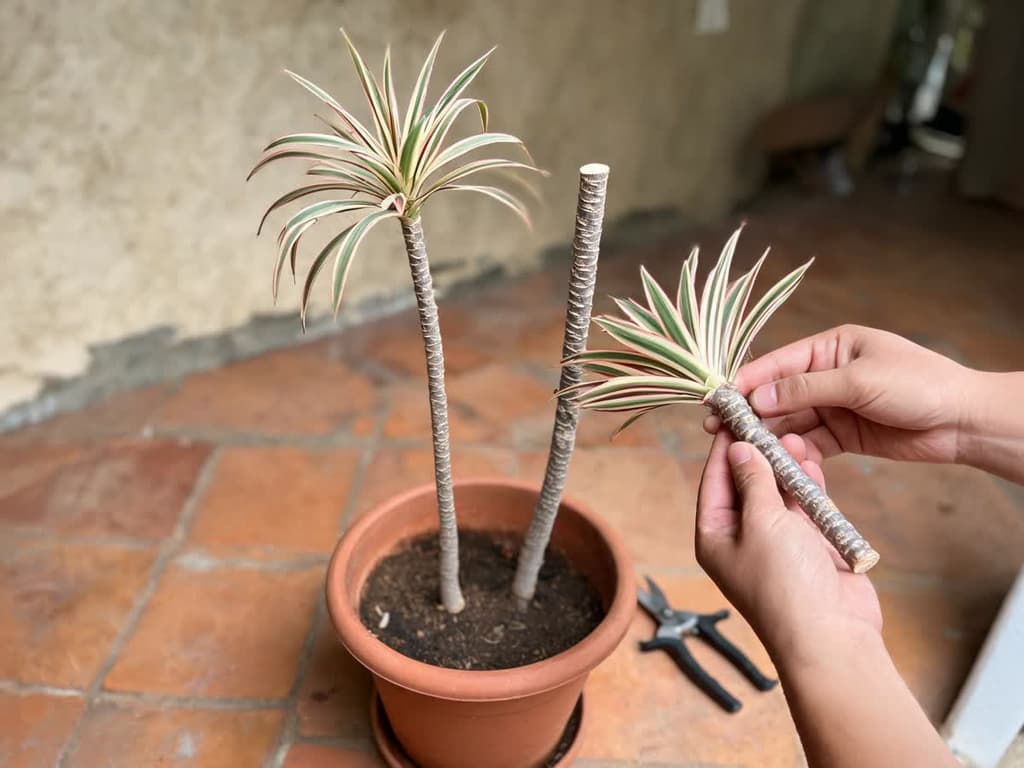
To propagate a Dracaena marginata Tricolor, cut the top of the plant with 4 to 6 inches of stem below the foliage. Plant this crown in a pot with moist soil. The tip develops roots and becomes a new plant. The cane left behind in the original pot pushes out fresh shoots right below the cut.
If your Tricolor has grown leggy with bare stems at the bottom, this cut is exactly what it needs. The bare stem that remains can be sliced into sections for even more cuttings. When a plant gets too tall, you can also air layer it, which roots the stem before you ever separate it from the parent plant.
Quick summary:
Tall, leggy Tricolor with leaves only at the top: cut off the crown. The tip becomes a new cutting and the remaining cane regrows.
Bare cane left over: cut it into sections of 2 to 3 inches with at least two nodes (the rings visible on the cane) and plant them right side up.
Tall plant with thick canes when you prefer not to cut all at once: try air layering about 12 inches below the growing tip.
Season in Brazil: early spring, in September and October.
Water: dracaena is sensitive to fluoride, and tap water in Brazil contains fluoride. For rooting, use rainwater or distilled water.
Which dracaena you have before taking cuttings
Dracaena marginata Tricolor is a variety of Dracaena marginata featuring slender, arching leaves striped with green, cream, and pink. NC State Extension lists the species under its accepted botanical name, Dracaena reflexa var. angustifolia, citing Dracaena marginata as an older synonym. The 'Tricolor' cultivar displays green leaves with ivory-white bands and pink margins.
The three methods covered in this guide also work for other cane dracaenas, such as the corn plant (Dracaena fragrans) and pleomele. The University of Florida (UF/IFAS) outlines these three techniques for the entire Dracaena genus.
Two plants commonly referred to as dracaenas behave differently:
The broadleaf "red dracaena" is usually a ti plant (Cordyline fruticosa), a plant from another genus that was previously classified as Dracaena terminalis, according to NC State.
Snake plant moved to the genus Dracaena (now Dracaena trifasciata), but it multiplies from leaf cuttings, according to Penn State Extension. No technical source describes a tricolor leaf turning into a cutting.
Methods that work on Dracaena Tricolor
Dracaena tricolor propagates by tip cuttings, stem cuttings, and air layering. These are the three methods that UF/IFAS lists for dracaena production. A cutting is a piece of the plant that forms its own roots after being cut. According to the same publication, large plants call for air layering or stem cuttings; small species call for tip cuttings.
Method | Best candidate | Rooting timeline |
|---|---|---|
Stem tip cutting (foliage crown) | Tall, leggy Tricolor with bare lower stem | No authoritative source has measured it specifically for Tricolor |
Bare cane segment | The leafless cane remaining after removing the crown | 8 to 10 weeks for roots and shoots across thick-stemmed plants in general (Iowa State) |
Air layering | Tall specimen with thick cane | From 1 month up to 1 year for roots to emerge, depending on species (UF/IFAS) |
Tip cutting in water | Not widely advised | Water roots are thin and struggle during the transition to soil (Texas A&M) |
Single detached leaf | None | No technical source reports a dracaena leaf forming a plant |
A cane section is simply a leafless piece of stem used to produce new growth. On a Tricolor, it comes from the bare trunk between the soil line and the foliage tuft.
Cutting the top of a Dracaena Tricolor yields two plants
Removing the top will not kill a Dracaena marginata Tricolor. NC State notes on its species profile that a pruned cane typically sprouts two or more fresh branches. Clemson Extension shares the same guidance for tall, bare stems: prune to your preferred height and fresh foliage will appear shortly.
Pruning off the top solves two problems simultaneously. The leafy crown roots into an entirely new plant. Meanwhile, the cane left in the container develops a fresh, fuller canopy with multiple foliage clusters.
Pick your cutting height based on the look you want for the base plant. New buds emerge just below the cut point, so prune at the exact level where you want the new canopy to start. For an outdoor landscape specimen hitting the eaves, you can cut far below the leaves.
An old anthurium follows this exact principle: a top cut below the aerial roots becomes a new plant while the base regrows. Tricolor does not develop aerial roots to guide your shears, leaving the placement entirely up to you.
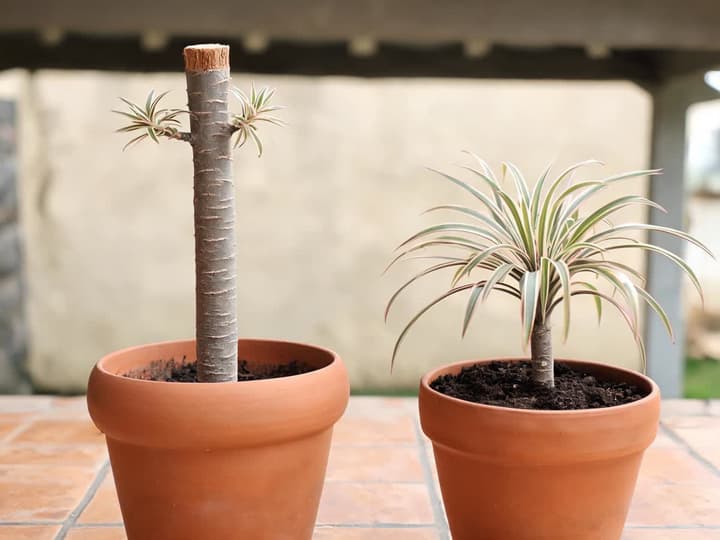
How to propagate Dracaena Tricolor from tip cuttings
A stem tip cutting from a Dracaena Tricolor consists of the top leafy tuft along with a bare section of cane underneath. It is the most straightforward route, instantly giving you a cutting that looks like a miniature established plant.
1. Water the mother plant the day before
Iowa State advises harvesting cuttings from fully hydrated stock plants. Water your Tricolor the day prior. A cutting that starts out wilted loses moisture before it ever grows roots to replenish it.
2. Cut the top with 4 to 6 inches of bare stem
Using clean, sharp bypass pruners or a knife, slice through the stem 4 to 6 inches below the lowest foliage. This is the length UF/IFAS recommends for most stem cuttings. Wipe your blade with rubbing alcohol before cutting.
3. Strip off any leaves that would sit below soil level
Gently peel away foliage along the section of stem that will be buried. UF/IFAS recommends clearing leaves from the lower inch of the cutting. Buried foliage decays quickly and spreads rot into the cane tissue.
4. Pot up right away without letting the cut surface dry
A Brazilian gardening guide suggests letting the wound callous for a few hours before planting. Iowa State advises the exact opposite: get the cutting into media as quickly as possible, since rootless cuttings absorb very little water. None of the university extension services recommend callousing dracaena cuts, and this guide follows their findings.
5. Apply rooting hormone if you wish
Rooting hormone is a powder or liquid containing auxins, plant compounds that encourage root development. Its use is entirely optional. If using it, dip only the bottom half-inch of the stem as directed by UF/IFAS and tap off any excess. Iowa State cautions that excessive hormone can actually delay root formation.
6. Pot the stem and enclose it with a plastic bag
Insert the base into a draining container, deep enough to hold the cutting upright. If top-heavy leaves make it wobble, secure the cane to a small bamboo stake. Water thoroughly and let all excess drain away.
Tent an open, clear plastic bag over the cutting, propping it with stakes so the plastic does not touch the leaves. Iowa State emphasizes that humid air is essential for successful root formation.
7. Provide warmth and bright, indirect light
Iowa State suggests 4 to 6 hours of bright, indirect light along with temperatures kept between 65 and 75 °F (18 to 24 °C). Direct sunlight trapped under plastic scorches foliage. Keep the mix evenly moist without waterlogging it until fresh growth appears at the center of the crown.
Cane cuttings: keeping the top side up
The bare trunk left after removing the leafy crown easily yields extra plants when cut into segments. Each piece needs nodes, the raised circular rings along the cane where old leaves once attached. New roots and leafy buds emerge directly from these nodes.
Cut cane pieces 2 to 3 inches long, ensuring each has at least two nodes. This matches the sizing recommended by Iowa State and Penn State Extension for indoor plant cane cuttings.
Mark the top end of each segment right after cutting. A light mark from a pen works well. Once cut, cane sections look identical at both ends, making it very easy to mix up polarity.
Plant upright with the top pointing up, burying about half the segment. NC State's gardening manual directs that buds must face upward and explicitly warns against sticking cuttings upside down. A bud is the node point where a new shoot originates.
Alternatively, lay the segment flat. NC State, Iowa State, and Penn State all approve laying cane cuttings horizontally across moist mix, pressed halfway into the soil. Placed horizontally, there is no upside down.
Iowa State notes that cane segments generally take 8 to 10 weeks to develop roots and shoots. This timeline applies broadly to thick-stemmed foliage houseplants rather than just Tricolor specifically. Once new shoots reach around 1 inch tall, move each plant into standard potting soil.
Air layering: rooting directly on the parent plant
Air layering induces root formation along an intact stem inside a wrap of damp moss before you ever sever the cutting. It suits large, thick-caned Tricolors when you hesitate to make a drastic cut all at once. Penn State includes dracaenas among the plants that propagate readily via this method.
NC State's manual details air layering for plants like dracaena, which skip the complete ring of bark removal used on woody outdoor trees:
About 12 inches below the growing tip, make an upward angled slice cutting through roughly one-third of the cane's thickness.
Prop the cut open with a wooden toothpick or matchstick.
Dust the cut with rooting hormone if you have some on hand.
Moisten the sphagnum moss, the dry moss sold for orchids, squeeze out the excess, and wrap the cut with it.
Enclose the moss in clear plastic wrap and fasten both the top and bottom with twist ties or electrical tape. Adding an outer layer of aluminum foil prevents strong sun from overheating the plastic, according to UF/IFAS.
Sever the cane just beneath the root ball once roots fill the moss, then pot up the rooted cutting moss and all.
UF/IFAS notes that visible roots can take anywhere from 1 month to an entire year depending on the species and season. The original plant continues to thrive, with the remaining stump pushing out fresh stems below the cut just like a pruned crown.
Croton also propagates through air layering, recommended for thick branches, using a removed ring of bark that dracaena does not require.
Propagating dracaena in water versus potting mix
Potting mix is the safest route for a dracaena cutting. Texas A&M AgriLife explains that roots formed in water are fibrous and slender. A plant rooted this way struggles to establish itself once moved to a pot. Dracaena is not on the list of plants that Texas A&M recommends for water rooting.
Water has a second problem, which is fluoride. NC State and Clemson record that dracaenas are very sensitive to fluoride. UF/IFAS lists fluoride among the causes of yellowed or dry leaf tips and margins. In Brazil, Law 6,050 of 1974 mandates water fluoridation in systems with treatment plants. Because of this, tap water usually contains fluoride.
If you still choose to root in water, opt for rainwater or distilled water and replace it whenever it turns cloudy. Transfer the cutting into potting mix as soon as the first roots show. NC State recommends distilled or fluoride-free water for Tricolor specimens.
When rooting directly in potting mix, choose an airy, well-draining medium that retains uniform moisture while allowing oxygen flow:
Equal parts peat moss and coarse sand. Peat moss consists of decomposed sphagnum moss and is sold bagged. It is one of the classic rooting media recommended by NC State.
Rinsed perlite used sparingly. Perlite consists of lightweight white grains of expanded volcanic rock. UF/IFAS instructs growers to leach perlite with water before using it with dracaenas, and Clemson suggests avoiding media with high perlite content due to fluoride release.
Skip fertilizers containing superphosphate, which Clemson identifies as another common source of fluoride contamination.
Best time to take Dracaena Tricolor cuttings in Brazil
The best time is early spring, which in Brazil runs from September to October. Iowa State calls early spring the ideal time, but notes that most houseplants can be propagated from cuttings year-round. Clemson also points to late summer, which in Brazil falls in February and March.
During the Brazilian winter, from June to August, the cutting roots more slowly. UF/IFAS records yellow bands on marginata foliage after a few hours between 32 and 37 °F (0 and 3 °C). Where frost occurs, keep the cutting indoors until spring.
Soft, rotting cane: can you salvage the top?
You can rescue the crown of a Dracaena Tricolor suffering from cane rot, provided there is still a section of firm stem below the leaves. That clean top serves as a standard stem tip cutting: slice above the soft decay and replant into fresh soil.
Cut through the cane well above any soft, discolored, or dark tissue.
Inspect the freshly exposed cross section. Pale, firm plant tissue indicates healthy stem. If you see browning, softness, or dark rings, cut higher up.
Disinfect your blade with rubbing alcohol between successive cuts to avoid transferring pathogens into clean tissue.
Pot the salvaged cutting into sterile potting mix and a sanitized pot, never reusing soil from the decaying plant.
UF/IFAS instructs propagators to harvest cuttings exclusively from healthy plants. A cutting taken from a rotting stem can harbor latent rot, so quarantine this cutting away from other houseplants for its initial weeks. Before attempting to save the remaining base, unpot it and check the root system: mushy, dark roots have completely rotted and cannot support plant growth.
Care during the initial months
Reliable signs that a cutting has rooted include fresh growth unfurling from the center of the tuft and resistance when you lightly touch the stem. Avoid pulling on the cutting to inspect root growth before then.
Acclimate away from the plastic bag gradually. UF/IFAS advises lowering humidity levels slowly before increasing light exposure. Vent the plastic covering for a few hours daily, steadily lengthening the open period before discarding the bag completely.
Water when the top surface feels dry to the touch, adding water until it drains freely out the bottom holes, following Clemson's care guidelines for dracaenas.
Brighter light brings out richer coloration. UF/IFAS reports that reddish shades on marginata deepen under higher light levels. A washed-out Tricolor cutting benefits from a brighter location out of harsh, direct sun.
Keep pruning trimmings away from pets. Dracaenas are toxic to dogs and cats; ASPCA includes vomiting, hypersalivation, and dilated pupils in cats among typical symptoms.
Frequently asked questions
Can you propagate an outdoor Dracaena Tricolor from the garden?
Yes, you can follow the exact same steps used for potted plants. Prune the top at your desired height for the future canopy and root the severed crown in a container of moist potting mix. The stump in your garden bed will sprout new shoots below the cut. Plants reaching rooflines also yield plenty of bare cane segments.
How long does a Dracaena Tricolor cutting take to root?
Controlled rooting times have not been documented specifically for Tricolor. For cane cuttings of indoor plants in general, Iowa State cites 8 to 10 weeks for combined root and shoot emergence. UF/IFAS notes that stem cuttings take between 2 and 16 weeks depending on species. The clearest sign of success is new leaf growth expanding from the foliage cluster.
Can you propagate dracaena from a cane branch?
Yes. A Tricolor branch topped with leaves functions as a stem tip cutting: cut it leaving 4 to 6 inches of bare cane, remove any foliage that would be buried, and pot it into moist mix. Leafless branches work just as well when divided into 2- to 3-inch cane cuttings bearing two nodes each.
Can you propagate dracaena from a single leaf?
Not with a Dracaena marginata Tricolor. None of the university sources describe cane dracaenas propagating from solitary leaf blades. New roots and buds develop exclusively from stem nodes. Hoya leaves face this same barrier: an isolated leaf can root but will never form stems or shoots, whereas watermelon peperomia produces brand-new plantlets directly from the base of a leaf petiole.
Before reaching for your shears
Confirm that your plant is indeed a cane dracaena before pruning. Tricolor, corn plant (Dracaena fragrans), and pleomele all respond well to the three methods detailed here. Cordylines and snake plants require different approaches. If your plant came with the house and remains unidentified, Bloom (available on iOS) identifies species from a quick snapshot. The free tier includes two identifications per month.
Dracaenas feature woody canes that readily sprout again after hard cuts. In contrast, peace lilies lack stems entirely and can only be propagated by clump division.
Sources consulted
When sources disagree, this guide follows university extension.
NC State Extension, North Carolina Extension Gardener Plant Toolbox, Dracaena reflexa var. angustifolia (plants.ces.ncsu.edu) and Cordyline fruticosa (plants.ces.ncsu.edu).
A. V. LeBude and F. A. Blazich, "Propagation," Chapter 13 of the North Carolina Extension Gardener Handbook, 2nd edition, NC State Extension, 2022 (content.ces.ncsu.edu).
D. B. McConnell, J. Chen, R. J. Henny, and K. C. Everitt, Cultural Guidelines for Commercial Production of Interiorscape Dracaena, UF/IFAS, publication EP149 (edis.ifas.ufl.edu).
UF/IFAS, Plant Propagation Techniques for the Florida Gardener, publication MG108 (edis.ifas.ufl.edu).
Iowa State University Extension, How to Propagate Houseplants by Stem Section (Cane) Cuttings (yardandgarden.extension.iastate.edu).
Penn State Extension, Propagating Houseplants (extension.psu.edu).
Texas A&M AgriLife Extension, Propagating Foliage & Flowering Plants (aggie-horticulture.tamu.edu).
Clemson Cooperative Extension, Home & Garden Information Center, Dracaena (hgic.clemson.edu).
ASPCA Animal Poison Control, Dracaena (aspca.org).
Brazil, Law No. 6,050, of May 24, 1974, on water fluoridation in supply systems (planalto.gov.br).
Related articles
How to Care for a Maidenhair Fern: Light, Water, and Revival Tips
Learn how to care for a maidenhair fern indoors: bright indirect light, consistently moist soil, high humidity, and how to revive it if it dries out completely.
How to Propagate Spider Plants: Root the Pup Before Cutting
The safest spider plant cutting comes from a pup still attached to the mother plant: rest the plantlet on soil in a small pot, wait for roots to establish, and only then cut the stolon. Learn when the pup is ready, whether rooting in water is worth it, how to divide the clump, and why plants fail to produce babies.
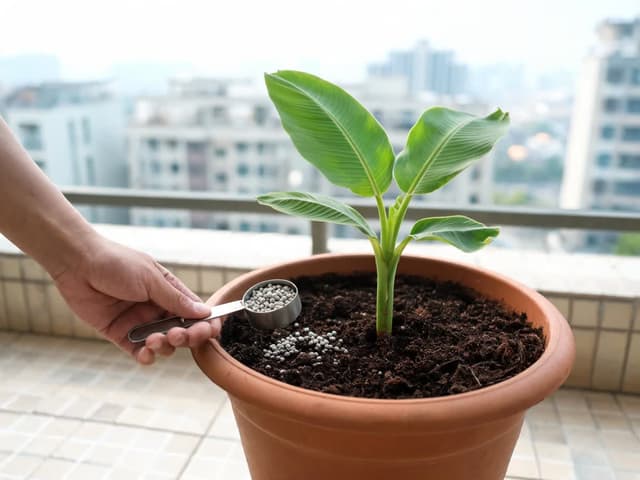
Banana plant fertilizer: fertilizing potted and backyard plants
Banana plant fertilizer needs more potassium than nitrogen, in a 3-1-6 ratio. For a potted plant on a balcony, use the label dose in spring and summer. In the backyard, fertilize every 2 months, adjusting the amount by mat age. Learn the formula, timing in Brazil, and signs of deficiency or excess.