Dipladenia With Yellow Leaves: Causes and What to Do
A dipladenia with yellow leaves usually has waterlogged roots or, during winter, was exposed to the cold. Here is how to distinguish between roots, cold, lack of fertilizer, pests, and normal leaf shedding, plus how to know if the plant can still be saved.
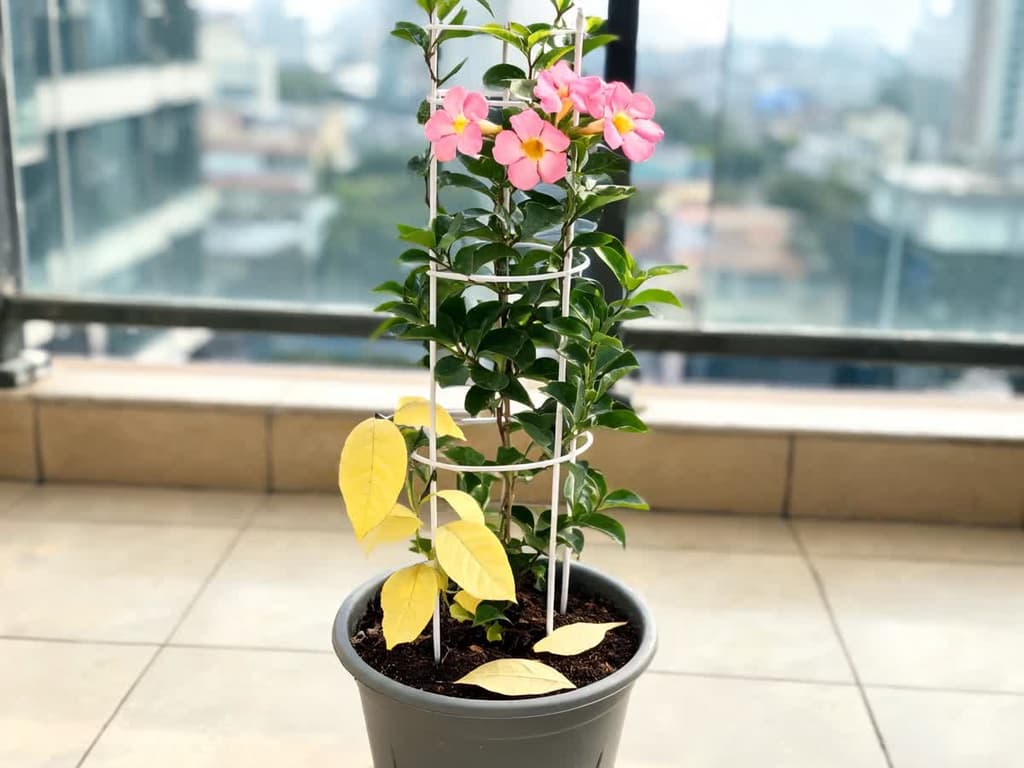
Dipladenia with yellow leaves usually has waterlogged roots or, in winter, spent a night below 10 °C (50 °F). Dipladenia and mandevilla are two names for plants of the same genus, Mandevilla: vines with pink, red, or white flowers. NC State Extension records Dipladenia as the former name of plants now classified in Mandevilla. A few old leaves yellowing near the base of the branches, with green tips, are normal turnover and need no fix.
You can save the dipladenia when the stem stays green under the bark and the roots still have firm, white parts. What changed before the yellowing (watering, cold, fertilizer) and where it appears on the plant point to the cause.
Dipladenia with yellow leaves and dark stems: can it still be saved?
The test that determines whether the plant can be saved is scraping the stem bark with your fingernail. The UF/IFAS Extension, from the University of Florida, teaches this test for cold-damaged plants. Green tissue right under the bark indicates a live stem at that point. Black or brown tissue indicates a dead stem.
Perform the test at three heights on each dark branch: near the tip, in the middle, and near the soil.
Green at all three heights: the stem is alive. Look for the cause in the sections below and do not cut anything.
Dark at the tip and green lower down: if there was no cold exposure, cut the branch right below the dark section, where the scratched bark already shows green. If the dark tissue appeared after a cold night, wait for new growth before cutting.
Dark at the tip, in the middle, and near the soil on all branches: take the plant out of the pot and check the roots before deciding.
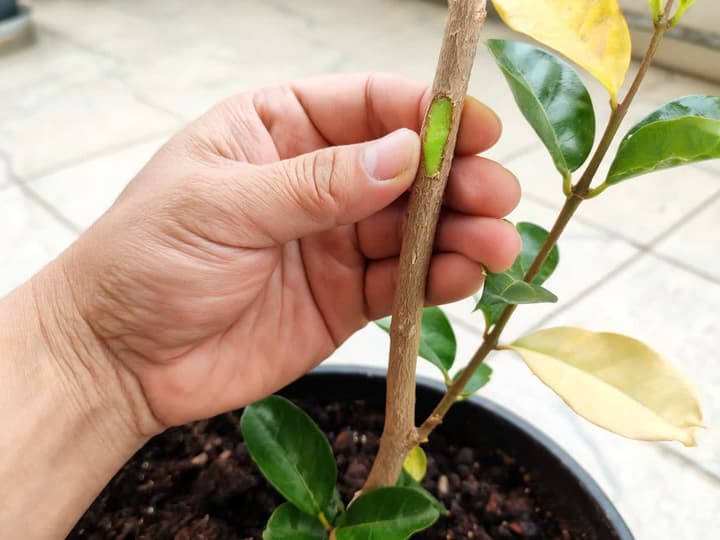
According to UF/IFAS, if you are unsure where to cut, wait for the plant to push new growth. The new shoots will reveal how far down the branch is alive.
Healthy roots are light-colored and firm. Iowa State University Extension describes rotted roots as dark and mushy. When you pull on a rotted root, the outer layer sloughs off and leaves only a thread in the center.
If the base of every branch is dark and almost all the roots are rotten, the whole plant is unlikely to recover. Even so, if any branch stays green at the tip, you can save the plant as a cutting. In a nursery, the cutting receives rooting hormone and stays under water mist. Under these conditions, according to the UF/IFAS production guide, a single-node cutting roots in about 4 weeks. The base of the cutting stays between 21 and 24 °C (70 and 75 °F).
Yellow leaves after days of wet soil: roots lacking oxygen
Soil that stays wet for several days leaves the roots without air, and roots without air rot. According to Iowa State, waterlogged soil is one of the stresses that most often paves the way for root rot fungi. A plant with root rot wilts from the bottom leaves up, and the leaves turn yellow and fall off.
To check, stick your finger 3 cm (1 inch) into the potting soil, two or three days after the last watering.
Soil still moist at 3 cm: watering is too frequent for this pot. Wait for the top 3 cm to dry out before watering again.
Standing water in the saucer under the pot: empty the saucer 15 minutes after each watering.
Pot without a drainage hole: switch to a pot with a drainage hole. Iowa State recommends soil that lets water drain through the bottom of the pot with every watering.
Constantly wet soil and dark roots: remove the rotted roots and repot into fresh, loose soil. Iowa State advises watering less frequently and replacing the soil once root rot appears.
Dipladenia also turns yellow from drought, but the signs in the soil are different. Dry soil pulling away from the edges of the pot indicates a lack of water. Light, watering, and fertilizing for a healthy dipladenia are in the guide on how to care for dipladenia.
A wilting plant with moist soil, yellow leaves falling, and dark, mushy roots are signs of root rot in dipladenia:
Yellow leaves after a cold night
Dipladenia is a tropical plant and sensitive to cold. Clemson Cooperative Extension, from Clemson University, gives 7 to 10 °C (45 to 50 °F) as the minimum temperature mandevilla tolerates. UF/IFAS explains that many tropical plants suffer chilling injury below 10 °C (50 °F), even without frost.
In Brazil, this yellowing appears in winter, from June to August, in places where night temperatures drop below 10 °C. Leaves that turn yellow or darken a few days after a cold night indicate cold damage.
According to UF/IFAS, a sudden drop in temperature causes more damage than reaching the same temperature gradually. Because of this, the first severe cold night of winter can do more harm than the subsequent cold nights.
What to do after the cold:
Do not prune the plant immediately after the cold. Wait for new growth to emerge and use the scratch test to find where the branch is still alive.
On nights below 10 °C, bring the pot indoors near a bright window. Return the pot to the balcony once night temperatures stay above 10 °C again.
In the cold, water less. Clemson recommends spacing out waterings during the rest period triggered by cold temperatures and weaker light.
Watering, pruning, and sheltering dipladenia from June to August are covered in dipladenia in winter. Yellow or dark leaves appearing a few days after a night below 10 °C are signs of cold damage in dipladenia:
Lower leaves turning yellow and moving upward: lack of fertilizer or waterlogged roots
When the lower leaves turn yellow first and the yellowing gradually moves upward, the likely causes are nitrogen deficiency or waterlogged roots. Iowa State explains that, with low nitrogen, the older, lower leaves turn light green or yellow first. Over time, the entire plant turns yellow, grows slowly, and drops leaves.
Waterlogged roots produce the exact same pattern, so inspect the soil before fertilizing. Remove the plant from the pot and examine the roots. If the top 3 cm of soil dries out between waterings and the roots are light-colored and firm, waterlogged roots can be ruled out. The remaining cause is nutrient deficiency.
Clemson recommends fertilizing mandevilla every 2 weeks during spring and summer with a fertilizer such as NPK 10-20-10. The three numbers represent the proportions of nitrogen, phosphorus, and potassium, in that order. UF/IFAS notes only that mandevilla requires regular fertilization without giving intervals or formulas; therefore, the schedule here follows Clemson.
Do not change the soil or relocate the plant merely because the bottom leaves turned yellow. First determine whether it is normal turnover, soggy soil, or lack of fertilizer. Other plants showing the same symptom can be found in the general guide on yellow leaves.
New yellow leaves with green veins
A yellow new leaf with green veins is a sign of chlorosis (yellowing of the leaf due to a lack of nutrients). When it appears on the leaves at the tips of the branches, Iowa State points to iron deficiency. In severe cases, the new leaf turns almost white and scorches along the edges.
According to Iowa State, overwatering, cold temperatures, and soil with a high pH produce symptoms identical to iron deficiency. Soil pH measures whether the soil is acidic or alkaline, and a high pH means alkaline soil. In these cases, the soil may contain iron, but the roots cannot absorb it.
Before applying an iron fertilizer, answer three questions: Does the top 3 cm of soil dry out between waterings? Are nighttime temperatures staying above 10 °C? Are the roots light-colored and firm? If the answer to any of these is no, correct that issue first and wait for the subsequent new leaves.
Yellowing with tiny specks, webbing, or sticky leaves: pests
Light-colored specks on the leaf, fine webbing on the underside, or a sticky coating indicate pests. NC State Extension lists mites, aphids, thrips, and whiteflies on mandevilla. Clemson also cites mealybugs and scale insects.
According to NC State, each mite bite leaves a small yellowish spot on the leaf. In a severe infestation, the spots merge and the entire plant turns yellow or bronze. The mite lives on the underside of the leaf and multiplies faster in hot, dry weather.
To confirm mites, tap a branch over a sheet of white paper. The specks moving on the paper are mites. NC State recommends insecticidal soap or horticultural oil (oil formulated for plants, sold at garden centers), applied to the undersides of the leaves. In warm weather, repeat the application 7 to 10 days later.
If the plant has mites, avoid fertilizers high in nitrogen until the infestation is gone. According to NC State, nitrogen makes the plant more nutritious for the mites to feed on.
A sticky, yellow leaf indicates aphids or scale insects. Aphids and scale insects suck sap and excrete a sugary liquid called honeydew, which makes the foliage sticky.
Brown spots before yellowing: anthracnose
When the leaf shows brown spots before turning yellow, the likely cause is a fungus. Clemson describes mandevilla anthracnose as light or dark brown spots on the leaf, followed by yellowing and leaf drop. What sets anthracnose apart is the brown spot that appears before the yellowing. With waterlogged roots, there is no prior spot: the leaf turns yellow and drops.
Remove the spotted leaves and any that have fallen into the pot by hand. Clemson recommends hand-picking diseased and dead leaves.
Anthracnose is one of 12 causes of yellow leaves on dipladenia, ranging from aphids to fusarium wilt. The dipladenia yellow leaves page features a symptom and treatment sheet for each one.
When yellow leaves on dipladenia are normal
A few old leaves turning yellow and dropping near the base of the branches is normal turnover. NC State classifies mandevilla as a broadleaf evergreen, meaning a plant that keeps its leaves year-round. Clemson explains that evergreen plants also shed their leaves, starting with the oldest ones.
According to Clemson, the plant draws back part of the nitrogen and phosphorus from the old leaf before dropping it. The turnover takes anywhere from a few days to a few weeks, and the new leaves at the branch tips stay green.
According to Clemson, leaf drop is no longer normal in two situations: when the new leaves turn yellow too, or when the entire plant turns yellow or brown. In those cases, return to the sections on roots, cold, and fertilizer.
If you received the plant without knowing its name, Bloom (available for iOS) identifies the species from a photo. The diagnostic tests in this article apply to both dipladenia and mandevilla.
What the yellowing on dipladenia indicates
Where the yellowing appears | What to check | Likely cause |
|---|---|---|
A few old leaves near the base, stopping after a few weeks | Green new tips and ongoing plant growth | Normal turnover |
Lower leaves, moving upward gradually | Moist soil 2–3 days after watering | Waterlogged roots |
Lower leaves, with yellowing that continues climbing | Slow growth along with light-colored, firm roots | Nitrogen deficiency |
Yellow or darkened leaves a few days after a cold night | Night below 10 °C | Cold damage |
New leaves, green veins | Watering, cold, and roots before iron | Iron deficiency or roots unable to absorb it |
Pale specks, webbing on leaf undersides | Branch tapped over white paper | Spider mites |
Sticky leaf | Insects on stems and undersides | Aphids or scale insects |
Brown spot before yellowing | Spots on the leaf before it turns yellow | Anthracnose |
Frequently asked questions
Should I cut yellow leaves off dipladenia?
Remove spotted, diseased, or dry leaves by hand: this is what Clemson recommends. Naturally shedding yellow leaves can remain until they fall on their own, as the plant reclaims nitrogen and phosphorus from them. Do not cut whole branches before doing the scratch test: scrape the bark and cut only the section that is black or brown underneath.
Does neem oil fix yellow leaves on dipladenia?
None of the extension services cited here test neem oil on dipladenia. Against spider mites, NC State recommends insecticidal soap or horticultural oil applied to the undersides of leaves, repeated 7 to 10 days later in warm weather. Yellowing caused by waterlogged roots, cold, or lack of fertilizer will not improve with any oil.
Does dipladenia lose leaves in winter?
It does, when the night drops below 10 °C. Clemson gives 7 to 10 °C as the minimum that mandevilla tolerates. In Brazil, this happens from June to August in the coldest places. During this period, shelter the pot from the wind, water less, and wait for new growth before pruning.
Are dipladenia and mandevilla the same plant?
They are plants of the same genus, Mandevilla, sold under two names. UF/IFAS explains that dipladenias, which are more compact, were once classified as a separate genus (Dipladenia) and have now returned to the genus Mandevilla. The causes of yellow leaves and the diagnostic tests in this article apply to both.
Related articles
Cyclamen with Yellow Leaves: Causes and What to Do
A cyclamen with yellow leaves might just be going dormant. Learn how the tuber and the time of year tell dormancy apart from rot, heat, thirst, and mites, and what to do in each case.
How to Water Cyclamen: Bottom Watering, Edge Watering, and the Wilt Test
How to water cyclamen without rotting the tuber: when the soil surface dries out, from below for 15 minutes or around the edge, never in the center. Plus the test to tell wilting from thirst apart from rot.
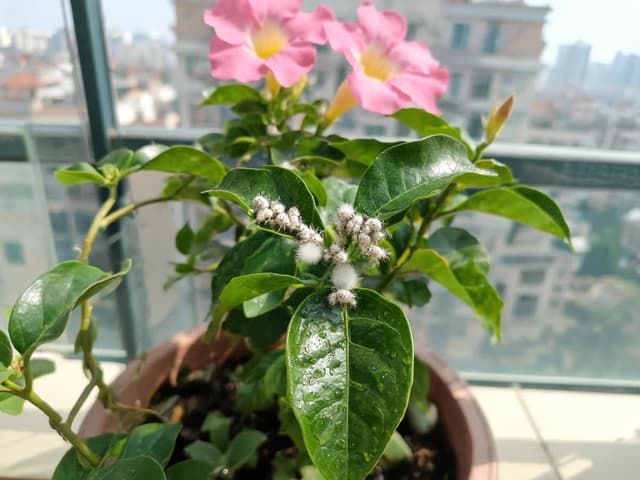
Dipladenia with Sticky White Dots: Which Pest Is It?
A sticky white dot on a dipladenia is almost always a mealybug, but whiteflies, aphids, spider mites, and the plant's own sap leave similar marks. See the test that separates each one and the source-backed treatment.