Dipladenia with Sticky White Dots: Which Pest Is It?
A sticky white dot on a dipladenia is almost always a mealybug, but whiteflies, aphids, spider mites, and the plant's own sap leave similar marks. See the test that separates each one and the source-backed treatment.
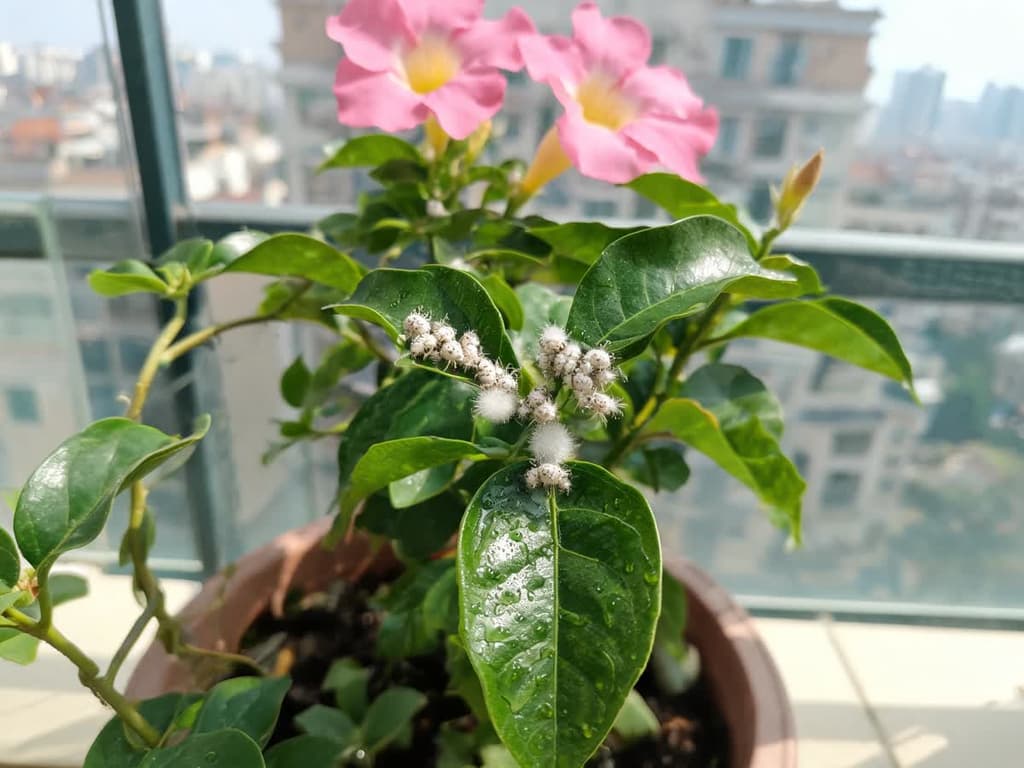
Dipladenia (mandevilla) with sticky white dots almost always has mealybugs. It is an insect up to 3 mm long covered in white wax that hides in the leaf axils and secretes a sticky, sugary droplet. Whiteflies, aphids, and spider mites leave similar marks, and the plant itself secretes white sap when cut. With only a few spots, you can save the plant. Move the pot away from other plants today and run the test below before buying any product.
Quick test: what is this white dot on your dipladenia
First look at where the white substance is located, then run the test from the corresponding row. Each test in the table uses only your eyes, a finger, a toothpick, a sheet of white paper, or a standard magnifying glass.
Where it is and what it looks like | 10-second test | What it is |
|---|---|---|
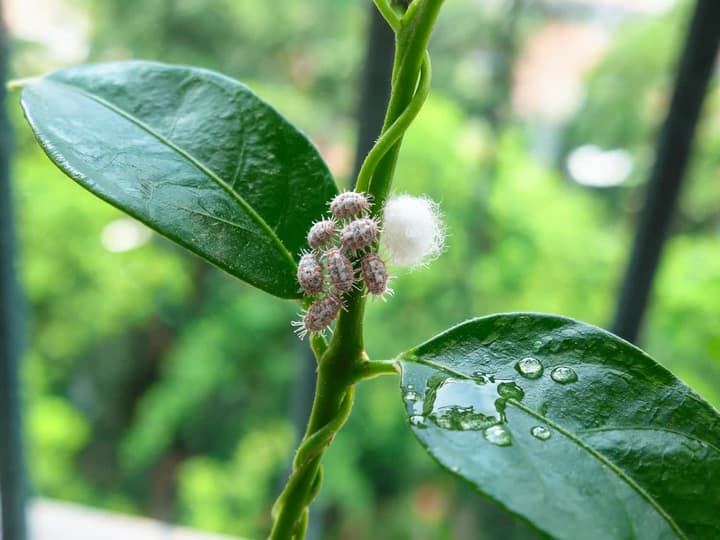
Cottony tuft in the leaf axils, on nodes, or between twining stems | Gently push the cotton aside with a toothpick: there is an oval bug underneath | Mealybug |
Cloud of tiny white winged insects | Shake the stem: they fly away | Adult whitefly |
Flat, cream-colored oval scales on the underside of the leaf | They do not fly or crawl when touched | Whitefly nymph |
Loose white specks on the upper surface of the leaf | Look for green or dark insects on stem tips and flower buds | Shed aphid skin |
Sticky sheen on lower leaves, the floor, or furniture | Touch it: it sticks like sugar syrup | Honeydew (sugary liquid secreted by the insect): the pest is above or next to this spot |
Light speckling on the leaf, sometimes with fine webbing | Tap the stem over a sheet of white paper: specks that crawl | Spider mite |
Brown or beige shell clinging to the stem | Flakes off with a fingernail | Scale insect |
Milky white droplet where a stem was cut or broken | Only appears where the plant was injured | The plant's own sap |
Viscous sheen at the base of the leaf stalk on new stems | Always stays in the exact same spot, without cotton or insects | Normal secretion from nodal glands |
Honeydew (the sugary liquid these insects release when sucking sap) falls onto whatever is beneath them. University of Maryland Extension describes a leaf with honeydew as shinier than normal and sticky to the touch (UMD). Because of this, a sticky lower leaf indicates that the pest is on the branches above or on the leaf itself.
Over time, honeydew turns black because of sooty mold, a fungus that grows on the sugar. According to University of Maryland Extension, it does not attack the plant and disappears on its own once the pest is controlled.
The page on dipladenia pests describes the most common pests of the species and what to do against each one.
What is not a pest: sap and nodal glands
Dipladenia releases a milky sap whenever a stem is cut or broken. NC State Extension notes that milky sap exudes from the cut (NC State). This droplet dries and can turn into a sticky white dot on the stem, always at the site of the injury.
UF/IFAS warns that this sap can irritate skin (UF/IFAS). Wear gloves when pruning or cleaning the plant.
Mandevilla also has colleters, small glands at the nodes that protect new shoots with a viscous secretion. A study on plants in the Apocynaceae family, the same family as mandevilla, states that colleters are easy to see with the naked eye. They sit at the nodes, at the base of the leaf petiole. In the genus Mandevilla, according to the same study, the secretion is purely mucilage (Ribeiro, Tölke, and Demarco, 2021). In a 2026 study on another species in the genus, the secretion was translucent and sticky enough to trap a small insect (Bueno et al., 2026).
Both studies examined Mandevilla splendens and Mandevilla venulosa, not potted dipladenia (Mandevilla sanderi). Even so, a stationary sticky sheen at the base of new leaves, without cotton or bugs, requires no treatment.
Mealybugs on dipladenia: how to remove them
The mealybug is a wingless insect up to 3 mm long, covered in white wax that looks like cotton. It wedges itself into crevices on the plant. NC State Extension notes that it usually stays at the base of stems and leaf petioles (NC State). The RHS also mentions the space between twining stems, which is how mandevilla climbs a trellis (RHS).
The treatment below follows Iowa State Extension, which provides the most comprehensive step-by-step guide for potted plants:
Move the pot away from other plants. Ants carry mealybugs from one plant to another, according to NC State.
Wash the plant with a strong stream of warm water to dislodge loose insects (Iowa State).
Touch an alcohol-dipped cotton swab to each insect and each cottony tuft (the egg sac). Touch only the bug, not the entire leaf. The alcohol concentration and the full schedule are in our step-by-step guide against mealybugs.
Apply insecticidal soap, neem oil, or horticultural oil weekly for 4 to 6 weeks. Horticultural oil is an oil formulated for plants, which coats the insect and blocks the pores it breathes through. The products work best on the nymphs, which hatch in waves every few weeks, according to Iowa State (Iowa State).
Cut and discard stems covered in cotton. Iowa State recommends pruning heavily infested parts.
If the entire plant is covered, it is often better to discard the dipladenia than to risk neighboring plants, according to Iowa State and the RHS. Before discarding it, check whether the white spots are ladybug larvae. The RHS notes that the larva of the mealybug destroyer ladybug (Cryptolaemus montrouzieri) resembles a large mealybug, and it preys on the insects and their eggs.
Why neem oil seems not to work on mealybugs
Contact products, such as neem, barely reach mealybug eggs. NC State explains that the eggs are trapped in fluffy wax and are therefore relatively waterproof. As for adults, Iowa State writes that horticultural oil does not control them (Iowa State).
Neem affects only the nymphs that have already hatched on the day of application. Those emerging from eggs later escape, which is why a single spraying appears ineffective. Results appear after weekly applications for 4 to 6 weeks, combined with dabbing visible adults using an alcohol-dipped cotton swab.
Whiteflies: the white bugs that fly when disturbed
The whitefly is a 1.5 mm insect with white wings. When you shake the plant, the adults rise in a cloud. The RHS uses this flight to tell whiteflies apart from aphids (RHS). On the undersides of the leaves are the nymphs, which look like flat, oval, cream-colored scales. Both adults and nymphs secrete honeydew.
Iowa State recommends spraying insecticidal soap or neem on the undersides of leaves weekly. It warns that control is often less effective than expected and that multiple weekly applications are necessary. Shake the branch before each application to check if adult numbers have decreased. Yellow sticky traps catch adults and help monitor whether the population is dropping, but they do not eliminate the pest. Whitefly nymphs that turn black have been parasitized by a tiny wasp (Encarsia) and are dead, according to the RHS.
Aphids on dipladenia shoots and buds
The aphid is a soft-bodied insect that is green, brown, or reddish. Iowa State says it gathers at branch tips, on the undersides of leaves, and on flower buds. In light infestations, the same extension recommends a strong blast of water to knock off the colony. If aphids return, apply insecticidal soap, as explained in the home remedies section. The white dots around them are usually the skins that aphids shed as they grow. The RHS says that white objects on the upper surface of a leaf are more likely aphid skins than whiteflies (RHS).
If there are ants moving up and down the dipladenia, look for aphids or mealybugs. The RHS explains that ants tend aphids to eat the honeydew.
If buds drop and there are no insects on the plant, look for issues with watering, light, and cold temperatures. These three care factors are covered in the guide on how to care for mandevilla.
Spider mites on dipladenia: pale speckling in hot, dry weather
Spider mites are so small that you see the damage before the pest: leaves become speckled with pale dots. NC State Extension calls this pattern stippling and states that spider mites are most active in hot, dry weather (NC State). In Brazil, watch the plant more closely during dry spells and on balconies that heat up significantly.
To confirm, tap a branch over a sheet of white paper: spider mites appear as tiny moving specks, while dirt stays still. The RHS suggests a 10x magnifying glass to see the mites and white cast skins on the undersides of leaves. According to the RHS, fine webbing only appears in heavy infestations (RHS).
NC State recommends insecticidal soap or horticultural oil, thoroughly coating the entire underside of the leaves. In hot weather, it suggests a second application 7 to 10 days later to target mites that were still in eggs. The same extension warns that high-nitrogen fertilizers can trigger spider mite outbreaks. If the leaves are also turning yellow, see the other causes in dipladenia with yellow leaves.
Scale insects: the brown shell on the stem
Scale insects look like a brown or tan crust 1.5 to 6 mm (1/16 to 1/4 inch) long, stuck to the stem or to the veins on the underside of the leaf. They barely move, and you often first notice the honeydew they secrete (Iowa State).
Iowa State recommends scraping each scale off with a fingernail or an alcohol-dipped cotton swab when there are only a few. For heavier infestations, apply product weekly for a month or longer. The protective shell shields the insect, so manual removal works better than spraying alone.
Home remedy against mealybugs on dipladenia: what has sources
Before any home remedy, the source-backed option is commercially prepared insecticidal soap. Iowa State explains that it is real soap, made to kill the insect on contact by disrupting its cell membranes (Iowa State). UF/IFAS states that registered insecticidal soaps contain only 1% to 2% soap (UF/IFAS). In simple math, 2% equals 20 ml of soap in 1 liter of water.
Dish soap divides the sources. Nebraska Extension says that some liquid dish soaps kill the insect poorly and tells you to test before using them (Nebraska Extension). Its 1% to 2% dilutions are for soap sprays, meaning soap mixed with water. UF/IFAS and Iowa State, in a text reviewed in December 2025, advise against it: detergent is not soap and burns leaves more easily. This article follows UF/IFAS and Iowa State, which are two of the three sources, and Iowa State provides the most recent guidance. Use ready-to-use insecticidal soap and do not use dish soap.
With any soap spray, follow these rules from Nebraska Extension and UF/IFAS:
Spot-test on a single leaf and wait 2 days before spraying the entire plant.
Coat the insect directly: soap kills only what it touches and leaves no residual effect on foliage.
Make at least 2 to 3 applications, 4 to 7 days apart. For mealybugs, follow Iowa State: every week for 4 to 6 weeks, because the crawlers hatch in waves.
Rinse the spray off the foliage with clean water about 2 hours later.
Do not apply above 32 °C or to drought-stressed plants (dry soil and wilted leaves).
Do not add vinegar or rubbing alcohol to spray solutions. UF/IFAS classifies both as toxic to plant tissue. The alcohol in step 3 for mealybugs is strictly for cotton swabs applied directly to the bug.
How to prevent pests from returning
Newly purchased plants can bring the pest to your other plants. The RHS recommends inspecting every plant you buy and keeping it isolated from others for at least a month (RHS). Check the leaf axils, nodes, and undersides of the leaves before placing the pot near other plants.
Afterward, inspect those same spots once a week. That way, you will catch pests while they can still be wiped away with a cotton swab. Clear dead leaves and pruning debris away from the pot, as the RHS notes they can harbor mealybugs or eggs. Avoid excessive high-nitrogen fertilizer, which encourages spider mites.
If you received the plant without knowing its name, Bloom (available for iOS) identifies the species from a photo and displays its care instructions. The tests and treatments in this article apply to both dipladenia and mandevilla, two names used for plants in the genus Mandevilla.
Frequently asked questions
Can a dipladenia with mealybugs be saved?
With minor infestations, yes. Dabbing each insect with an alcohol-soaked cotton swab and applying insecticidal soap weekly for 4 to 6 weeks usually resolves it. If the stems are entirely blanketed in cotton, Iowa State and the RHS consider it safer to discard the plant. This prevents pests from spreading to neighboring plants.
Do dipladenia mealybugs spread to other plants?
Yes. Females crawl short distances, and NC State notes that ants transport mealybugs between plants. Outdoors, nymphs can also be carried by the wind. Keep your dipladenia away from other plants during treatment and check the leaf axils of neighboring plants once a week.
Can I treat dipladenia pests if I have a cat on my balcony?
Choose non-chemical methods: a strong water spray, an alcohol-tipped cotton swab directly on the bug, and pruning heavily infested stems. Insecticidal soap acts strictly on contact and leaves no residual effect on foliage, according to Iowa State. As a precaution, keep your cat away while the plant is wet and read the product label regarding pets. For the plant itself, check whether mandevilla is toxic to pets.
Does black sooty mold on dipladenia leaves harm the plant?
Sooty mold is a fungus that feeds on honeydew and does not attack plant tissue, according to University of Maryland Extension. It leaves the leaf surface black and dirty. Wipe away honeydew and sooty mold with a damp cloth, and control the pest producing the honeydew. Without fresh honeydew, sooty mold clears up on its own over time.
Related articles
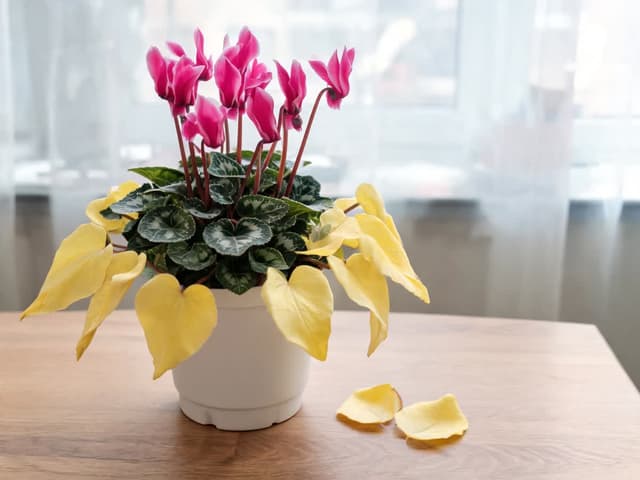
Cyclamen with Yellow Leaves: Causes and What to Do
A cyclamen with yellow leaves might just be going dormant. Learn how the tuber and the time of year tell dormancy apart from rot, heat, thirst, and mites, and what to do in each case.
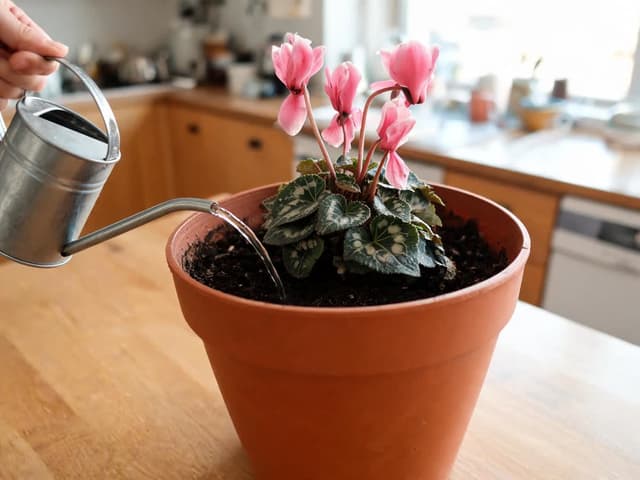
How to Water Cyclamen: Bottom Watering, Edge Watering, and the Wilt Test
How to water cyclamen without rotting the tuber: when the soil surface dries out, from below for 15 minutes or around the edge, never in the center. Plus the test to tell wilting from thirst apart from rot.
Does Dipladenia Like Sun or Shade? Sunlight Hours and Placement
Dipladenia likes sun: at least 6 hours of direct sunlight per day to bloom well. In intense heat, afternoon shade prevents scorched leaves. See which balcony exposure to choose, how to read the foliage, and what to expect indoors.