Cyclamen with Yellow Leaves: Causes and What to Do
A cyclamen with yellow leaves might just be going dormant. Learn how the tuber and the time of year tell dormancy apart from rot, heat, thirst, and mites, and what to do in each case.
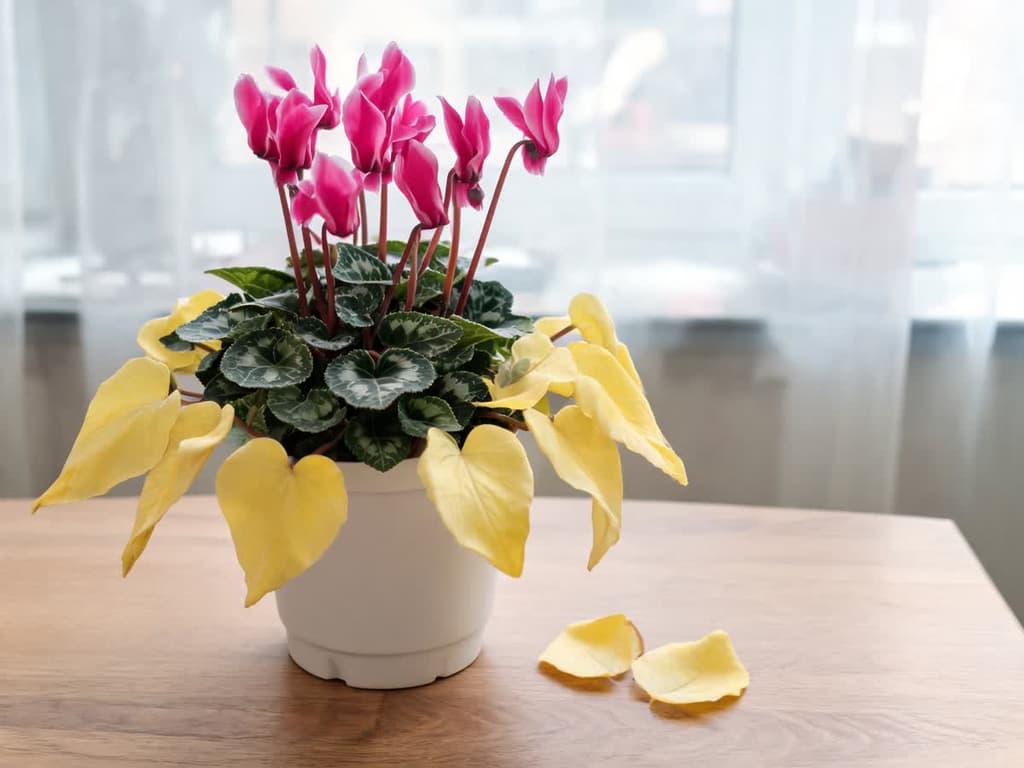
Cyclamen with yellow leaves after blooming, in late spring, is usually entering dormancy. In Brazil, this happens between October and December. Dormancy is a summer rest: the leaves die back and only the tuber stays alive in the soil. The tuber is the round, brown, half-buried base that the leaves grow from. If it is firm, the plant is generally alive; the exception is Fusarium wilt, explained below. If it is soft and smells bad, it is rot, and the cyclamen will not recover.
Outside that period, while the plant still has plenty of buds, yellowing points to a problem. The causes include indoor heat, too much or too little water, mites, or, more rarely, Fusarium wilt, a fungal disease. The tuber, the soil, and the month when the yellowing began separate one cause from another.
When it started | What you see | Likely cause | What to do |
|---|---|---|---|
Late spring (in Brazil, October to December), after flowering | Leaves yellowing one by one, firm tuber | Summer dormancy | Gradually cut back on watering; it is not a disease |
Days or weeks after purchase, in a warm room | Yellow leaves and buds drying out without opening | Heat | Move the pot to the coolest room in the house |
Any time of year, with consistently wet soil | Soft, yellow leaves, drooping stems | Overwatering | Stop watering until the surface dries and squeeze the tuber |
Right after the soil dries out completely | Soft, drooping leaves, then turning yellow | Thirst | Bottom water by setting the pot in a dish of water for 15 minutes |
In full bloom, with proper watering | Older leaves turning yellow, plant wilting and collapsing, firm tuber | Fusarium wilt | Cut the tuber open; if dark inside, discard |
Warm weather and dry air | Tiny yellow speckles or deformed new leaves | Mites | Isolate the plant from others and do the white paper test |
Months in a dark corner or without fertilizer | Leaves turning evenly pale | Low light or lack of nitrogen | More indirect light; fertilize only while new leaves appear |
Any time | Soft, mushy tuber with a foul smell | Soft rot | Discard the plant and the soil |
This guide applies to the florist's cyclamen (Cyclamen persicum). It has heart-shaped leaves, often patterned with silver, and nodding flowers with petals turned upward. If the plant was a gift and you do not know its name, Bloom (available for iOS) identifies the species from a photo. Year-round care, from watering to reblooming, is covered in the guide on cyclamen care.
Is a Cyclamen with Yellow Leaves Dormant or Dying?
The tuber reveals whether a cyclamen with yellow leaves is alive. Clear away a bit of soil with your finger if needed, and gently squeeze the top of the tuber with your fingertip. It will be in one of these four conditions:
Firm and plump, like a raw potato: the plant is alive. The Cyclamen Society, a British society dedicated to cyclamens, writes that a "plump and hard" tuber is fine, even without any leaves.
Soft, mushy, or foul-smelling: this is soft rot, caused by bacteria. Cornell University describes a soft decay of the tuber that collapses the entire plant. Discard the plant and the soil.
Shriveled and wrinkled, like an old potato: the tuber has lost too much water. The Montreal Botanical Garden warns that during the summer rest period, the tuber stays dry, but it must not dehydrate and wrinkle. If it is still hard, water along the edge just until the soil darkens slightly and squeeze the tuber again after a week.
Firm, but the plant wilts and collapses with soil that is neither soggy nor dry: cut the tuber in half. A brown or purplish interior indicates Fusarium wilt, according to Cornell. Discard the plant.
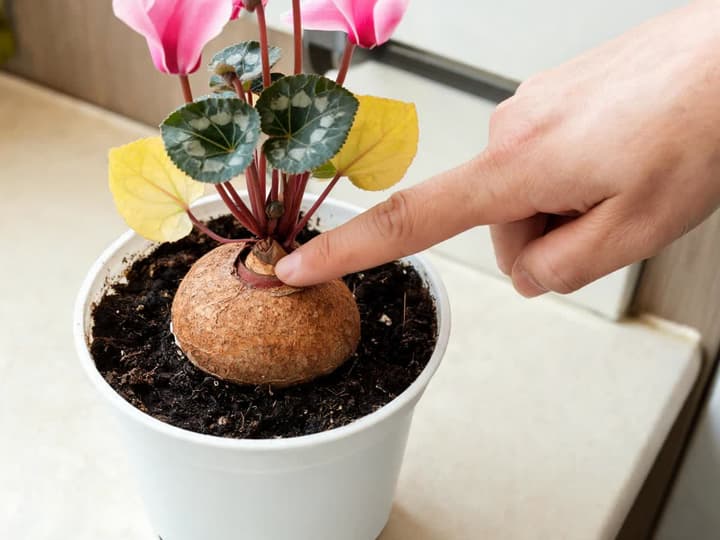
A firm tuber with yellow leaves can be dormancy, heat, watering mistakes, mites, or Fusarium. The time of year separates dormancy from the other causes. Yellowing in late spring (in Brazil, from October to December), after blooming, is dormancy.
Yellow Leaves After Flowering: Summer Dormancy
Cyclamen dormancy begins when blooming ends and the weather warms up. Cyclamen comes from Mediterranean climate regions, with mild, rainy winters and hot, dry summers. The University of Wisconsin Extension describes the cyclamen's rhythm. It grows in the fall, blooms from winter to early spring, and stays dormant all summer. In Brazil, the leaves usually yellow in October and November, and the plant stays dormant from December to February.
The leaves turn yellow one by one over several weeks, while the last flowers wither. NC State Extension notes that during dormancy, the leaves turn yellow and drop. The tuber remains firm the entire time.
To help it get through dormancy:
When the leaves start turning yellow, water only when the soil surface dries out, using less water each time. No source measures how much to reduce it.
Stop fertilizing. A plant without leaves does not use fertilizer.
Remove each leaf once it has turned completely yellow, giving the base of the stem a sharp twist.
Keep the pot in a shady, well-ventilated spot with barely moist soil until new leaves return.
Dormancy lasts 6 to 8 weeks, according to the Iowa State University Extension, or 2 to 3 months, according to the Wisconsin Extension. Neither measured this in Brazil: wait up to 3 months before giving up on the cyclamen, as long as the tuber remains firm. The guide on how to care for cyclamen shows both ways to store the tuber in the summer: in the pot or out of it.
Newly Purchased Cyclamen Turning Yellow: Heat
A cyclamen that turns yellow a few days after purchase, while still carrying buds, is usually too hot or getting too much water. Check the room temperature first. Clemson University states that above 21 °C, buds stop developing. The Wisconsin Extension recommends 16–18 °C during the day and around 10 °C at night.
Heat also brings on dormancy early. The Cyclamen Society explains that an overheated cyclamen "senses" that summer has arrived and gets ready to sleep. As an example, the society cites a sunny window. It also addressed the case of a cyclamen that turned yellow during its first week at home. The society considered overwatering, heat, or both to be the most likely causes.
In Brazil, cyclamen is usually purchased in bloom in autumn and winter. If you have an indoor thermometer, check the room in the afternoon: above 21 °C (70 °F), the cyclamen is too warm. To keep it blooming:
Move the pot to the coolest room in the house, with bright indirect light and no afternoon sun.
Keep the pot away from stoves, heaters, and warm air vents. Clemson warns that near a heat vent, soil dries out too quickly.
If the pot receives direct sun for hours, hang a sheer curtain in front of the window.
A leaf that has already yellowed from heat will not turn green again. The sign that the change worked is firm new growth and opening buds.
Yellow, Limp Leaves with Wet Soil: Overwatering
A yellow, soft leaf with soil that has been wet for days means overwatering. The Royal Horticultural Society (RHS), the British horticultural society, says yellow leaves on a potted cyclamen can be a sign of too much watering. The Cyclamen Society notes that limp leaves from overwatering are often mistaken for thirst. Watering more at this point ends up killing the cyclamen.
Standing water rots the roots first and then the tuber. The UC IPM, the University of California's pest management program, describes root rot. The roots turn dark and rot, and the lower leaves wilt and can turn yellow. In soft rot, the plant collapses suddenly and the tuber turns mushy.
If the tuber is firm, do this:
Empty the saucer and decorative outer pot. Remove the decorative foil wrapping around the pot or punch drainage holes in it, as the University of Illinois Extension advises, so excess water can drain away.
Hold off on watering until the soil surface feels dry to the touch.
Slide the plant out of its pot and examine the roots. Dark, rotting roots are the telltale sign of root rot described by UC IPM.
If the potting mix stays waterlogged after several days or if you find rotted roots, repot into fresh, light, well-draining soil. Leave the top half of the tuber exposed above the soil line, as the Wisconsin Extension recommends.
Remove soft, yellowing leaves with a twist at the base.
Going forward, water along the rim of the pot or from the bottom, only when the surface has dried out.
If the tuber is soft, throw away the plant and its soil. The Montreal Botanical Garden describes soft rot as yellowing foliage, rapidly wilting leaves, and a mushy tuber. The botanical garden instructs you to discard the affected plant.
Limp, Yellow Leaves with Dry Soil: Underwatering
Limp leaves with dry soil mean thirst, and in cyclamen this comes before yellowing. The Wisconsin Extension says that cyclamen foliage should stay firm and upright; if it softens, the plant likely needs water. The University of Missouri describes the sequence of underwatering: wilted leaves, then yellow leaves, then flowers and central buds that collapse.
To help the plant recover, water from the bottom. Place the pot in a saucer filled with water for 15 minutes, as the Wisconsin Extension suggests. Then take the pot out of the saucer and allow it to drain thoroughly. No source measures how long it takes for limp leaves to perk back up after watering.
A leaf that has already turned yellow will not become green again. Twist that leaf off and focus on caring for the ones that stay green. To avoid a repeat, touch the soil before you water, and irrigate when the surface feels dry, before the plant begins to droop.
Yellow Older Leaves and Plant Collapsing Despite Proper Watering: Fusarium Wilt
Fusarium wilt is a disease caused by a soil fungus that plugs the internal vascular channels carrying water up through the plant. UC IPM describes gradual yellowing that begins on the oldest leaves, followed by wilting. The tuber remains firm on the outside. Because of this, the disease can easily fool the tuber test.
The sign that distinguishes Fusarium wilt from dormancy is that the plant wilts. In dormancy, the plant only turns yellow. With Fusarium wilt, it wilts and collapses even with proper watering. The first symptom often appears only close to flowering, according to the HDC technical guide, a British research body for plant growers. Cornell explains how to confirm it: cut the tuber in half. If the inside is brown or purplish, it is Fusarium.
There is no known cure for potted cyclamens with Fusarium. Discard the plant and soil, and wash the pot thoroughly before reusing it. HDC also notes that the fungus can travel on seeds or young plugs. At that stage, the plant shows no symptoms. The plant may arrive at your home already infected.
Yellow Stippling and Deformed Leaves: Mites
Two types of mites cause cyclamen leaves to turn yellow, and both thrive in warm, dry air. Mites are microscopic arachnid relatives that suck sap from the foliage.
The two-spotted spider mite leaves yellow specks on the leaf. The Cyclamen Society describes the attack as yellow stippling and leaf drop if no one takes action. NC State Extension explains that the specks join together and the entire leaf turns yellow or bronze. It teaches a test: tap the foliage over a sheet of white paper and look for moving specks. Also check the undersides of the leaves, where eggs and fine webbing appear.
The cyclamen mite is invisible to the naked eye and attacks new leaves in the center of the plant. The University of Kentucky describes infested leaves as distorted, often curled inward, darker, and spotted. The Montreal Botanical Garden notes yellowing, curling, and distortion of the leaves, and states that preventing this mite is easier than eradicating it.
What you should do depends on the mite:
Two-spotted spider mite: isolate the plant from others and spray insecticidal soap on the undersides of the leaves, as Clemson and the Wisconsin Extension suggest. Follow the application rate and interval on the product label.
Cyclamen mite: discard the plant. The Wisconsin Extension and Clemson recommend throwing it out because this pest is exceptionally difficult to control.
Cyclamen Leaves Turning Evenly Pale: Low Light or Lack of Fertilizer
Leaves that lose their deep green shade evenly, without spotting, point to low light or a nitrogen deficiency. Nitrogen is a key fertilizer nutrient; without it, foliage fades to pale green and eventually turns yellow. NC State notes that low light causes cyclamens to grow weak, producing smaller blooms and paler leaves. The Wisconsin Extension also includes insufficient light among the reasons for yellowing foliage. Move the pot near a bright window out of intense midday sun.
No source on cyclamen describes nutrient deficiencies in detail. The general rule comes from Iowa State. Nitrogen deficiency yellows older, lower leaves first. An iron deficiency yellows new leaves while leaving the veins green.
Fertilize only while the cyclamen has new leaves and flowers, once a month, at the rate on the label. Use a low-nitrogen liquid fertilizer formulated for flowering plants. The Wisconsin Extension warns that too much fertilizer makes foliage soft and more prone to disease. Excess fertilizer also causes harm: the Montreal Botanical Garden links overfertilizing to soft rot. And fertilizer will not fix leaves that turned yellow from heat, overwatering, or dormancy. Yellowing that starts on the lower leaves and yellowing that starts on the new leaves indicate different causes. The guide to yellow leaves shows how to separate these causes in other houseplants.
Should I Remove Yellow Leaves from My Cyclamen?
Yes: remove the leaf that has turned completely yellow by holding the stem near the base, twisting, and pulling until it detaches entirely from the tuber. The Cyclamen Society recommends removing dead leaves and flowers with a firm tug on the stem. The NYBG, the New York Botanical Garden, also instructs you to remove yellow leaves.
Do not cut the stem with scissors. The remaining stub can rot. Ohio State University notes that gray mold (a fungus) easily attacks the stub of a cut stem. Also pick up any leaves that fall onto the soil.
Frequently Asked Questions
Can a yellow cyclamen leaf turn green again?
No. A leaf that has turned yellow cannot regain its green color, whether the cause was thirst, heat, or overwatering. The Cyclamen Society mentions this scenario: an underwatered cyclamen whose yellowed leaves never greened back up. What does improve after correcting the care are the new leaves, which emerge firm and green. Remove the yellow leaf by twisting it off at the base.
Does Epsom salt fix yellow leaves on cyclamens?
None of the sources on cyclamens recommend Epsom salt (magnesium sulfate). It only remedies magnesium deficiency, which Iowa State describes as yellowing between the veins of older leaves. Yellow leaves caused by dormancy, heat, overwatering, or mites will not improve with it. Check the tuber, the soil, and the time of year first.
Are yellow leaves on a cyclamen in winter a sign of dormancy?
Almost never. In Brazil, from June to September cyclamens are in full bloom, and dormancy only begins later, with the spring heat. Yellow leaves during these months point to indoor heat, overwatering, thirst, or mites. Another possible cause in winter is frost: potted cyclamens cannot tolerate frost outdoors.
How long does cyclamen dormancy last?
Cyclamen dormancy lasts 6 to 8 weeks according to Iowa State, or 2 to 3 months according to the Wisconsin Extension. In Brazil, it generally runs from December to February. New leaves appear when the weather cools down, usually in March or April. When they appear, resume watering whenever the surface of the soil dries out.
What to Do Today with a Yellowing Cyclamen
Squeeze the tuber. If it is firm, check the season. In late spring (in Brazil, from October to December), after flowering, it is dormancy, and the plant just needs less water. At other times, check the soil, room heat, and the undersides of the leaves. If it is soft and smells bad, discard the plant and the soil and start fresh with a new cyclamen.
Related articles
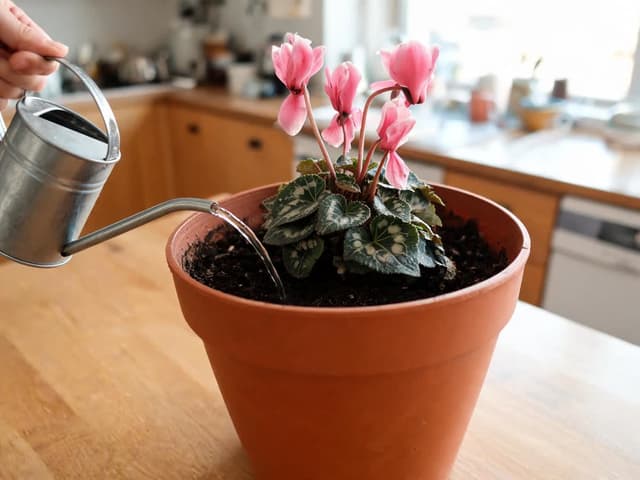
How to Water Cyclamen: Bottom Watering, Edge Watering, and the Wilt Test
How to water cyclamen without rotting the tuber: when the soil surface dries out, from below for 15 minutes or around the edge, never in the center. Plus the test to tell wilting from thirst apart from rot.
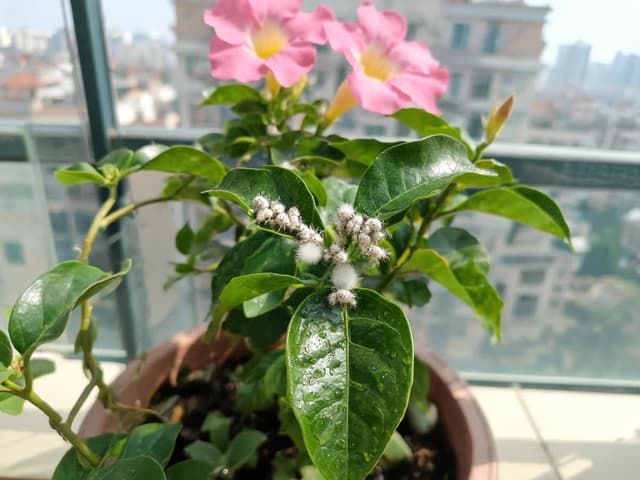
Dipladenia with Sticky White Dots: Which Pest Is It?
A sticky white dot on a dipladenia is almost always a mealybug, but whiteflies, aphids, spider mites, and the plant's own sap leave similar marks. See the test that separates each one and the source-backed treatment.
Does Dipladenia Like Sun or Shade? Sunlight Hours and Placement
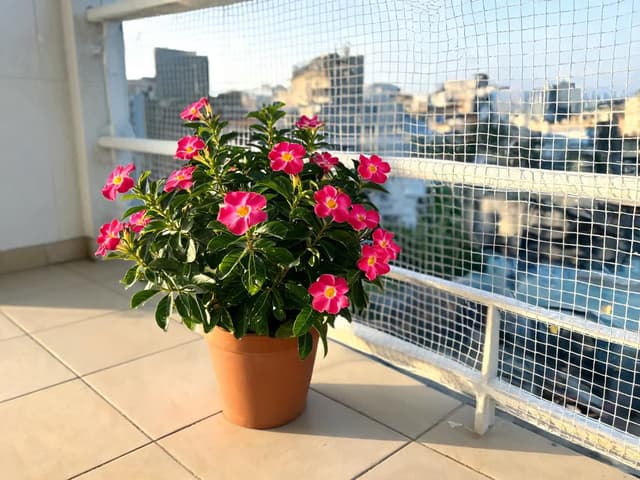
Dipladenia likes sun: at least 6 hours of direct sunlight per day to bloom well. In intense heat, afternoon shade prevents scorched leaves. See which balcony exposure to choose, how to read the foliage, and what to expect indoors.