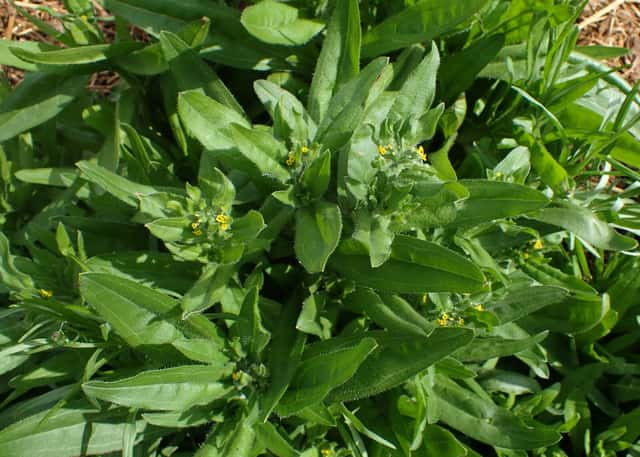
Boraginaceae
Yellow burrweed: Full Sun Plant
Amsinckia calycina
This is not a cultivated plant: it grows wild along roadsides, pastures, and wheat fields. It sprouts with the first autumn or winter rains, blooms in spring, and dies when the heat arrives. If it appears in a pasture or garden, it is advisable to pull it out before it releases seeds, as it is toxic to livestock. Use gloves: the hairs irritate the skin.
Every 7 days
Direct sun
° - °C
% - %
Categories
What is Yellow burrweed?
Yellow burrweed (Amsinckia calycina) is a easy-care plant from the Boraginaceae family. Amsinckia calycina is an annual herb in the borage family (Boraginaceae), native to Chile and Argentina. It grows from 15 to 50 cm, sometimes up to 1 m, and the entire stem and leaves are covered in stiff hairs that prickle when touched. The leaves are long and narrow, up to 20 cm, initially forming...
Yellow burrweed grows up to 1.0m, watering every 7 days. It is not suitable for indoor environments and not safe for pets.
Unlike many tropical plants, Yellow burrweed tolerates watering mistakes. Best for beginners. Without precautions, ingestion can cause irritation in pets. Keep out of reach of cats and dogs.
How to Care for Yellow burrweed?
TLDR: Yellow burrweed needs Direct sun, watering every 7 days, and temperatures between 15-30°C with 40-70% humidity.
How Often Should You Water Yellow burrweed?
Does not require watering: it survives on rainwater from autumn to spring. If keeping it in a pot or garden for observation, water when the soil surface is dry, approximately once a week, without waterlogging.
How Much Light Does Yellow burrweed Need?
Full sun. It grows in open areas without tree shade: roadsides, sown fields, and grasslands.
What Is the Best Soil for Yellow burrweed?
Tolerates almost any soil type, from sandy to clayey, and thrives in disturbed or recently plowed earth.
What Pot Should You Use for Yellow burrweed?
Not typically grown in pots. If you wish to observe it, any pot with drainage holes about 15 cm deep for the taproot will suffice.
What Is Yellow burrweed and Where Does It Come From?
Amsinckia calycina is an annual herb in the borage family (Boraginaceae), native to Chile and Argentina. It grows from 15 to 50 cm, sometimes up to 1 m, and the entire stem and leaves are covered in stiff hairs that prickle when touched. The leaves are long and narrow, up to 20 cm, initially forming a rosette at ground level. In spring, it produces small, pale yellow flowers (4 to 8 mm) in coiled clusters resembling a fiddlehead that gradually unfurl. Each fruit splits into four wrinkled seeds surrounded by a hairy calyx, which clings to wool, clothing, and grain. Outside its native range, it has become a weed in cereal crops and pastures in Australia and New Zealand. The seeds contain alkaloids that cause liver damage in livestock, particularly horses, cattle, and pigs.
How to Propagate Yellow burrweed?
Seed
This is its only method of reproduction: a single plant can produce up to 1,600 seeds, which stick to clothing and animal fur. Do not sow it near pastures or crops, as it becomes invasive and is toxic to livestock.
- 1 Collect the seeds when the calyx turns brown and dry in late spring.
- 2 Sow them in autumn on disturbed soil, barely covered.
- 3 Keep the soil moist until the seedlings emerge.
- 4 The plant forms a rosette in winter and blooms in spring.
Materials needed:
How Big Does Yellow burrweed Grow?
TLDR: Yellow burrweed can reach up to 1.0m tall with Fast growth rate.
Max height
1.0m
Growth rate
Fast
Warning: Toxic Plant
This plant can be toxic if ingested. Keep out of reach of:
Is your plant showing symptoms?
Click on the symptom to discover possible causes:
Compare with similar plants
| Attribute | Difficulty | Light | Watering | Pet Safe |
|---|---|---|---|---|
| Field Maple | Easy | Bright indirect | 14d | ✓ |
| Iberian Houseleek | Easy | Direct sun | 14d | ✓ |
| Silver Birch | Easy | Direct sun | 14d | ✓ |
| Common Blanketflower | Easy | Direct sun | 10d | ✓ |





