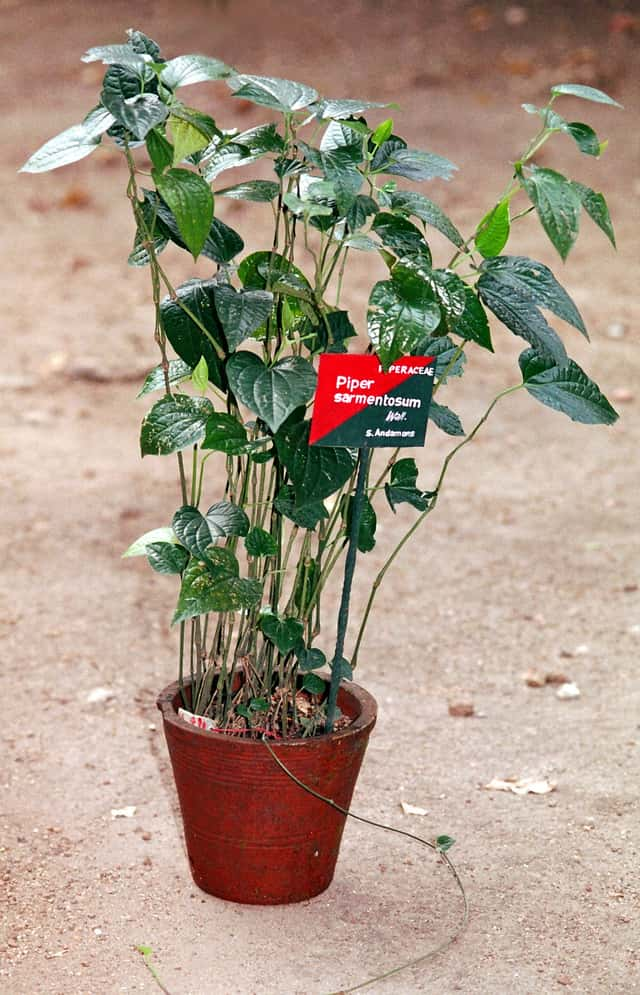
Piperaceae
Wild Betel: Ground Cover Plant
Piper sarmentosum
A shade or partial shade plant that thrives in warmth (18-30 °C), high air humidity (70-90%), and rich, fresh, well-drained soil with a slightly acidic to neutral pH (5-7). Never allow the substrate to dry out completely or become waterlogged. It is sensitive to frost and dry winds. Susceptible to root rot if overwatered.
Every 3 days
Low light
18° - 30°C
70% - 90%
Categories
What is Wild Betel?
Wild Betel (Piper sarmentosum) is a easy-care plant from the Piperaceae family. Wild betel (Piper sarmentosum) is an evergreen perennial plant from the Piperaceae family, native to Southeast Asia. Its creeping stems root at the nodes and form a dense mat, with upright shoots reaching about 50 cm. Its heart-shaped, glossy green leaves with a peppery taste are widely used in cook...
Wild Betel grows up to 50cm, watering every 3 days, 18°C – 30°C, 70–90% humidity. It is suitable for indoor environments and safe for pets.
Unlike many tropical plants, Wild Betel tolerates watering mistakes. Best for beginners. Unlike many popular species, Wild Betel is safe to keep around pets. Without adequate drainage, root rot can develop within 7 days.
How to Care for Wild Betel?
TLDR: Wild Betel needs Low light, watering every 3 days, and temperatures between 18-30°C with 70-90% humidity.
How Often Should You Water Wild Betel?
Keep the soil consistently moist but never waterlogged: water as soon as the surface begins to dry, ensuring good drainage.
How Much Light Does Wild Betel Need?
Prefers light shade to partial shade and bright indirect light; avoid direct full sun, which can scorch the leaves.
What Is the Best Soil for Wild Betel?
Rich potting mix with organic matter, fresh, light, and well-draining, with a pH of 5 to 7.
What Pot Should You Use for Wild Betel?
Wide, shallow pot with drainage holes, or a planter, to allow the creeping stems to spread.
What Is Wild Betel and Where Does It Come From?
Wild betel (Piper sarmentosum) is an evergreen perennial plant from the Piperaceae family, native to Southeast Asia. Its creeping stems root at the nodes and form a dense mat, with upright shoots reaching about 50 cm. Its heart-shaped, glossy green leaves with a peppery taste are widely used in cooking (la lot leaves, mieng kham) and traditional medicine.
How to Propagate Wild Betel?
Stem Cutting
- Nodes that touch the ground root naturally, which also allows for clump division.
- 1 Stem Selection
Take a healthy semi-hardwood stem with at least 2 to 3 nodes during the growing season.
- 2 Preparation
Remove the lower leaves and plant the cutting in a moist substrate.
- 3 Rooting
Keep warm, with high humidity and partial shade until rooted.
Materials needed:
How Big Does Wild Betel Grow?
TLDR: Wild Betel can reach up to 50cm tall with Medium growth rate.
Max height
50cm
Growth rate
Medium
Foliage
Evergreen
Plant Uses
Edible
Can be consumed
Medicinal
Medicinal properties
Ground Cover
Soil coverage
Ornamental
Great for decoration
Medicinal Uses
- Traditional use for coughs
- Traditional relief for toothaches
- Traditional anti-inflammatory properties
- Traditional aid for digestion
- Traditional use for rheumatism
Culinary Uses
- Raw leaves in salads
- Cooked leaves in curries
- Leaves as wraps for fillings (mieng kham)
- Sautéed leafy vegetable
Is your plant showing symptoms?
Click on the symptom to discover possible causes:
What Diseases Commonly Affect Wild Betel?
TLDR: Wild Betel is susceptible to 9 known diseases. Monitor regularly for early detection.
Root Rot
Root rot is a serious fungal disease that affects the root system of plants, causing them to decay and die. It is primarily caused by overwatering, poor drainage, or soil-borne fungi such as Pythium, Phytophthora, Rhizoctonia, and Fusarium. The disease thrives in waterlogged conditions where roots are deprived of oxygen, making them susceptible to fungal infection.
Pythium Root Rot
Pythium root rot is a serious fungal disease caused by various Pythium species including P. aphanidermatum, P. ultimum, and P. irregulare. These water molds are present in practically all cultivated soils and attack plant roots under wet conditions, causing rapid wet rot that can extend into the stem. The disease is favored by poor drainage, overwatering, and specific temperatures depending on the species.
Phytophthora Root Rot
Disease caused by fungus-like organisms (oomycetes) that live in soil and can survive for years. It affects roots, stem, and crown of plants, being especially severe in waterlogged or poorly drained soils. It is the second most common cause of root rot in trees and shrubs.
Powdery Mildew
Powdery mildew is a common fungal disease caused by various fungi species including Erysiphe, Podosphaera, Oïdium, and Leveillula. It affects over 10,000 plant species worldwide. The disease thrives in warm, dry climates with high humidity and appears as a distinctive white powdery coating on plant surfaces.
Compare with similar plants
| Attribute | Difficulty | Light | Watering | Pet Safe |
|---|---|---|---|---|
| Field Maple | Easy | Bright indirect | 14d | ✓ |
| Iberian Houseleek | Easy | Direct sun | 14d | ✓ |
| Silver Birch | Easy | Direct sun | 14d | ✓ |
| Common Blanketflower | Easy | Direct sun | 10d | ✓ |





